HelloGrowthCRM software
Built for real small-business sales teams
HelloGrowthCRM helps reps qualify faster, follow up on time, and close more deals—with practical automation in one place.
- AI lead scoring and pipeline visibility
- Built-in dialer, WhatsApp, and email automation
- Sales forecasting and RevOps-ready reporting
A CRM for UAE recruitment agencies is a recruiting system that helps firms in Dubai, Abu Dhabi, and Sharjah manage candidate pipelines, client job orders, interview scheduling, bilingual follow-ups, and placement revenue in one place while supporting UAE data protection, calling, messaging, and invoicing needs.
Key Takeaways
- UAE recruitment agencies need one workflow for candidates, clients, jobs, interviews, offers, and post-placement care.
- A good recruitment CRM must support the UAE data protection laws, plus DIFC and ADGM rules where relevant.
- Bilingual Arabic and English outreach should be built into email, WhatsApp, SMS, and calling workflows.
- Recruiters need visibility into submission-to-interview ratios, time-to-fill, and placement revenue in AED.
- HelloGrowthCRM combines pipeline control, automation, and AI-driven follow-up inside one AI CRM built for revenue teams.
- Free-zone and mainland firms should also track VAT and invoicing workflows alongside placements and retainers.
Why UAE recruitment agencies need a specialized CRM
A specialized CRM for UAE recruitment agencies is important because generic CRMs do not map cleanly to recruiter workflows like candidate sourcing, shortlisting, submissions, interview coordination, offer management, and placements. UAE firms also need local compliance support for PDPL, bilingual communication, and AED-based revenue tracking.
Recruitment agencies do not sell one standard product. They manage two linked pipelines at the same time:
- A candidate pipeline
- A client job order pipeline
That creates operational complexity fast. A recruiter may submit five candidates to one Dubai client. Three may interview. One may get an offer. Another may fit a Sharjah role better. A generic contact database does not handle that relationship well.
In practice, agencies need records for:
- Clients and hiring managers
- Job orders and vacancy details
- Candidates and CV versions
- Submissions by role
- Interview rounds
- Offer status
- Placement date
- Replacement guarantee window
- Invoice and payment status
When I have audited pipelines like this, the biggest issue is not lead generation. It is broken handoffs. Candidate notes sit in WhatsApp. Client feedback sits in email. Interview times sit in personal calendars. Revenue forecasts become guesswork. A system like HelloGrowthCRM ties that flow together with Meeting Scheduler, Smart Inbox, and AI Pipeline Management.
What should a CRM for UAE recruitment agencies include?
A CRM for UAE recruitment agencies should include candidate and client records, linked job orders, submission tracking, interview workflows, bilingual communication history, recruiter task management, revenue reporting in AED, and compliance controls for UAE, DIFC, or ADGM data handling depending on the firm’s legal setup.
At minimum, the system should support the daily motions of a recruiter and team lead.
Candidate pipeline management
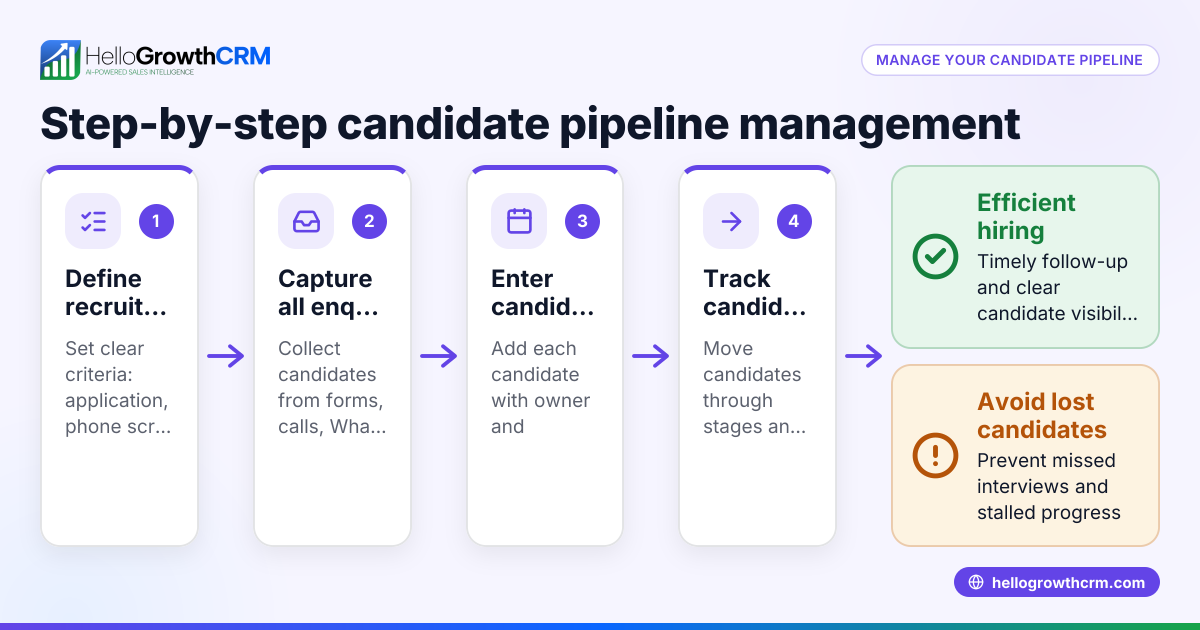
Recruiters need to move candidates through clear stages, such as:
- Sourced
- Screened
- Qualified
- Submitted
- Interviewing
- Offered
- Placed
- On guarantee
- Closed
This is where Sales Task Boards help. Recruiters can see what needs action now. Team leads can spot stalled candidates before a client complains.
Client job order tracking
Each job order should hold:
- Role title and department
- Hiring company and decision-maker
- Salary range in AED
- Visa or relocation requirements
- Priority level
- Service type, such as retained or contingency
- Open date and target fill date
With Revenue Attribution, agencies can tie placements back to source channels, recruiter effort, and client accounts.
Interview and follow-up coordination
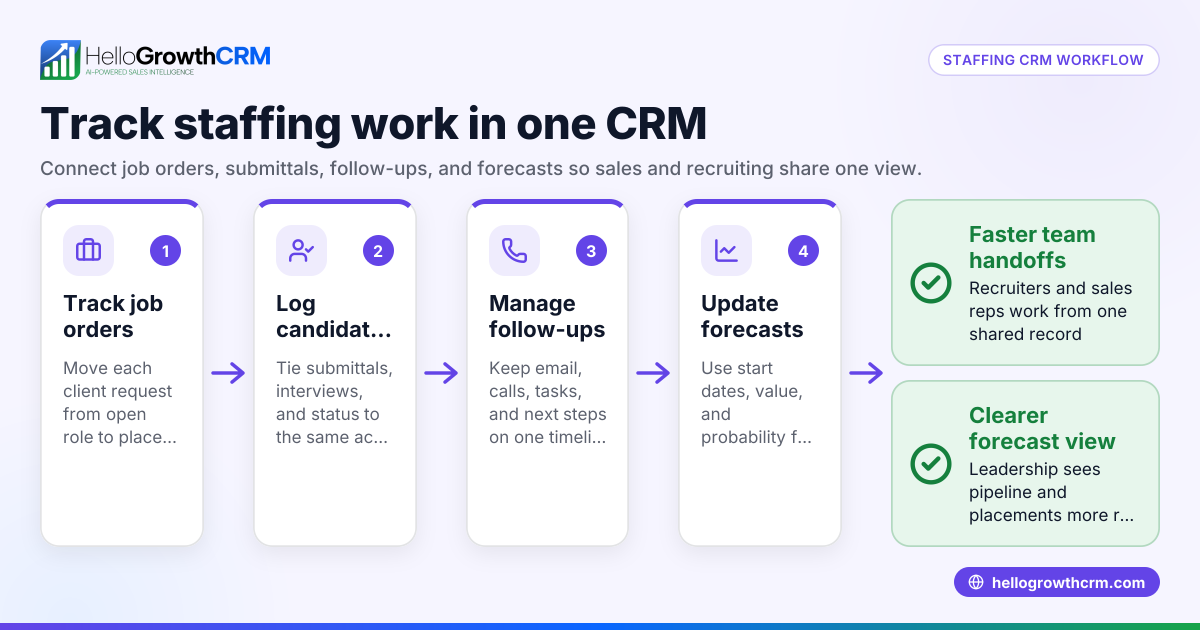
Recruitment speed often depends on follow-up speed. A CRM should log calls, emails, WhatsApp messages, interview schedules, feedback, and reminders in one timeline. HelloGrowthCRM supports this through Email Automation, CRM Dialer, and WhatsApp & SMS CRM.
Recruiter performance reporting
Useful metrics include:
- Submission-to-interview rate
- Interview-to-offer rate
- Offer-to-join rate
- Time-to-submit
- Time-to-fill
- Revenue per recruiter
- Guarantee-period replacement rate
In one rollout we did with a 12-person sales team that had recruiter-style pipeline stages, simply standardizing stage exit criteria cut status confusion within two weeks. The same principle applies in agencies. Define what “submitted” means. Define what “interview scheduled” means. Your data gets cleaner fast.
How HelloGrowthCRM fits recruitment agency workflows
HelloGrowthCRM fits recruitment agency workflows by connecting client acquisition, job order management, candidate submissions, communication history, recruiter tasks, and revenue reporting in one platform. That makes it easier for agency owners to run delivery and growth together instead of forcing teams to stitch tools manually.
Many recruitment firms start with spreadsheets, email folders, and separate ATS tools. That can work for a very small desk. It breaks at scale.
HelloGrowthCRM is useful when your agency wants one operating layer for both delivery and revenue operations. You can use Features to review the broader platform, but the most relevant pieces for agencies are practical:
Unified records for clients, jobs, and candidates
You can structure pipelines around job orders and candidate submissions instead of only generic deals. That gives managers a clearer picture of:
- Which clients have active openings
- Which recruiters own each search
- Which candidates were sent where
- Which roles are at risk of delay
AI-assisted prioritization
With AI Lead Scoring, firms can prioritize client opportunities and inbound hiring requests. With AI Deal Insights, leaders can spot delayed searches, quiet clients, or jobs with low candidate traction.
Communication and scheduling
Recruiters can manage email and messaging activity without losing context. That matters when outreach mixes Arabic and English, or when multiple recruiters touch the same account. Integrations like Gmail, WhatsApp, Google Meet, and Calendly reduce admin work.
Forecasting and management visibility
Placement firms need real forecasts, not rough estimates. Sales Forecasting and Pipeline Health Score help agencies understand likely placement revenue, role risk, and recruiter capacity.
This is also where I would add a limitation. If your agency has highly complex temp staffing payroll, rosters, and timesheets, you may still need a specialist back-office layer. HelloGrowthCRM is strongest as the client, candidate, communication, and revenue operating system.
How PDPL, DIFC, and ADGM affect recruitment CRM setup
PDPL, DIFC, and ADGM affect recruitment CRM setup because agencies process personal data, CVs, compensation details, contact information, and hiring feedback. Your CRM must support lawful handling, access control, retention discipline, and communication consent practices based on whether the entity is mainland, DIFC, or ADGM regulated.
The UAE has a national framework under the Federal Personal Data Protection Law. Free-zone entities may also fall under separate regimes, including the DIFC Data Protection Law. ADGM firms should also review their own local data protection requirements.
What this means in day-to-day recruiting
For agencies, practical compliance usually means:
- Limiting access to sensitive candidate records
- Storing consent and contact preference history
- Avoiding unnecessary data collection
- Setting retention and deletion rules
- Logging who changed records and when
- Controlling exports of CVs and candidate notes
CRM configuration tips for UAE agencies
Use simple controls first:
- Role-based permissions for recruiters, managers, and finance
- Separate views for candidate, client, and finance records
- Mandatory consent fields where needed
- Audit trails for submissions and edits
- Standard reasons for data retention
If you work across mainland and free-zone entities, document which legal entity owns each database and workflow. That sounds basic, but it prevents messy cross-entity data handling later.
How to handle TDRA-aware calling and bilingual follow-ups
TDRA-aware calling and bilingual follow-ups mean recruitment agencies should design call, SMS, WhatsApp, and email workflows that respect local telecom expectations, keep communication relevant, and give candidates and clients clear, language-appropriate messages with proper opt-out and preference handling.
The UAE telecom environment is practical, but teams should still avoid uncontrolled outreach. Use approved channels, clear identity, and sensible cadence. Do not let recruiters spam candidates from personal numbers with no record.
Bilingual outreach matters in the UAE
In Dubai and Abu Dhabi especially, recruiter outreach often needs both English and Arabic options. Even when the job brief is in English, a candidate or client contact may respond better to Arabic for scheduling, reminders, or follow-ups.
A strong workflow should include:
- Language preference field
- Arabic and English templates
- Separate client and candidate sequences
- Time-zone aware send windows
- Logged call outcomes
HelloGrowthCRM helps here with WhatsApp & SMS CRM, CRM Dialer, and Smart Inbox. If you also need telephony or automation connections, review Twilio and All Integrations.
A simple follow-up model
Use a structured cadence for candidate submissions:
- Day 0: Submit CV and shortlist note
- Day 1: Confirm receipt with client
- Day 2: Ask for shortlist feedback
- Day 4: Call hiring manager
- Day 6: Send bilingual reminder
- Day 8: Escalate internally if no update
For agencies that want a starting point, the Follow-Up Cadence Builder can help shape a cleaner process.
How to track job orders, placements, and VAT-linked invoicing in AED
Tracking job orders, placements, and VAT-linked invoicing in AED means the CRM should connect commercial terms, placement milestones, invoice status, and finance data so recruiters, account managers, and finance teams all see the same status without chasing updates across spreadsheets.
This matters more than many agencies expect. Once placements happen, revenue leakage starts in the handoff to finance.
The UAE Federal Tax Authority provides official VAT guidance and registration information at tax.gov.ae.
What to track inside the CRM
For each client and placement, capture:
- Agreed fee model
- VAT registration status
- Currency, usually AED
- Invoice trigger date
- Candidate start date
- Replacement guarantee end date
- Payment due date
- Paid or outstanding status
With Proposal Builder, agencies can standardize fee proposals and terms before jobs open. For firms that need finance sync, integrations such as QuickBooks and Stripe can reduce rekeying.
Why finance visibility matters
A placement is not complete when the candidate signs. It is complete when the invoice is issued, paid, and cleared against the guarantee period. Agencies that track only “wins” tend to miss:
- Delayed invoice issuance
- Incorrect VAT treatment
- Unpaid retainers
- Replacement fee disputes
CRM for UAE recruitment agencies: HelloGrowthCRM vs generic CRM
HelloGrowthCRM vs generic CRM for UAE recruitment agencies comes down to workflow fit, local compliance readiness, and recruiter productivity. Generic systems can store contacts, but agencies usually need linked candidate-job-client processes, bilingual communication tools, and stronger operational visibility to scale across UAE hiring markets.
A useful comparison is below.
| Requirement | Generic CRM | HelloGrowthCRM |
|---|---|---|
| Candidate + client + job order linkage | Often needs custom work | Fits revenue and pipeline workflows better |
| Bilingual Arabic/English follow-ups | Usually manual | Easier with templates and communication tools |
| UAE-focused compliance workflows | Limited by default | Better suited for structured access and audit processes |
| Calling, WhatsApp, email in one flow | Often split across apps | Supported through native features and integrations |
| AED pipeline and placement tracking | Possible but basic | Stronger forecasting and revenue visibility |
| Recruiter task management | Generic tasks only | Better pipeline, board, and reminder controls |
| AI prioritization | Varies widely | Supported with AI Sales Copilot and related AI tools |
Disclosure matters here: HelloGrowthCRM is our product, so this is not a neutral lab test. The point is fit. If your team needs a pure ATS with deep job board syndication and complex staffing payroll, compare carefully. If you need one CRM to run agency growth, client delivery, communication, and placement forecasting, HelloGrowthCRM is a strong option.
How to implement a CRM for UAE recruitment agencies: Step-by-Step
Implementing a CRM for UAE recruitment agencies works best when you map your current hiring workflow first, then configure candidate and client stages, permissions, bilingual templates, and finance fields before rollout. That reduces recruiter resistance and gives managers cleaner reporting from the first month.
- Map your current process
List every step from client brief to invoice collection. Include who owns each action and where data currently lives. - Define core records
Set up standard fields for clients, hiring managers, job orders, candidates, submissions, interviews, offers, and placements. - Build stage definitions
Create clear entry and exit rules for each stage. Use precise definitions, such as “submitted with client confirmation” rather than vague labels. - Set permissions and compliance controls
Restrict access by role. Separate recruiter, manager, and finance visibility. Add consent, retention, and audit fields where needed. - Create Arabic and English templates
Build message templates for candidate outreach, client updates, interview scheduling, and offer follow-ups. Store language preference on each record. - Connect communications and calendar tools
Sync email, WhatsApp, calling, and meeting tools so every touchpoint is logged in one place. - Add revenue and VAT fields
Track fee type, invoice trigger, AED amount, VAT status, payment due date, and guarantee period. - Pilot with one desk first
Start with one recruiter team or one office, such as Dubai, before rolling out across Abu Dhabi and Sharjah. - Measure weekly adoption
Review activity logging, stage hygiene, follow-up compliance, and time-to-submit each week for the first month. - Refine with RevOps support
If the team lacks internal operations capacity, Managed RevOps can help tighten process and reporting.
For Emirati recruitment teams that want cleaner submissions, faster follow-ups, and better compliance visibility, HelloGrowthCRM brings your client, candidate, and revenue workflows into one system. You can explore the platform through a Demo, compare plans on Pricing, or start a Free Trial to test it with your Dubai, Abu Dhabi, or Sharjah desk.
About the author
Ayaan Merchant is a Sales Operations Lead at HelloGrowthCRM with 9 years of experience in B2B SaaS, RevOps, and CRM implementation. He has worked on pipeline design, automation, and forecasting for service businesses with multi-stage handoffs and strict compliance needs. One project that informed this article was a rollout for a regional professional services team that needed bilingual communication workflows, territory controls, and finance-linked pipeline reporting across UAE entities.
Frequently Asked Questions
Q: What is the best CRM for UAE recruitment agencies?
A: The best CRM for UAE recruitment agencies is one that manages candidates, client job orders, interviews, placements, and bilingual follow-ups in one system while supporting UAE data protection and AED-based reporting. HelloGrowthCRM is a strong fit for firms that want one operating layer for delivery and growth.
Q: Can a CRM help recruitment agencies comply with UAE PDPL?
A: Yes, a CRM can help recruitment agencies comply with UAE PDPL by supporting access controls, consent tracking, audit history, and cleaner data handling processes. It does not replace legal advice, but it makes compliance execution much easier day to day.
Q: Do recruitment agencies in DIFC or ADGM need different CRM settings?
A: Yes, recruitment agencies in DIFC or ADGM often need different CRM settings because free-zone entities may follow separate data protection rules from mainland entities. In practice, that means careful permission design, retention rules, and entity-specific data ownership.
Q: How should UAE recruiters manage Arabic and English follow-ups?
A: UAE recruiters should manage Arabic and English follow-ups by storing language preference and using separate templates for candidates and clients. This helps keep communication clear, respectful, and more effective across Dubai, Abu Dhabi, and Sharjah hiring markets.
Q: Can HelloGrowthCRM track placements and invoices in AED?
Frequently Asked Questions
Ready to put this into practice?
Set up your pipeline, WhatsApp follow-ups, and AI lead scoring in minutes — free, no credit card.
Try HelloGrowthCRM freeGet CRM tips in your inbox
Join thousands of sales professionals who get weekly insights on CRM strategy, AI automation, and pipeline optimization.

The HelloGrowthCRM team publishes guides on CRM strategy, AI sales tools, and revenue operations for small business sales teams.