HelloGrowthCRM software
Built for real small-business sales teams
HelloGrowthCRM helps reps qualify faster, follow up on time, and close more deals—with practical automation in one place.
- AI lead scoring and pipeline visibility
- Built-in dialer, WhatsApp, and email automation
- Sales forecasting and RevOps-ready reporting
A CRM for US IT staffing firms is a recruiting and revenue system built to manage job orders, candidate redeployment, client rate cards, compliant email and calling outreach, and post-placement billing in one pipeline so recruiters, account managers, and finance teams can work from a single source of truth.
Key Takeaways
- US IT staffing firms need more than a generic CRM. They need candidate, client, job order, and billing workflows in one place.
- Redeployment is often the fastest path to margin. A strong CRM should surface end dates, skills, bill rates, and re-engagement tasks automatically.
- TCPA and CAN-SPAM guardrails matter for US outbound. Recruiters need consent tracking, opt-out handling, and channel-level controls.
- Client rate cards should live beside job orders and submissions, not in scattered spreadsheets or inboxes.
- HelloGrowthCRM helps staffing teams replace fragmented Salesforce or HubSpot setups with recruiter-friendly workflows, AI CRM, and cleaner quote-to-cash connections to Stripe and QuickBooks.
Why US IT staffing firms need a specialized CRM
A specialized CRM for US IT staffing firms is necessary because generic CRMs track accounts and deals well, but they rarely model submissions, placements, redeployment windows, pay-versus-bill margins, or outreach compliance in the way staffing operators in New York, Chicago, and Austin actually work every day.
Most staffing firms start with spreadsheets, a basic ATS, and either Salesforce or HubSpot. That works for a while. Then the cracks show:
- Recruiters keep candidate notes in email
- Account managers store client rate cards in PDFs
- Finance tracks invoices outside the CRM
- Redeployment lists are built manually every Friday
- SMS and call activity lacks consent controls
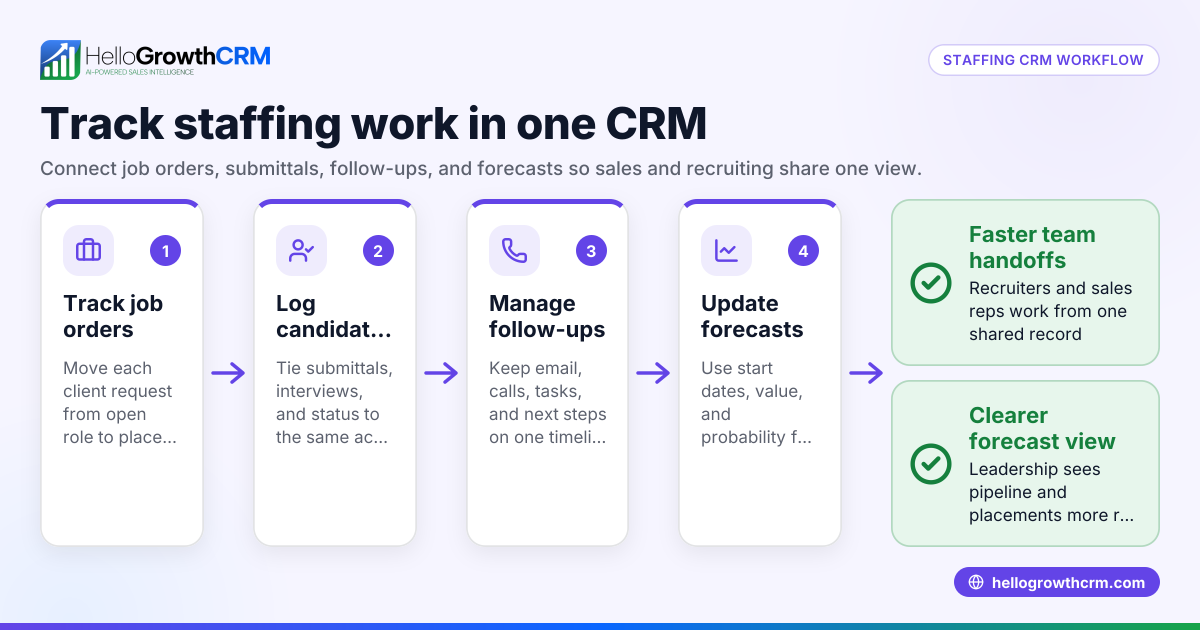
In practice, IT staffing is a multi-object workflow. You are not just managing leads. You are managing:
- Clients and hiring managers
- Job orders and required skills
- Candidate records and submissions
- Interview stages and offers
- Placements, end dates, extensions, and redeployment
- Rate cards, markup, and margin
- Collections, invoices, and revenue attribution
When I have audited pipelines like this, the biggest issue is usually not lead volume. It is workflow fragmentation. Teams lose revenue because no system ties candidate availability, client demand, and compliance together. That is where a system like HelloGrowthCRM matters. It combines AI Pipeline Management, Revenue Attribution, and recruiter outreach tools in one operating layer.
What workflows matter most in a CRM for US IT staffing firms
The most important workflows in a CRM for US IT staffing firms are job order intake, candidate matching, submission tracking, redeployment alerts, client rate-card management, consent-safe outreach, and quote-to-cash handoff so every recruiter, salesperson, and finance partner can move faster without losing auditability.
Candidate redeployment should be a first-class pipeline
Redeployment is often the cheapest source of net-new gross margin. Former consultants already know your process. The client may know their work quality. Time-to-fill is often shorter.
A CRM should track:
- Assignment start and projected end dates
- Skills, certifications, and location preferences
- Bill rate, pay rate, and target markup
- Rehire eligibility
- Prior client performance notes
- Consent status for email, SMS, and calls
In one rollout we did with a 12-person sales team and 18 recruiters, redeployment increased only after we stopped treating it like a spreadsheet export. We built a live queue that showed consultants ending in the next 30, 45, and 60 days. Recruiters got tasks through Sales Task Boards, and managers used Customer Health Score signals to flag shaky accounts before contractors rolled off.
Job orders and submissions need recruiter-friendly stages
Staffing teams do not sell a simple linear deal. A client account can have five open reqs, each with multiple candidates and several interview loops. That means your CRM stages should reflect staffing reality.
A practical stage model includes:
- Job order received
- Qualification completed
- Rate card confirmed
- Candidates sourced
- Submitted to client
- Interviewing
- Offer out
- Placement started
- Extension or redeployment review
This is where AI Deal Insights and AI Lead Scoring can help. They show which job orders are stale, which submissions are aging, and where recruiters should focus first.
Client rate cards must sit next to the opportunity
Rate cards are too important to leave in spreadsheets. Your CRM should tie each account and job order to approved bill rates, overtime rules, location premiums, vendor tiers, and margin floors in USD.
That matters in US markets. A Java architect role in New York may carry very different rates than a cloud support role in Austin. If the rate card is buried in email, recruiters submit the wrong numbers. That slows approvals and hurts trust.
How HelloGrowthCRM fits IT staffing teams moving beyond Salesforce or HubSpot
HelloGrowthCRM fits IT staffing teams moving beyond Salesforce or HubSpot by combining CRM, recruiter workflow automation, compliance controls, and revenue operations in one system, so firms can manage candidate redeployment, client rate cards, submissions, and billing handoffs without paying for heavy customization or juggling disconnected tools.
This is not a claim that Salesforce or HubSpot are bad products. They are strong platforms. But staffing firms often outgrow generic data models and end up with expensive admin overhead.
Here is the tradeoff many US staffing firms face:
| Capability | Salesforce or HubSpot with customization | HelloGrowthCRM for IT staffing workflows |
|---|---|---|
| Candidate redeployment tracking | Usually custom objects, reports, and admin work | Native pipeline-friendly workflow with tasks and alerts |
| Client rate cards | Often managed in custom fields or external sheets | Centralized at account and job-order level |
| Recruiter outreach | Possible, but often spread across separate tools | Built-in Email Automation, CRM Dialer, and WhatsApp & SMS CRM |
| AI guidance | Add-ons vary by stack | Unified AI Sales Copilot and pipeline insights |
| Quote-to-cash visibility | Often stitched via apps and ops support | Direct finance workflows with Stripe and QuickBooks |
| Time to adapt for staffing | Longer for lean ops teams | Faster for mid-market staffing teams |
| RevOps support | Internal team or partner required | Optional Managed RevOps support |
HelloGrowthCRM is our product, so that comparison is not neutral. The useful question is fit. If you have a large in-house Salesforce admin team and highly custom enterprise workflows, a platform-first path may still make sense. If you are a US staffing firm with under 50 recruiters and account managers, faster workflow alignment usually matters more than platform flexibility.
How to manage TCPA-safe outreach and CAN-SPAM guardrails
Managing TCPA-safe outreach and CAN-SPAM guardrails means your CRM should track consent, store opt-out history, separate channels by permission level, and give recruiters templates and automations that reduce risky behavior while preserving speed across calls, email, and text campaigns.
For staffing teams, compliance risk is operational risk. Recruiters move fast. That is normal. But fast outreach without controls creates exposure.
The Federal Trade Commission’s CAN-SPAM guidance requires commercial emails to avoid deceptive headers, identify the message as an ad when applicable, include a valid postal address, and honor opt-out requests. The Federal Communications Commission explains TCPA restrictions on autodialed or prerecorded calls and texts, especially where prior express consent is required.
What your CRM should enforce
At minimum, your CRM should support:
- Channel-specific consent fields
- Source of consent capture
- Time-stamped opt-out events
- Suppression lists across campaigns
- Calling windows by timezone
- Approved message templates
- Audit logs for recruiter actions
A good setup also connects your communication stack. HelloGrowthCRM can centralize replies with Smart Inbox, route appointments via Meeting Scheduler, and extend workflows through Twilio, Gmail, and Slack.
Compliance is not only about marketing
Staffing firms sometimes assume these rules only matter to demand generation teams. In the US, recruiter outreach can still trigger compliance obligations depending on the message type, audience, and channel. That is why the safest operating model is to build controls into the system instead of relying on memory.
I have seen firms in Chicago and New York use excellent scripts but weak process controls. The fix was simple. We made consent visible at the record level and blocked certain sequences unless consent fields were complete. Recruiters still moved fast. They just had safer defaults.
Why SOC 2 expectations now shape staffing CRM decisions
SOC 2 expectations shape staffing CRM decisions because enterprise clients increasingly expect staffing vendors to show mature security controls, access policies, and audit readiness, especially when candidate data, compensation details, and customer communications live across multiple systems and vendors.
US mid-market and enterprise buyers now ask harder security questions during vendor review. That is especially true in financial services, healthcare tech, and public company environments.
The AICPA notes that SOC 2 reports evaluate controls relevant to security, availability, processing integrity, confidentiality, and privacy. The NIST Cybersecurity Framework is also widely used as a reference for risk management and control maturity.
What staffing operators should look for
From a practical buying view, ask these questions:
- Can you control role-based access by recruiter, account manager, and finance user?
- Are communication logs centralized?
- Are integrations governed and documented?
- Can you see audit trails for record changes?
- Is sensitive financial data kept in the right systems?
- Can the vendor support your security review process?
This is another reason to reduce tool sprawl. Every disconnected ATS, dialer, texting app, and spreadsheet creates another place where candidate data can leak or become inconsistent.
How to connect placements to rate cards, Stripe, and QuickBooks
Connecting placements to rate cards, Stripe, and QuickBooks means creating a workflow where approved job orders, bill rates, placement dates, and invoice triggers pass cleanly from recruiting into finance so the firm can invoice accurately, forecast collections, and measure margin by client and recruiter.
Why quote-to-cash breaks in staffing
Most staffing firms lose time after the placement, not before it. A recruiter closes a role. Then finance has to ask:
- Which rate card applies?
- What is the approved bill rate?
- When does billing start?
- Is there a guarantee period?
- Is this a one-time placement fee or contract billing?
- Which customer entity should be invoiced?
That handoff should not happen in email.
What a cleaner setup looks like
A better system uses the CRM as the operational source of truth, then syncs billing data into finance tools. HelloGrowthCRM can support this with Revenue Attribution, Sales Forecasting, and direct integrations to Stripe and QuickBooks.
This matters for forecasting too. According to the U.S. Small Business Administration, 82% of business failures are due to poor cash flow management or poor understanding of cash flow https://www.sba.gov/blog/how-improve-your-cash-flow-management.
For staffing firms, quote-to-cash discipline improves:
- Invoice accuracy
- DSO visibility
- Gross margin reporting
- Recruiter and account manager accountability
- Client trust
How to set up a CRM for US IT staffing firms: Step-by-Step
Setting up a CRM for US IT staffing firms means mapping recruiter and account workflows first, then configuring records, stages, permissions, outreach rules, and finance integrations so candidate redeployment, client rate cards, compliance, and revenue reporting all run from one connected system.
- Map your core records
Define your main objects first: clients, contacts, job orders, candidates, submissions, placements, and rate cards. Keep naming simple and consistent. - Build staffing-specific pipeline stages
Use stages that reflect real staffing motion, not generic SaaS sales. Include submission, interview, offer, start, extension, and redeployment review. - Create rate card fields and margin rules
Store bill rate, pay rate, markup, overtime terms, geography, and client-specific exceptions in the CRM. Use USD fields and approval logic. - Set redeployment triggers
Create alerts for assignment end dates at 60, 45, and 30 days. Push follow-up work into Sales Task Boards and prioritize with the Pipeline Health Score. - Set channel-specific consent controls
Add fields for email consent, SMS consent, call consent, source, and opt-out date. Connect your outreach stack through All Integrations and enforce safe defaults. - Standardize recruiter messaging
Build approved templates for outreach, interview reminders, and redeployment campaigns. Use Email Automation and a controlled CRM Dialer workflow. - Connect finance systems
Sync closed placements and billing triggers to Stripe and QuickBooks. Make sure finance receives clean client, entity, and rate data. - Add reporting and coaching layers
Track submittal-to-interview ratio, interview-to-offer ratio, stage velocity in days, gross margin by client, and redeployment rate. Use Demo sessions to review workflow adoption with managers.
If you want a faster path, start with HelloGrowthCRM’s Features and pair the rollout with Managed RevOps. That is usually the simplest move for American staffing teams that want less admin overhead and more recruiter productivity.
For US IT staffing firms trying to centralize recruiter workflows, control outreach risk, and clean up quote-to-cash, HelloGrowthCRM gives you a practical path beyond generic CRM setups. Explore the Free Trial, review Pricing, or book a Demo to see how American staffing teams can run candidate redeployment, client rate cards, and compliant outreach in one pipeline.
About the author
Marcus Hale is a Sales Operations Lead at HelloGrowthCRM with 9 years of experience in B2B SaaS, RevOps, and recruiting workflow design. He has led CRM redesigns for staffing and services teams across the United States, including a project that unified recruiter outreach, redeployment alerts, and billing handoffs for a multi-office IT staffing firm serving New York and Austin. His work focuses on pipeline design, compliance-safe automation, and revenue visibility. This article reflects both product knowledge and hands-on rollout experience.
Frequently Asked Questions
Q: What is the best CRM for US IT staffing firms?
A: The best CRM for US IT staffing firms is one that handles job orders, candidate redeployment, rate cards, outreach compliance, and billing handoffs in one workflow. Generic CRMs can work, but staffing firms usually need heavier customization and more admin support to reach the same result.
Q: Can a CRM help with candidate redeployment?
A: Yes, a CRM can help with candidate redeployment by tracking assignment end dates, skills, prior placements, and re-engagement tasks in one place. The key is setting alerts and recruiter queues early enough to act before a consultant rolls off.
Q: Does TCPA apply to recruiter text messages and calls?
A: Yes, TCPA can apply to recruiter text messages and calls depending on the channel, consent, and dialing method used. Staffing firms should get legal guidance for their exact use case and use CRM-level controls to track consent and opt-outs.
Q: How should staffing firms manage client rate cards in a CRM?
A: Staffing firms should manage client rate cards in a CRM by storing approved bill rates, overtime rules, geography premiums, and exceptions at the account and job-order level. That reduces pricing errors and speeds recruiter response time.
Q: Is HelloGrowthCRM better than Salesforce or HubSpot for staffing?
Frequently Asked Questions
Ready to put this into practice?
Set up your pipeline, WhatsApp follow-ups, and AI lead scoring in minutes — free, no credit card.
Try HelloGrowthCRM freeGet CRM tips in your inbox
Join thousands of sales professionals who get weekly insights on CRM strategy, AI automation, and pipeline optimization.

The HelloGrowthCRM team publishes guides on CRM strategy, AI sales tools, and revenue operations for small business sales teams.