HelloGrowthCRM software
Built for real small-business sales teams
HelloGrowthCRM helps reps qualify faster, follow up on time, and close more deals—with practical automation in one place.
- AI lead scoring and pipeline visibility
- Built-in dialer, WhatsApp, and email automation
- Sales forecasting and RevOps-ready reporting
HelloGrowthCRM setup for Indian SME sales teams means configuring one shared sales system that captures IndiaMART, JustDial, and WhatsApp leads, assigns them by rules, tracks follow-up SLAs, syncs payment and accounting handoffs, and keeps a forecast-ready pipeline with India-specific compliance controls under DPDPA 2023.
For Indian SME teams, this setup matters because lead volume is high, response speed is uneven, and sales often happen across inside reps, field reps, distributors, and founders. A clean HelloGrowthCRM rollout helps teams in Mumbai, Pune, Bangalore, and tier-2 markets stop losing enquiries between spreadsheets, inboxes, and personal phones.
Key Takeaways
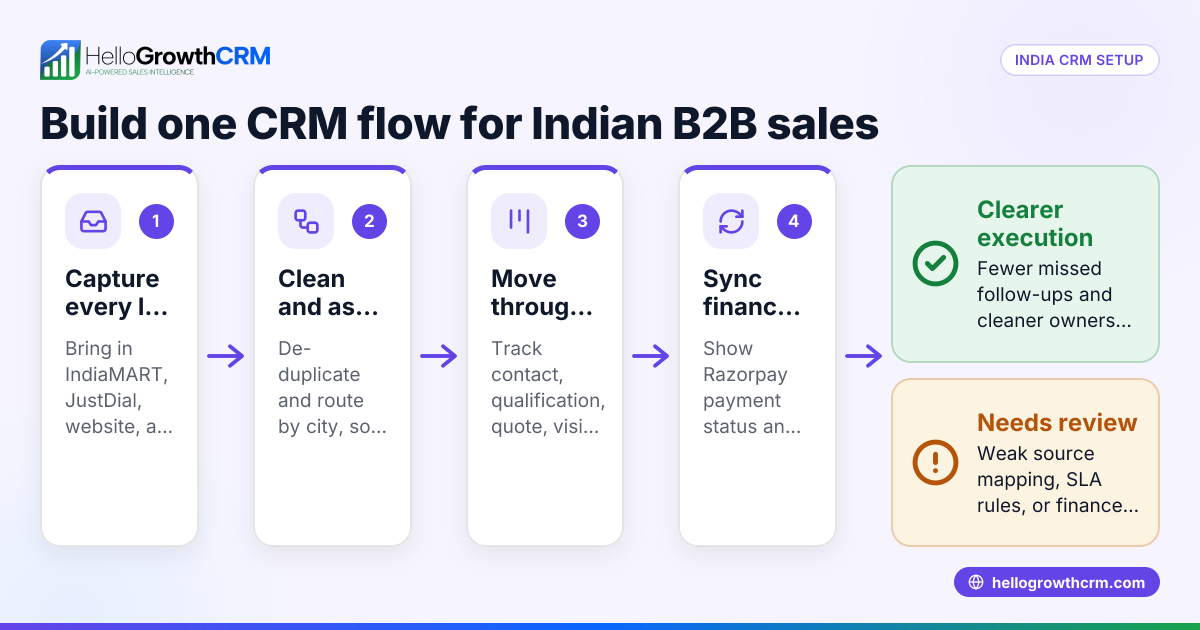
- Use HelloGrowthCRM to bring IndiaMART, JustDial, website, and WhatsApp enquiries into one pipeline instead of managing leads across separate tools.
- Set assignment rules by city, pin code, product line, or rep capacity to protect response-time SLAs and reduce lead cherry-picking.
- Connect WhatsApp, Razorpay, and accounting workflows to keep sales, collections, and ops aligned.
- Track stage-velocity, source-to-win rate, and ageing by owner to improve forecasting with Sales Forecasting and AI Pipeline Management.
- Apply practical DPDPA 2023 controls such as consent capture, role-based access, retention rules, and audit trails for Indian buyer data.
- HelloGrowthCRM fits Indian SME teams especially well when sales happen across phone, field visits, WhatsApp, and distributor-led follow-up.
Why Indian SME sales teams need a unified HelloGrowthCRM setup
Indian SME sales teams need a unified HelloGrowthCRM setup because IndiaMART, JustDial, WhatsApp, calls, and referrals usually enter through separate channels, which creates duplicate records, missed follow-ups, and weak forecasting. One pipeline gives leaders a single source of truth for lead ownership, activity, conversion, and revenue.
In practice, most Indian SMEs do not have a lead shortage. They have a routing and execution problem.
A typical team gets enquiries from:
- IndiaMART
- JustDial
- Website forms
- WhatsApp messages
- Calls to sales mobiles
- Partner or dealer referrals
- Walk-ins from local branches
When these leads sit in spreadsheets or personal inboxes, three issues show up fast:
- No clear owner
- No response-time discipline
- No trusted forecast
In one rollout we did with a 12-person sales team selling industrial equipment across Mumbai, Pune, Nashik, and Aurangabad, lead loss was not caused by poor demand. It came from slow first response, duplicate calling, and no city-based routing. Once we moved all inbound sources into a shared pipeline with SLA alerts and role-based views, managers could finally see where deals were stalling.
This matters even more for teams using AI CRM workflows. AI only helps when data is structured. If lead source, owner, stage, next action, and payment status are missing, automation creates noise instead of speed.
What a good HelloGrowthCRM setup looks like for IndiaMART, JustDial, and WhatsApp leads
A good HelloGrowthCRM setup for IndiaMART, JustDial, and WhatsApp leads creates one standard lead object, one routing logic, one activity timeline, and one forecasting pipeline, while preserving source details that matter for conversion analysis and SLA enforcement across cities, reps, and product lines.
The goal is not just importing leads. The goal is making every enquiry usable.
Standardize the lead capture layer
Create one common structure for all inbound leads. At minimum, include:
- Lead source
- Source campaign or listing
- Contact name
- Mobile number
- Company name
- City and state
- Pincode
- Product interest
- Budget range
- Lead timestamp
- Consent or communication preference
- Assigned owner
- Next follow-up date
If your team uses Smart Inbox and CRM Dialer, each call, WhatsApp message, and note should appear on the same record. This prevents the classic issue where a founder talks to a buyer but the field rep never sees that context.
Preserve source-level detail without fragmenting the pipeline
Keep one pipeline, but tag the acquisition path. For example:
- IndiaMART – Direct enquiry
- IndiaMART – Catalog callback
- JustDial – Purchase intent lead
- WhatsApp – Ad response
- WhatsApp – Existing customer referral
This helps with source-to-stage analysis later in Revenue Attribution.
Match pipeline stages to the real Indian buying motion
For many Indian B2B SMEs, a workable pipeline looks like this:
- New enquiry
- First contact attempted
- Qualified
- Site visit or demo planned
- Proposal shared
- Negotiation
- Payment pending
- Won
- Lost
- Nurture
If your field motion includes dealer visits or plant inspections, add those as activity types, not separate pipeline stages. That keeps forecasting clean.
Which integrations matter most in an Indian SME rollout
The most important integrations in an Indian SME rollout are WhatsApp, Razorpay, Tally-related accounting workflows, Gmail, calling, and meeting tools, because these connect sales conversations to payment, fulfilment, and finance handoffs instead of leaving commercial steps outside the CRM.
For most teams, the useful stack is not large. It just needs to be connected well.
WhatsApp is usually the operating system of the sales floor
In India, WhatsApp often becomes the real sales inbox. Buyers ask for pricing, brochures, GST details, and payment links there.
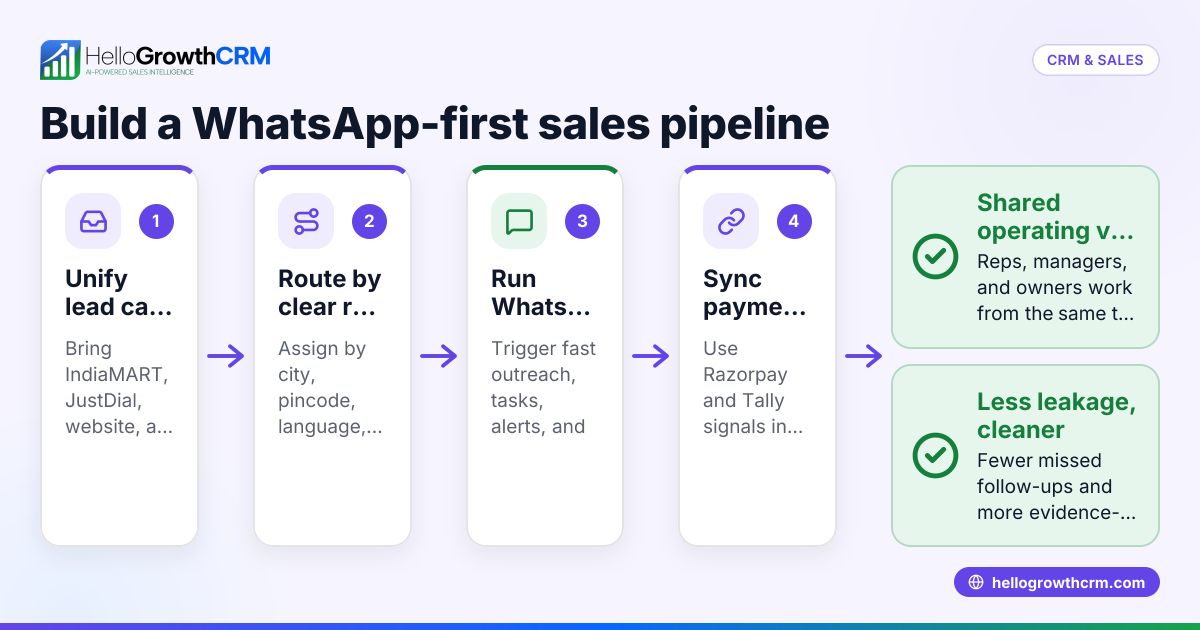
Use WhatsApp & SMS CRM or the native WhatsApp connection to:
- log inbound and outbound messages
- assign chat ownership
- trigger reminders when chats go cold
- move hot conversations into a live opportunity
- keep communication on company-controlled records
Razorpay closes the gap between proposal and payment
For many SMEs, deals stall after verbal approval because payment links, advance invoices, and finance coordination happen outside the CRM. Connecting Razorpay lets teams mark when a payment link was sent, when an advance was collected, and when an order can move forward.
The Reserve Bank of India publishes official payment system guidance and regulatory updates for digital payment ecosystems at rbi.org.in.
Tally sync should be simple and role-based
Some teams connect Tally directly. Others use Zapier, middleware, or finance-led exports. The right answer depends on process maturity.
A practical setup is:
- CRM owns lead, opportunity, quote, and payment status
- Accounting owns invoice, ledger, tax posting, and reconciliation
- Sync only essential commercial fields both teams need
When I have audited pipelines like this, the biggest error is trying to make CRM and accounting identical. They should be connected, not merged.
How to set lead assignment and follow-up SLAs in HelloGrowthCRM
Setting lead assignment and follow-up SLAs in HelloGrowthCRM means defining who gets each lead, how fast first contact must happen, what happens if no action is taken, and how managers see breaches in real time so demand does not die in queues.
Without SLA discipline, routing rules alone do not help.
Start with assignment logic that reflects the market
Use assignment rules based on:
- City or region
- Pincode clusters
- Product category
- Dealer vs direct channel
- Enterprise vs SME account size
- Rep capacity
- Language requirement
For example, a rep in Pune may own western Maharashtra, while Mumbai inside reps qualify metro leads before passing site visits to field staff. Territory Management helps maintain these rules as teams grow.
Define simple SLA bands
For most SMEs, these are enough:
- Hot leads: first response within 5-15 minutes
- Standard inbound leads: first response within 30-60 minutes
- Qualified opportunities: next action scheduled within 24 hours
- Proposal stage: follow-up every 48-72 hours until clear outcome
Use Sales Task Boards and Email Automation to push reminders and overdue queues.
Measure the right metrics
Track:
- First response time
- Contact rate
- Qualification rate
- Stage-velocity in days
- Proposal-to-win rate
- Lead ageing by owner
- Lost reason by source
According to official Meta reporting, WhatsApp has more than 2 billion monthly users globally, which helps explain why it is a primary business communication channel for Indian SMEs (WhatsApp).
How to keep one clean pipeline for forecasting
Keeping one clean pipeline for forecasting means using consistent stage definitions, mandatory next-step fields, clear owner rules, and separate views for source analysis versus revenue forecasting, so managers do not inflate the forecast with unqualified or inactive deals.
Forecasting breaks when every rep interprets stages differently.
Separate lead qualification from deal commitment
Do not move every enquiry into a revenue stage. Use qualification gates first. A deal should enter the forecast only when key fields are present, such as:
- Buying need
- Decision maker or influencer
- Expected value
- Decision timeline
- Next meeting date
- Owner confirmation
This is where AI Lead Scoring and AI Deal Insights help. They do not replace judgement. They help managers spot weak opportunities faster.
Use one forecast category framework
A simple framework works well for SMEs:
| Forecast Category | Meaning | Entry Rule | Manager Action |
|---|---|---|---|
| Pipeline | Early, not committed | Qualified but no commercial event yet | Coach next step |
| Best Case | Real deal, still fluid | Proposal shared or meeting scheduled | Review weekly |
| Commit | Expected this period | Buyer confirmed timeline and commercial terms | Inspect twice weekly |
| Closed Won | Revenue secured | Payment or signed confirmation received | Handover to ops |
This article is about HelloGrowthCRM, which is our product, so that comparison naturally reflects our operating model. The limitation is clear: if your team has 200+ reps, multiple legal entities, and complex ERP requirements, you may need a heavier enterprise architecture than most SMEs need.
How to handle DPDPA 2023 controls in a practical SME CRM setup
Handling DPDPA 2023 controls in a practical SME CRM setup means collecting only needed data, recording communication preferences, restricting access by role, documenting retention rules, and keeping an auditable trail of who viewed, changed, or exported customer information.
This does not need to become a legal project before it becomes an operational one.
India’s Ministry of Electronics and Information Technology provides official resources for the Digital Personal Data Protection framework at meity.gov.in.
Practical controls to configure from day one
Start with these controls:
- Role-based access for sales, managers, finance, and support
- Consent or communication preference fields
- Restricted export permissions
- Activity logging for record edits
- Data retention rules for stale or lost leads
- Team policies for using personal phones and WhatsApp
Pay attention to field-heavy teams
For reps travelling across Pune, Nagpur, Indore, Coimbatore, or tier-3 markets, the main risk is not usually cyber complexity. It is uncontrolled data movement through personal devices.
In one deployment with a building materials distributor network, we found sales reps were forwarding buyer details between personal WhatsApp groups. The fix was simple but strict: company-owned chat workflows, limited exports, and all visit notes logged in CRM by end of day through mobile-friendly forms and Meeting Scheduler records.
How to hellogrowthcrm setup for indian sme sales teams: Step-by-Step
Setting up HelloGrowthCRM for Indian SME sales teams works best when you map lead sources, standardize fields, define routing and SLA rules, connect WhatsApp and payment workflows, then clean the pipeline for forecasting and compliance before scaling automation across managers, field reps, and inside sales users.
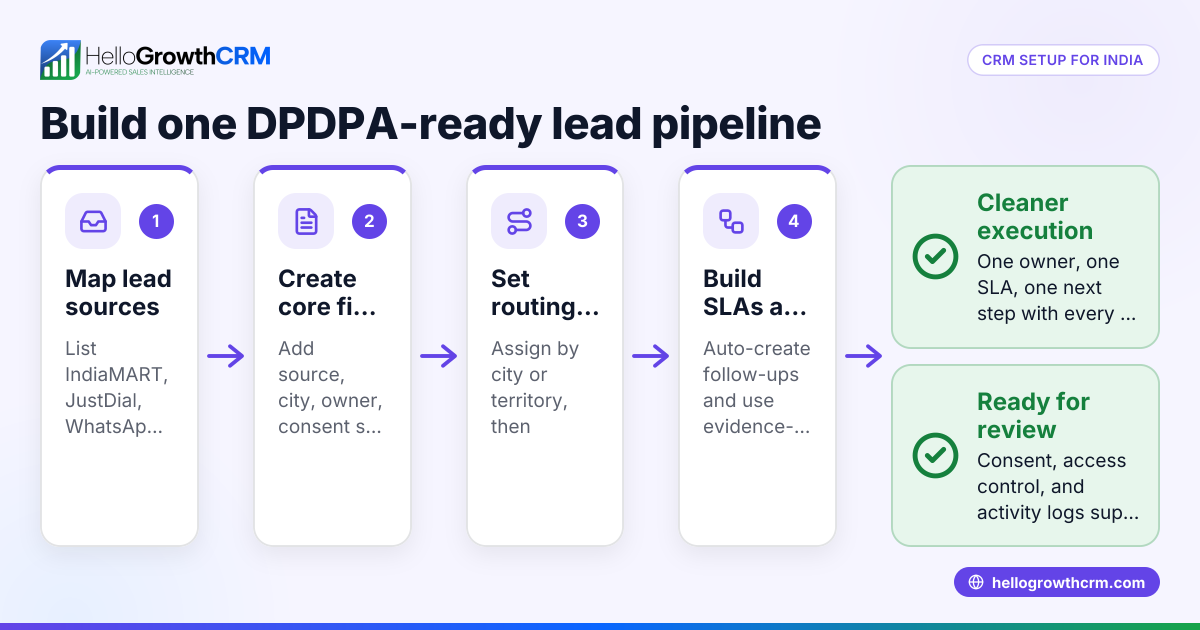
- Map your lead sources
List every source feeding demand today, including IndiaMART, JustDial, website forms, calls, WhatsApp, referrals, and partners. Note who receives each lead and where it currently gets logged. - Create a standard lead schema
Build one set of fields for source, city, pincode, product, budget, owner, consent, and next action. This is the base for Features, automation, and reporting. - Connect communication channels
Set up Gmail, WhatsApp, calling, and calendars so reps work from one record. Use All Integrations if you need other source connections. - Import and deduplicate old data
Merge repeat contacts by mobile number, company, and email. Mark inactive records clearly so they do not pollute new SLA queues. - Configure assignment rules
Route leads by geography, product, or capacity. Add fallback rules for unassigned leads and manager reassignment. - Set follow-up SLAs and alerts
Define first response targets and overdue reminders. Use dashboard views for breach tracking and daily review. - Build your pipeline and forecast categories
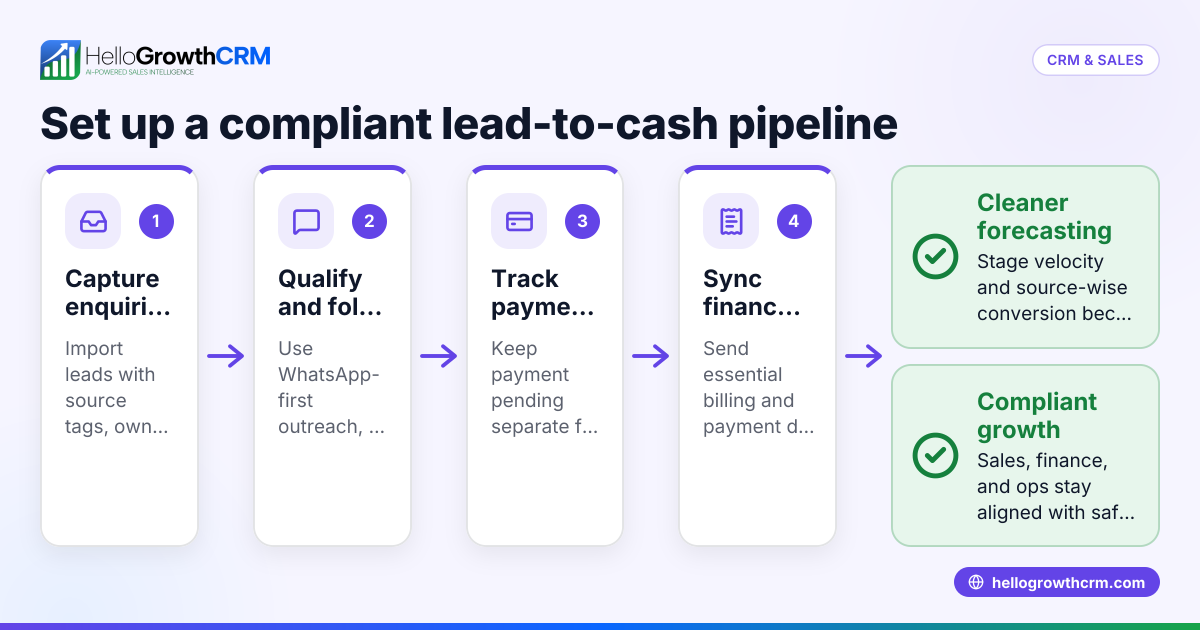
Keep stages simple and tied to real buyer milestones. Use Sales Forecasting to review pipeline coverage, ageing, and expected revenue. - Connect commercial handoffs
Add proposal, payment-link, and finance status steps using Proposal Builder and Razorpay-linked workflows. Keep accounting sync limited to key fields needed by finance. - Apply DPDPA 2023 controls
Restrict access by role, log exports, and capture communication permissions. Train reps on what must stay inside CRM, especially for WhatsApp-led workflows. - Test with one region first
Pilot with one city or one team, such as Mumbai inside sales or Pune field sales. Then scale after two weeks of live feedback.
Common rollout mistakes Indian teams should avoid
Indian SME teams should avoid overcomplicated pipelines, weak ownership rules, excessive custom fields, and unmanaged WhatsApp usage, because these create low adoption, messy forecasts, and hidden lead leakage even when the CRM itself is configured correctly.
The most common problems I see are operational, not technical.
Four mistakes that hurt adoption fastest
- Too many stages: reps stop updating them
- No mandatory next step: managers cannot inspect pipeline health
- Founders bypassing the system: lead ownership becomes political
- Finance and sales using different revenue statuses: forecasting breaks
What works better
Use tight process design first. Then add AI and automation.
A strong baseline often includes AI Sales Copilot, Pipeline Health Score, and CRM ROI Calculator after the team is already logging data consistently.
If you want to see how this looks in your own market, start a Free Trial or book a Demo. HelloGrowthCRM is built for Indian teams that need one place to manage inbound leads, field follow-up, payments, and forecasting without forcing enterprise-grade complexity onto SME sales motions.
About the author
Arjun Mehta is a Revenue Operations Lead at HelloGrowthCRM with 10 years of experience helping B2B sales teams improve lead management, pipeline hygiene, and forecasting. He has led CRM and RevOps rollouts for SaaS, industrial, and services businesses across India. One project that informed this article was a multi-city inbound routing setup for a 12-person SME sales team handling IndiaMART, WhatsApp, and field visits across Mumbai and Pune.
Frequently Asked Questions
Q: What is the best way to capture IndiaMART and JustDial leads in HelloGrowthCRM?
A: The best way to capture IndiaMART and JustDial leads in HelloGrowthCRM is to map both sources into one standard lead format with source tags, owner rules, and SLA timers. This keeps all enquiries in one queue. It also makes source-wise conversion reporting much more reliable.
Q: Can HelloGrowthCRM handle WhatsApp-based sales follow-up for Indian teams?
A: Yes, HelloGrowthCRM can handle WhatsApp-based sales follow-up for Indian teams by linking chats to contact and deal records with clear ownership and reminders. This helps teams avoid using personal chat histories as the system of record. It also improves manager visibility.
Q: How should Indian SME teams set lead assignment rules?
A: Indian SME teams should set lead assignment rules by geography, product line, account type, language, and rep capacity. This matches the real market better than round-robin alone. It is especially useful when field reps cover tier-2 or tier-3 territories.
Q: Does HelloGrowthCRM support Razorpay and accounting handoffs?
A: Yes, HelloGrowthCRM supports Razorpay and accounting handoffs by tracking payment-link actions and syncing key commercial status fields into downstream finance workflows. The main goal is visibility. Sales should know payment status without turning CRM into a full accounting system.
Q: How do I keep my pipeline clean enough for forecasting?
A: To keep your pipeline clean enough for forecasting, only move qualified opportunities into forecast stages and require a next step, value, and timeline. This removes inflated pipeline numbers. It also helps managers inspect deal quality, not just deal count.
Q: What DPDPA 2023 controls should a small sales team set first?
A: The first DPDPA 2023 controls a small sales team should set are role-based access, consent or communication preference fields, export restrictions, and activity logs. These controls are practical and fast to implement. They also reduce risk from unmanaged personal-device usage.
Q: Is HelloGrowthCRM a good fit for field-heavy teams outside metro cities?
A: Yes, HelloGrowthCRM is a good fit for field-heavy teams outside metro cities when they need mobile-friendly lead tracking, visit logging, and central visibility across distributed reps. It works well for mixed inside-plus-field motions. Adoption depends on simple process design and manager follow-through.
Q: How long does a typical HelloGrowthCRM setup take for an SME?
A: A typical HelloGrowthCRM setup for an SME usually takes one to three weeks for core lead capture, routing, pipeline setup, and reporting. The exact timeline depends on data quality and integration complexity. Starting with one pilot region usually speeds up adoption.
Frequently Asked Questions
Ready to put this into practice?
Set up your pipeline, WhatsApp follow-ups, and AI lead scoring in minutes — free, no credit card.
Try HelloGrowthCRM freeGet CRM tips in your inbox
Join thousands of sales professionals who get weekly insights on CRM strategy, AI automation, and pipeline optimization.

The HelloGrowthCRM team publishes guides on CRM strategy, AI sales tools, and revenue operations for small business sales teams.