HelloGrowthCRM software
Built for real small-business sales teams
HelloGrowthCRM helps reps qualify faster, follow up on time, and close more deals—with practical automation in one place.
- AI lead scoring and pipeline visibility
- Built-in dialer, WhatsApp, and email automation
- Sales forecasting and RevOps-ready reporting
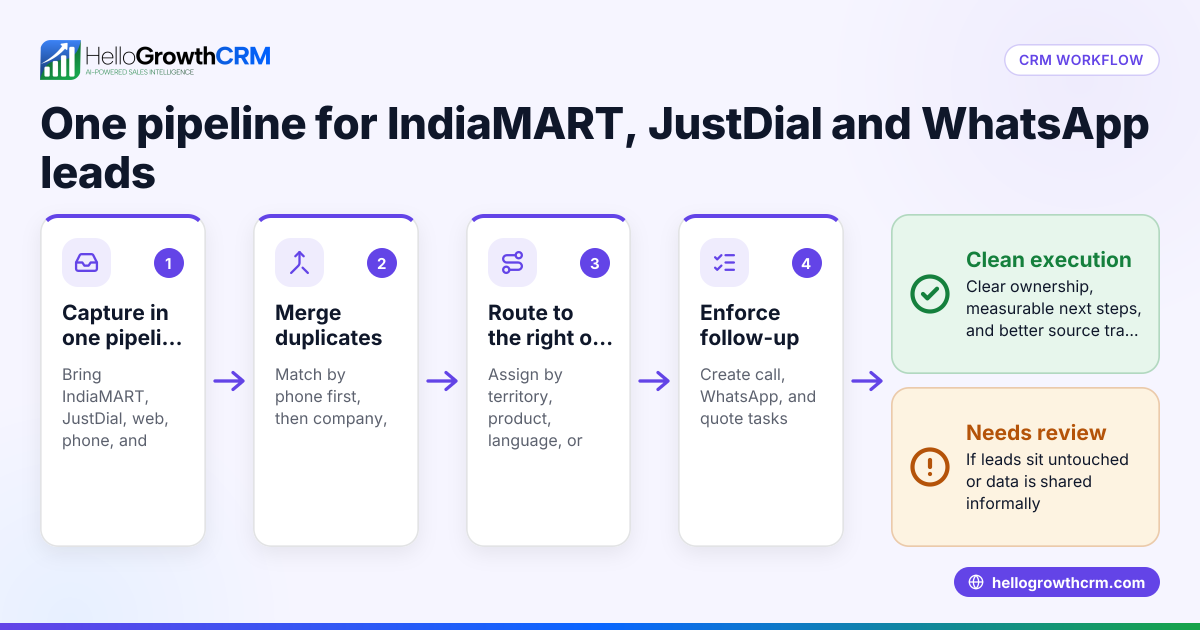
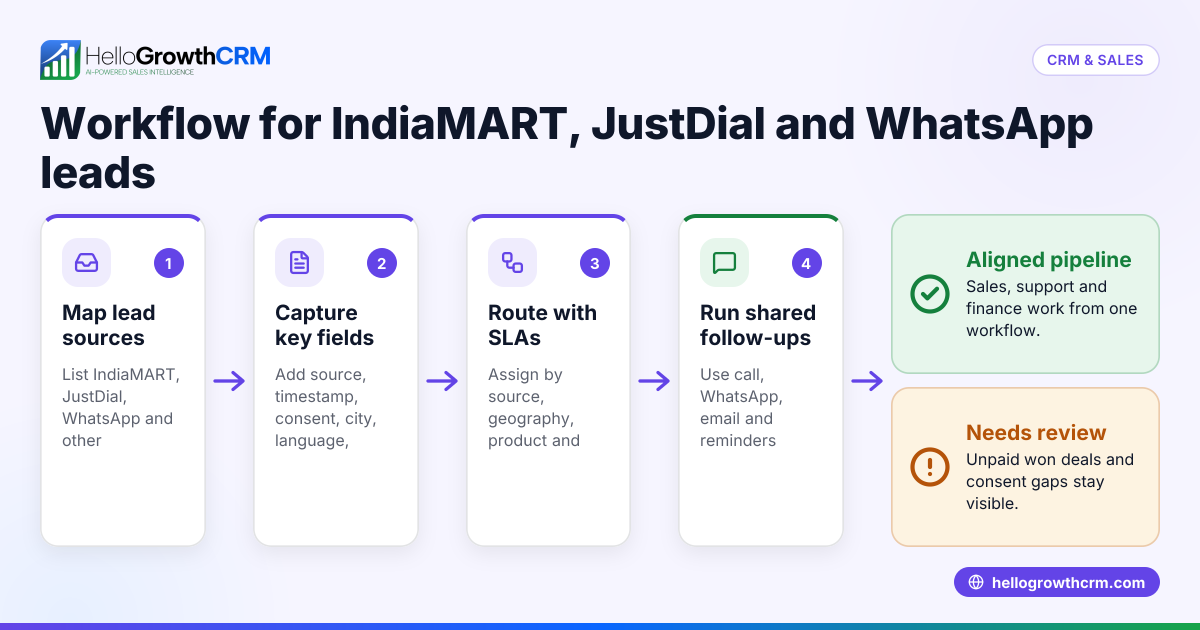
A CRM workflow for IndiaMART, JustDial, and WhatsApp leads is a structured process that captures every enquiry, checks consent, assigns the lead to the right rep, triggers fast WhatsApp-first follow-up, tracks stage movement, and connects payments and accounting so Indian SME sales teams can convert more leads without losing compliance or forecast control.
Key Takeaways
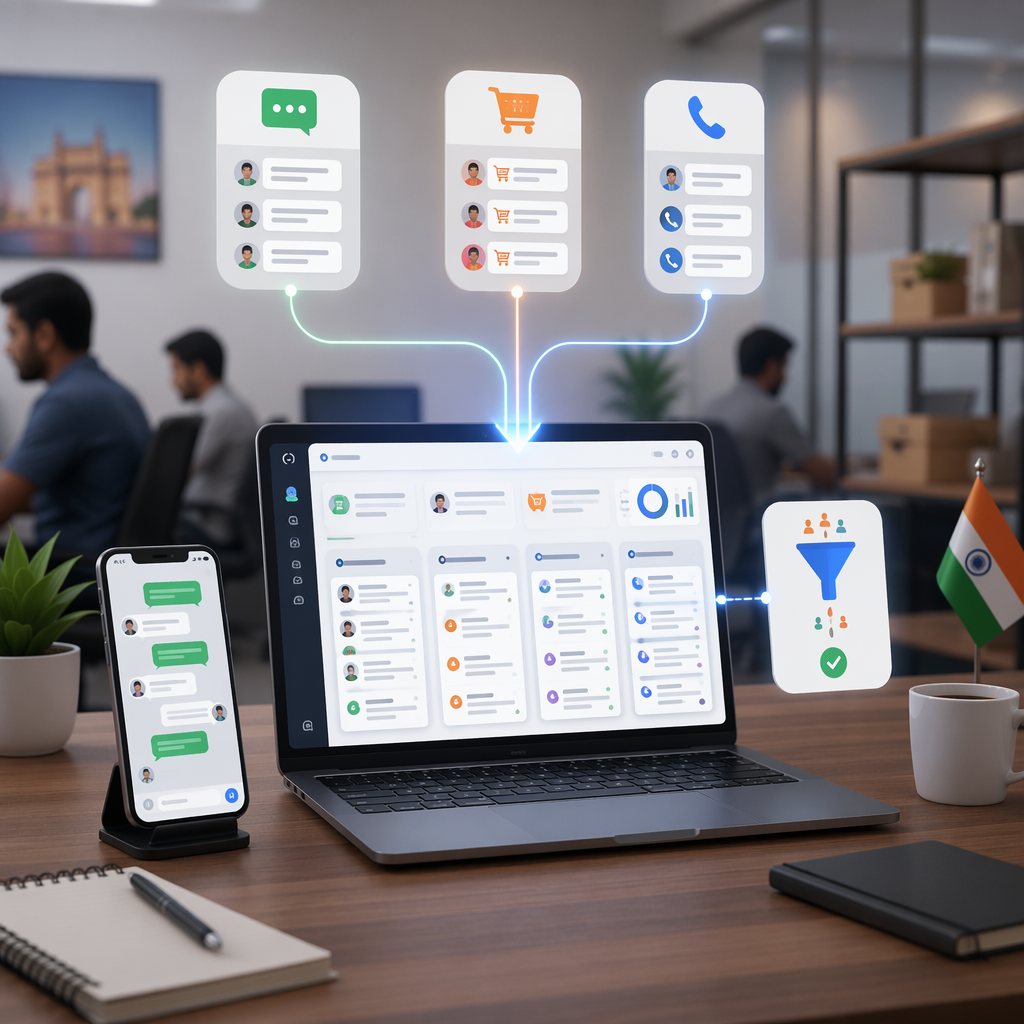
- IndiaMART, JustDial, and WhatsApp leads need one shared intake workflow inside a single AI CRM, not separate spreadsheets or rep-owned inboxes.
- For most Indian SME teams, the best response motion is WhatsApp first, then call, then email, with clear consent logging for DPDPA 2023.
- Lead assignment should use geography, product line, language, and response capacity, especially for Mumbai, Pune, and tier-2 or tier-3 territories.
- Razorpay payment status and Tally-ready finance data should flow back into the CRM so forecasting reflects real buying intent.
- Pipeline stages must measure qualification quality, quote movement, payment status, and follow-up gaps, not just “open” and “closed.”
- HelloGrowthCRM helps Indian teams unify capture, routing, automation, forecasting, and WhatsApp execution in one system.
Why Indian SME teams need a dedicated CRM workflow for IndiaMART, JustDial, and WhatsApp leads
A dedicated CRM workflow for IndiaMART, JustDial, and WhatsApp leads matters because these channels create fast, high-volume enquiries with uneven intent, incomplete data, and heavy follow-up pressure, so without one process for capture, consent, routing, and stage tracking, Indian SME teams lose speed, duplicate effort, and forecasting accuracy.
IndiaMART and JustDial leads often arrive with partial context. A buyer may ask for price, stock, delivery, or a callback. Then the real conversation moves to WhatsApp. If that shift is not tracked, the lead disappears into personal phones.
In practice, I have seen this happen most often with 5 to 25 rep teams in Mumbai and Pune. One rep saves a lead in their phone. Another calls the same lead two hours later. A third sends a quote with no stage update. The manager still thinks the pipeline is healthy.
That is why the workflow needs five connected parts:
- Lead capture from all sources
- Consent and communication logging
- Smart assignment
- Follow-up automation
- Forecasting tied to commercial signals
In HelloGrowthCRM, teams usually start by connecting WhatsApp & SMS CRM, Zapier, and All Integrations so every lead enters one record. That becomes the source of truth for sales, finance, and management.
What makes these lead sources different
These three sources behave differently, even when they feed the same team.
| Lead source | Typical buyer intent | Common issue | Best first action | CRM field to prioritise |
|---|---|---|---|---|
| IndiaMART | Active product or vendor search | Low context, price shopping | WhatsApp intro within 5 minutes | Product category + city |
| JustDial | Broad local discovery | Duplicate and low-fit leads | Call + WhatsApp confirmation | Location + service need |
| WhatsApp inbound | High response probability | Unstructured chat data | Immediate qualification | Consent status + enquiry type |
A shared workflow does not mean identical handling. It means one system with source-specific rules.
What a DPDPA-safe pipeline looks like for Indian sales teams
A DPDPA-safe pipeline for Indian sales teams is a lead management process that records why data was collected, who contacted the prospect, what channel was used, whether consent was given for ongoing communication, and how long records are retained, while still keeping response speed high enough for SME sales.
India’s Digital Personal Data Protection framework requires teams to treat customer data with more care, not less. The Ministry of Electronics and Information Technology provides the official policy context for India’s data protection framework.
For sales teams, the practical meaning is simple:
- Capture only useful sales data
- Record lead source clearly
- Log consent for ongoing outreach
- Give buyers a way to stop non-essential communication
- Limit access to customer records
If a buyer submits an enquiry on IndiaMART or JustDial, that does not mean every rep can message them forever on every channel. Your CRM should separate:
- Transactional updates, like quote sharing or payment links
- Follow-up messages tied to the enquiry
- Promotional campaigns or reactivation messages
In one rollout we did with a 12-person sales team selling industrial supplies across Maharashtra, the biggest compliance gap was not data storage. It was reps exporting numbers into personal phones and sending repeated WhatsApp nudges weeks after the buyer had gone silent. We fixed that by moving messaging into a shared CRM inbox and making consent status mandatory before campaign enrollment.
Minimum DPDPA-safe fields to store
Create required fields for:
- Lead source
- Date and time of capture
- Consent status
- Consent source
- Preferred contact channel
- Product interest
- City and state
- Assigned owner
- Last outreach timestamp
Use Smart Inbox and Gmail or WhatsApp integrations so activity stays inside the account history. This reduces audit risk and improves manager visibility.
How to assign IndiaMART, JustDial, and WhatsApp leads without creating chaos
The best way to assign IndiaMART, JustDial, and WhatsApp leads is to use simple rules based on location, product line, language, and rep capacity, then layer service-level targets on top so high-intent leads get a response in minutes and low-fit leads do not clog your active pipeline.
Most SME teams overcomplicate lead routing. They build too many rules too early. Start with four.
Rule 1: Geography first
Route by city cluster or pin code zone.
Examples:
- Mumbai Metro
- Pune and Pimpri-Chinchwad
- Rest of Maharashtra
- Gujarat
- Tier-2 and tier-3 North India
This matters because delivery terms, language comfort, and visit feasibility differ. A Pune rep may close faster in Nashik than a Mumbai rep with no territory context. Territory Management helps keep this clean as you grow.
Rule 2: Product or service line second
If you sell multiple categories, route by the product selected or inferred from the enquiry. This avoids generalist reps mishandling technical deals.
Rule 3: Capacity and speed third
Do not assign new leads to reps with old untouched queues. Use active open-lead count and average first-response time as balancing signals. AI Lead Scoring can also help separate “call now” from “nurture later” leads.
Rule 4: Named-account exceptions
Existing customers, distributors, or high-value prospects should go to the account owner, even if geography rules say otherwise.
When I have audited pipelines like this, the fastest win is usually not more leads. It is fixing unowned leads older than 15 minutes. A simple dashboard with “new, uncontacted, overdue” cuts leakage fast. Teams can track that with Sales Task Boards and a shared Meeting Scheduler for booked follow-ups.
What the best WhatsApp-first follow-up workflow looks like
The best WhatsApp-first follow-up workflow is a short, permission-aware sequence that confirms the buyer’s requirement, offers one clear next step, and moves quickly to a call or quote, because Indian SME buyers often respond faster on WhatsApp than by email and expect concise communication.
WhatsApp is often the real conversion channel for Indian SMEs. It is where buyers ask for photos, GST details, stock updates, and delivery timelines. But it should not become an untracked side channel.
Recommended first-hour sequence
- Within 5 minutes: Send a short WhatsApp introduction with name, company, and reason for contact.
- Within 10 minutes: Attempt a call if the lead score is high.
- Within 20 minutes: Send one value message. Example: price range, lead time, or catalog.
- Within 60 minutes: Ask one qualification question and offer a clear next step.
Keep the first message simple:
- Acknowledge source
- Confirm product need
- Ask one question
- Offer a call or quote
What to avoid
- Long brochures on first touch
- Multiple reps messaging the same buyer
- Daily follow-ups with no new value
- Personal number outreach with no CRM logging
The Reserve Bank of India states that digital payment transactions in India have grown strongly in recent years, which is one reason buyers now expect fast quote-to-payment handoffs in digital sales journeys (RBI Payments Vision 2025).
Use Email Automation for slower channels, but keep the primary playbook anchored in WhatsApp & SMS CRM. If inbound volume is high, AI Voice Agent or CRM Dialer can support first-touch speed for missed calls and after-hours enquiries.
Which pipeline stages improve forecast accuracy for these lead sources
Pipeline stages that improve forecast accuracy for IndiaMART, JustDial, and WhatsApp leads are stages tied to evidence, such as contacted, qualified, requirement confirmed, quote sent, negotiation, payment pending, and won, because stage names should reflect buyer actions and commercial progress, not vague rep opinion.
Many SME pipelines fail because they are too generic:
- New
- Contacted
- Interested
- Closed
That structure tells a manager almost nothing about conversion health.
A better pipeline for Indian SME sales
Use stages like these:
- New Lead
Captured but not yet contacted. - First Contact Attempted
WhatsApp, call, or both initiated. - Connected
Buyer replied or spoke with rep. - Qualified
Budget, need, timeline, quantity, or use case validated. - Requirement Confirmed
SKU, service scope, location, and delivery fit confirmed. - Quote Sent
Proposal or rate shared. Use Proposal Builder if your team sends many custom quotes. - Negotiation / Follow-Up
Commercial discussion active. - Payment Pending
Buyer agreed, payment link or PO awaited. - Won
Payment or formal order confirmed. - Lost / Nurture
Closed with reason code.
Forecasting metrics that actually matter
Inside Sales Forecasting and AI Pipeline Management, watch these metrics:
- First-response time
- Contact rate by source
- Stage conversion rate
- Stage velocity in days
- Quote-to-payment conversion
- Lost reason by source
- Aging in negotiation
If you want cleaner forecasts, do not allow reps to move deals to “qualified” without required fields. That discipline matters more than fancy dashboards.
How to connect Razorpay payments and Tally-ready finance data to the workflow
Connecting Razorpay payments and Tally-ready finance data to the workflow means pushing quote, order, and payment status back into the CRM so sales can see which deals are real, finance can reconcile faster, and managers can forecast on actual buyer commitment instead of verbal intent.
This is where many teams break the chain. Sales sends a payment link. Finance gets the receipt. The CRM never updates. The deal sits in “negotiation” for a week even though the buyer already paid.
Razorpay handoff best practice
At minimum, send these values from Razorpay into the CRM:
- Payment link created
- Payment link sent date
- Amount
- Payment status
- Payment date
- Order reference
This lets the sales manager distinguish:
- Warm negotiation
- Verbal yes with no payment
- Real commitment with money movement
Tally sync considerations
If your finance team still uses Tally, the CRM does not need to replace it. It needs to pass clean commercial data forward.
Keep these identifiers consistent:
- Customer legal name
- GST number
- Billing city and state
- Invoice amount
- Payment mode
- Order or invoice reference
If you use QuickBooks or Stripe for some flows, apply the same logic. The main goal is forecast quality. Once payment intent becomes visible in the CRM, your commit number gets much more reliable. Revenue Attribution can also help teams see which source actually created revenue, not just enquiries.
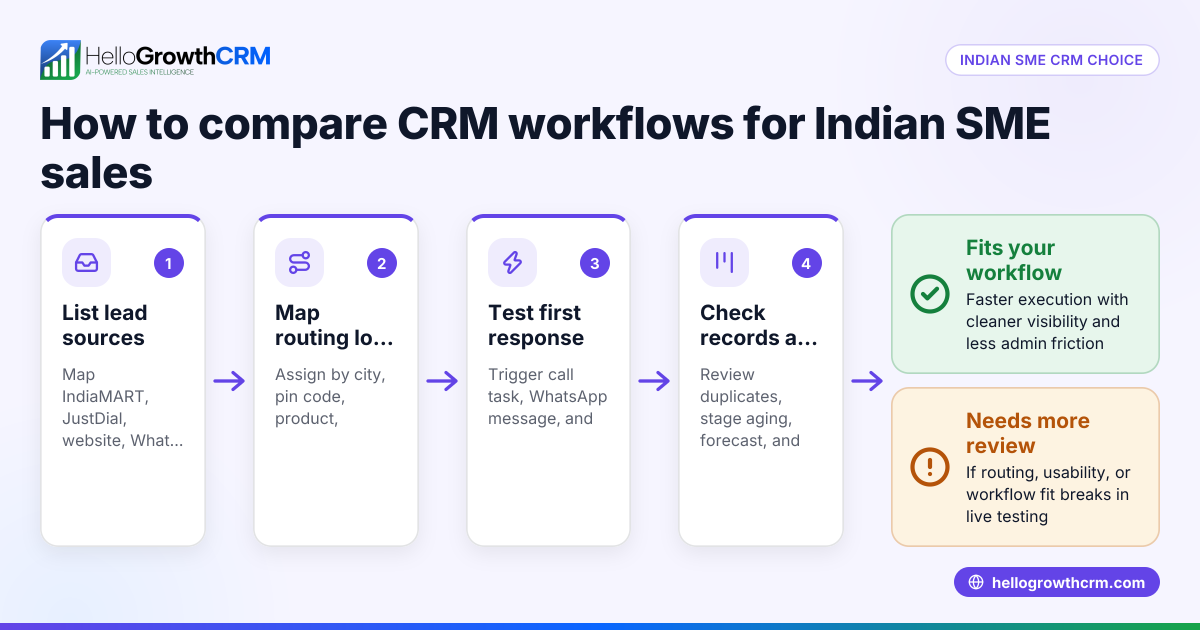
How to build a CRM workflow for IndiaMART, JustDial, and WhatsApp leads: Step-by-Step
Building a CRM workflow for IndiaMART, JustDial, and WhatsApp leads starts with one capture layer, then adds consent fields, routing rules, follow-up automation, stage definitions, and payment feedback loops so Indian SME teams can respond faster, stay DPDPA-aware, and forecast with more confidence.
- Map your lead sources
List every inbound path, including IndiaMART, JustDial, direct WhatsApp, missed calls, website forms, and referrals. Connect them into one record using All Integrations or OpenAI plus workflow tools where needed. - Create mandatory intake fields
Make source, city, consent status, owner, enquiry type, and last contact time required. This stops incomplete lead creation. - Set lead assignment rules
Start with geography, product line, and capacity. Keep exceptions limited to named accounts or strategic deals. - Build WhatsApp-first sequences
Use short templates for first response, reminder, quote follow-up, and no-response closure. Log every touch in the CRM. - Define evidence-based stages
Replace vague stages with buyer-action stages such as connected, qualified, quote sent, and payment pending. - Add SLA alerts
Trigger tasks when a new lead is untouched for 5, 15, or 30 minutes. Use Slack or Microsoft Teams for manager escalation. - Connect payment status
Push Razorpay activity into the deal record. Mark payment-pending deals separately from active negotiation. - Review weekly by source
Compare response time, contact rate, quote rate, and win rate across IndiaMART, JustDial, and WhatsApp. Use a Pipeline Health Score or CRM ROI Calculator to spot leakage.
For Indian SME teams, this workflow works best for sales orgs under 50 reps. Above that, expect more complex routing, role-based permissions, and stronger admin governance.
If your team handles IndiaMART, JustDial, and WhatsApp leads every day, HelloGrowthCRM gives you the structure to capture, route, follow up, forecast, and stay more DPDPA-aware in one place. You can explore the full Features, review Pricing, book a Demo, or start a Free Trial built for Indian sales teams.
About the author
Rohan Kulkarni is a Sales Operations Lead at HelloGrowthCRM with 10 years of experience in B2B SaaS, RevOps, and CRM process design. He has led CRM rollouts for Indian SME sales teams across manufacturing, services, and distribution. One recent project involved redesigning lead routing and WhatsApp follow-up for a 12-rep industrial supplier selling across Mumbai, Pune, and tier-2 Maharashtra markets. That hands-on work informed the workflow and field recommendations in this article.
Frequently Asked Questions
Q: What is the best CRM workflow for IndiaMART, JustDial, and WhatsApp leads?
A: The best CRM workflow for IndiaMART, JustDial, and WhatsApp leads captures every enquiry in one system, logs consent, assigns by territory and fit, triggers WhatsApp-first follow-up, and tracks payment signals. This helps Indian SME teams reduce missed leads and improve forecast accuracy.
Q: How fast should Indian sales reps respond to IndiaMART or JustDial leads?
A: Indian sales reps should respond to IndiaMART or JustDial leads within 5 minutes when possible, especially for high-intent enquiries. Fast first contact matters because these buyers often compare multiple vendors at the same time.
Q: Is WhatsApp follow-up allowed under DPDPA 2023?
A: WhatsApp follow-up can be used under DPDPA 2023 when it is tied to the buyer’s enquiry, handled with clear purpose, and logged properly in your CRM. Teams should also respect opt-outs and avoid uncontrolled personal-number outreach.
Q: How should I assign leads across Mumbai, Pune, and tier-2 or tier-3 markets?
A: You should assign leads across Mumbai, Pune, and tier-2 or tier-3 markets using geography first, then product line, language, and rep capacity. This keeps response times low and improves local conversion quality.
Q: Which pipeline stages are best for forecast accuracy in Indian SME sales?
Frequently Asked Questions
Ready to put this into practice?
Set up your pipeline, WhatsApp follow-ups, and AI lead scoring in minutes — free, no credit card.
Try HelloGrowthCRM freeGet CRM tips in your inbox
Join thousands of sales professionals who get weekly insights on CRM strategy, AI automation, and pipeline optimization.

The HelloGrowthCRM team publishes guides on CRM strategy, AI sales tools, and revenue operations for small business sales teams.