HelloGrowthCRM software
Built for real small-business sales teams
HelloGrowthCRM helps reps qualify faster, follow up on time, and close more deals—with practical automation in one place.
- AI lead scoring and pipeline visibility
- Built-in dialer, WhatsApp, and email automation
- Sales forecasting and RevOps-ready reporting
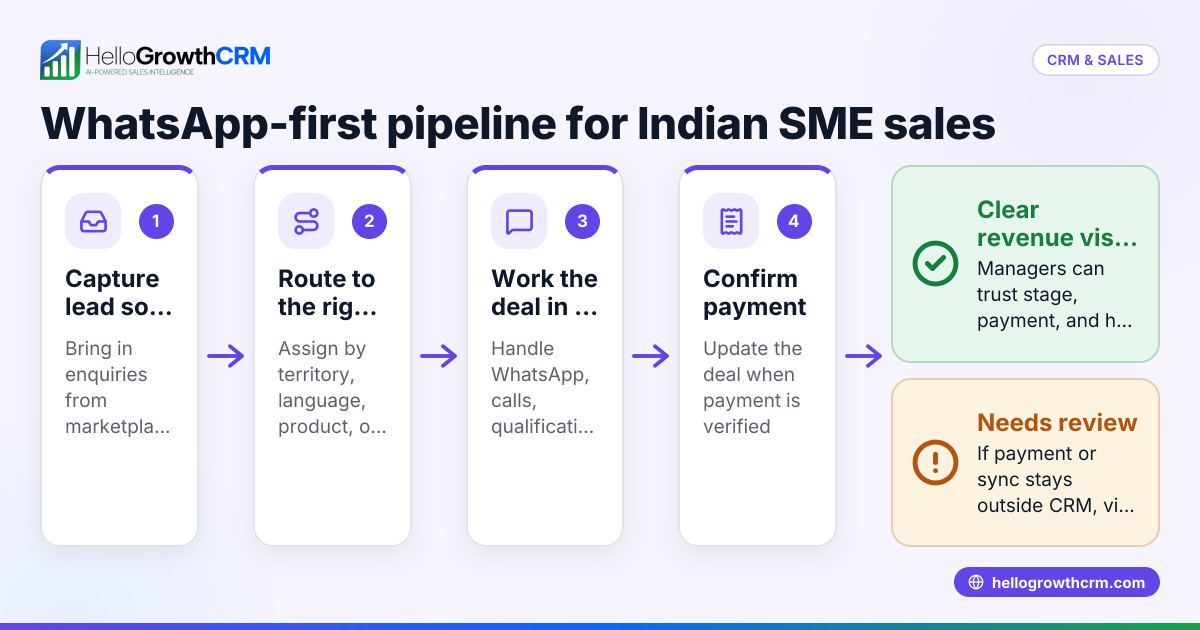
A whatsapp-first crm pipeline for indian smes is a sales system that captures leads from IndiaMART, JustDial, websites, and WhatsApp into one shared pipeline, routes them by territory and source, automates follow-ups, tracks payment and ledger status, and handles personal data in line with India’s DPDPA 2023.
Key Takeaways
- Indian SMEs need one pipeline for IndiaMART, JustDial, website, and WhatsApp leads, not separate inboxes and spreadsheets.
- A WhatsApp-first setup works best when lead routing, stage rules, follow-up SLAs, and payment status all live inside the same CRM.
- HelloGrowthCRM can connect lead capture, WhatsApp & SMS CRM, Revenue Attribution, Razorpay events, and Tally sync into one operating workflow.
- DPDPA 2023-safe setup starts with purpose-based data capture, access control, consent-aware messaging, and audit-ready records.
- Forecasting gets more accurate when owners use stage-entry criteria, stage-velocity in days, and payment-confirmed revenue rules instead of gut feel.
Why Indian SMEs need a WhatsApp-first CRM pipeline
A WhatsApp-first CRM pipeline for Indian SMEs matters because most buyer conversations move fast, happen on mobile, and often start outside the CRM. If leads from IndiaMART, JustDial, forms, and WhatsApp stay disconnected, teams miss follow-ups, double-call prospects, and lose forecast accuracy.
For many Indian SMEs, WhatsApp is the real front office. The lead may begin on IndiaMART. The qualification happens on a phone call. The quote gets discussed on WhatsApp. The payment proof comes on WhatsApp again. If these touchpoints are spread across personal phones, Excel sheets, and one owner’s memory, scale breaks.
That is why I recommend centralising the motion inside HelloGrowthCRM instead of adding another passive database. Teams can combine Smart Inbox, CRM Dialer, Meeting Scheduler, and AI Pipeline Management so every rep sees the same history.
In one rollout we did with a 12-person sales team selling industrial components across Mumbai, Pune, and Nashik, the biggest issue was not lead volume. It was response lag. IndiaMART leads were getting a callback after three hours, while WhatsApp leads were answered in ten minutes. Once we set one routing queue and one SLA inside the CRM, conversion improved without increasing ad spend.
Common failure points in Indian SME sales stacks
Most teams come to this problem after trying to patch workflows together. The common issues are:
- IndiaMART leads go to one email inbox
- JustDial leads land on a sales manager’s phone
- Website forms go to a developer-managed mailbox
- WhatsApp chats stay on personal devices
- Payment status sits in Razorpay
- Ledger and invoicing status sit in Tally
- Forecasting happens in Excel on Fridays
This is exactly where a connected AI CRM becomes useful. It is not just for storing contacts. It becomes the working system for sales execution.
What a good WhatsApp-first pipeline should include
A good WhatsApp-first pipeline should include unified lead capture, instant routing, stage definitions, channel-aware follow-up, payment visibility, ledger sync, and forecast rules tied to evidence. For Indian SMEs, it should also support WhatsApp as a core channel, territory ownership, and practical compliance under DPDPA 2023.
A usable setup is simple enough for a 5-30 person team, but strict enough to stop leakage. That means each stage must answer one question: what has been proven?
Here is the operating model I use most often for SMEs selling across Mumbai, Bangalore, Pune, and tier-2 markets:
| Pipeline Element | What it means | Rule for Indian SMEs |
|---|---|---|
| Lead source capture | Know where the enquiry came from | Tag IndiaMART, JustDial, website, WhatsApp, referral |
| Owner assignment | One rep owns next action | Route by city, pincode, product line, or language |
| First response SLA | Time to first human reply | Target 5-15 minutes during business hours |
| Qualification stage | Basic fit is confirmed | Need buyer need, city, use case, budget range |
| Quote stage | Commercials have been sent | Quote ID and amount must be logged |
| Payment stage | Buyer intent is financial | Razorpay status or PO evidence required |
| Won stage | Revenue is real | Payment confirmed or invoice raised per your policy |
| Lost stage | Reason is coded | Use reason taxonomy, not free text only |
This structure works well with Sales Task Boards and Sales Forecasting, because the forecast is tied to stage evidence, not optimism.
Stage definitions that reduce pipeline noise
Use tight entry rules:
- New Lead: Captured, but no meaningful response yet
- Contacted: First call, WhatsApp, or email attempted
- Qualified: ICP fit plus need plus expected timeline
- Quoted: Proposal or price shared
- Negotiation: Active objection handling or commercial discussion
- Payment Pending: Razorpay link sent, PO shared, or approval pending
- Won: Payment confirmed or invoice raised
- Lost: Closed with coded reason
When I have audited pipelines like this, the biggest fix is usually stage discipline. Teams often move deals to “hot” or “interested,” which means nothing. Use operational stages instead.
How to connect IndiaMART, JustDial, website, WhatsApp, Razorpay, and Tally in HelloGrowthCRM
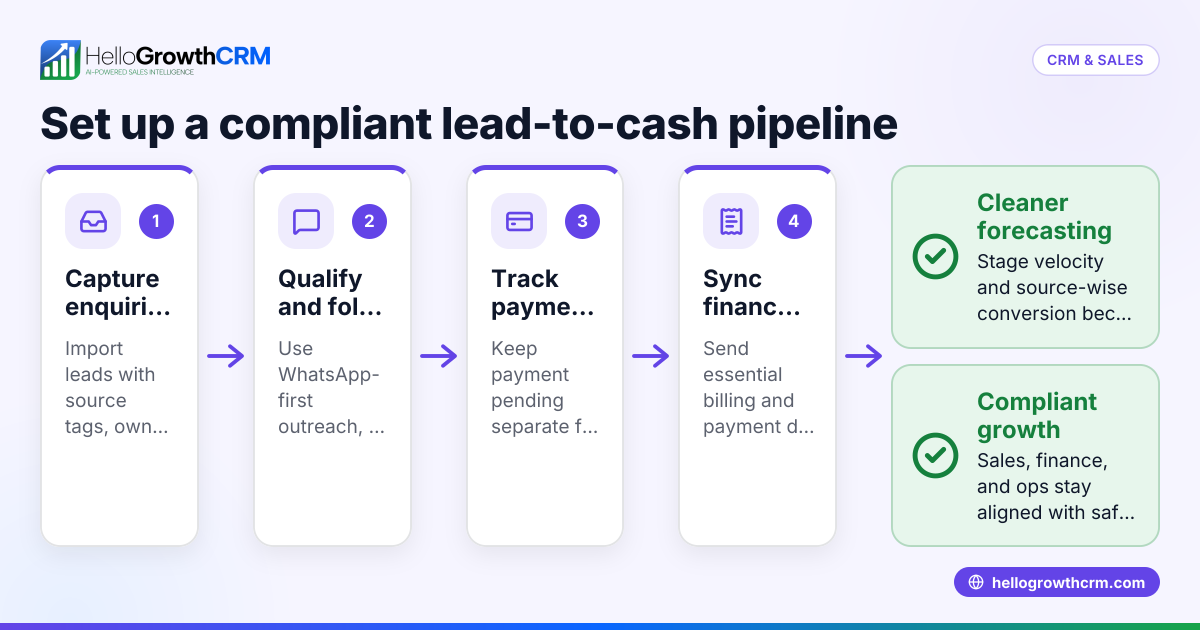
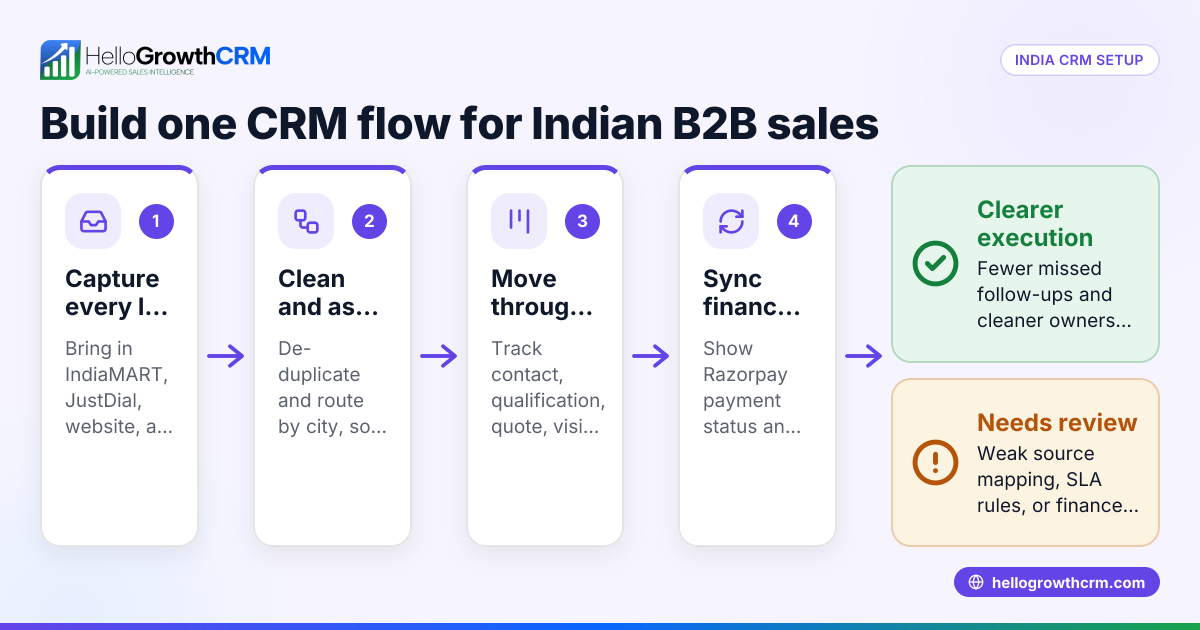
You can connect IndiaMART, JustDial, website, WhatsApp, Razorpay, and Tally in HelloGrowthCRM by standardising lead fields, pushing all enquiries into one inbox, mapping owner rules, and syncing finance signals back into deal records so reps, managers, and owners work from the same truth.
Start with data structure before automation. If your fields are messy, automation only creates faster confusion.
Lead capture and source mapping
Create the same required fields across all sources:
- Lead name
- Company name
- Mobile number
- City
- State
- Product interest
- Source
- Enquiry timestamp
- GSTIN, if relevant later
- Consent or communication basis, where applicable
Website forms can be connected with Zapier or direct workflows. If your team already uses Gmail, Slack, or Google Meet, connect those early so activity logging stays central.
For WhatsApp, use WhatsApp & SMS CRM and the WhatsApp integration so conversations are not trapped on personal numbers.
Payment and accounting visibility
Razorpay and Tally should not sit outside the pipeline. They should change deal confidence.
The Reserve Bank of India regulates payment systems under the Payment and Settlement Systems framework, making payment traceability and status accuracy especially important for operational controls in Indian businesses: https://www.rbi.org.in/.
In practice, set these triggers:
- Razorpay payment link sent → update deal to Payment Pending
- Razorpay payment captured → mark commercial confirmation event
- Tally invoice created → stamp invoice number in account record
- Tally outstanding due > agreed terms → flag account for collections follow-up
If you use Razorpay, Stripe, or QuickBooks in parallel for some business lines, map each to the same lifecycle status. Owners should not need three dashboards.
Tally sync for customer records
Many Indian SMEs still run accounting discipline in Tally. That is normal. The mistake is keeping CRM and accounting disconnected. Sync customer master data, invoice references, GST-related identifiers, and outstanding status where possible. If your workflow needs broader connections, use All Integrations as the control layer.
Lead routing and follow-up rules that work in India
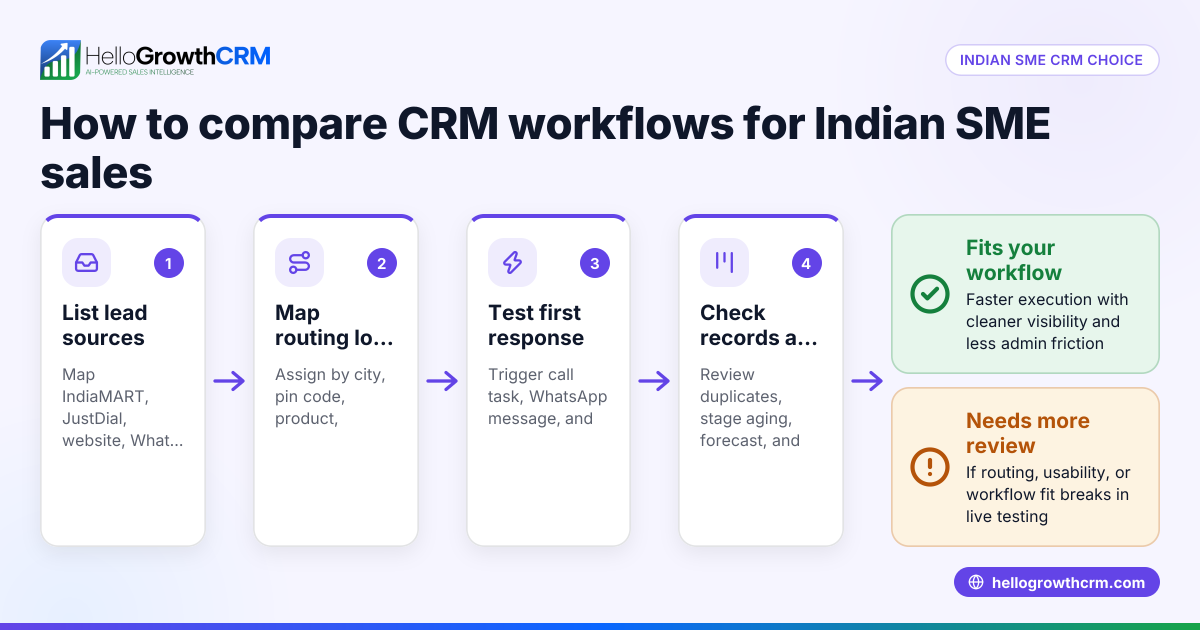
Lead routing and follow-up rules work in India when they match real buying behaviour by geography, response speed, and channel preference. The best setups assign one clear owner, set a first-response SLA, trigger WhatsApp-first outreach, and escalate ignored leads before they go cold.
Indian inbound demand is uneven. A Mumbai industrial buyer may expect a callback in minutes. A distributor in Indore may prefer WhatsApp first. A buyer in Coimbatore may want regional language support. Your routing logic should reflect this.
Use these assignment rules:
- By city cluster: Mumbai, Pune, Bangalore, Chennai, Delhi NCR
- By pincode or state
- By product category
- By language preference
- By source quality score
- By existing customer vs new lead
A practical sequence inside HelloGrowthCRM:
- Lead enters from IndiaMART, JustDial, website, or WhatsApp
- CRM applies source tag and territory rule
- Rep gets task and WhatsApp template suggestion
- If no first action in 10 minutes, manager alert fires
- If no response from buyer in 24 hours, follow-up cadence starts
- If buyer replies, next task is created automatically
This is where AI Lead Scoring, Follow-Up Cadence Builder, and AI Sales Copilot help smaller teams act like larger ones.
Suggested first-response SLA by source
- WhatsApp inbound: 5 minutes
- IndiaMART lead: 10 minutes
- JustDial lead: 10 minutes
- Website form: 15 minutes
- Referral lead: 30 minutes, but personalised
I have seen IndiaMART-heavy teams in Pune improve connect rates simply by moving from callback-only to call plus WhatsApp in the first five minutes. The speed mattered, but the second channel mattered too.
Forecasting rules for SME owners and sales managers
Forecasting rules for SME owners work when every forecast category is tied to a specific proof point, such as qualification completeness, quote issued, payment link sent, or payment received. For Indian SMEs, forecasting should separate pipeline intent from cash confidence.
Do not forecast all open deals the same way. Use categories with evidence:
A simple forecast model for Indian SMEs
- Pipeline: Early deals with basic qualification only
- Best Case: Quote sent and buyer actively engaged
- Commit: Commercial alignment plus decision date plus next step fixed
- Near-Cash: PO shared, payment link sent, or approval in motion
- Closed Won: Payment captured or invoice raised under your accounting rule
Use measurable controls:
- Stage-velocity in days
- No-activity days
- Quote-to-payment conversion rate
- Source-wise win rate
- Territory-wise average deal cycle
- Weighted value vs actual collection value
If you want owners to trust the number, show both booked revenue and cash-linked confidence. Pipeline Health Score and CRM ROI Calculator are useful here because they force operational clarity.
A widely cited sales operations lesson still applies: forecast quality improves when definitions are standard and inspection is routine, not heroic. In HelloGrowthCRM, AI Deal Insights and AI Pipeline Management can flag stale deals before they distort the month.
DPDPA 2023-safe lead handling for WhatsApp-first teams
DPDPA 2023-safe lead handling means Indian SMEs should collect only needed personal data, record why they collected it, control who can access it, and avoid careless forwarding of lead details across personal devices and unmanaged WhatsApp groups.
India’s Ministry of Electronics and Information Technology is the official source for India’s data protection framework and Digital Personal Data Protection Act resources: https://www.meity.gov.in/data-protection-framework.
For SME sales teams, this does not mean adding legal complexity. It means adding basic operational hygiene.
Practical DPDPA controls inside the pipeline
- Capture only necessary fields at lead stage
- Record source and purpose of collection
- Restrict export rights to managers or admins
- Keep sales activity in CRM-linked channels, not personal phones
- Use role-based permissions for finance, sales, and support
- Maintain deletion or suppression workflows where required
- Avoid broadcasting lead lists in open WhatsApp groups
This works especially well when teams use one shared Smart Inbox and Managed RevOps support to document rules.
Important limitation
This article is an execution guide, not legal advice. For regulated sectors or larger enterprises, get legal review on consent language, retention, and cross-functional access design. For teams under 50 reps, the controls above are a strong operational baseline.
How to set up a WhatsApp-first CRM pipeline for Indian SMEs: Step-by-Step
To set up a WhatsApp-first CRM pipeline for Indian SMEs, start by defining one lead schema, one shared pipeline, and one ownership model, then connect WhatsApp, inbound sources, payment and accounting signals, and finally enforce follow-up, forecasting, and compliance rules through automation and reporting.
- Define your pipeline stages
Create 6-8 stages with clear entry rules. Avoid vague labels like “hot lead” and use operational stages like Qualified, Quoted, and Payment Pending. - Standardise lead fields
Make source, city, mobile, product interest, and owner mandatory. Add finance and GST fields later in the lifecycle to keep lead capture simple. - Connect inbound channels
Bring website, IndiaMART, JustDial, and WhatsApp into one pipeline. Use Zapier or direct integrations where needed. - Set routing logic
Route leads by city, pincode, language, or product line. For distributed teams, use Territory Management so ownership stays visible. - Build WhatsApp-first follow-up
Trigger an immediate WhatsApp plus call sequence for inbound leads. Use Email Automation only as a secondary channel for many SME segments. - Connect payment status
Sync Razorpay events to the deal record. Treat payment link sent, paid, and failed states as operational sales signals. - Sync accounting context
Push invoice and ledger references from Tally into the customer record. This helps sales, accounts, and collections work from one account timeline. - Apply forecasting rules
Define what qualifies as Pipeline, Best Case, Commit, and Won. Use stage velocity and no-activity alerts to stop false forecasts early. - Add DPDPA-safe controls
Limit access, centralise communication, and document retention rules. Keep customer data in CRM-linked workflows, not scattered across employee devices. - Review weekly and refine monthly
Inspect SLA breaches, source conversion, and stage aging every week. Update scripts, templates, and routing rules every month based on real outcomes.
Why HelloGrowthCRM fits this Indian SME use case
HelloGrowthCRM fits this Indian SME use case because it combines lead capture, WhatsApp-centric communication, pipeline control, automation, finance-aware status updates, and RevOps visibility in one working system instead of forcing owners to manage disconnected point tools.
This is also where I should be clear: HelloGrowthCRM is the product I am writing about, so this is not a neutral vendor comparison. The advantage for Indian SMEs is execution fit. You can evaluate Features, review Pricing, or book a Demo based on your own process maturity.
For teams selling across Mumbai, Bangalore, Pune, and tier-2 or tier-3 markets, the real value is not a prettier dashboard. It is faster response, cleaner routing, better quote follow-up, and more believable forecasts. If your team wants to test this in a live environment, start a Free Trial and build your WhatsApp-first pipeline in HelloGrowthCRM for Indian sales execution.
About the author
Rohan Kulkarni is a Revenue Operations Lead at HelloGrowthCRM with 9 years of experience in B2B SaaS, CRM implementation, and sales process design for Indian SMEs. He has led pipeline redesigns for inside sales and field-assisted teams across manufacturing, SaaS, and business services. One project that informed this article was a multi-city rollout for a 12-person sales team that unified IndiaMART, WhatsApp, payment tracking, and accounting handoff into one managed pipeline.
Frequently Asked Questions
Q: What is a WhatsApp-first CRM pipeline for Indian SMEs?
A: A WhatsApp-first CRM pipeline for Indian SMEs is a sales workflow where WhatsApp is the main communication channel, but all leads, tasks, deals, and payments are tracked inside one CRM. This helps teams avoid missed follow-ups and scattered customer history.
Q: Can HelloGrowthCRM capture leads from IndiaMART and JustDial?
A: Yes, HelloGrowthCRM can capture leads from IndiaMART and JustDial when those sources are mapped into a shared intake workflow. The key is standard field mapping, source tagging, and automatic owner assignment after capture.
Q: Why should payment status be part of the sales pipeline?
A: Payment status should be part of the sales pipeline because it shows whether buyer intent is turning into revenue. For many Indian SMEs, a deal is not truly secure until a Razorpay payment, PO, or invoice milestone is recorded.
Q: How do I make a CRM pipeline DPDPA 2023-safe?
A: To make a CRM pipeline DPDPA 2023-safe, collect only needed data, record why it was collected, limit access, and keep customer communication inside managed systems. For larger or regulated businesses, add legal review and formal retention policies.
Q: What pipeline stages work best for Indian SME sales teams?
A: The best pipeline stages for Indian SME sales teams are New Lead, Contacted, Qualified, Quoted, Negotiation, Payment Pending, Won, and Lost. These stages are simple, measurable, and easy for owners and reps to inspect weekly.
Q: Should Indian SMEs use WhatsApp before email for lead follow-up?
A: Yes, many Indian SMEs should use WhatsApp before email for lead follow-up because buyers often respond faster on mobile messaging than on email. The best practice is usually call plus WhatsApp, with email used for formal documents.
Q: Can HelloGrowthCRM help with forecasting for small sales teams?
A: Yes, HelloGrowthCRM can help with forecasting for small sales teams by linking forecast categories to stage evidence, activity, and payment signals. This gives owners a more realistic view than spreadsheet-based forecasting alone.
Q: Is this setup only useful for large companies?
A: No, this setup is especially useful for small and mid-sized companies because they usually suffer most from scattered leads and manual follow-up. Teams under 50 reps often get the fastest gains from one shared pipeline and strict SLA rules.
Frequently Asked Questions
Ready to put this into practice?
Set up your pipeline, WhatsApp follow-ups, and AI lead scoring in minutes — free, no credit card.
Try HelloGrowthCRM freeGet CRM tips in your inbox
Join thousands of sales professionals who get weekly insights on CRM strategy, AI automation, and pipeline optimization.

The HelloGrowthCRM team publishes guides on CRM strategy, AI sales tools, and revenue operations for small business sales teams.