HelloGrowthCRM software
Built for real small-business sales teams
HelloGrowthCRM helps reps qualify faster, follow up on time, and close more deals—with practical automation in one place.
- AI lead scoring and pipeline visibility
- Built-in dialer, WhatsApp, and email automation
- Sales forecasting and RevOps-ready reporting
A UAE CRM sales workflow checklist is a practical setup plan for capturing leads, routing them safely under PDPL and free-zone rules, sending bilingual Arabic-English follow-ups, keeping VAT-ready customer records, and forecasting weighted pipeline in AED inside one CRM such as HelloGrowthCRM for teams in Dubai, Abu Dhabi, and Sharjah.
Key Takeaways
- UAE sales teams need a workflow that covers lead capture, consent, assignment, follow-up, forecasting, and finance handoff.
- PDPL compliance should start at form design, field permissions, retention rules, and audit trails, not after go-live.
- Free-zone teams in DIFC and ADGM may need extra data governance checks beyond mainland practices.
- Bilingual outreach works best when routing, templates, and rep ownership reflect Arabic and English buyer preferences.
- AED forecasting is more reliable when stage definitions, probabilities, close dates, and VAT-related account fields are enforced in the CRM.
- HelloGrowthCRM helps unify AI Lead Scoring, Email Automation, Sales Forecasting, and Revenue Attribution in one workflow.
Why a UAE CRM sales workflow checklist matters
A UAE CRM sales workflow checklist matters because local B2B teams must do more than move leads through stages; they must route data lawfully, respect bilingual buying habits, record finance-ready customer details, and forecast revenue in AED with enough discipline for management, RevOps, and finance teams.
Many CRM projects fail because teams treat workflow as a sales-only issue. In the UAE, it is also a compliance and operations issue.
A solid checklist helps you standardise:
- Lead source capture
- Consent and communication preferences
- Territory and language assignment
- Follow-up timing
- Opportunity qualification
- Forecast categories
- VAT and billing record completeness
In one rollout we did with a 12-person sales team selling into Dubai and Abu Dhabi, the biggest fix was not a new dashboard. It was forcing required fields before reps could move a deal from discovery to proposal. That single change cleaned up owner confusion, reduced duplicate accounts, and made forecasts usable.
This is where an AI CRM should help the team work, not just store records. HelloGrowthCRM is our product, so that is the lens here. The goal is practical execution for Emirati teams, not generic theory.
The UAE workflow risk most teams miss
Most teams focus on lead volume first. They ignore what happens after a lead enters the CRM.
The common failure points are:
- Web forms collecting more personal data than needed
- Leads assigned without language or territory logic
- Follow-ups sent without channel consent checks
- Forecasts built from stale close dates
- Finance data captured too late for invoicing and VAT records
The UAE has federal and free-zone data protection regimes that make this more important. The UAE’s Personal Data Protection Law is outlined by the official government portal at u.ae. DIFC entities also need to consider the DIFC Data Protection Law framework.
What should be included in a UAE CRM sales workflow checklist?
A UAE CRM sales workflow checklist should include lead capture fields, consent controls, routing rules, bilingual outreach templates, qualification standards, pipeline stage governance, AED forecasting logic, VAT-ready account data, and reporting rules that match mainland UAE or free-zone requirements such as DIFC and ADGM.
Think of the checklist as five linked systems:
- Data capture
- Lead assignment
- Sales execution
- Forecast governance
- Finance readiness
1) Lead capture and data minimisation
Start with only the fields you truly need.
For most B2B teams, that means:
- Full name
- Work email
- Phone number
- Company name
- Emirate
- Job title
- Product interest
- Consent status
- Preferred language
- Lead source
Do not ask for extra personal data unless it supports a real workflow. Under PDPL-style good practice, collect what is necessary, explain why, and control access.
In HelloGrowthCRM, use Features to map mandatory fields by source. For example, a Meta Ads lead might need campaign and language fields, while an inbound demo request might also require company size and use case.
2) Assignment logic
Routing rules should reflect the UAE market.
Useful rules include:
- Emirate-based routing: Dubai, Abu Dhabi, Sharjah
- Language-based routing: Arabic-first or English-first
- Segment routing: SME, mid-market, enterprise
- Product routing: inbound to CRM Dialer or WhatsApp & SMS CRM specialists
- Existing customer routing: handoff to account management using Customer Health Score
When I have audited pipelines like this, poor routing usually shows up as slow first response times and uneven rep workloads. A routing rule is not complete until you also define a fallback owner, SLA clock, and reassignment trigger.
3) Follow-up and channel governance
Bilingual follow-up should be built into templates, not left to rep memory.
Set up:
- Arabic and English email templates
- Arabic and English WhatsApp or SMS templates
- Call tasks by timezone and emirate
- Consent-aware channel rules
- First response SLA by source
If your team works across Gmail, WhatsApp, and calling, centralise activity in a Smart Inbox so managers can see whether outreach happened and on which channel.
4) Qualification and opportunity control
Do not create opportunities for every lead. Use a framework.
For B2B teams, MEDDPICC or a lighter BANT-plus-fit model works well. Require fields such as:
- Business pain
- Use case
- Budget range in AED
- Decision process
- Expected go-live date
- Legal entity location
- Billing entity
- VAT registration status if known
5) Forecast and finance readiness
A usable forecast needs clean stage rules and currency discipline.
At minimum, enforce:
- Close date
- Stage probability
- Deal amount in AED
- Primary product
- Billing frequency
- Owner
- Forecast category: commit, best case, pipeline
The UAE standard VAT rate is 5% according to the Federal Tax Authority. That matters because finance teams often need customer legal names, billing addresses, and tax registration details captured before invoicing.
How PDPL, DIFC, ADGM, and TDRA shape CRM workflow design
PDPL, DIFC, ADGM, and TDRA considerations shape CRM workflow design by deciding what data you collect, who can access it, how consent is tracked, which channels you can use for outreach, and where your team needs extra controls for free-zone entities or telecom-related communications.
This is not legal advice. It is an operating checklist for revenue teams. Your counsel should validate the final setup.
PDPL-aware CRM controls
Use these controls as your baseline:
- Purpose-limited fields on forms
- Consent language on capture forms
- Role-based field permissions
- Retention or review rules for inactive records
- Audit trail for status changes
- Export controls for sensitive records
For teams using Managed RevOps, we usually define one data map before touching automation. That avoids building workflows on bad assumptions.
DIFC and ADGM free-zone considerations
If your sales entity or customer records sit inside DIFC or ADGM structures, add a legal review for:
- Data transfer flows
- Processor relationships
- Cross-border access by support teams
- Retention windows
- Subject request handling
You do not need to overbuild on day one. But you do need clear ownership between sales ops, IT, and legal.
TDRA and outreach norms
For calling and messaging, align with current UAE telecom and messaging expectations, then confirm campaign practices internally. In practical terms, your CRM should support:
- Opt-in and opt-out tracking
- Quiet-hour discipline
- Human review of bulk messaging
- Channel-specific templates
- Bilingual etiquette
In the UAE, Arabic-first outreach can improve trust in government-adjacent, logistics, construction, and family-owned business segments. English-first often works in software, services, and multinational buying groups. The right approach is account-level preference, not one company-wide assumption.
Bilingual lead routing and follow-up rules that work in the UAE
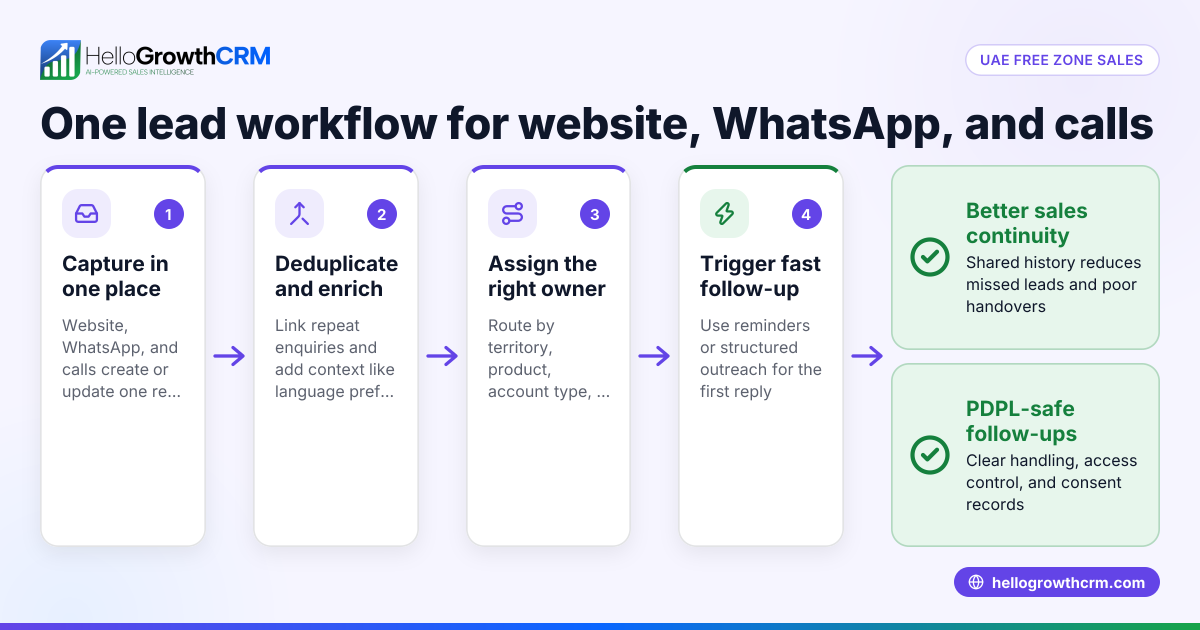
Bilingual lead routing and follow-up rules work best in the UAE when language preference, emirate, source, and account type are captured at lead entry, then used to trigger the right owner, template, SLA, and channel sequence automatically inside the CRM.
Here is a simple operating model:
| Workflow element | Recommended UAE rule | HelloGrowthCRM setup |
|---|---|---|
| Lead language | Required field: Arabic, English, Unknown | Form mapping + routing rules |
| Emirate | Required for territory logic | Territory Management |
| First touch | Under 15 minutes for high-intent demo requests | Task automation + Meeting Scheduler |
| Messaging channel | Respect consent and channel preference | WhatsApp & SMS CRM |
| Rep fallback | Reassign after SLA breach | Sales Task Boards |
| Lead priority | Score by fit + intent + source | AI Lead Scoring |
| Manager visibility | Daily queue and exception alerts | Slack alerts |
Example bilingual sequence
For a Dubai inbound lead from a demo form:
- Send instant English confirmation email.
- If language is Arabic, send Arabic WhatsApp template after consent check.
- Create a call task for the assigned rep within 15 minutes.
- If no contact in 4 hours, notify manager.
- If no meeting booked in 48 hours, trigger a second sequence.
In one Sharjah deployment, we found reps were manually translating messages on the fly. That slowed response time and created inconsistent tone. Pre-approved Arabic and English templates fixed it in one week.
How to build AED pipeline forecasting inside HelloGrowthCRM: Step-by-Step
Building AED pipeline forecasting inside HelloGrowthCRM means standardising stages, probabilities, close dates, currency fields, owner accountability, and finance-ready account data so your forecast reflects real selling progress in Dubai, Abu Dhabi, and Sharjah instead of rep optimism or incomplete deal records.
- Define stage exit criteria
Write one rule for each stage. Example: a deal cannot enter Proposal until pain, buyer role, expected value, and next meeting are logged. - Set default probabilities by stage
Start simple. Use a fixed probability by stage, then refine after 60 to 90 days of real conversion data. - Force AED as the reporting currency
Let reps store source values if needed, but standardise forecast reporting in AED using Sales Forecasting. - Add forecast categories
Use pipeline, best case, and commit. Managers should review category changes weekly. - Require close date hygiene
Block stale deals from remaining in active forecast views. If a close date slips, require a reason code. - Capture billing and VAT fields early
Add legal entity name, billing address, and VAT-related customer fields at opportunity stage, not after verbal close. - Track pipeline quality, not just amount
Use tools like the Pipeline Health Score to flag aged deals, missing next steps, and weak qualification. - Review forecast by segment and emirate
Break out Dubai, Abu Dhabi, and Sharjah performance. Segment views usually reveal where stage definitions are drifting.
The metrics I would review every Monday
A good UAE forecast review should include:
- Total open pipeline in AED
- Weighted pipeline in AED
- Commit amount this month
- Stage conversion rate
- Average stage age in days
- Push rate by owner
- New meetings booked
- Uncontacted inbound leads
- Missing VAT-ready fields on late-stage deals
If you want a quick benchmark, start with the CRM ROI Calculator and compare forecast quality before and after workflow enforcement.
Common mistakes UAE B2B teams make with CRM workflows
UAE B2B teams commonly make CRM workflow mistakes when they over-collect data, skip consent design, leave language routing manual, let reps create custom stages, delay finance fields until after close, and rely on spreadsheet forecasts instead of a controlled CRM process.
The fixes are usually operational, not technical.
Mistake 1: Treating all inbound leads the same
A demo request from Abu Dhabi is not the same as a cold list import or event scan. Separate workflows by intent level and source quality.
Mistake 2: Using one pipeline for every sales motion
If you sell subscriptions, implementation services, and renewals, split the workflow. One pipeline cannot serve every motion well.
Mistake 3: Ignoring free-zone complexity
If contracts, processors, or data controllers vary by entity, record the right legal entity details in the account and opportunity.
Mistake 4: Forecasting from rep opinion only
Use stage-based rules, not “gut feel.” AI Pipeline Management and AI Deal Insights can help managers spot deals with weak evidence.
Mistake 5: No audit trail for changes
If ownership, consent, or close dates change, your CRM should log it. This is important for control and coaching.
This setup works especially well for teams under 50 reps. Above that, expect to add stronger admin governance, sandbox testing, and more formal field-level security.
Choosing HelloGrowthCRM for UAE workflow execution
HelloGrowthCRM fits UAE workflow execution when your team needs one system for lead capture, routing, bilingual outreach, call and message logging, AED forecasting, and RevOps reporting without stitching together multiple fragile tools and spreadsheets.
For UAE teams, the value is not just features. It is workflow control.
HelloGrowthCRM combines:
- AI Lead Scoring for priority routing
- Email Automation for bilingual sequences
- CRM Dialer and WhatsApp & SMS CRM for outreach
- Meeting Scheduler for fast conversion
- Revenue Attribution for source reporting
- Sales Forecasting for AED visibility
- All Integrations for finance and comms connectivity
If you are evaluating fit, review Pricing, book a Demo, or start a Free Trial. For teams with messy handoffs between marketing, sales, and finance, a structured Managed RevOps rollout is often faster than trying to clean everything up internally.
For Emirati teams that need a PDPL-aware, bilingual, AED-ready workflow, HelloGrowthCRM gives you a practical path to standardise execution across Dubai, Abu Dhabi, and Sharjah.
About the author
I’m Kareem Hassan, Sales Operations Lead at HelloGrowthCRM, with 10 years of experience in B2B SaaS revenue operations, CRM design, and pipeline governance. I have led CRM rollouts for sales teams across the GCC, including a UAE project that unified inbound routing, bilingual follow-ups, and finance handoff for a 12-person commercial team selling across Dubai and Abu Dhabi. That hands-on work shaped the checklist and field rules in this article. HelloGrowthCRM is the product I work on, so I have written this guide with that disclosure in mind.
Frequently Asked Questions
Q: What is a UAE CRM sales workflow checklist?
A: A UAE CRM sales workflow checklist is a step-by-step operating framework for capturing leads, routing them correctly, following up in the right language, keeping compliant customer records, and forecasting revenue in AED. It helps sales, RevOps, and finance teams work from one controlled process.
Q: Does PDPL affect how sales teams use a CRM in the UAE?
A: Yes, PDPL affects how UAE sales teams use a CRM by shaping what data they collect, why they collect it, who can access it, and how consent and retention are managed. In practice, that means cleaner forms, role-based permissions, and better audit trails.
Q: Do DIFC and ADGM companies need different CRM rules?
A: Yes, DIFC and ADGM companies may need different CRM rules because free-zone data protection obligations can add governance requirements beyond mainland workflows. The core sales process can stay similar, but legal review of data access, transfers, and retention is important.
Q: How should UAE teams handle Arabic and English sales follow-ups?
Frequently Asked Questions
Ready to put this into practice?
Set up your pipeline, WhatsApp follow-ups, and AI lead scoring in minutes — free, no credit card.
Try HelloGrowthCRM freeGet CRM tips in your inbox
Join thousands of sales professionals who get weekly insights on CRM strategy, AI automation, and pipeline optimization.

The HelloGrowthCRM team publishes guides on CRM strategy, AI sales tools, and revenue operations for small business sales teams.