AI Call Coach That Guides Reps in Real Time
HelloGrowthCRM's AI call coach listens to live sales calls and surfaces battle cards, objection handling tips, and next-best actions on the rep's screen — without the prospect hearing a word.
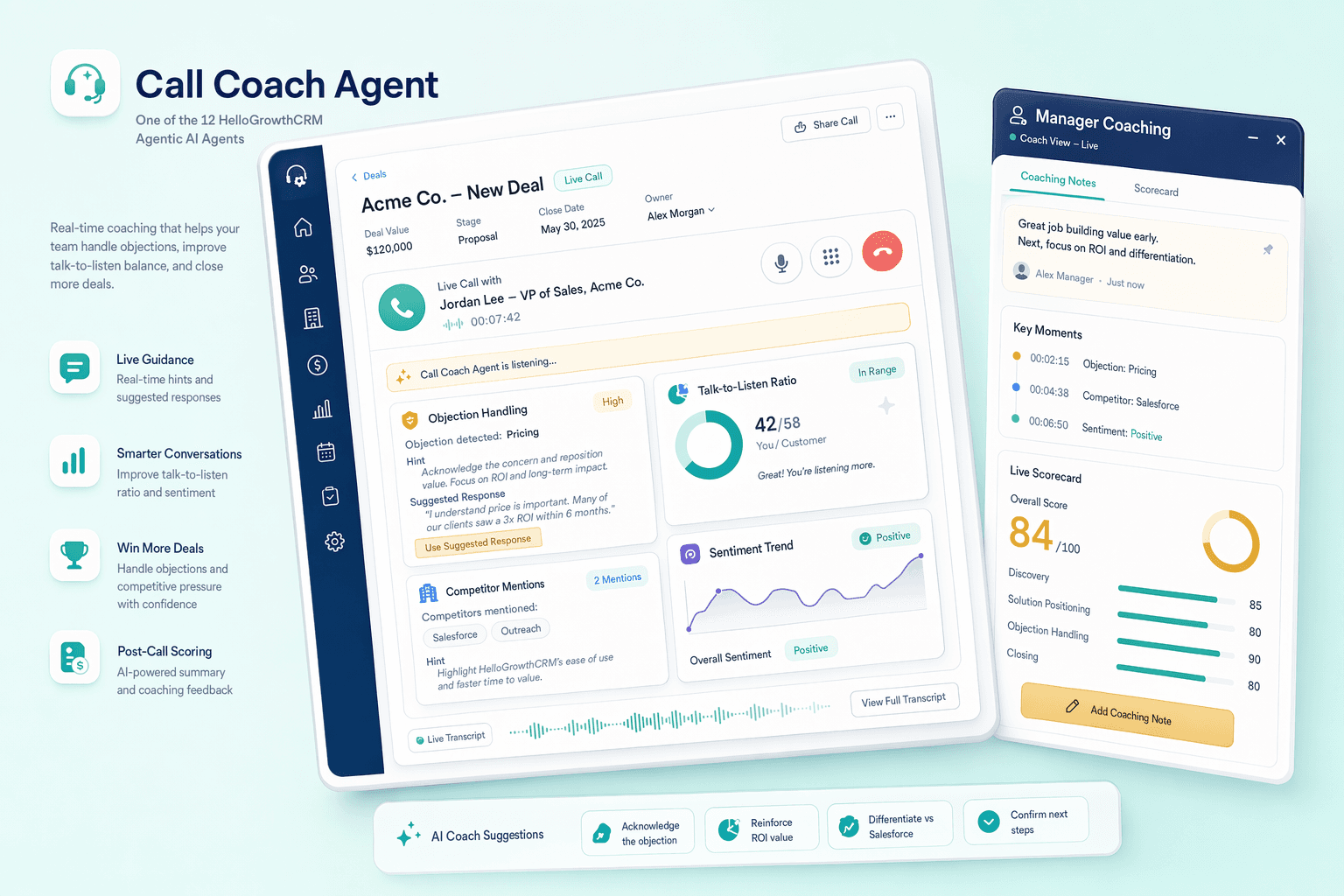
Why teams evaluate call coaching
Call Coaching usually becomes important when a repeated part of the revenue workflow is creating too much manual work, too little visibility, or too much tool-switching. Teams are rarely shopping for a feature in isolation. They are usually trying to make one meaningful workflow cleaner, faster, and easier to inspect.
That is why buyers usually look beyond the headline capability and inspect the surrounding details: Real-time coaching overlay during live calls, AI objection detection with suggested responses, Battle card triggers when competitors are mentioned, Competitor mention alerts and countering tips. Those details determine whether the feature actually improves day-to-day execution or simply adds another surface area to manage.
Where call coaching fits in the workflow
Most teams adopt this capability as part of practical motions such as new rep ramp-up, objection handling consistency, competitive deal coaching. The value tends to show up fastest when the workflow is tied to a clear owner, a clear next action, and a visible outcome that managers can review later.
It also matters how this page connects to the rest of the stack. For many teams, tools such as Twilio, Zoom, Google Meet, Salesforce are what make the feature operational instead of theoretical because they keep data, communication, and handoffs in sync.
What a strong rollout looks like for call coaching
The best rollout usually starts small: one high-value workflow, one clear ownership model, and one review rhythm for adoption. Once the team is consistently using the feature, managers can expand into deeper automation, reporting, or cross-functional handoffs without rebuilding the foundation.
In practice, that means evaluating not only what the feature can do, but also whether the team can maintain the process around it. Ease of use, reporting trust, and manager visibility matter just as much as the feature checklist itself.
- Use it first for new rep ramp-up if that is the workflow creating the most friction today.
- Use it first for objection handling consistency if that is the workflow creating the most friction today.
- Use it first for competitive deal coaching if that is the workflow creating the most friction today.
- Use it first for manager-led coaching programs if that is the workflow creating the most friction today.
How It Works
Get started in three simple steps
Key Features
Use Cases
New Rep Ramp-Up
New sales reps can lean on real-time coaching during their first 30 days to learn objection handling, positioning, and talk-track best practices while managing real opportunities.
What teams care about
- Fast adoption with less manual cleanup for managers and reps.
- Clear visibility into workflow execution, outcomes, and accountability.
- Reliable handoffs into the CRM record so downstream teams keep full context.
Deep dive
Open the sections that matter most instead of scrolling through a long uninterrupted text block.
What Is AI Call Coaching?
AI call coaching is a real-time guidance system that listens to live sales calls and delivers relevant coaching tips, battle cards, and objection responses to a sales rep's screen during the call. Unlike traditional sales coaching, which happens after the call in a meeting, AI coaching happens in the moment when the rep can actually apply it.
The system detects key moments — when objections are raised, competitors are mentioned, or pricing is discussed — and surfaces contextual guidance that helps reps close more deals.
Why Real-Time Call Coaching Improves Win Rates
Sales calls are won or lost in real time based on how reps handle objections and competitive pressure in the moment. Most reps forget objection scripts, fumble competitive counters, or miss buying signals because they are focused on the conversation itself.
Real-time AI coaching removes that cognitive load. When an objection appears, the rep sees the response. When a competitor is mentioned, battle cards appear. The rep can focus on the conversation while the AI handles the tactical guidance.
Call Coaching vs. Manual Sales Training
Traditional sales training happens in a classroom or coaching session — far removed from the actual call where reps need the guidance most. By the time a rep realizes they made a mistake, the call is over and the deal is at risk.
AI call coaching brings coaching into the moment it matters most: during the call. Reps get instant feedback, see best-practice responses in context, and improve with every call. Post-call scoring ensures that managers can also measure improvement and identify gaps for follow-up coaching.
Real-Time Coaching vs Post-Call Analysis
Most call intelligence tools are post-call tools — they transcribe the call, analyze the recording, and surface insights an hour or a day later. By then, the deal moment has passed. The Call Coach Agent operates in real time, surfacing coaching hints, talk-track suggestions, and competitive positioning directly in the rep's interface while the call is still happening. This shifts coaching from a retrospective activity into a live performance enhancer.
The agent monitors conversation flow through live transcription and identifies patterns that correlate with negative deal outcomes: rep talk-time exceeding 70% of the conversation, competitor mentions without a pre-loaded response, pricing discussions before value has been established, and objection signals without acknowledgment. When these patterns are detected, the agent surfaces the relevant battle card, talk-track, or coaching prompt — not as an interruption, but as a sidebar suggestion the rep can act on or ignore.
Manager Coaching Workflows Enabled by the Call Coach Agent
Beyond live rep coaching, the Call Coach Agent builds a coaching intelligence layer for managers. It tracks rep performance patterns across calls — which objections each rep struggles with, which conversation patterns precede their highest-converting calls, and which talk-tracks are being used vs skipped. Managers can review these patterns in aggregate to identify rep-specific coaching opportunities without listening to hours of call recordings.
The agent also flags calls for manager review based on configurable criteria: deals above a certain value where specific objections were raised, competitor mentions in large opportunity calls, or conversations where the rep's sentiment score dropped significantly. This prioritized review list means managers spend their limited coaching time on the conversations that most need attention, rather than randomly sampling from their team's call log.
AI call coaching is a real-time guidance system that listens to live sales calls and delivers relevant coaching tips, battle cards, and objection responses to a sales rep's screen during the call. Unlike traditional sales coaching, which happens after the call in a meeting, AI coaching happens in the moment when the rep can actually apply it.
The system detects key moments — when objections are raised, competitors are mentioned, or pricing is discussed — and surfaces contextual guidance that helps reps close more deals.
Buyer playbook
Compare, launch, and govern the workflow with an interactive overview instead of four long generic essays.
How teams evaluate call coaching
The best pages help buyers understand fit quickly instead of forcing them through long walls of copy.
Check whether the product covers the capabilities you actually care about, such as Real-time coaching overlay during live calls, AI objection detection with suggested responses, Battle card triggers when competitors are mentioned, Competitor mention alerts and countering tips.
Test if it supports real execution scenarios like New Rep Ramp-Up, Objection Handling Consistency, Competitive Deal Coaching.
Confirm the workflow stays connected to Twilio, Zoom, Google Meet, Salesforce so reporting and handoffs remain reliable.
Frequently Asked Questions
Explore More
Related Products
Free Tools & Calculators
WhatsApp Template Generator
Draft WhatsApp message templates for intros, follow-ups, payments and support. Free.
Lead Scoring Calculator
Build a custom scoring model with weights.
CRM ROI Calculator
Calculate the revenue impact of adopting a CRM.
Pipeline Calculator
Model your pipeline stages and conversion rates.