HelloGrowthCRM software
Built for real small-business sales teams
HelloGrowthCRM helps reps qualify faster, follow up on time, and close more deals—with practical automation in one place.
- AI lead scoring and pipeline visibility
- Built-in dialer, WhatsApp, and email automation
- Sales forecasting and RevOps-ready reporting
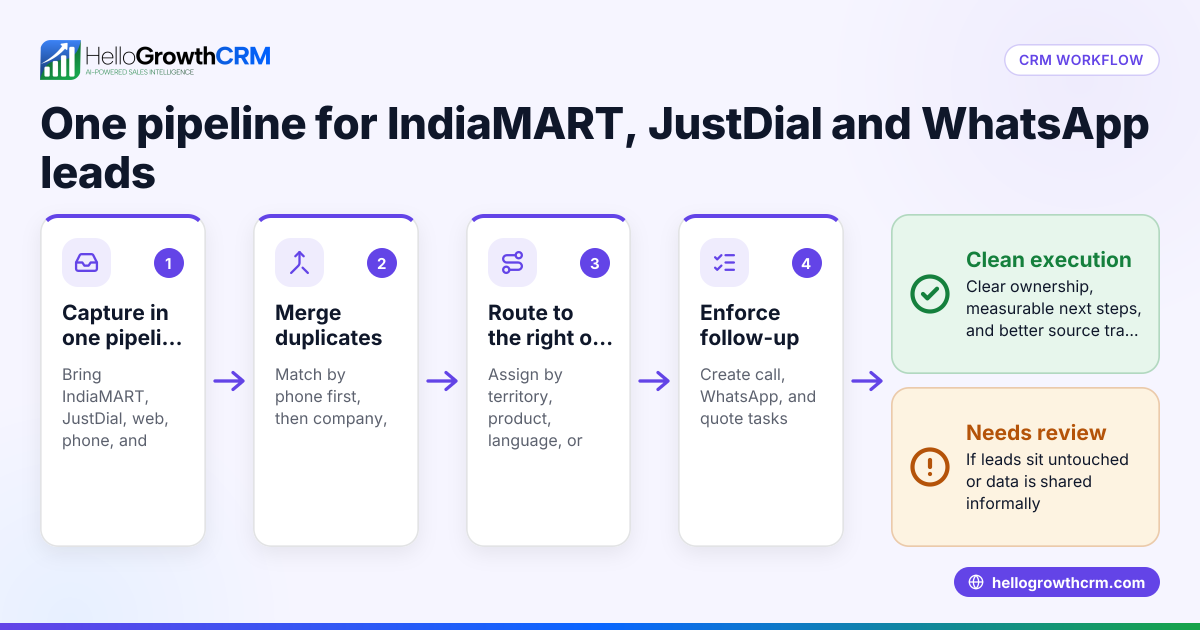
CRM lead assignment rules for IndiaMART, JustDial, WhatsApp, and website forms in India are the logic a sales team uses to route every enquiry to the right rep by territory, product, source, language, and urgency, so response time drops, ownership stays clear, and forecasting becomes reliable across Mumbai, Pune, and tier-2 markets.
Key Takeaways
- Good lead assignment rules cut response delays and stop duplicate follow-up across IndiaMART, JustDial, website, and WhatsApp.
- Indian B2B teams should route leads by pin code, city cluster, product line, language, and deal potential.
- Lead ownership must include SLAs, reassignment logic, and closed-loop updates from payments and finance systems.
- DPDPA 2023-safe handling matters when teams collect phone numbers, WhatsApp opt-ins, and enquiry data across channels.
- HelloGrowthCRM can connect lead routing with WhatsApp & SMS CRM, Revenue Attribution, Razorpay, and accounting sync for cleaner INR forecasting.
Why CRM lead assignment rules matter for Indian B2B sales teams
CRM lead assignment rules matter for Indian B2B sales teams because inbound volume from IndiaMART, JustDial, website forms, and WhatsApp often arrives unevenly, with incomplete data and high speed-to-lead pressure; structured routing prevents missed enquiries, reduces rep conflict, and creates a cleaner pipeline for forecasting and follow-up.
Many Indian SMEs still assign leads in a WhatsApp group or Excel sheet. That works until volume rises. Then three problems appear fast:
- Two reps call the same prospect
- No one calls low-data leads from marketplaces
- Managers cannot see source-wise conversion rates
In one rollout we did with a 12-person sales team selling industrial equipment in Pune and Nashik, the real problem was not lead volume. It was ownership ambiguity. IndiaMART leads were going to one inside sales rep, WhatsApp enquiries to founders, and website demos into email inboxes. The team believed they had a conversion issue. They actually had a routing issue.
That is where a structured AI CRM helps. It turns every enquiry into a standard object with source, time stamp, owner, SLA, and next action. Once that foundation is in place, AI Pipeline Management and Sales Forecasting become more accurate because the pipeline is no longer full of orphan leads.
The cost of bad assignment logic
Bad assignment logic shows up in simple ways:
- Slow first response
- Wrong rep-product fit
- No language matching
- Duplicate lead creation
- Stale opportunities with no clear owner
- Inflated forecasts
India has a special challenge here. Leads from Mumbai may need enterprise handling. Leads from Kolhapur or Coimbatore may need distributor-style follow-up. Leads from IndiaMART often need fast qualification. Leads from WhatsApp often need conversation continuity inside a shared inbox, not a personal phone.
Which lead sources need different routing logic in India?
The lead sources that need different routing logic in India are IndiaMART, JustDial, website forms, and WhatsApp because each source carries different intent, data quality, response expectations, and buyer behaviour; the best CRM rules treat them differently instead of pushing every enquiry into one generic queue.
IndiaMART leads: fast response, strong qualification
IndiaMART leads often come with broad intent. Buyers may submit multiple enquiries to many vendors. That means speed matters, but qualification matters just as much.
For IndiaMART, I usually recommend rules based on:
- Product category selected
- Buyer city or pin code
- Budget range if available
- Existing customer vs new prospect
- Response within 5 to 15 minutes during business hours
If you sell across Mumbai, Pune, Ahmedabad, and tier-2 cities, route by region first, then by product specialist. Do not send every IndiaMART lead to the nearest rep if technical knowledge is required.
JustDial leads: local territory and call readiness
JustDial leads tend to be more local and phone-first. They often need quick call attempts, not long email sequences. Pair these leads with a CRM Dialer or at least a strict callback SLA.
Best rules for JustDial usually include:
- Local territory mapping
- Language preference
- Day-part routing for calling hours
- Reassignment if first call is not logged within SLA
Website forms: richer data, better segmentation
Website leads often have better structured form fields. Use them. If your form asks for company size, use that for routing. If it asks for use case, use that for specialist assignment.
This is where AI Lead Scoring can help rank enterprise-style requests over low-fit enquiries without discarding smaller deals that matter in India.
WhatsApp leads: continuity and consent
WhatsApp leads need thread continuity. They should not live on a rep’s private device. Route them into a team inbox using WhatsApp & SMS CRM or Smart Inbox, then assign by queue rules.
India has over 500 million WhatsApp users, according to Meta's official company information and public reporting summarized by WhatsApp and industry coverage from Reuters.
WhatsApp is the default business channel for many Indian SMEs. That makes assignment design even more important.
What are the best CRM lead assignment rules for IndiaMART, JustDial, and WhatsApp in India?
The best CRM lead assignment rules for IndiaMART, JustDial, and WhatsApp in India combine source-based routing, territory ownership, skill matching, SLA triggers, and fallback reassignment, so teams can answer quickly without sacrificing lead quality, rep accountability, or forecasting accuracy.
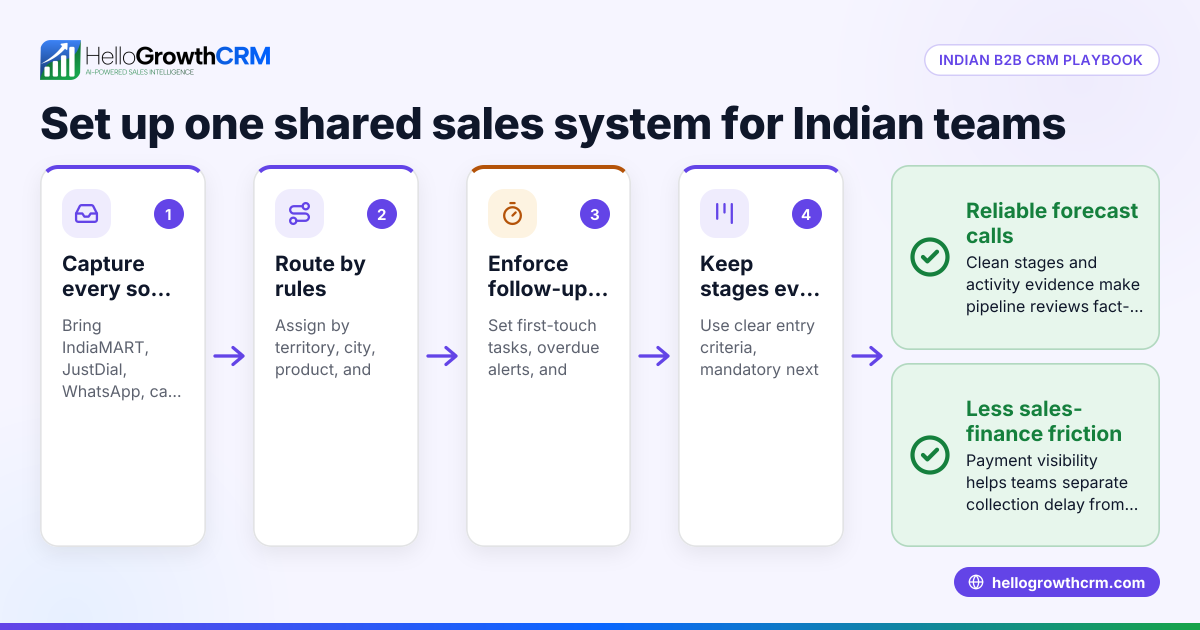
A practical rule stack for Indian B2B teams looks like this:
| Rule Type | Best Use Case | Example for Indian Teams | Risk if Missing |
|---|---|---|---|
| Source-based routing | Different handling by channel | IndiaMART to inside sales, WhatsApp to shared queue, website demo to AE pod | Same workflow for very different lead intent |
| Territory routing | Geo ownership | Mumbai metro to West team, Pune to West-2, Nagpur to central pod | Rep conflict and slow travel-based follow-up |
| Product routing | Specialist handling | ERP enquiry to product specialist, standard package to SDR | Wrong discovery and low win rate |
| Language routing | Better connection | Hindi, Marathi, Tamil, or Kannada assignment | Lower connect and weaker trust |
| Round-robin | Fair load balancing | Equal distribution within Bangalore SaaS inbound pod | Lead pile-up with one rep |
| SLA-based reassignment | Speed control | Reassign if no first call in 10 minutes | Leads go cold |
| Account ownership | Existing customer expansion | Existing Tally-connected customer goes to AM, not new business rep | Duplicate outreach |
| Payment-signal routing | Priority based on buying signal | Razorpay payment started but failed gets CS or AM follow-up | High-intent buyer gets ignored |
The minimum fields every lead should carry
Before routing, standardize these fields in your CRM:
- Lead source
- Campaign or listing source
- City
- State
- Pin code
- Product interest
- Language
- Company name
- Phone number
- Existing customer flag
- Lead score
- Owner
- First-response SLA clock
If you use HelloGrowthCRM, these can flow into Sales Task Boards, Meeting Scheduler, and AI Deal Insights so managers can see which routing rules actually improve conversion.
A practical ownership model
Use this ownership logic:
- New inbound: owned by SDR or inside sales
- Qualified opportunity: owned by AE or field rep
- Existing customer enquiry: owned by account manager
- Payment or invoice issue: owned by finance success or AM
- No response within SLA: auto-reassign to backup queue
When I have audited pipelines like this, the biggest issue is usually that ownership changes are not event-based. Teams move leads manually. That creates leakage. A CRM should change ownership when a lead hits a clear milestone, such as qualification complete, meeting booked, quote sent, or payment received.
How should Indian teams handle DPDPA 2023 and consent in lead assignment?
Indian teams should handle DPDPA 2023 and consent in lead assignment by collecting only necessary personal data, storing source and consent context, restricting access by role, and keeping communication relevant to the enquiry, especially when using phone numbers and WhatsApp for business outreach.
India’s Digital Personal Data Protection Act, 2023 creates a stronger expectation around purpose limitation, lawful processing, and responsible handling of personal data; the Ministry of Electronics and Information Technology provides the official policy framework at MeitY.
For CRM routing, this means a few simple habits matter:
- Capture source of consent or enquiry
- Record whether WhatsApp follow-up was requested or implied by the conversation context
- Restrict sensitive fields to only the teams that need them
- Avoid exporting raw lead sheets to personal devices
- Keep audit trails on owner changes and activity history
DPDPA-safe operating practices for SMEs
You do not need an enterprise privacy office to improve. Start with these controls:
- Use role-based permissions inside your CRM
- Keep marketplace leads in the CRM, not scattered spreadsheets
- Mask or limit exports where possible
- Sync approved payment and invoice fields only
- Train reps not to copy personal numbers into private WhatsApp groups
If your sales process touches payments, also stay aligned with official guidance from the Reserve Bank of India and your payment provider’s compliance standards. For many SMEs, this becomes relevant when using Razorpay data to prioritize follow-up after a payment attempt or quote acceptance.
How to build CRM lead assignment rules for IndiaMART, JustDial, and WhatsApp: Step-by-Step
To build CRM lead assignment rules for IndiaMART, JustDial, and WhatsApp, start by standardizing lead fields and source mapping, then define ownership, SLA windows, reassignment triggers, and reporting metrics, so every enquiry moves through one controlled system instead of multiple inboxes and ad hoc spreadsheets.
- Map every inbound source
List all entry points: IndiaMART, JustDial, website forms, WhatsApp, referrals, and partner leads. Connect them into one system using All Integrations or Zapier if needed. - Create one lead schema
Standardize the fields every source must populate. Even if IndiaMART gives limited data, force consistent source tags, city tags, and owner fields. - Define routing priority
Choose the order of logic. A common model is existing account first, then territory, then product, then round-robin inside the correct pool. - Set SLA rules by source
IndiaMART and JustDial usually need the fastest callback. Website demo requests may allow a longer but still strict SLA. Use tasks, alerts, and Email Automation for no-touch acknowledgements. - Build fallback reassignment
Reassign if no call, message, or qualification note is logged within the SLA. Include manager visibility and backup owner rules. - Separate lead ownership from account ownership
New enquiry ownership can sit with inside sales, while account ownership stays with the AM. This stops channel conflict for existing customers. - Connect payment and finance signals
Sync Razorpay events and accounting data where possible. If you use Tally in finance, map invoice or payment status into CRM forecasting logic, even if the sync happens through middleware or ops workflows. - Track conversion by rule
Measure speed-to-lead, qualification rate, meeting-booked rate, quote rate, win rate, and days-to-stage by source and owner group. Use Pipeline Health Score or CRM ROI Calculator to review impact.
Example rule set for a 15-rep Indian SME team
A simple setup might look like this:
- Mumbai and Navi Mumbai leads → West pod
- Pune, Nashik, Aurangabad → West-2 pod
- IndiaMART industrial product enquiries → specialist SDR queue
- JustDial local service enquiries → call-first inside sales queue
- WhatsApp messages from existing customers → account manager queue
- Payment attempt via Razorpay but no confirmation → priority follow-up queue
- No action in 10 minutes for IndiaMART/JustDial → auto-reassign
- No qualification in 24 hours → manager review
This works especially well for teams under 50 reps. Above that, expect more complex rules around named accounts, partner channels, branch offices, and capacity balancing. That is also where Managed RevOps becomes useful.
How do Razorpay signals, Tally sync, and forecasting improve lead ownership?
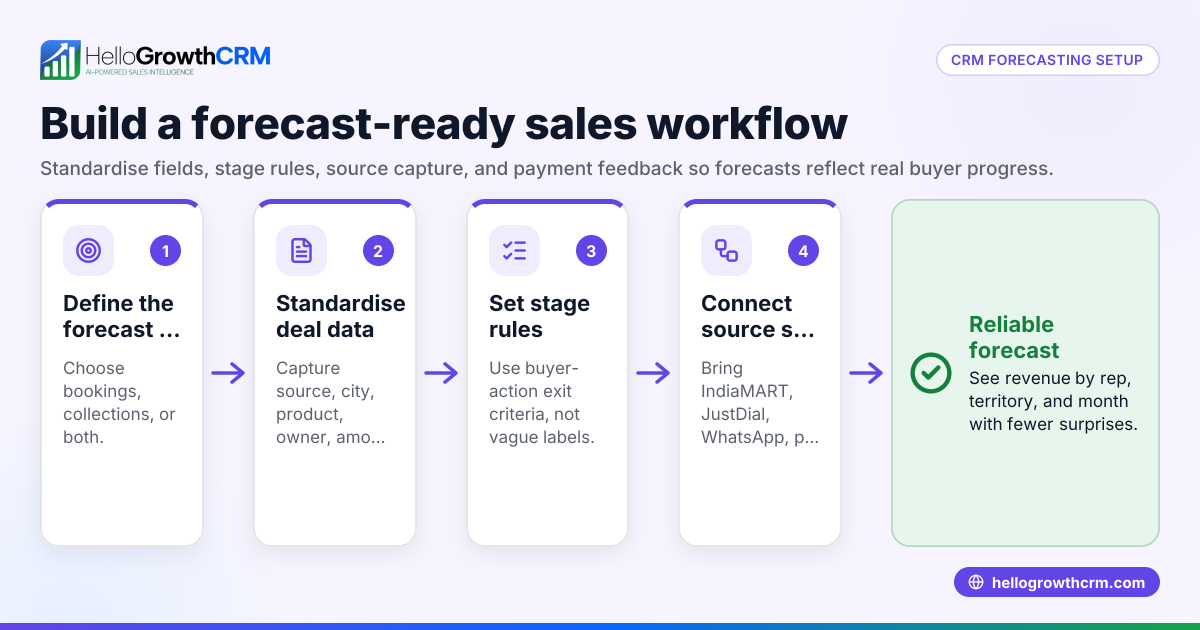
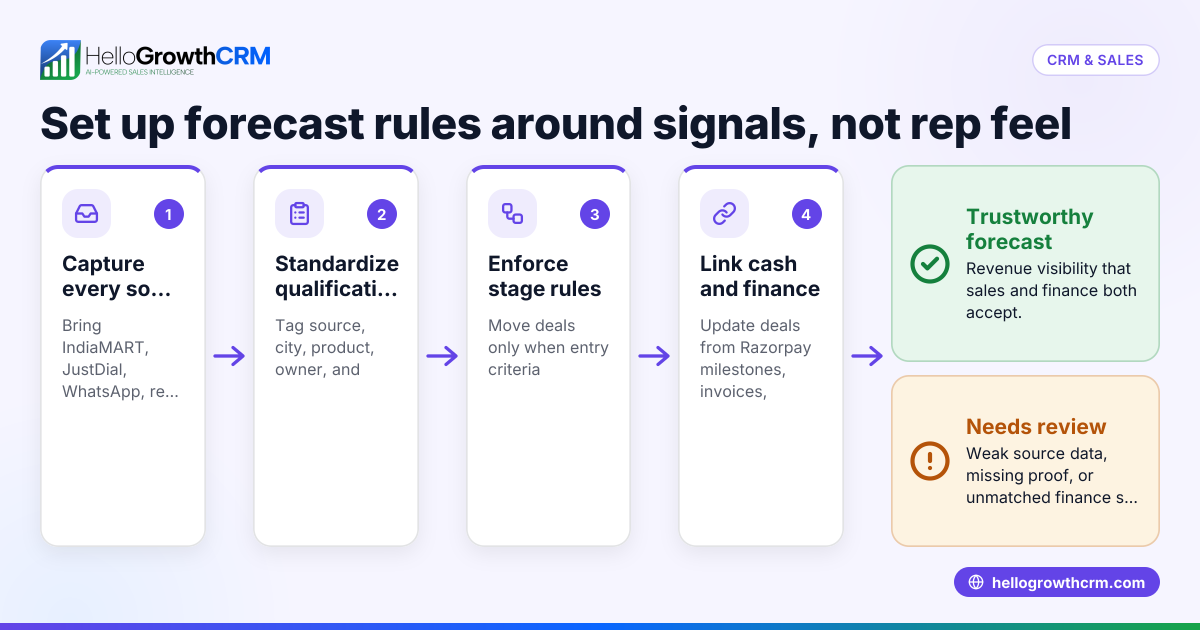
Razorpay signals, Tally sync, and forecasting improve lead ownership by connecting commercial events to CRM records, which helps teams prioritize high-intent prospects, identify payment-stage drop-offs, and build a more accurate INR forecast based on actual buying behaviour instead of rep opinion alone.
Many Indian teams treat lead management and finance as separate systems. That creates blind spots.
A better model is simple:
- Lead comes from IndiaMART or website
- Rep qualifies and sends quote
- Customer pays advance through Razorpay
- Finance records invoice in Tally
- CRM updates deal stage and expected revenue
With HelloGrowthCRM, this closed loop can support Revenue Attribution, stronger Sales Forecasting, and better next-step automation. If a buyer in Bangalore starts payment but does not complete it, that is not just a finance event. It is a sales priority signal.
Forecasting gets cleaner when ownership is clean
Forecasting breaks when:
- Leads have no owner
- Deals have the wrong owner
- Payments are not linked back to opportunities
- Existing customer expansion is mixed with cold inbound
In one manufacturing CRM cleanup project, we reduced forecast noise mainly by fixing account ownership and payment-linked stage exits. The team had been blaming rep discipline. The root issue was system design.
If you want to evaluate your current setup, start with HelloGrowthCRM’s Features, review Pricing, or book a Demo to see how lead routing, WhatsApp, and forecasting fit together for Indian sales teams.
For Indian teams selling across metros and tier-2 markets, HelloGrowthCRM gives you one place to route IndiaMART, JustDial, website, and WhatsApp enquiries, assign owners clearly, capture Razorpay buying signals, and support cleaner forecasting in INR. You can start with a Free Trial and build a lead assignment model that fits how Indian SMEs actually sell.
About the author
Arjun Mehta is a Revenue Operations Lead at HelloGrowthCRM with 11 years of experience building inbound routing, pipeline governance, and forecasting systems for B2B sales teams. He has worked with SaaS, industrial, and services companies across Mumbai, Pune, and Bangalore. One project that informed this article was a 15-rep IndiaMART-plus-WhatsApp rollout for a Pune-based SME, where structured ownership rules cut duplicate follow-up and improved source-level reporting within one quarter.
Frequently Asked Questions
Q: What are CRM lead assignment rules in India?
A: CRM lead assignment rules in India are the logic used to send each inbound enquiry to the right sales rep based on source, territory, product, language, account status, and urgency. They help Indian teams respond faster and avoid duplicate outreach across IndiaMART, JustDial, website forms, and WhatsApp.
Q: How should I assign IndiaMART leads in a CRM?
A: IndiaMART leads should be assigned in a CRM using fast SLA-based routing, then filtered by territory, product fit, and buyer quality. Most teams do best when they respond within minutes, qualify quickly, and auto-reassign untouched leads to a backup queue.
Q: How should I route JustDial and WhatsApp enquiries differently?
A: JustDial and WhatsApp enquiries should be routed differently because JustDial is usually call-first and local, while WhatsApp needs shared conversation continuity and consent-aware handling. Use territory and language rules for JustDial, and team inbox plus ownership rules for WhatsApp.
Q: What is a good lead response SLA for Indian SME sales teams?
A: A good lead response SLA for Indian SME sales teams is usually 5 to 15 minutes for high-intent inbound sources like IndiaMART, JustDial, and WhatsApp during working hours. The exact SLA depends on deal size, staffing, and whether your team sells locally or across multiple regions.
Q: How do I avoid duplicate lead follow-up across channels?
A: You avoid duplicate lead follow-up across channels by using one CRM record per prospect, matching phone and email data, and enforcing ownership plus reassignment rules. Shared inboxes, source tagging, and activity logs are essential when leads arrive through WhatsApp and marketplace listings.
Q: Is DPDPA 2023 relevant to CRM lead routing?
A: DPDPA 2023 is relevant to CRM lead routing because sales teams handle personal data like names, phone numbers, and messages that must be stored and used responsibly. In practice, that means capturing source context, limiting access, and keeping lead data inside approved systems.
Q: Can Razorpay and Tally data improve lead assignment?
A: Razorpay and Tally data can improve lead assignment by showing which enquiries have moved closer to revenue and which accounts need the right owner next. Payment attempts, invoice status, and customer records make prioritization and forecasting much more reliable.
Q: Which CRM is best for Indian teams using IndiaMART, JustDial, and WhatsApp?
A: The best CRM for Indian teams using IndiaMART, JustDial, and WhatsApp is one that combines source-based routing, shared WhatsApp handling, SLA automation, and INR-friendly forecasting in one workflow. HelloGrowthCRM is built for this use case, but teams should still validate fit based on process complexity and rep count.
Frequently Asked Questions
Ready to put this into practice?
Set up your pipeline, WhatsApp follow-ups, and AI lead scoring in minutes — free, no credit card.
Try HelloGrowthCRM freeGet CRM tips in your inbox
Join thousands of sales professionals who get weekly insights on CRM strategy, AI automation, and pipeline optimization.

The HelloGrowthCRM team publishes guides on CRM strategy, AI sales tools, and revenue operations for small business sales teams.