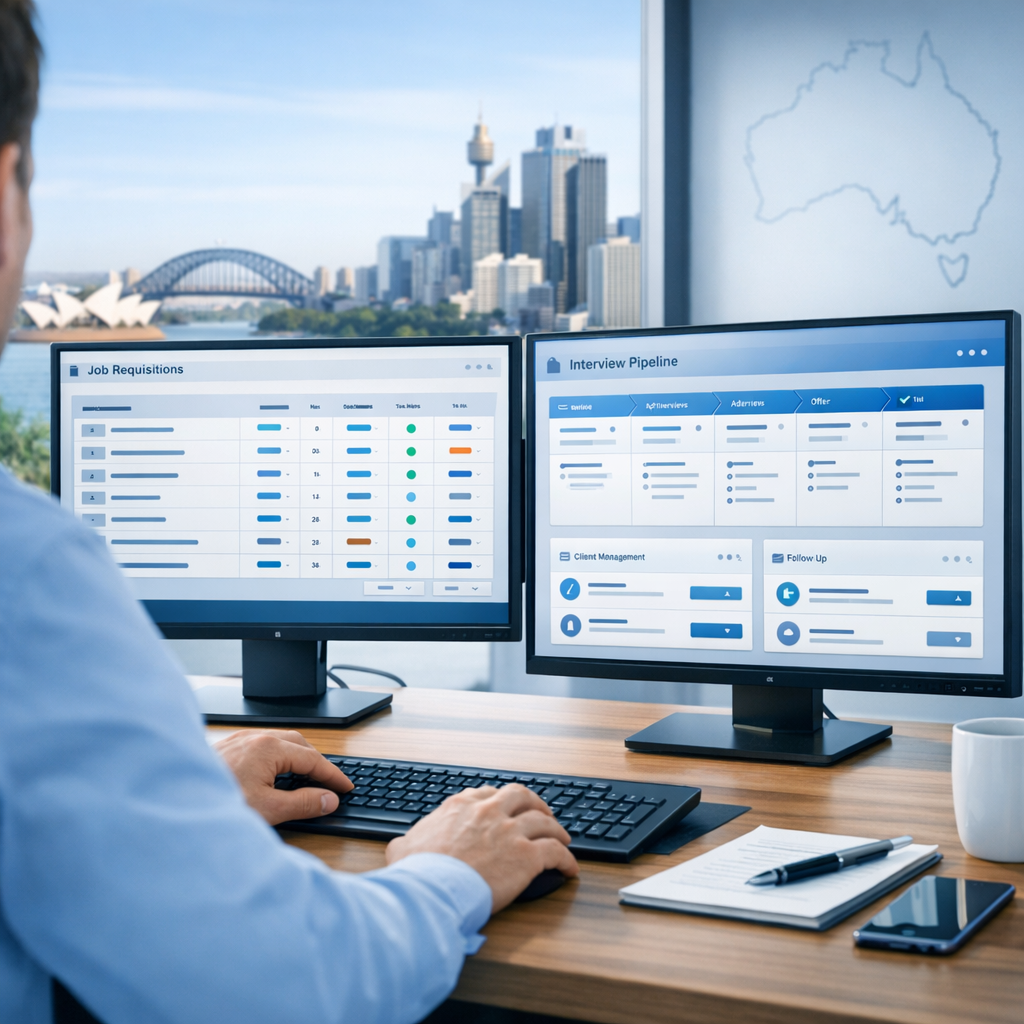
HelloGrowthCRM software
Built for real small-business sales teams
HelloGrowthCRM helps reps qualify faster, follow up on time, and close more deals—with practical automation in one place.
- AI lead scoring and pipeline visibility
- Built-in dialer, WhatsApp, and email automation
- Sales forecasting and RevOps-ready reporting
A crm for new zealand recruitment agencies is a recruitment-focused customer relationship management system that helps Auckland and Wellington firms manage employer job orders, candidate records, submissions, interviews, placements, outreach consent, and billing in one place while staying aligned with New Zealand compliance and reporting needs.
Key Takeaways
- Recruitment agencies need one system for employers, candidates, jobs, submissions, interviews, and placement revenue.
- In New Zealand, CRM setup should reflect the Privacy Act 2020 and the Unsolicited Electronic Messages Act for outreach.
- HelloGrowthCRM helps agencies centralise recruiter workflows, automate follow-up, and keep reporting clear in NZD.
- Xero sync matters for placement invoicing, contractor billing, and finance visibility across Auckland and Wellington teams.
- Agencies growing through NZTE and export-led hiring need better territory, pipeline, and client-account reporting.
- The best CRM for recruitment is not just a database. It must support workflow, compliance, and recruiter speed.
Why recruitment agencies in New Zealand need a specialised CRM
A recruitment agency in New Zealand needs a specialised CRM because general-purpose sales tools rarely handle job orders, candidate shortlists, interview stages, placement dates, and compliant candidate outreach in one workflow. Recruiters need a system that treats both employers and candidates as active relationships, not just static contacts.
Recruitment has a dual-pipeline model. You are managing demand from hiring companies and supply from candidate pools at the same time. That creates more moving parts than a standard B2B sales process.
A practical setup for Auckland agencies usually needs:
- employer account records
- hiring manager contacts
- job orders and vacancies
- candidate profiles and CV history
- submissions and shortlist tracking
- interview scheduling
- offer and placement stages
- post-placement check-ins
- invoicing and finance handoff
When I have audited pipelines like this, the biggest issue is not lead volume. It is record fragmentation. One recruiter keeps notes in email. Another stores CVs in shared folders. A third tracks interview outcomes in spreadsheets. That slows response time and creates compliance risk.
HelloGrowthCRM brings those workflows into one place through core Features, recruiter-friendly Smart Inbox, Meeting Scheduler, and Sales Task Boards. For agencies that want AI support, the platform’s AI CRM and AI Pipeline Management help teams prioritise the next best action across job, client, and candidate pipelines.
What makes recruitment CRM different from standard sales CRM
Recruitment CRM is different because one deal can involve multiple people, milestones, and compliance checks before revenue lands.
For example, a commercial recruitment desk in Auckland may open one role for a logistics employer, source 18 candidates, submit 5, coordinate 3 interviews, manage 1 offer, and invoice after placement. A basic contact pipeline does not model that well.
Recruitment agencies also need:
- searchable talent pools
- source tracking by channel
- CV and note history
- candidate ownership rules
- activity logging across calls, SMS, WhatsApp, and email
- placement-based revenue forecasting in NZD
How HelloGrowthCRM supports the full recruitment workflow
HelloGrowthCRM supports the full recruitment workflow by connecting employer acquisition, job intake, candidate matching, interview coordination, placement tracking, and post-placement follow-up inside one revenue system. That helps New Zealand agencies reduce admin, improve recruiter response times, and keep finance and compliance records more consistent.
The key is to map recruitment work to clear pipeline objects. Employer accounts sit at the top. Job orders become active opportunities. Candidate submissions become measurable progression events. Placements become revenue outcomes.
Job order intake and client account management
Job order intake works best when agencies standardise the fields every recruiter must capture before sourcing begins.
Use structured fields such as:
- role title
- location such as Auckland CBD, Wellington, or Christchurch
- salary band in NZD
- contract or permanent type
- hiring urgency
- replacement or net-new role
- required certifications
- interviewer panel
- fee terms
- exclusivity status
With HelloGrowthCRM, agencies can store employer contacts, track communication history, and use Proposal Builder for retained or exclusive search agreements. Account owners can also use Territory Management to split Auckland, Wellington, and South Island patches more cleanly.
Candidate submissions and shortlist management
Candidate submissions need version control, ownership, and speed. That is where many firms lose time.
In one rollout we did with a 12-person sales team that also handled recruitment-style submissions, the biggest gain came from standardising stage entry criteria. A submission only moved forward after CV, salary expectation, work rights, and availability were captured in mandatory fields. That cut rework fast.
HelloGrowthCRM helps recruiters:
- track candidate source and status
- log calls with CRM Dialer
- send sequences through Email Automation
- manage mobile-first follow-up via WhatsApp & SMS CRM
- prioritise candidates with AI Lead Scoring
For hiring teams, that means cleaner shortlists and fewer back-and-forth emails.
Compliance for candidate and client outreach in New Zealand
Compliance for candidate and client outreach in New Zealand means agencies must collect, store, use, and message personal information in ways that align with the Privacy Act 2020 and the Unsolicited Electronic Messages Act. A recruitment CRM should support lawful contact, preference management, and auditable communication history.
This is where many agencies need a more deliberate process. Recruitment often moves quickly. But fast outreach does not remove legal obligations.
The Office of the Privacy Commissioner explains that the Privacy Act 2020 sets rules for collecting, using, and disclosing personal information in New Zealand. The Department of Internal Affairs states that the Unsolicited Electronic Messages Act 2007 regulates commercial electronic messages, including email and text outreach.
Practical compliance controls recruiters should build into CRM
A compliant setup should include:
- consent or contact basis fields
- source-of-data tracking
- candidate communication preferences
- unsubscribe handling
- email and SMS opt-out recording
- data retention review dates
- recruiter notes on lawful purpose
Auckland agencies often run mixed workflows. Some candidates apply directly. Others come from referrals, LinkedIn, events, or talent pools built over years. CRM records should show how contact data entered the system.
This works especially well inside HelloGrowthCRM when outreach runs from one logged workspace instead of disconnected personal inboxes. Teams can use Gmail, Slack, and Twilio connections to keep records centralised. If your agency operates with outbound playbooks, use Follow-Up Cadence Builder before activating automations.
Limits and risk areas to watch
This approach works well for teams under 50 recruiters. Above that, expect more work on role-based permissions, data governance, and audit policies.
Also, CRM helps with process. It does not replace legal advice. If your agency handles sensitive candidate data or cross-border hiring, review your workflows against New Zealand privacy guidance and your own counsel.
Managing interviews, placements, and post-placement follow-up
Managing interviews, placements, and post-placement follow-up in one CRM helps recruitment agencies reduce missed handoffs, improve hiring manager visibility, and protect placement revenue. The best systems track each stage clearly, assign owners automatically, and trigger follow-up tasks after start date, not just before it.
A placement is not the end of the workflow. It is the start of service delivery, retention monitoring, and often future account expansion.
Interview coordination and stakeholder communication
Interview coordination gets messy when recruiters use calendars, email threads, and notes in separate tools.
HelloGrowthCRM simplifies that through Meeting Scheduler, Google Meet, and Microsoft Teams integrations. Recruiters can track interview rounds, panel notes, candidate feedback, and next-step tasks from one record.
Useful interview fields include:
- round number
- interviewer names
- format: phone, video, onsite
- feedback due date
- decision status
- risks or objections
- expected offer date
Placement tracking and revenue visibility
Placement tracking should connect recruiter activity to real revenue. That matters for desk performance and management reporting.
Statistics New Zealand reports there were 546,732 enterprises in New Zealand in 2024. That creates a broad employer base for specialist agencies, but it also means account segmentation and recruiter focus matter.
With HelloGrowthCRM, agencies can use Sales Forecasting and Revenue Attribution to report on:
- active job orders
- shortlist-to-interview conversion
- interview-to-offer conversion
- offer-to-placement rate
- placement value in NZD
- recruiter billings by month
- client lifetime value
Post-placement follow-up can also run through task automation. Typical checkpoints include week one, day 30, day 90, and post-probation review.
HelloGrowthCRM vs generic CRM for NZ recruitment agencies
HelloGrowthCRM vs generic CRM for NZ recruitment agencies comes down to workflow fit, speed, and compliance visibility. Generic CRM tools can store contacts, but they often need heavy customisation to support recruitment pipelines, candidate submissions, NZD placement reporting, and recruiter-specific follow-up across multiple channels.
HelloGrowthCRM is our product, so that is worth stating clearly. The advantage is not that every agency needs more software. The advantage is having one system that mirrors how recruiters actually work.
| Requirement | Generic CRM | HelloGrowthCRM for recruitment agencies |
|---|---|---|
| Employer and candidate records | Often split or awkward to model | Easy to manage as linked records and pipelines |
| Job order workflow | Requires custom setup | Fits structured job intake and stage tracking |
| Candidate submission tracking | Usually manual notes or custom fields | Built for activity, status, and follow-up visibility |
| Outreach across email, SMS, and calls | Often separate tools | Unified with Email Automation, CRM Dialer, and WhatsApp & SMS CRM |
| NZD revenue reporting | Possible but generic | Clear placement and forecast reporting in NZD |
| Xero finance sync | Often middleware-dependent | Strong fit through QuickBooks alternatives and All Integrations, with Xero-style finance workflows supported via connector setup |
| AI support | Varies | Built-in AI Sales Copilot and AI Deal Insights |
| RevOps support | Usually self-serve only | Optional Managed RevOps help |
Where generic CRM can still work
Generic CRM can work for solo recruiters or very small firms with simple permanent placement workflows.
But once you have:
- multiple recruiters
- shared talent pools
- finance handoffs
- outbound cadences
- branch reporting
- compliance reviews
you usually need more than a contact database.
How to set up a CRM for New Zealand recruitment agencies: Step-by-Step
Setting up a CRM for New Zealand recruitment agencies means mapping your client and candidate workflow first, then configuring records, stages, automations, reporting, and compliance controls so recruiters can move from job intake to placement and invoicing without jumping between inboxes, spreadsheets, and disconnected finance tools.
- Define your core record types
Set up employer accounts, hiring manager contacts, candidates, and job orders. Keep naming rules consistent so Auckland and Wellington teams report the same way. - Build stage-based pipelines
Create stages for intake, sourcing, submission, interview, offer, placement, and follow-up. Use measurable entry criteria for each stage. - Capture mandatory compliance fields
Add fields for consent basis, source, communication preferences, and work eligibility. This supports Privacy Act and outbound review needs. - Connect recruiter communication tools
Link inboxes and channels through Gmail, WhatsApp, and calling tools so activity logs to one record. - Automate follow-up and reminders
Trigger tasks after submissions, interviews, offers, and start dates. This helps reduce dropped candidates and forgotten client updates. - Connect finance workflows
Map placement fees, invoice triggers, and payment status. If your team uses finance connectors and billing workflows, review your CRM ROI Calculator assumptions before rollout. - Set up reporting in NZD
Build dashboards for recruiter billings, job fill rate, stage conversion, and average days to placement. Use branch filters for Auckland, Wellington, and Christchurch. - Pilot with one desk first
Start with a single practice area such as tech or industrial. Tune the process before a full agency rollout.
Where NZTE and export-led growth fit
Agencies supporting offshore expansion or export-led hiring need account planning, partner tracking, and cleaner reporting.
New Zealand Trade and Enterprise supports business growth through its official site at nzte.govt.nz. For agencies that work with fast-growing exporters, CRM should track hiring demand by market, role type, and expansion stage. That makes capacity planning more accurate.
Reporting, finance sync, and recruiter productivity in Auckland
Reporting, finance sync, and recruiter productivity matter in Auckland because agency margins depend on speed, fill rate, and accurate billing. A CRM should show which job orders are moving, which recruiters are overloaded, what has been placed, and what needs to flow into finance without manual reconciliation.
For most New Zealand agencies, Xero is the default SMB finance stack. Even if your exact workflow uses middleware, the CRM should still own the placement milestone that triggers billing.
That means your reporting should answer:
- Which clients have the highest placement value?
- Which recruiters have the best submission-to-placement ratio?
- Which job types stall most often?
- How much billed revenue is due this month in NZD?
- Which post-placement check-ins are overdue?
HelloGrowthCRM supports that visibility through Sales Task Boards, Pipeline Health Score, and RevOps Maturity Assessment. If your team needs more advanced rollout help, a Demo or Free Trial is the fastest way to see the workflow live.
For New Zealand recruitment agencies that need one system for client job orders, candidate submissions, compliant outreach, and NZD placement reporting, HelloGrowthCRM gives recruiters a practical operating layer instead of another disconnected database. If your Auckland or Wellington team is ready to centralise workflow and grow faster, start a Free Trial or book a Demo with HelloGrowthCRM today.
About the author
Liam Hart is a Sales Operations Lead at HelloGrowthCRM with 11 years of experience in B2B SaaS, RevOps, and workflow design for service businesses. He has led CRM rollouts for recruitment-style teams across ANZ, including a project that rebuilt candidate submission and post-placement tracking for a 14-user agency desk. His work focuses on pipeline design, automation, forecasting, and compliance-ready operating processes for growing revenue teams.
Frequently Asked Questions
Q: What is the best CRM for New Zealand recruitment agencies?
A: The best CRM for New Zealand recruitment agencies is one that manages employers, candidates, job orders, submissions, interviews, placements, and compliant outreach in one system. For agencies that want NZD reporting, automation, and recruiter workflows, HelloGrowthCRM is a strong fit.
Q: Can a CRM help recruitment agencies comply with New Zealand privacy and spam rules?
A: Yes, a CRM can help recruitment agencies comply with New Zealand privacy and spam rules by recording consent, contact source, preferences, and communication history. It will not replace legal advice, but it gives agencies a clearer audit trail and better process control.
Q: How does HelloGrowthCRM handle candidate submissions?
A: HelloGrowthCRM handles candidate submissions by linking candidate records, recruiter activity, submission stages, and follow-up tasks in one workflow. That helps recruiters see who was sent, when they were sent, and what action is needed next.
Q: Is HelloGrowthCRM suitable for Auckland recruitment firms with multiple recruiters?
A: Yes, HelloGrowthCRM is suitable for Auckland recruitment firms with multiple recruiters because it supports shared pipelines, account ownership, task visibility, and performance reporting. That makes it easier to manage team capacity and reduce duplicated work.
Q: Can recruitment agencies connect CRM workflows to Xero?
Frequently Asked Questions
Ready to put this into practice?
Set up your pipeline, WhatsApp follow-ups, and AI lead scoring in minutes — free, no credit card.
Try HelloGrowthCRM freeGet CRM tips in your inbox
Join thousands of sales professionals who get weekly insights on CRM strategy, AI automation, and pipeline optimization.

The HelloGrowthCRM team publishes guides on CRM strategy, AI sales tools, and revenue operations for small business sales teams.