HelloGrowthCRM software
Built for real small-business sales teams
HelloGrowthCRM helps reps qualify faster, follow up on time, and close more deals—with practical automation in one place.
- AI lead scoring and pipeline visibility
- Built-in dialer, WhatsApp, and email automation
- Sales forecasting and RevOps-ready reporting
A HelloGrowthCRM pipeline audit template is a built-in sales review workflow that helps managers and reps find stalled deals, missing next steps, weak stage hygiene, and forecast risk fast by combining required fields, stale-deal alerts, and pipeline views instead of relying on custom reports or spreadsheet audits.
Key Takeaways
- HelloGrowthCRM’s pipeline audit template gives sales teams a repeatable way to inspect open deals without building reports from scratch.
- Required next-step fields make rep accountability visible and easier to coach.
- Stale-deal alerts help managers catch inactive opportunities before they distort forecast calls.
- Manager views show missing data, aging deals, and stage bottlenecks in one place.
- The template works best when paired with consistent stage definitions, close-date rules, and regular review cadences.
- Teams can extend the workflow with AI Pipeline Management, AI Deal Insights, and Sales Forecasting.
What is the HelloGrowthCRM pipeline audit template?
The HelloGrowthCRM pipeline audit template is a structured pipeline review workflow inside HelloGrowthCRM that flags stalled deals, missing next steps, and inconsistent opportunity hygiene so managers can clean active pipeline faster, improve forecast confidence, and standardize rep follow-through without creating manual spreadsheets or one-off dashboards.
At a practical level, this template is not just a static checklist. It is a repeatable operating view built around the way sales managers actually inspect pipeline health each week.
In HelloGrowthCRM, the workflow usually includes:
- a required next-step field on every active opportunity
- stale-deal rules based on last activity or stage age
- manager filters for missing follow-up actions
- close-date checks for outdated forecasts
- stage-by-stage inspection of aging and volume
- rep-level accountability views
That matters because pipeline quality problems are usually simple. Deals sit too long. Reps forget to log the next meeting. Close dates roll forward every week. Forecast categories become guesswork.
When I have audited pipelines like this for B2B SaaS teams, the first issue is rarely lead volume. It is almost always poor opportunity hygiene. Managers think they have coverage, but half the pipeline has no clear next action.
A sales pipeline with defined stages and consistent process use helps organizations improve sales execution, according to Gartner’s CRM sales topic overview.
Why pipeline audits matter for forecast accuracy and rep accountability
Pipeline audits matter because forecast accuracy and rep accountability depend on clean, current opportunity data; when next steps are missing, close dates are stale, and inactive deals remain open, managers lose trust in pipeline coverage and spend forecast meetings debating data quality instead of coaching real deal movement.
A pipeline audit gives managers a common inspection standard. That is the real value. It turns subjective deal review into a measurable routine.
What a good audit catches early
A strong audit process surfaces issues before quarter end, including:
- deals with no scheduled next action
- opportunities with no recent customer activity
- close dates pushed multiple times
- deals stuck in one stage beyond the normal cycle
- large deals missing qualification details
- rep pipelines padded with low-probability opportunities
In one rollout we did with a 12-person sales team, managers had been running forecast calls from CRM list views plus Slack follow-ups. Once we required a next-step date and next-step note on every active deal, forecast meetings got shorter within two weeks because managers stopped asking basic status questions.
Why missing next steps are such a strong signal
A missing next step is often the clearest early warning sign in pipeline management. If a deal has no agreed action, no scheduled meeting, and no owner commitment, it is usually not advancing.
This is where HelloGrowthCRM’s Sales Task Boards, Meeting Scheduler, and Smart Inbox can reinforce the workflow. The audit template does not just expose the issue. It also helps reps act on it.
B2B sales organizations with disciplined sales process management are more likely to improve execution and forecast consistency, a theme repeatedly reinforced in practitioner research from sources like Harvard Business Review’s sales coverage.
Which HelloGrowthCRM features power the pipeline audit workflow?
The HelloGrowthCRM pipeline audit workflow is powered by a set of connected features that make pipeline gaps visible in real time, including required next-step fields, stale-deal alerts, manager views, activity tracking, and forecasting tools that turn messy opportunity lists into a consistent operating rhythm for sales leaders.
This matters because most teams do not need more dashboards. They need fewer decisions. The right workflow shows what to fix first.
Required next-step fields
This is the backbone of the template.
For every active opportunity, managers can require reps to capture:
- the next action
- the next action date
- the owner
- optional meeting or task context
That simple rule creates cleaner pipeline reviews. If a rep cannot name the next step, the deal likely does not belong in an active commit discussion.
If your team already uses Email Automation, CRM Dialer, or WhatsApp & SMS CRM, those activities also help managers verify whether the recorded next step matches real outreach.
Stale-deal alerts
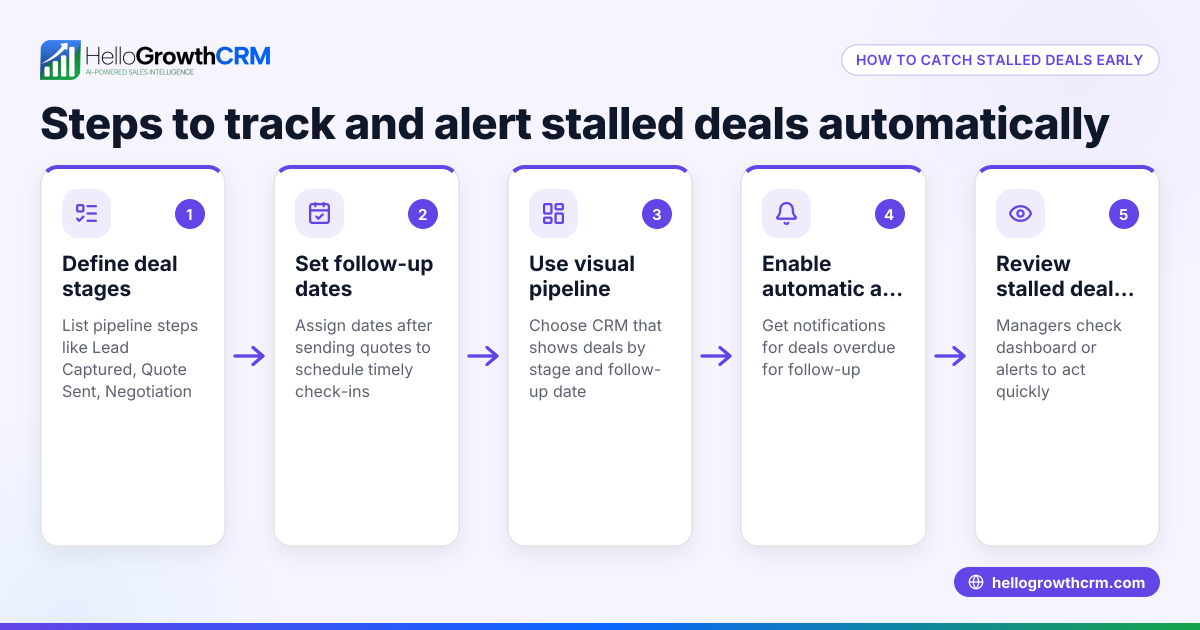
Stale-deal alerts flag opportunities that have had no meaningful activity for a set time period. Teams can define inactivity based on days since last touch, days in stage, or missing scheduled follow-up.
This is one of the fastest ways to improve forecast trust. A rep may feel a deal is still alive. The system can show that nothing has happened for 21 or 30 days.
Manager pipeline views
Manager views let leaders filter active opportunities by risk patterns such as:
- no next step
- stale activity
- overdue tasks
- missing close date updates
- oversized deal value relative to stage evidence
- rep-specific hygiene gaps
These views are especially useful for first-line managers who want action, not analysis. If you need a broader health benchmark, HelloGrowthCRM’s Pipeline Health Score and RevOps Maturity Assessment can help standardize the baseline.
Forecast and AI support
For teams that want a deeper layer, Sales Forecasting, AI Deal Insights, and Deal Risk Agent help connect audit signals to likely outcome risk. That means managers can separate “admin issues” from “real deal slippage.”
What does the template help sales managers find?
The HelloGrowthCRM pipeline audit template helps sales managers find the exact gaps that weaken active pipeline quality, including stalled deals, blank next-step fields, outdated close dates, inconsistent stage progression, low-activity opportunities, and rep habits that inflate forecast numbers without enough buying evidence.
Here is the key point: the template is built to help managers inspect open pipeline quickly. It is not meant to be a deep BI project.
The five most common pipeline gaps
- Stalled deals
These deals have not moved stages or seen real customer engagement within a defined time window. - Missing next steps
These opportunities show interest on paper but no concrete follow-up motion. - Stage mismatch
The deal sits in a late stage, but required proof points are missing. - Outdated close dates
The expected close date no longer reflects buyer behavior. - Activity inflation
Lots of logged touches exist, but none move the deal toward qualification or decision.
In my experience, managers often focus too much on stage count and not enough on stage quality. A pipeline with 40 “active” late-stage deals may look healthy. But if 18 have no confirmed next meeting, it is not a late-stage pipeline. It is a reporting problem.
HelloGrowthCRM vs manual pipeline audits
| Audit approach | Speed to review | Setup effort | Accountability | Forecast confidence | Best for |
|---|---|---|---|---|---|
| Spreadsheet audit | Slow | Medium | Low | Low | Very small teams |
| Custom BI report stack | Medium | High | Medium | Medium | Teams with dedicated ops support |
| HelloGrowthCRM pipeline audit template | Fast | Low | High | High | Managers who need immediate action |
This is also why many teams move from ad hoc CRM exports to a built-in workflow. The audit should live where reps already work, alongside Features, AI CRM, and your day-to-day pipeline views.
How to use the HelloGrowthCRM pipeline audit template: Step-by-Step
Using the HelloGrowthCRM pipeline audit template means setting clear opportunity rules, turning on next-step requirements, defining stale thresholds, reviewing manager views, and coaching reps on flagged deals in a weekly cadence so pipeline cleanup becomes part of normal sales execution instead of an end-of-quarter scramble.
- Define active pipeline rules
Decide which opportunities count as active. Most teams use open deals with a target close date and assigned owner. - Make next steps required
Require a next-step description and date for every deal beyond early qualification. This creates visible accountability immediately. - Set stale-deal thresholds
Choose inactivity rules by stage. Early stages may go stale after 10 to 14 days. Late stages often need tighter monitoring. - Create manager audit views
Build filters for no next step, no recent activity, overdue tasks, and aged stage duration. This becomes the weekly review dashboard. - Review by rep and by stage
Look at both views. Rep views show hygiene habits. Stage views show process bottlenecks across the team. - Coach action, not status
Ask reps to either advance, recover, or close out flagged deals. Avoid “still working on it” updates. - Tie audit results to forecast calls
Use audit findings before commit meetings. This cleans the forecast before leadership reviews it. - Refine the template monthly
Adjust stale rules, required fields, and stage definitions based on what actually predicts slippage.
If you want a faster starting point, teams often pair this workflow with the Lead Scoring Calculator, CRM ROI Calculator, and Follow-Up Cadence Builder to improve input quality around the pipeline itself.
What are the best practices for standardizing pipeline audits across teams?
The best way to standardize pipeline audits across teams is to use one shared template, enforce stage-entry criteria, require next-step fields, align stale-deal definitions to selling motion, and review the same manager views every week so reps are coached against the same operating rules.
Consistency matters more than complexity. A simple audit done every week beats a detailed audit done once a quarter.
Use stage-entry criteria, not just stage names
Many sales teams say they have a pipeline process. In reality, they have stage labels. That is not enough.
For each stage, define the minimum evidence required. For example:
- confirmed business problem
- identified economic buyer
- next meeting booked
- mutual action plan started
- proposal sent
- procurement path known
If your team uses MEDDPICC or another qualification framework, map it into the audit. This keeps managers from treating all stage-three deals as equal.
Keep thresholds realistic by segment
This workflow works especially well for teams under 50 reps. Above that, you may need separate audit templates by segment, region, or sales motion. Enterprise cycles often need different stale thresholds than SMB cycles.
Make reps own the cleanup
The audit should not become a manager-only admin project. Reps need to update the pipeline before review meetings. HelloGrowthCRM can support that through task visibility, AI Sales Copilot, and integrations like Slack, Gmail, and Calendly.
Forrester has also written about the growing importance of disciplined revenue process and buyer-aligned selling motions in modern sales organizations through its sales research and blogs at Forrester.
What should you avoid when auditing pipeline inside a CRM?
When auditing pipeline inside a CRM, teams should avoid overcomplicated custom reports, vague stage definitions, weak ownership rules, and audits that focus on data completeness without testing actual deal momentum, because those habits create cleaner dashboards without creating a more reliable forecast.
The biggest mistake is treating the audit as a reporting exercise. The goal is better decisions.
Common audit mistakes
- Too many fields: Reps stop updating the CRM if every deal needs ten mandatory inputs.
- No action standard: Managers identify issues but do not require advance, recover, or close decisions.
- Same stale rule for every stage: Early and late stages behave differently.
- No close-lost discipline: Dead deals stay open and inflate coverage.
- No management rhythm: A template alone will not fix pipeline quality.
I also recommend being clear about product context. HelloGrowthCRM is our product, so this article focuses on the workflow we believe is most practical for growth-stage B2B teams. If you already have a strong BI team and a rigid enterprise sales process, a custom reporting layer may still be useful. But many teams do not need that complexity to get better pipeline hygiene.
Why HelloGrowthCRM is a fast way to clean up pipeline without custom reports
HelloGrowthCRM is a fast way to clean up pipeline because it combines audit rules, activity visibility, manager views, and forecasting in one place, so sales leaders can spot missing next steps and stale deals quickly without stitching together exports, BI dashboards, and manual follow-up trackers.
That speed is the feature. Managers should not need RevOps support every time they want to inspect active pipeline.
HelloGrowthCRM is especially useful if you want to:
- reduce end-of-month cleanup work
- improve one-on-one pipeline coaching
- create consistent rep expectations
- tighten forecast calls
- replace spreadsheet audit habits
Because the audit workflow sits close to execution, teams can move directly from inspection to action. Reps can update tasks, send follow-ups, schedule meetings, and log progression without leaving the system. If you need broader workflow flexibility, Managed RevOps, All Integrations, and a guided Demo can help tailor the setup.
If your team is ready to stop guessing which opportunities are real, start with HelloGrowthCRM’s built-in pipeline audit workflow, explore the full Pricing, or launch a Free Trial to see how quickly you can find stalled deals and missing next steps.
About the author
Rohan Mehta is a Sales Operations Lead at HelloGrowthCRM with 11 years of experience in B2B SaaS revenue operations, pipeline management, and forecasting. He has led CRM and RevOps rollouts for growth-stage sales teams across North America, Europe, and APAC. One project that shaped this article was a pipeline redesign for a 12-rep SaaS team that cut inactive late-stage opportunities by rebuilding stage rules, next-step enforcement, and weekly manager audit views.
Frequently Asked Questions
Q: What is a pipeline audit template in HelloGrowthCRM?
A: A pipeline audit template in HelloGrowthCRM is a structured review workflow that helps teams inspect open opportunities for stalled deals, missing next steps, stale activity, and weak forecast data. It gives managers one repeatable way to review pipeline quality without relying on custom reports.
Q: How does HelloGrowthCRM find stalled deals?
A: HelloGrowthCRM finds stalled deals by flagging opportunities with no recent activity, long stage age, overdue follow-up, or outdated next steps. Managers can then filter these risks in audit views and decide whether to advance, recover, or close the deal.
Q: Why are required next-step fields important for pipeline reviews?
Frequently Asked Questions
Ready to put this into practice?
Set up your pipeline, WhatsApp follow-ups, and AI lead scoring in minutes — free, no credit card.
Try HelloGrowthCRM freeGet CRM tips in your inbox
Join thousands of sales professionals who get weekly insights on CRM strategy, AI automation, and pipeline optimization.

The HelloGrowthCRM team publishes guides on CRM strategy, AI sales tools, and revenue operations for small business sales teams.