HelloGrowthCRM software
Built for real small-business sales teams
HelloGrowthCRM helps reps qualify faster, follow up on time, and close more deals—with practical automation in one place.
- AI lead scoring and pipeline visibility
- Built-in dialer, WhatsApp, and email automation
- Sales forecasting and RevOps-ready reporting
Effective sales pipeline management is crucial for any B2B team looking to succeed in a competitive marketplace. It encompasses the processes that help track leads, monitor sales, and ultimately, close deals. Using HelloGrowthCRM, businesses can implement effective strategies to optimize their sales pipeline management. This blog will explore actionable insights on enhancing lead tracking, forecasting, and workflow automation to improve sales outcomes.
Understanding Sales Pipeline Management
Sales pipeline management refers to the systematic approach of overseeing the process of converting leads into customers. It involves several stages, from lead generation to closing the deal. Effective management of this pipeline allows businesses to:
- Track the progress of leads
- Identify potential bottlenecks
- Predict revenue more accurately
Using advanced tools like HelloGrowthCRM can significantly streamline these processes.
Key Components of an Effective Sales Pipeline
An effective sales pipeline consists of several key components. Understanding these elements will help you implement better strategies. Here are the main components to focus on:
- Lead Generation: Attract potential customers through various channels, such as content marketing and social media.
- Lead Qualification: Assess leads based on their readiness to buy and fit with your ideal customer profile.
- Sales Engagement: Conduct outreach to leads to build relationships and nurture them through the sales process.
- Closing: Finalize the deal and convert leads into paying customers.
Importance of Tracking Leads
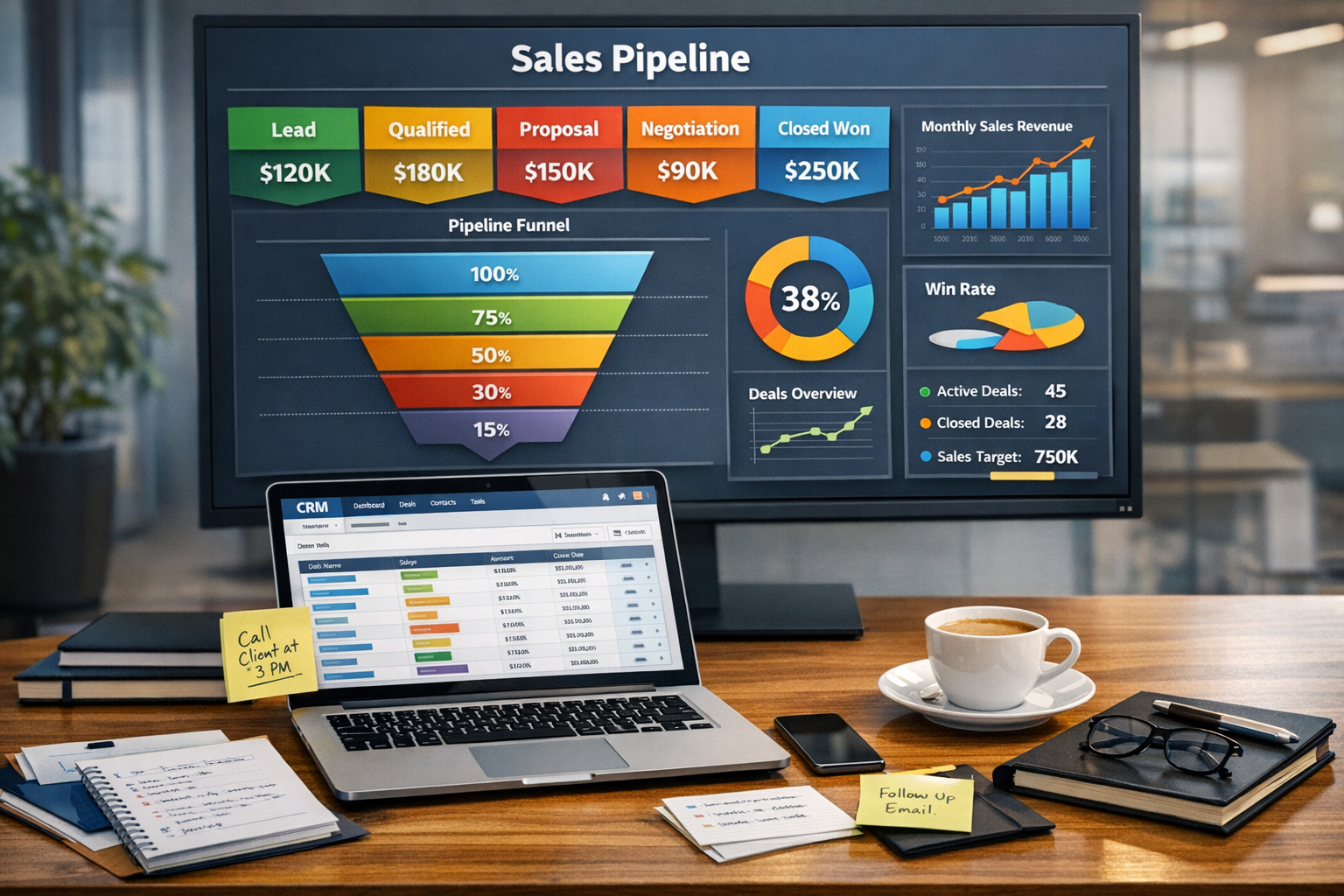
Tracking leads is essential for effective sales pipeline management. It allows sales teams to know where each prospect stands in the buying process. With tools like the Sales Task Boards, you can visualize the stage of every lead in your pipeline.
HelloGrowthCRM provides intuitive dashboards that display real-time information. You can see how many leads are in each stage. This visibility helps your sales team prioritize their efforts, ensuring that no lead is overlooked.
Optimizing Your Lead Tracking
Making lead tracking efficient is crucial for good sales pipeline management. Here are some strategies to enhance lead tracking using HelloGrowthCRM:
1. Use AI Lead Scoring
AI-driven lead scoring can categorize your leads based on their likelihood to convert. This tool assesses multiple variables, including engagement level and past interactions. Here’s how to implement it:
- Identify key metrics for your ideal customers.
- Set up the AI Lead Scoring feature in HelloGrowthCRM.
- Leverage the scoring system to prioritize outreach to high-potential leads.
2. Automate Data Collection
Collecting lead data can be time-consuming if done manually. Automate this process using HelloGrowthCRM. You can integrate with tools like Zapier to pull data from various sources. This automation lets your team focus on selling rather than data entry.
3. Maintain Clean Data
Having accurate and up-to-date information on your leads is essential. Regularly clean your CRM to remove duplicates and outdated data. Implementing Revenue Attribution will help track leads’ interactions, offering insights into their journey.
Enhancing Sales Forecasting
Accurate forecasting is essential for effective sales pipeline management. It helps you predict revenue and allocate resources more efficiently. Here are some ways to enhance your forecasting:
1. Utilize Sales Forecasting Tools
HelloGrowthCRM offers built-in Sales Forecasting features that allow you to derive forecasts from existing data. Follow these steps to improve your forecasting:
- Analyze past sales data for trends.
- Use AI-driven insights to enhance your projections.
- Regularly update forecasts based on new data.
2. Set Realistic Goals
While setting goals, ensure they are achievable. Unrealistic goals can lead to disappointment and decreased morale. Use historical data as a basis for goal-setting. This approach will make your forecasts more reliable.
3. Communicate with Your Team
Maintain clear communication with your sales team. Regularly discuss your forecasting process to keep everyone aligned. Team meetings should focus on:
- Reviewing market trends
- Discussing any changes in lead behavior
- Updating strategies based on new insights
Automating Workflows
Workflow automation streamlines sales processes and saves time. With HelloGrowthCRM, you can automate several steps in your pipeline management. Consider implementing the following strategies:
1. Set Up Email Automation
Email automation can nurture leads and keep your prospects engaged. Use HelloGrowthCRM's Email Automation to schedule follow-ups and send personalized messages. Here’s how to optimize it:
- Segment your leads based on their activity.
- Create tailored content for each segment.
- Monitor engagement metrics to adjust your approach.
2. Utilize Meeting Scheduler
Efficient scheduling is vital for maintaining momentum in the sales process. The Meeting Scheduler feature in HelloGrowthCRM can automate this task. Here’s what to do:
- Sync your calendar with HelloGrowthCRM.
- Allow leads to book meetings based on your availability.
- Send reminders to reduce no-shows.
3. Implement AI Agents
HelloGrowthCRM's AI Voice Agents can assist in handling routine queries. This allows your sales team to focus on high-impact activities. AI can:
- Answer common questions from leads.
- Schedule follow-up calls.
- Collect lead information during calls.
Reviewing Sales Performance
Continuously reviewing your sales performance is vital for improvement. Utilize HelloGrowthCRM's analytics features to track success metrics. Regular evaluations will help you:
- Identify strong and weak areas in your sales strategy.
- Adapt quickly to changing market conditions.
- Make informed decisions on resource allocation.
Key Metrics to Track
Focus on the following metrics to gauge your sales pipeline health:
- Conversion Rates: Calculate the percentage of leads that convert into customers.
- Sales Cycle Length: Assess how long it takes to close deals from the first contact.
- Average Deal Size: Monitor the average revenue generated per deal closed.
Enhancing Collaboration within Your Team
Collaboration is essential for smooth sales pipeline management. Here are strategies to enhance teamwork using HelloGrowthCRM:
1. Use Shared Dashboards
Shared dashboards provide visibility into team performance. This feature allows team members to view updates in real-time. You can establish accountability and transparency in the sales process. Use insights shared on the dashboard to celebrate successes and identify areas for improvement.
2. Integrate Communication Tools
Integrate HelloGrowthCRM with tools such as Slack or Microsoft Teams. This integration will facilitate seamless communication among team members. Quick exchanges can help address issues promptly and maintain sales momentum.
3. Conduct Regular Team Meetings
Regular team meetings can foster a collaborative environment. Use these meetings to:
- Share insights and experiences.
- Discuss potential challenges.
- Align on goals and strategies.
FAQ Section
Here are some frequently asked questions about sales pipeline management and HelloGrowthCRM.
1. What is sales pipeline management?
Sales pipeline management is the process of tracking leads, managing sales stages, and optimizing the path to closing deals. It helps organizations forecast revenue and improve workflow.
2. How does HelloGrowthCRM improve lead tracking?
HelloGrowthCRM offers tools like AI Lead Scoring and smart dashboards to track and prioritize leads effectively. Automation features further streamline data collection.
3. Why is sales forecasting important?
Sales forecasting helps businesses predict future revenue and allocate resources accordingly. Accurate forecasts ensure better planning and strategic marketing efforts.
4. What are the benefits of automating workflows?
Automating workflows saves time and reduces manual errors. Features like email automation and meeting scheduling can enhance the productivity of your sales team.
5. Can HelloGrowthCRM integrate with other tools?
Yes, HelloGrowthCRM supports multiple integrations, including tools like Zapier and Gmail, for enhanced functionality.
6. How can I get started with HelloGrowthCRM?
You can sign up for a free trial of HelloGrowthCRM to explore its features and see how it can improve your sales pipeline management.
Conclusion
Effective sales pipeline management is a game-changer for B2B teams aiming to improve their sales outcomes. With HelloGrowthCRM's advanced tools, you can optimize lead tracking, enhance forecasting, and automate key workflows. Implement these strategies to streamline your sales processes and close more deals.
Ready to take your sales pipeline management to the next level? Try HelloGrowthCRM today!
Implementation Checklist for Effective Strategies for Sales Pipeline Management Using HelloGrowthCRM
Teams researching sales pipeline management usually need more than a high-level definition. They need a repeatable process, clear ownership, and a way to connect day-to-day execution back to pipeline quality and revenue outcomes. That is why the most useful version of this topic is practical: it should help a team decide what to standardize, what to automate, and what to measure first.
Start by deciding where sales pipeline management fits in the revenue workflow. For some teams it belongs near lead qualification, because better prioritization affects who gets attention first. For others it belongs in pipeline management, because the real problem is inconsistent stage movement, poor follow-up discipline, or weak forecast confidence. The exact placement matters because it determines which records, fields, and manager reviews should change after the process is introduced.
Step-by-step rollout model
- Define the business outcome the team wants from sales pipeline management. That could be faster speed-to-lead, better conversion from demo to opportunity, cleaner qualification, or fewer stalled deals.
- Identify which team owns the process day to day. A workflow with no owner usually becomes a dashboard topic instead of an execution habit.
- Decide which fields or signals are required. Keep the list narrow enough that reps can maintain it without turning the CRM into admin overhead.
- Add automations only after the workflow is clear. Good automation reduces repetitive work, but bad automation hides process problems and makes reporting less trustworthy.
- Review performance weekly. Teams improve faster when they inspect real records, not just summary charts.
What strong teams usually standardize
- A clear definition of when a lead, account, or deal qualifies for the next step
- Required fields that support follow-up, segmentation, and reporting
- Ownership rules for handoffs, reminders, and stage progression
- Manager review checkpoints for aging, conversion, and execution quality
- An escalation path for records that are blocked, stale, or missing context
Metrics to watch after rollout
When a team implements sales pipeline management well, performance should change in ways that are visible. Look at conversion rate between stages, response time, meeting creation, pipeline age, follow-up completion, and forecast confidence. If those numbers do not move after implementation, the process may be too theoretical, too hard to use, or not connected tightly enough to how reps actually work inside the CRM.
It is also useful to separate activity metrics from quality metrics. A team can appear busy while still failing to improve outcomes. Measuring both helps leadership understand whether sales pipeline management is increasing output only, or improving the quality of decisions and follow-through as well.
How HelloGrowthCRM supports this workflow
HelloGrowthCRM is most effective when the team uses it as an operating system rather than a contact database. The platform helps centralize lead records, activity history, communication, automation triggers, reporting, and follow-up actions in one place. That matters for sales pipeline management because it reduces the gap between strategy and execution. Reps can see the context, managers can inspect progress, and leaders can connect the process back to revenue performance.
For example, a team may start with a simple scoring or qualification framework, then connect it to follow-up tasks, reporting views, internal alerts, and manager dashboards. Another team may apply the same principle to messaging, meeting scheduling, outbound sequencing, or account prioritization. In each case, the system works best when the workflow is inspectable and the next step is obvious.
Common mistakes that reduce content quality and execution quality
One common mistake is treating sales pipeline management as a one-time setup instead of an ongoing operating discipline. Teams launch the framework, create a dashboard, and assume the problem is solved. In reality, the process needs feedback loops. Inputs drift, rep behavior changes, and the market evolves. Without review, even a good workflow loses accuracy.
Another mistake is overcomplicating the first version. Teams sometimes try to capture too many fields, too many exceptions, or too many automations before the basic operating model is stable. That creates resistance and lowers adoption. A better approach is to launch the smallest version that still produces measurable decisions, then add sophistication after the team trusts the workflow.
Practical FAQ extension
How long should a team give this process before judging results?
Most teams need a few weeks of consistent use before they can evaluate whether sales pipeline management is improving execution. The exact timing depends on deal cycle length and lead volume, but a workflow should usually be reviewed across multiple reporting intervals before large conclusions are drawn.
Does sales pipeline management matter only for large sales teams?
No. Smaller teams often benefit even more because a clear workflow prevents follow-up gaps and makes performance easier to inspect without adding management layers. The key is to keep the process proportional to team size.
What is the best first improvement to make?
Usually the best first improvement is clarity. Define the next step, the owner, and the required information. Once those are stable, automation and reporting become much more valuable.
Final execution notes for Effective Strategies for Sales Pipeline Management Using HelloGrowthCRM
sales pipeline management becomes commercially valuable when it helps a team move faster with more confidence, not when it just adds vocabulary. The teams that get the best results usually connect workflow design, data hygiene, automation, and manager inspection into one rhythm. That is the lens readers should use when evaluating any approach connected to HelloGrowthCRM.
Frequently Asked Questions
Ready to put this into practice?
Set up your pipeline, WhatsApp follow-ups, and AI lead scoring in minutes — free, no credit card.
Try HelloGrowthCRM freeGet CRM tips in your inbox
Join thousands of sales professionals who get weekly insights on CRM strategy, AI automation, and pipeline optimization.

The HelloGrowthCRM team publishes guides on CRM strategy, AI sales tools, and revenue operations for small business sales teams.