HelloGrowthCRM software
Built for real small-business sales teams
HelloGrowthCRM helps reps qualify faster, follow up on time, and close more deals—with practical automation in one place.
- AI lead scoring and pipeline visibility
- Built-in dialer, WhatsApp, and email automation
- Sales forecasting and RevOps-ready reporting
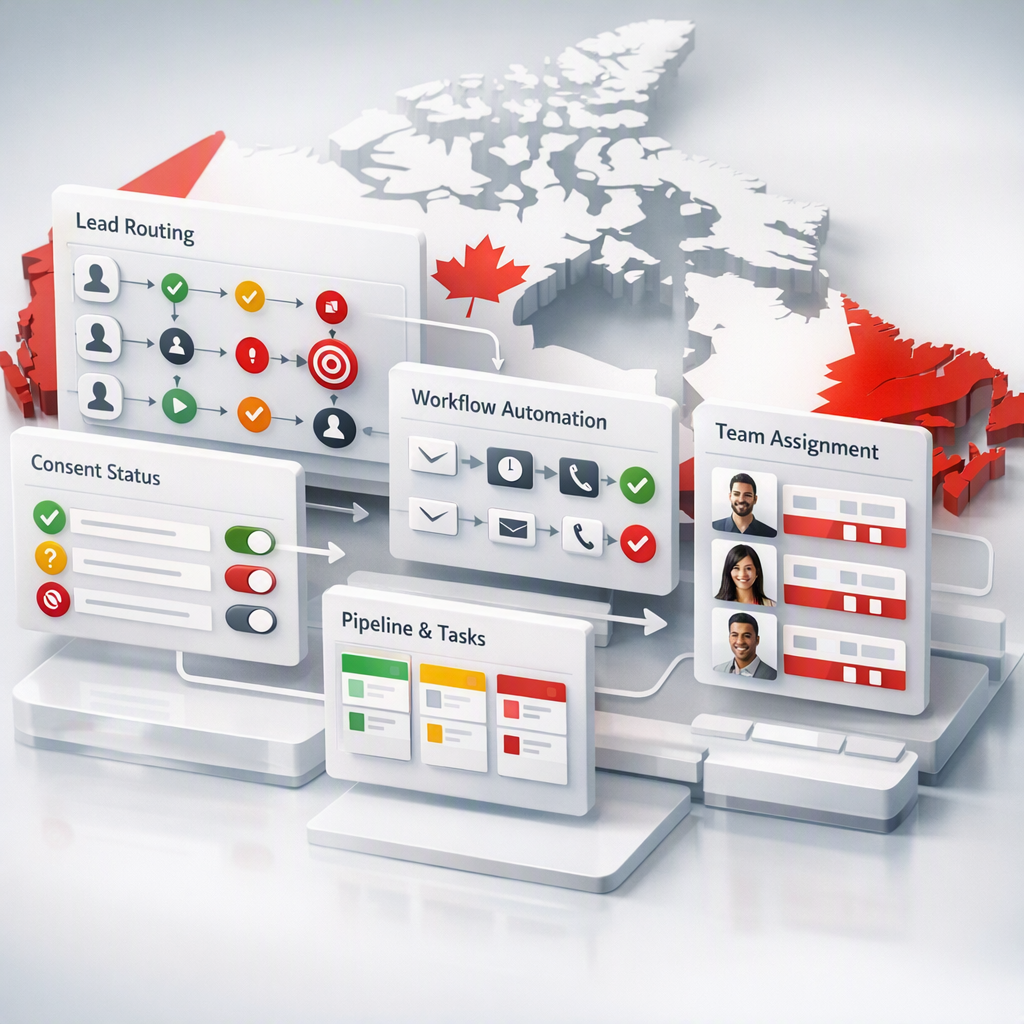
AI lead scoring for Canadian SMBs is the use of CRM-based machine learning and rules to rank, route, and follow up with prospects using Canadian compliance controls, including PIPEDA-ready data handling, Quebec Law 25 consent awareness, CASL-safe outreach logic, bilingual workflows, and CAD-friendly finance syncs.
Key Takeaways
- Canadian SMBs need lead scoring that balances speed with compliance, not just higher model accuracy.
- The best setup combines AI scoring with clear routing rules, consent status, territory logic, and finance handoffs.
- PIPEDA, Quebec Law 25, and CASL affect what data you collect and how you automate follow-up.
- Bilingual EN/FR sequences matter for Montreal teams and for national coverage across Canada.
- QuickBooks Online and Xero syncs help sales and finance agree on account status, invoices, and customer readiness.
- HelloGrowthCRM makes this easier with AI Lead Scoring, Email Automation, and AI CRM workflows built for growing revenue teams.
What is AI lead scoring for Canadian SMBs?
AI lead scoring for Canadian SMBs is a method of predicting which leads are most likely to convert, then using that score to trigger routing, outreach, and handoffs inside a CRM while respecting Canadian privacy and anti-spam rules. It works best when AI and policy rules operate together.
For most SMBs, the goal is not perfect prediction. The goal is better rep focus. A strong system helps your team answer three practical questions fast:
- Which lead should a rep call first?
- Which lead should enter an automated nurture flow?
- Which lead should wait until consent, qualification, or finance readiness is confirmed?
In HelloGrowthCRM, teams usually start with a blended model. They combine fit signals, engagement signals, and compliance signals. That means the score does not only reflect intent. It also reflects whether the lead can be contacted and by whom.
The three score layers that matter most
A simple Canadian scoring design usually includes:
- Fit score: industry, company size, province, role, revenue band, tech stack
- Intent score: page visits, form fills, email replies, meeting bookings, pricing views
- Actionability score: consent status, language preference, territory owner, duplicate risk, billing readiness
I have seen SMBs in Toronto overcomplicate this. They build 30 scoring rules before they define handoff actions. That usually fails. Start with 8-12 inputs and attach each score band to a clear next step.
Why SMBs need routing, not just ranking
A high score without routing does not create revenue. It creates another dashboard. In HelloGrowthCRM Features, the practical win comes from linking score thresholds to ownership, SLA timers, and sequence entry rules.
In one rollout we did with a 12-person sales team, the biggest gain did not come from the model itself. It came from routing demo-request leads above a score threshold directly to named account owners, while low-consent leads went to a slower nurture path with human approval.
Why do Canadian compliance rules change how lead scoring should work?
Canadian compliance rules change lead scoring because they determine what signals you can use, how you store them, when you can automate outreach, and what disclosures or consent records you must keep. For Canadian SMBs, a useful score must reflect legal actionability, not just purchase intent.
Canada is not a one-rule market. You need to think about privacy, outbound messaging, and provincial obligations together.
PIPEDA sets baseline private-sector privacy rules for many commercial activities in Canada. Quebec organizations also need to account for Law 25 controls around privacy governance, transparency, and assessments in certain cases. CASL governs much of your outbound commercial messaging and matters directly for automated follow-up.
What PIPEDA changes in practice
PIPEDA pushes teams to collect only the information they need and explain why they need it. In scoring terms, that means:
- Avoid collecting extra personal data just because the model can use it
- Define the purpose of each field and signal
- Keep audit trails for consent, source, and data updates
- Restrict who can see sensitive lead details
If your team uses Smart Inbox, Gmail, or Slack alerts, make sure only the needed contact and opportunity details flow into those channels.
What CASL changes in practice
CASL changes whether your team can trigger outbound sequences automatically. That is a routing issue, not just a legal issue.
Canada’s Anti-Spam Legislation applies to commercial electronic messages such as email, SMS, and some social messages. The CRTC explains that CASL generally requires consent for commercial electronic messages, subject to specific exceptions and conditions, and requires identification information and an unsubscribe mechanism in applicable messages. See the official CRTC summary at crtc.gc.ca/eng/internet/anti.htm.
That means your score should include:
- Consent type and date
- Source of consent
- Expiry or review date for implied consent, where relevant
- Channel permissions for email, SMS, and WhatsApp
This is why many teams pair Email Automation with WhatsApp & SMS CRM only after building channel-level permission fields.
Which data should Canadian SMBs use in an AI lead scoring model?
Canadian SMBs should use lead scoring data that is predictive, necessary, and operationally safe, including firmographic fit, buying intent, engagement recency, qualification milestones, consent status, territory data, and finance signals. The best model uses fewer high-value fields rather than many weak or risky ones.
A practical model for a 5-50 rep team does not need hundreds of variables. In fact, smaller teams often get better outcomes from a transparent scoring framework that managers can audit weekly.
Recommended scoring inputs for Canada-based teams
Here is a practical scoring framework for Toronto, Vancouver, and Montreal SMBs:
| Signal category | Example fields | Why it matters | Canadian note |
|---|---|---|---|
| Firmographic fit | Industry, employee count, province, annual revenue | Shows ICP match | Use province for territory and language logic |
| Contact fit | Job title, seniority, function | Helps qualification | Avoid storing unnecessary personal details |
| Intent | Pricing page visits, demo requests, repeat sessions | Shows buying interest | Keep source tracking clear |
| Engagement | Email reply, meeting booked, call connected | Shows real activity | Respect CASL and channel permissions |
| Qualification | Budget, timeline, use case, MEDDPICC status | Improves sales readiness | Useful for rep handoff |
| Compliance | Consent type, source, language preference | Controls safe outreach | Needed for CASL-safe sequences |
| Finance | Existing customer, unpaid invoice, quote accepted | Helps handoff timing | Sync from QuickBooks or Xero |
Add negative scoring on purpose
Most teams remember positive scoring and forget negative scoring. That is a mistake. You should reduce points for:
- Personal email domains when your ICP is B2B
- Student or consultant titles if they are not buyers
- No activity in 30-60 days
- Unsubscribed or no-consent status
- Duplicate records
- Existing customer issues that need success or finance review first
When I have audited pipelines like this, negative scoring usually fixes more rep frustration than positive scoring. It keeps low-quality leads from jumping the queue.
How should lead routing work for Toronto, Montreal, and Vancouver teams?
Lead routing for Toronto, Montreal, and Vancouver teams should use score thresholds plus geography, language, product line, and compliance status so the right rep gets the right lead at the right time. Routing works best when every path has an owner, SLA, and fallback rule.
This is where many SMBs lose speed. They assign by province alone. That ignores bilingual needs, account ownership, and lead source quality.
A practical Canadian routing model
Use a hierarchy like this inside AI Pipeline Management:
- Eligibility check: duplicate status, consent status, required fields complete
- Priority check: score band, intent spike, demo request, referral source
- Assignment rule: territory, language, segment, named account, round robin
- Follow-up rule: call task, email sequence, meeting link, nurture
- Escalation rule: reassignment if untouched after SLA window
Example routing logic by city
- Toronto: Route finance, SaaS, and professional services accounts by segment and rep capacity. High-score inbound leads should trigger Meeting Scheduler options immediately.
- Montreal: Route by French preference first, then territory. If no French-capable rep is available, assign an English-speaking owner with a bilingual template and manager alert.
- Vancouver: Route by time zone and industry cluster. For lower-intent leads, assign to SDR nurture before AE ownership.
Bilingual EN/FR workflow design
For national teams, language preference should be a core field, not a note. Set it from:
- Form selection
- Landing page language
- Email reply language
- Rep update after first conversation
Then tie language to templates, AI Sales Copilot prompts, and sequence branches. This helps Montreal coverage and improves buyer experience across Canada.
How to set up AI lead scoring for Canadian SMBs: Step-by-Step
Setting up AI lead scoring for Canadian SMBs means defining your ideal customer profile, selecting low-risk predictive signals, mapping compliance fields, building routing rules, connecting outreach and finance systems, then reviewing score quality weekly so sales, marketing, and finance trust the results.
- Define your ICP and score goal
Decide whether the score predicts meeting booked, qualified pipeline, or closed-won. For SMBs, “qualified meeting booked” is often the cleanest first target. - Create core fields
Add company size, province, language, lead source, consent type, consent date, owner, and product interest. Keep the field set tight and explain each field’s purpose. - Build a simple scorecard first
Start with 8-12 factors. Blend fit, intent, and actionability. If needed, use the Lead Scoring Calculator before you automate anything. - Set routing thresholds
Define what happens at each score band. For example, 80+ goes to a rep within 15 minutes, 50-79 enters SDR review, and below 50 enters nurture. - Connect outreach tools safely
Link Email Automation, CRM Dialer, and WhatsApp only after channel permissions are mapped. This avoids unsafe auto-sequences. - Add bilingual sequence logic
Route French-preference contacts into FR-first templates. For Quebec, add review rules for privacy notices and consent language where needed. - Sync finance status
Connect QuickBooks or All Integrations tools for invoice, customer, or quote context. This helps sales avoid pushing accounts that need finance review first. - Review model performance weekly
Check score-to-meeting conversion, SLA compliance, false positives, and rep feedback. Use Sales Forecasting and Revenue Attribution to see whether high-score leads truly drive revenue.
What does a PIPEDA-ready, CASL-safe workflow look like in HelloGrowthCRM?
A PIPEDA-ready, CASL-safe workflow in HelloGrowthCRM combines transparent data collection, consent-aware automation, role-based access, and clear audit trails so lead scoring drives revenue without exposing your team to avoidable compliance or process risk. The strongest setup links compliance fields directly to actions.
A simple workflow might look like this:
Example workflow
- Website form captures source, province, language, and consent checkbox details
- AI Lead Scoring assigns an initial score from fit and intent
- Compliance rules verify channel permissions before any sequence starts
- Routing sends the lead to Toronto, Montreal, or Vancouver coverage based on territory and language
- A rep gets a call task or sequence suggestion through Sales Task Boards
- Finance sync checks whether the company is already an active customer or has billing flags
- Managers review score quality through weekly pipeline reports
QuickBooks Online or Xero sync use cases
Finance sync is not just for invoicing. It improves lead actionability.
Use a sync to show:
- Existing customer vs net-new prospect
- Open invoice risk
- Legal entity and billing details
- Currency and CAD billing context
- Handoff readiness for proposals and onboarding
If your team sells retainers, implementation projects, or annual software contracts, this matters a lot. It keeps sales from treating every inbound account as net new when finance already has history on the buyer.
Where AI helps most
AI is most useful when it speeds decisions your team already understands. In HelloGrowthCRM AI CRM, the high-value use cases are:
- Predicting rep priority
- Suggesting next best action
- Flagging stale high-score leads
- Recommending sequence changes after replies
- Surfacing deal and account risk
This works well for teams under 50 reps. Above that, expect more work on governance, model monitoring, and territory exceptions. If you have a complex multi-brand structure, consider Managed RevOps support.
If you want a Canadian-ready setup that connects scoring, routing, outreach, and finance in one workflow, try HelloGrowthCRM with a Free Trial or book a Demo. It is built to help Canadian sales teams move faster while staying aligned with privacy and outbound requirements.
About the author
Jordan Mercer is a Revenue Operations Lead at HelloGrowthCRM with 10 years of experience helping B2B SaaS teams improve lead management, pipeline quality, and sales automation. He has led CRM and scoring rollouts for Canadian SMBs across Toronto, Montreal, and Vancouver. One project that shaped this article was a bilingual lead-routing redesign for a Quebec and Ontario sales team that needed CASL-safe sequences, French-first assignment logic, and QuickBooks Online finance handoffs.
Frequently Asked Questions
Q: What is the best AI lead scoring setup for Canadian SMBs?
A: The best AI lead scoring setup for Canadian SMBs combines fit, intent, and compliance signals so reps act on leads that are both likely to buy and safe to contact. Start simple, attach clear routing actions to each score band, and review performance weekly.
Q: Does PIPEDA affect how we score leads in a CRM?
A: Yes, PIPEDA affects how you score leads in a CRM because it influences what personal information you collect, why you collect it, and how you protect it. Use only necessary fields, document purpose, and limit access to sensitive data.
Q: How does CASL affect automated lead follow-up?
A: CASL affects automated lead follow-up by limiting when your team can send commercial electronic messages without the right consent and message requirements. Your CRM should track consent source, channel permissions, and unsubscribe status before sequences fire.
Q: Should we use AI lead scoring with bilingual English and French sequences?
A: Yes, you should use AI lead scoring with bilingual English and French sequences if you sell across Canada or cover Quebec. Language preference should influence routing, templates, and rep assignment so buyers get a consistent experience.
Q: Can QuickBooks Online improve lead scoring?
A: Yes, QuickBooks Online can improve lead scoring by adding customer status, billing context, and finance readiness to your routing logic. This helps reps avoid treating existing or at-risk accounts like brand-new leads.
Q: What score threshold should trigger sales routing?
A: The score threshold that should trigger sales routing depends on your conversion data, but most SMBs should start with three bands tied to clear actions. Use a high-priority band for fast human follow-up, a mid band for SDR review, and a low band for nurture.
Q: Is AI lead scoring worth it for a small Canadian sales team?
A: Yes, AI lead scoring is worth it for a small Canadian sales team when it reduces rep guesswork and improves follow-up speed without adding process clutter. The return is strongest when your team already has clean stages, ownership rules, and basic consent tracking.
Frequently Asked Questions
Ready to put this into practice?
Set up your pipeline, WhatsApp follow-ups, and AI lead scoring in minutes — free, no credit card.
Try HelloGrowthCRM freeGet CRM tips in your inbox
Join thousands of sales professionals who get weekly insights on CRM strategy, AI automation, and pipeline optimization.

The HelloGrowthCRM team publishes guides on CRM strategy, AI sales tools, and revenue operations for small business sales teams.