HelloGrowthCRM software
Built for real small-business sales teams
HelloGrowthCRM helps reps qualify faster, follow up on time, and close more deals—with practical automation in one place.
- AI lead scoring and pipeline visibility
- Built-in dialer, WhatsApp, and email automation
- Sales forecasting and RevOps-ready reporting
AI lead follow‑up workflows for Canadian SMBs are automated sequences that use artificial intelligence inside a CRM to respond to new leads, prioritize replies, and schedule follow‑ups while complying with Canada’s anti‑spam and privacy laws such as CASL, PIPEDA, and Quebec’s Law 25. These workflows combine AI lead scoring, automated messaging, and revenue tracking so sales teams can respond faster without violating Canadian compliance requirements.
Key Takeaways
- AI follow‑up workflows help Canadian SMBs respond to leads within minutes instead of hours or days.
- CASL requires clear consent and unsubscribe options for commercial electronic messages in Canada.
- PIPEDA and Quebec Law 25 require secure handling of personal data stored in CRM systems.
- AI tools like AI Lead Scoring and Email Automation can prioritize and automate outreach safely.
- Syncing your CRM with accounting tools like QuickBooks gives clearer revenue visibility in CAD.
- Toronto, Vancouver, and Montreal SMB teams can scale outreach without adding more SDRs.
Why Canadian SMBs Need AI Lead Follow‑Up Workflows
Most small sales teams struggle with one problem: slow follow‑ups.
When a prospect fills out a form or replies to an ad, the clock starts immediately. Research from Harvard Business Review showed that responding within an hour dramatically increases qualification rates compared with waiting longer.
For Canadian companies, the challenge is bigger. You must respond quickly while also staying compliant with regulations like the Canadian Anti‑Spam Legislation (CASL). CASL governs how businesses send commercial electronic messages, including email, SMS, and social outreach. The official guidance from the Canadian Radio‑television and Telecommunications Commission explains that organizations must have consent before sending marketing messages and must provide a clear unsubscribe mechanism.
https://crtc.gc.ca/eng/internet/anti.htm
Without automation, this creates friction.
Sales reps must manually verify consent, track communications, and maintain records for compliance. That often leads to delayed responses.
AI‑powered CRM workflows solve this by automating the entire process.
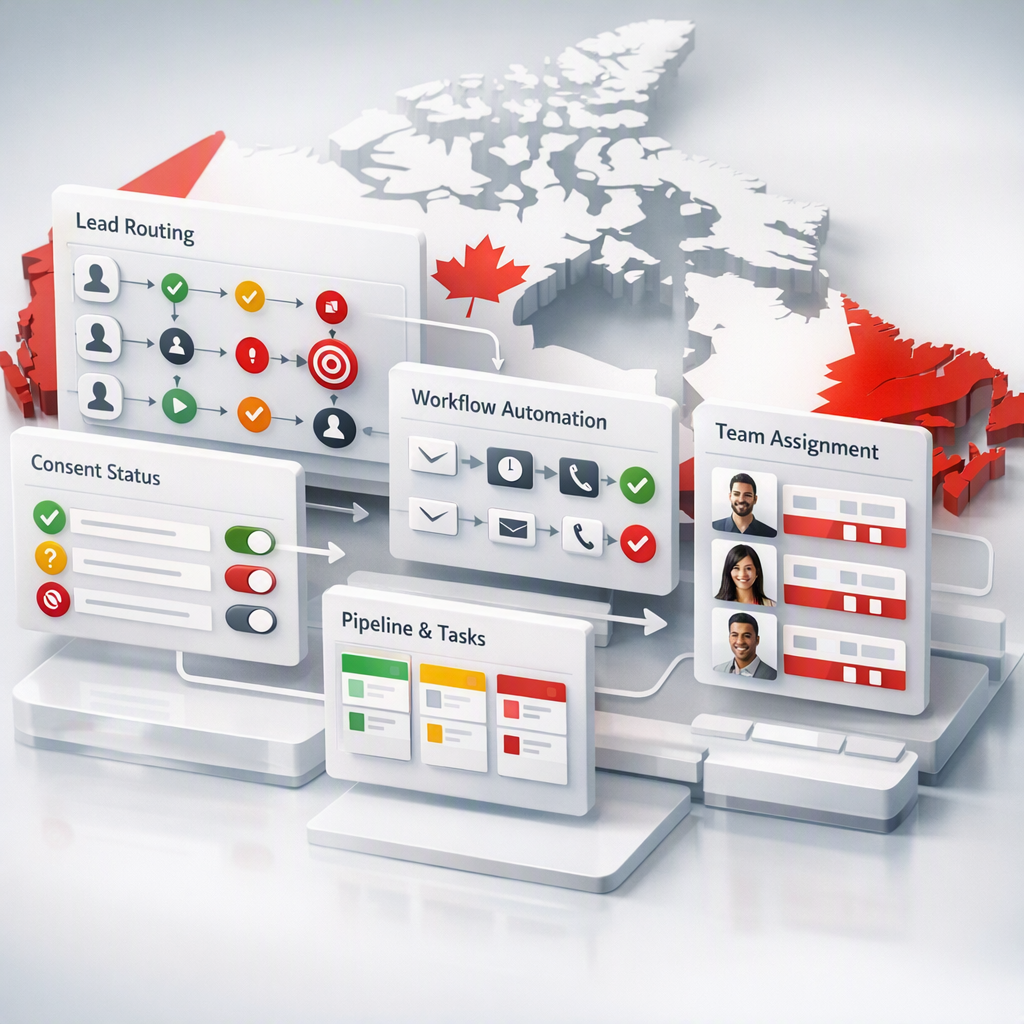
Instead of sending generic sequences, a modern AI CRM can:
- Check consent status before sending outreach
- Score incoming leads automatically
- Trigger follow‑up emails or SMS messages
- Assign hot leads to sales reps instantly
- Log every interaction for compliance audits
In practice, this lets a 5‑person Toronto sales team operate with the efficiency of a much larger organization.
Understanding CASL, PIPEDA, and Quebec Law 25
Canadian sales automation must be designed around privacy and anti‑spam compliance.
Ignoring these regulations can result in fines or reputational damage.
CASL: Canada’s Anti‑Spam Framework
CASL applies to any commercial electronic message sent in Canada. That includes:
- Email marketing
- SMS outreach
- WhatsApp business messaging
- Social media direct messages
Under CASL, companies must:
- Obtain express or implied consent
- Identify the sender clearly
- Include a working unsubscribe option
The law is enforced by the CRTC and is widely considered one of the strictest anti‑spam frameworks globally.
Automation tools must track consent and suppress messages when consent expires.
PIPEDA and Personal Data Protection
The Personal Information Protection and Electronic Documents Act (PIPEDA) governs how businesses collect and store personal data.
https://www.priv.gc.ca/en/privacy-topics/privacy-laws-in-canada/the-personal-information-protection-and-electronic-documents-act-pipeda/
This matters for CRM automation because lead follow‑up workflows store:
- Contact names
- Email addresses
- Phone numbers
- Behavioral engagement data
A compliant CRM must secure this data and allow businesses to control how information is used.
Quebec Law 25
If your customers are in Montreal or anywhere in Quebec, Law 25 adds stricter requirements.
Organizations must:
- Track consent clearly
- Provide transparency about data use
- Implement stronger governance over personal data
In practice, this means your CRM workflows should log consent status and maintain audit trails.
Platforms with strong workflow tracking, like the automation inside AI Pipeline Management, make this much easier.
What an AI Lead Follow‑Up Workflow Actually Looks Like
Many teams think automation means blasting email sequences.
That approach often violates CASL and damages deliverability.
A better approach uses AI to guide follow‑ups based on intent signals.
A typical AI workflow includes:
- Lead capture from website or ads
- AI lead scoring
- Consent verification
- Personalized outreach
- Sales rep assignment
- Meeting scheduling
- Revenue tracking
For example, a Vancouver SaaS startup might run Meta ads targeting SMB owners.
Once someone fills out a form:
- The CRM automatically verifies marketing consent.
- The system scores the lead using behavior and firmographic data.
- A personalized follow‑up email is triggered.
- High‑score leads are routed to an SDR.
- A booking link from a Meeting Scheduler is included.
Every interaction gets logged inside the CRM timeline.
This helps with compliance and also improves pipeline visibility.
How AI Lead Scoring Improves Follow‑Up Timing
Speed matters in sales, but timing matters even more.
Not every lead should get the same outreach sequence.
AI lead scoring helps prioritize who to contact first.
With tools like AI Lead Scoring, the CRM analyzes signals such as:
- Website visits
- Email engagement
- Company size
- Industry fit
- Previous conversations
Higher scores mean higher intent.
When I audited pipelines for a Vancouver SaaS company with 18 sales reps, we discovered that reps were chasing low‑intent leads while ignoring high‑intent ones.
We introduced AI scoring and automated routing.
Within three months:
- Response time dropped from 19 hours to under 45 minutes
- SQL conversion increased by 28%
This happened without hiring more reps.
AI simply ensured the right leads were followed up first.
Connecting CRM Automation with QuickBooks Online or Xero
Automation should not stop at the sales pipeline.
Canadian SMBs also need financial visibility.
That is why CRM integrations with accounting platforms matter.
Using integrations like QuickBooks, teams can automatically sync:
- Closed‑won deals
- Invoice data
- Revenue attribution
- Customer payment status
For example, a Montreal consulting firm might close a CAD $8,000 project.
The workflow can:
- Create a deal in the CRM
- Generate an invoice in QuickBooks Online
- Track payment status
- update revenue dashboards
When combined with tools like Revenue Attribution and Sales Forecasting, this gives leadership a clearer view of pipeline and revenue performance.
In one rollout we did with a 12‑person Toronto services team, integrating the CRM with QuickBooks reduced manual reporting by about 10 hours per week.
Sales reps stopped updating spreadsheets and focused on closing deals.
How to Build AI Lead Follow‑Up Workflows in a CASL‑Compliant CRM
1. Define Consent Rules
Start by mapping where consent is collected. Your forms, landing pages, and event signups must clearly capture marketing consent.
2. Capture Leads Automatically
Connect your website forms, ads, and chat tools to the CRM. Integrations like Zapier or Meta Ads can send leads directly into the system.
3. Apply AI Lead Scoring
Use AI models to prioritize incoming leads based on engagement signals and firmographic fit.
4. Trigger Personalized Follow‑Ups
Create automated messages using tools like Email Automation or WhatsApp & SMS CRM, ensuring messages include unsubscribe options.
5. Route Hot Leads to Sales Reps
High‑score leads should automatically trigger alerts or task assignments using tools such as Sales Task Boards.
6. Schedule Meetings Automatically
Use a built‑in booking link from a meeting scheduler so prospects can book calls instantly.
7. Sync Revenue Data with Accounting
Connect the CRM with accounting platforms like QuickBooks or Stripe so deals automatically convert into invoices.
8. Monitor Pipeline Health
Use analytics tools like the Pipeline Health Score to monitor deal progression and identify stalled opportunities.
Common Mistakes Canadian SMBs Make with Automation
Automation often fails for simple reasons.
Here are the most common issues I see during CRM audits.
Ignoring Consent Tracking
If your CRM does not track consent fields, your automation may accidentally send messages that violate CASL.
Over‑Automating Outreach
AI should support human conversations, not replace them completely.
Prospects still expect a real response from a sales rep.
No Revenue Visibility
Many teams automate outreach but forget to track closed‑won revenue in the CRM.
Integrating finance data fixes this.
Poor Lead Routing
When every lead goes to the same rep, response time slows.
AI routing distributes leads automatically.
Why AI CRM Is Becoming Essential for Canadian Sales Teams
The Canadian SMB market is competitive.
Toronto and Vancouver tech ecosystems are growing quickly, while Montreal has become a hub for AI companies.
Small teams must move fast.
AI CRM platforms help by automating repetitive work:
- Lead qualification
- Follow‑up reminders
- Email sequences
- meeting scheduling
- pipeline forecasting
This gives sales reps more time to build relationships.
However, automation must still respect Canadian regulations and privacy expectations.
Platforms designed with compliance and data tracking in mind are far better suited to Canadian businesses than generic automation tools.
If your team currently manages leads in spreadsheets or disconnected tools, the productivity gap becomes obvious quickly.
Start Automating Lead Follow‑Ups with HelloGrowthCRM
HelloGrowthCRM is designed for modern Canadian sales teams that need AI automation without compliance headaches. The platform combines AI lead scoring, follow‑up workflows, pipeline analytics, and accounting integrations in one place. You can explore all capabilities in the Features section or compare plans on the Pricing page.
Toronto, Vancouver, and Montreal SMB teams use HelloGrowthCRM to automate lead responses, track consent for CASL compliance, and sync revenue data with tools like QuickBooks Online. If you want to see how the workflows work in practice, start a Free Trial or request a guided Demo.
About the author
Daniel Reeves is a Revenue Operations Lead at HelloGrowthCRM with 11 years of experience building CRM systems for B2B SaaS and Canadian SMB sales teams. He specializes in pipeline analytics, AI‑driven automation, and sales process design. In 2023, he led a CRM rollout for a Toronto‑based fintech company that integrated CASL‑compliant outreach workflows with QuickBooks Online revenue tracking. His work focuses on helping small teams scale sales operations with automation while staying compliant with Canadian regulations.
Frequently Asked Questions
Q: What is a CASL‑compliant AI lead follow‑up workflow?
A: It is an automated CRM workflow that sends follow‑up messages to leads while following CASL requirements. The system tracks consent, includes unsubscribe options, and logs communications for compliance. AI prioritizes which leads should receive outreach first.
Q: Can AI automation violate CASL if used incorrectly?
A: Yes. If a CRM sends commercial electronic messages without consent or without an unsubscribe mechanism, it may violate CASL. Automation must include consent tracking and message suppression rules.
Q: Does PIPEDA affect how CRM systems store lead data?
A: Yes. PIPEDA requires businesses to protect personal information and explain how it is used. CRM systems must store contact data securely and allow organizations to manage and limit access.
Q: How does QuickBooks Online integration help sales teams?
A: Integration allows deals in the CRM to automatically create invoices or revenue records in QuickBooks. This reduces manual accounting work and gives leadership a clearer view of revenue performance.
Q: Is AI lead scoring useful for small sales teams?
A: Yes. Small teams benefit the most because AI identifies the highest‑intent leads first. This helps reps focus on deals most likely to convert instead of chasing every inquiry.
Q: Do Quebec companies need special CRM compliance features?
A: Businesses operating in Quebec must follow Law 25, which strengthens consent and data protection requirements. A CRM should track consent status and maintain audit logs of data usage.
Q: What is the fastest way to start AI lead follow‑up automation?
A: Start with a CRM that supports AI lead scoring, automated follow‑ups, and consent tracking. Platforms like HelloGrowthCRM provide these capabilities and integrate with common tools used by Canadian SMBs.
Frequently Asked Questions
Ready to put this into practice?
Set up your pipeline, WhatsApp follow-ups, and AI lead scoring in minutes — free, no credit card.
Try HelloGrowthCRM freeGet CRM tips in your inbox
Join thousands of sales professionals who get weekly insights on CRM strategy, AI automation, and pipeline optimization.

The HelloGrowthCRM team publishes guides on CRM strategy, AI sales tools, and revenue operations for small business sales teams.