Call Insights and Sentiment Analysis for Sales Teams
Understand what's happening across every sales call. Track sentiment trends, topic frequency, talk ratios, and deal risk signals — so managers can coach smarter and reps can close faster.
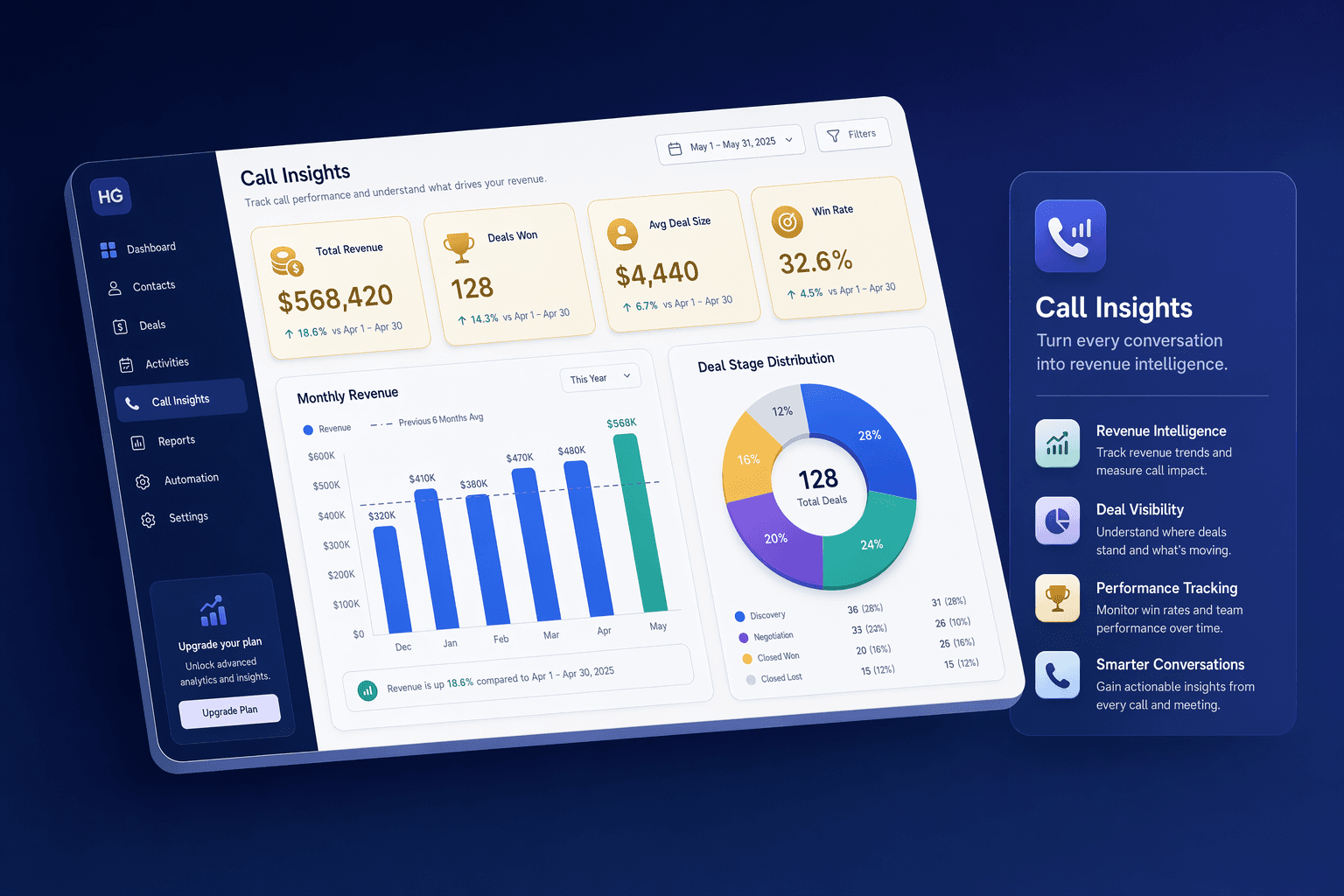
Why teams evaluate call insights
Call Insights usually becomes important when a repeated part of the revenue workflow is creating too much manual work, too little visibility, or too much tool-switching. Teams are rarely shopping for a feature in isolation. They are usually trying to make one meaningful workflow cleaner, faster, and easier to inspect.
That is why buyers usually look beyond the headline capability and inspect the surrounding details: Call sentiment analysis — positive, neutral, negative, Topic and keyword tracking across calls, Talk-to-listen ratio monitoring per rep, Call outcome prediction based on conversation signals. Those details determine whether the feature actually improves day-to-day execution or simply adds another surface area to manage.
Where call insights fits in the workflow
Most teams adopt this capability as part of practical motions such as coaching based on real data, early deal risk detection, sales methodology refinement. The value tends to show up fastest when the workflow is tied to a clear owner, a clear next action, and a visible outcome that managers can review later.
It also matters how this page connects to the rest of the stack. For many teams, tools such as Twilio, Google Meet, Zoom are what make the feature operational instead of theoretical because they keep data, communication, and handoffs in sync.
What a strong rollout looks like for call insights
The best rollout usually starts small: one high-value workflow, one clear ownership model, and one review rhythm for adoption. Once the team is consistently using the feature, managers can expand into deeper automation, reporting, or cross-functional handoffs without rebuilding the foundation.
In practice, that means evaluating not only what the feature can do, but also whether the team can maintain the process around it. Ease of use, reporting trust, and manager visibility matter just as much as the feature checklist itself.
- Use it first for coaching based on real data if that is the workflow creating the most friction today.
- Use it first for early deal risk detection if that is the workflow creating the most friction today.
- Use it first for sales methodology refinement if that is the workflow creating the most friction today.
- Use it first for team performance benchmarking if that is the workflow creating the most friction today.
How It Works
Get started in three simple steps
Key Features
Use Cases
Coaching Based on Real Data
Instead of guessing which reps need coaching, use call analytics to identify specific gaps. See which reps have high talk ratios, low engagement, or miss objections.
What teams care about
- Fast adoption with less manual cleanup for managers and reps.
- Clear visibility into workflow execution, outcomes, and accountability.
- Reliable handoffs into the CRM record so downstream teams keep full context.
Deep dive
Open the sections that matter most instead of scrolling through a long uninterrupted text block.
Why Call Analytics Transform Sales Management
Managers spend hours in one-on-ones trying to coach reps on vague gut feelings. 'You need to listen more,' or 'You're not handling objections well.' But without data, coaching is guesswork.
Call insights provide concrete data. Managers can show a rep exactly how much they talked versus listened in their last 10 calls. They can show sentiment trends and where deals are at risk. That turns coaching into a data-driven conversation.
How Sentiment Analysis Predicts Deal Outcomes
The sentiment of a sales call often predicts whether it will close. If a prospect sounds engaged and positive, the deal is likely moving forward. If sentiment is negative or declining, the deal is at risk.
AI sentiment analysis identifies these patterns automatically so managers can spot at-risk deals and take action before the deal stalls. That's more effective than waiting for a deal to be marked lost.
Talk Ratio and Sales Effectiveness
One of the most consistent findings in sales research is that reps who talk less and listen more close more deals. But most reps don't know their talk ratio and can't improve what they don't measure.
Call analytics surfaces talk ratio for every call so reps can see their patterns and adjust. Over time, reps improve their listening skills and deal win rates improve.
Managers spend hours in one-on-ones trying to coach reps on vague gut feelings. 'You need to listen more,' or 'You're not handling objections well.' But without data, coaching is guesswork.
Call insights provide concrete data. Managers can show a rep exactly how much they talked versus listened in their last 10 calls. They can show sentiment trends and where deals are at risk. That turns coaching into a data-driven conversation.
Buyer playbook
Compare, launch, and govern the workflow with an interactive overview instead of four long generic essays.
How teams evaluate call insights
The best pages help buyers understand fit quickly instead of forcing them through long walls of copy.
Check whether the product covers the capabilities you actually care about, such as Call sentiment analysis — positive, neutral, negative, Topic and keyword tracking across calls, Talk-to-listen ratio monitoring per rep, Call outcome prediction based on conversation signals.
Test if it supports real execution scenarios like Coaching Based on Real Data, Early Deal Risk Detection, Sales Methodology Refinement.
Confirm the workflow stays connected to Twilio, Google Meet, Zoom so reporting and handoffs remain reliable.
Frequently Asked Questions
What are Call Analytics and Insights?
HelloGrowthCRM's call insights go beyond recording — the AI analyses every call across your entire team and surfaces patterns that are impossible to spot manually. Talk-to-listen ratios, sentiment scores, competitor mentions, objection frequency, and next-step commitment rates are aggregated across hundreds of calls and displayed in a team analytics dashboard. Managers can identify which rep behaviours correlate with won deals and build systematic coaching to replicate them.
In most Indian sales teams, call analysis happens accidentally — a manager listens to a call randomly and gives informal feedback. HelloGrowthCRM makes call analysis systematic and scalable. Every call contributes data to the team's performance model. The insight that “deals where reps ask 5+ questions in the first call close 3x more often” comes from the actual call data of your team — not an external benchmark.
Key Capabilities
- Talk-to-Listen Ratio Analytics: Track average talk ratio per rep and compare to team benchmarks. Identify reps who talk too much (above 65%) versus those who listen too little — both patterns correlate with lower conversion rates.
- Sentiment Analysis: AI analyses emotional tone per call moment — detecting negative sentiment spikes where the prospect expressed frustration or disengagement. Negative sentiment events are flagged as coaching moments.
- Competitor Mention Intelligence: When a competitor is named in any call, HelloGrowthCRM logs the mention with context (what was said before and after). The competitor intelligence report shows which competitors come up most often and in which deal stages.
- Objection Pattern Analysis: Track which objections appear most frequently across the team, which reps handle them most effectively, and how objection frequency correlates with deal outcomes.
- Next-Step Commitment Rate: Track what percentage of calls end with a specific, time-bound next step committed. This metric is one of the highest predictors of deal progression in B2B sales.
- Discovery Question Frequency: Count the average number of discovery questions asked per call per rep. Correlate discovery question count with close rate to identify the optimal number for your sales process.
How Indian Sales Leaders Use It
- Building a Winning Call Script: A Bengaluru SaaS VP Sales analysed 3 months of call data and identified that the top 20% of reps by close rate all asked about the prospect's existing reporting process in the first 10 minutes. She added this question to the call script and saw average close rates improve across the rest of the team within 6 weeks.
- Competitor Response Playbook: A Delhi enterprise software company used competitor mention tracking to identify that HubSpot was mentioned in 40% of late-stage calls. The sales manager built a specific HubSpot objection response guide using the exact language prospects were using — improving win rates in competitive deals.
- Sentiment-Based Deal Risk Scoring: A Mumbai financial services firm uses call sentiment analysis to flag deals where multiple negative sentiment moments appeared in recent calls. These deals are added to the at-risk pipeline list and receive priority manager attention before the quarter closes.
Call insights are available on HelloGrowthCRM's Growth plan. Compare plans. Pair with AI call coaching or explore the CRM dialer to see where call data comes from.