HelloGrowthCRM software
Built for real small-business sales teams
HelloGrowthCRM helps reps qualify faster, follow up on time, and close more deals—with practical automation in one place.
- AI lead scoring and pipeline visibility
- Built-in dialer, WhatsApp, and email automation
- Sales forecasting and RevOps-ready reporting
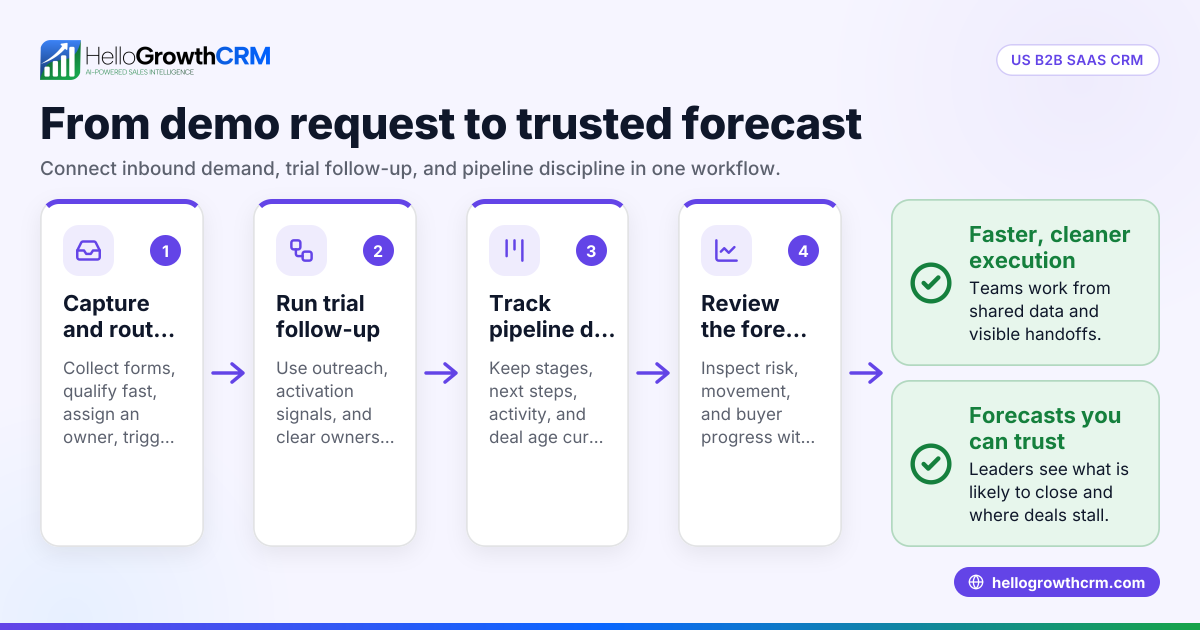
AI follow-up workflows for demo requests are automated sequences inside an AI CRM that reply to inbound demo forms in seconds, qualify buyer intent, route high-fit accounts to the right rep, and push prospects to book meetings faster without adding manual SDR work.
Key Takeaways
- AI follow-up workflows help B2B teams respond to demo requests instantly, which reduces lead decay and lifts meeting-booking rates.
- The best workflows do more than send an email. They score intent, enrich context, assign ownership, and trigger rep action.
- Strong workflow design depends on clear rules for qualification, routing, speed-to-lead, and fallback paths when prospects do not reply.
- HelloGrowthCRM fits teams that want AI-driven follow-up tied to AI CRM, AI Lead Scoring, and Meeting Scheduler in one system.
- Managed setup matters. Many teams need help mapping fields, alerts, SLA rules, and rep handoffs, which is where Managed RevOps can speed deployment.
What are AI follow-up workflows for demo requests?
AI follow-up workflows for demo requests are rule-based and AI-assisted automations that start the moment a prospect submits a demo form, then send a first response, assess intent, route the lead, and guide the buyer toward a booked meeting using personalized next steps.
In plain terms, this is the system behind “we got your request” done well.
A weak workflow sends one generic email and stops. A strong workflow does five things fast:
- Confirms receipt
- Checks fit and urgency
- Assigns the right owner
- Offers an easy booking path
- Alerts sales when human action matters
For B2B teams, this matters because demo requests are high-intent conversions. They are not top-of-funnel newsletter signups. They often come from buyers who already compared vendors, visited your Pricing page, or asked for a Demo. If your first response is slow, generic, or misrouted, you lose momentum.
In HelloGrowthCRM, the workflow can connect form capture, AI Lead Scoring, Smart Inbox, and Meeting Scheduler so reps do not need to stitch tools together manually.
Why demo-request workflows need a different design
Demo-request follow-up is different from standard nurture automation because the buyer already raised a hand. That changes both tone and timing.
The workflow should prioritize:
- Minutes, not hours
- Qualification, not long nurture
- Booking, not just engagement
- Rep visibility, not hidden automation
- Clear fallbacks for no-response cases
In one rollout we did with a 12-person sales team, the biggest issue was not email copy. It was ownership. Enterprise requests sat in a shared inbox while SMB leads were overworked by AEs. Once we added territory routing and SLA alerts, booking speed improved more than any template rewrite.
Why do AI follow-up workflows increase demo bookings?
AI follow-up workflows increase demo bookings because they remove the delay between buyer intent and seller action, personalize the first touch at scale, and make sure the right rep gets the right lead with enough context to move straight to scheduling.
Speed is the first lever. Demo-request leads cool off fast. If the reply comes hours later, the buyer may already be comparing another vendor or filling out another form.
Harvard Business Review reported that firms that tried to contact potential customers within an hour were nearly seven times as likely to qualify the lead as those that waited even an hour longer.
That principle still holds in modern B2B funnels. The exact channel mix changed, but lead decay did not.
The three booking levers that matter most
1. Response speed
Your workflow should fire immediately. That means:
- Instant confirmation email
- Instant internal notification
- Instant lead scoring
- Instant booking option
If your stack needs multiple tools to do this, delays creep in. That is why many teams evaluate unified systems through Features rather than point tools.
2. Relevance
The first message should reflect what the buyer actually asked for. If the form says “need Salesforce migration help,” the reply should not read like a generic product pitch. Context can come from:
- Form fields
- UTM source
- Company size
- Pages viewed
- CRM history
- Intent score
A connected Revenue Attribution view also helps teams see which sources drive booked meetings, not just form fills.
3. Frictionless scheduling
A workflow should reduce clicks, not add them. The fastest path is often a direct booking link matched to territory, segment, or use case. If you send buyers into a back-and-forth email loop, conversion drops.
What should an effective AI demo-request workflow include?
An effective AI demo-request workflow should include instant acknowledgment, fit scoring, lead routing, rep alerts, meeting-booking prompts, follow-up branches, and clear exit rules so every demo request gets a fast, relevant, and measurable response.
Most teams over-focus on the first email. The workflow is bigger than that.
Core workflow components
Instant acknowledgment
This confirms receipt and sets expectations. Keep it short. Tell the buyer what happens next and give them a booking option right away.
With HelloGrowthCRM, this can be powered by Email Automation and paired with a Meeting Scheduler.
AI qualification and scoring
Use explicit and implicit signals together:
- Explicit: company size, role, region, use case, budget, timeline
- Implicit: page visits, source, repeat sessions, email engagement, past activity
When I have audited pipelines like this, weak scoring models usually overvalue engagement and undervalue ICP fit. A prospect who clicked three emails is not always better than a VP from a target account who submitted one clear request.
Routing and ownership rules
Good routing answers:
- Which rep owns the account?
- What if the territory is unclear?
- What if the lead is an existing customer?
- What if the account is already open in pipeline?
- What if no rep accepts the task within SLA?
This is where Territory Management, Sales Task Boards, and Slack alerts help.
Rep alerts with context
Do not send “new lead” alerts with no detail. Include:
- Lead score
- Company and role
- Source
- Notes from the form
- Existing account status
- Recommended next step
The best alerts let a rep act in under 30 seconds.
Comparison: manual follow-up vs AI workflow follow-up
| Factor | Manual follow-up | AI follow-up workflow in HelloGrowthCRM |
|---|---|---|
| First-response speed | Often delayed by inbox checks | Sent instantly after form submit |
| Qualification | Rep reviews by hand | AI + rules score fit and intent automatically |
| Routing | Can sit in shared inboxes | Routed by segment, region, or owner rules |
| Booking path | Often email back-and-forth | Direct scheduler link in first response |
| Rep context | Fragmented across tools | Centralized in AI CRM |
| Scale | Requires more SDR capacity | Handles higher volume without headcount growth |
| Visibility | Hard to audit consistently | Workflow logs and SLA tracking built in |
How do you design automation rules without hurting buyer experience?
You design automation rules without hurting buyer experience by using AI to speed up response and add relevance, while keeping messages short, honest, and easy to escalate to a human when the buyer shows strong intent or asks complex questions.
Bad automation feels robotic because it tries to fake a person. Good automation feels helpful because it removes waiting.
Workflow design decisions that matter
Decide your qualification threshold
Not every demo request deserves the same path. Create bands such as:
- Hot: ICP fit + high urgency + target account
- Warm: reasonable fit but unclear urgency
- Low-fit: low match, partner request, job seeker, student, or spam risk
Hot leads should get rep alerts, accelerated task creation, and immediate access to the right calendar. Warm leads can get AI-assisted clarification. Low-fit leads may get a lighter sequence or a redirect.
Define your handoff rules
Use specific triggers for human involvement, such as:
- Lead score above threshold
- Target account match
- Buyer asks procurement or security questions
- Existing open opportunity found
- Reply sentiment shows urgency
- Repeat form submission within 7 days
HelloGrowthCRM users often pair AI Sales Copilot and AI Deal Insights to give reps guidance instead of dumping raw data on them.
Keep the first response simple
The best first-response email usually has:
- A clear confirmation
- One sentence of relevance
- One booking CTA
- One fallback option to reply with context
Do not overload it with case studies, brochures, and six links.
Common mistakes to avoid
- Routing all leads to one queue
- Ignoring time zones
- Sending the same copy to every segment
- Failing to suppress customers, partners, and job applicants
- Letting reps override rules with no audit trail
- Measuring opens instead of booked meetings
Gartner notes that seller productivity depends heavily on reducing friction in the tech stack and workflow design, not just adding more tools, which is consistent with why unified CRM automation performs better than disconnected handoffs for many teams (Gartner sales CRM topic page).
How to build AI follow-up workflows for demo requests: Step-by-Step
Building AI follow-up workflows for demo requests means mapping the buyer journey from form submit to booked meeting, then configuring scoring, routing, messaging, alerts, and reporting so fast automation supports human selling instead of replacing it.
- Define your conversion goal
Start with one primary goal: booked meeting rate from demo requests. Secondary goals can include first-response time, rep acceptance time, and qualified-meeting rate. - Map form inputs and CRM fields
Align every form field to a CRM field and owner rule. If data is messy here, automation breaks later. This is a common setup task during Managed RevOps. - Create your scoring logic
Combine ICP fit, buying role, use case, urgency, and source quality. If needed, benchmark your model with the Lead Scoring Calculator. - Set routing and SLA rules
Route by segment, geography, account owner, or product line. Add fallback assignment if no rep acts within your SLA. - Write the first-response sequence
Build a fast, short reply with a direct scheduling option. Then add branches for no reply, partial qualification, and high-intent responses. - Trigger rep alerts in the right channels
Push alerts into email, CRM tasks, and tools like Slack. Include enough context so the rep can call, email, or text quickly. - Connect booking and communications
Sync your scheduler, inbox, and meeting tools. HelloGrowthCRM can connect with Gmail, Google Meet, Microsoft Teams, and Calendly as needed. - Track workflow outcomes weekly
Review booked meetings, no-show rate, unworked leads, and stage progression. The Pipeline Health Score can help teams spot leaks after the handoff.
Which metrics should B2B teams track?
B2B teams should track first-response time, booking rate, qualified-meeting rate, SLA compliance, routing accuracy, and downstream pipeline conversion because the real value of AI follow-up is not activity volume, but more revenue from inbound intent.
If you only measure email metrics, you will miss the point.
The most useful dashboard metrics
Speed metrics
- Median first-response time
- Time to human follow-up
- Time to first booking click
- Time to accepted owner assignment
Conversion metrics
- Demo-request-to-booked-meeting rate
- Booked-to-attended rate
- Demo-request-to-qualified-opportunity rate
- Pipeline created per demo request
Quality metrics
- Lead score accuracy
- Misdirected lead rate
- Duplicate account rate
- Rep SLA adherence
For teams that want cleaner forecasting after inbound handoff, Sales Forecasting and AI Pipeline Management become relevant once meetings turn into live opportunities.
Know the limits
This approach works especially well for teams with moderate to high inbound volume. If you get only a few demo requests each week, simple alerts may be enough. For very large global teams, expect more complexity around territories, language routing, and compliance.
Forrester has also emphasized that B2B buyers now expect low-friction, contextual digital engagement across channels, which supports investing in better automation around high-intent conversions (Forrester sales blogs).
When is HelloGrowthCRM the right fit for AI demo-request automation?
HelloGrowthCRM is the right fit for AI demo-request automation when your team wants one system to capture inbound intent, score and route leads, trigger fast follow-up, and help reps book meetings without adding more disconnected tools or manual SDR work.
This is not just about sending automated emails. It is about operational control.
HelloGrowthCRM is a good fit when you need:
- AI-driven lead qualification in the CRM, not in a separate app
- Booking workflows tied to rep ownership and territories
- Alerting across inbox, tasks, and collaboration tools
- Clear reporting from form submit to pipeline creation
- Hands-on support for workflow design and rollout
We should be clear on trust here: HelloGrowthCRM is our product, so we are not claiming it is right for every company. Teams with highly custom enterprise stacks may need deeper integration planning. Teams under heavy regulatory constraints may also need extra review before enabling AI-driven messaging.
That said, for many B2B teams evaluating AI CRM, Email Automation, AI Lead Scoring, and Managed RevOps, HelloGrowthCRM offers a practical path to launch faster and manage less tool sprawl.
If you want to see how your demo-request funnel could work with instant response, intent scoring, rep alerts, and faster booking in one platform, start a Free Trial or book a Demo with HelloGrowthCRM.
About the author
Rohan Mehta is a Revenue Operations Lead at HelloGrowthCRM with 10 years of experience in B2B SaaS sales systems, pipeline design, and automation strategy. He has led CRM and workflow rollouts for growth-stage teams across inbound sales, SDR operations, and forecasting. One project that shaped this article was a global demo-routing redesign for a multi-region SaaS team, where form response, qualification, and booking workflows were rebuilt to cut lead handoff delays.
Frequently Asked Questions
Q: What is an AI follow-up workflow for demo requests?
A: An AI follow-up workflow for demo requests is an automated sequence that responds to demo submissions, qualifies the lead, routes ownership, and helps the buyer book a meeting faster. It combines rules, CRM data, and AI signals to reduce manual follow-up work.
Q: How fast should B2B teams respond to a demo request?
A: B2B teams should respond to a demo request immediately, ideally within minutes of form submission. Fast response protects buyer intent and improves qualification odds, especially when the first message includes a direct scheduling option.
Q: Can AI book demo meetings without a sales rep?
A: AI can help book demo meetings without a sales rep handling every first touch, but most B2B teams still need human reps for high-intent or complex conversations. The best setup automates scheduling and qualification while escalating the right cases.
Q: What should be included in a demo-request follow-up workflow?
A: A demo-request follow-up workflow should include instant acknowledgment, lead scoring, routing, rep alerts, booking links, and fallback paths for no response. It should also track SLA compliance and downstream conversion to measure true impact.
Q: How do you qualify demo requests automatically?
Frequently Asked Questions
Ready to put this into practice?
Set up your pipeline, WhatsApp follow-ups, and AI lead scoring in minutes — free, no credit card.
Try HelloGrowthCRM freeGet CRM tips in your inbox
Join thousands of sales professionals who get weekly insights on CRM strategy, AI automation, and pipeline optimization.

The HelloGrowthCRM team publishes guides on CRM strategy, AI sales tools, and revenue operations for small business sales teams.