HelloGrowthCRM software
Built for real small-business sales teams
HelloGrowthCRM helps reps qualify faster, follow up on time, and close more deals—with practical automation in one place.
- AI lead scoring and pipeline visibility
- Built-in dialer, WhatsApp, and email automation
- Sales forecasting and RevOps-ready reporting
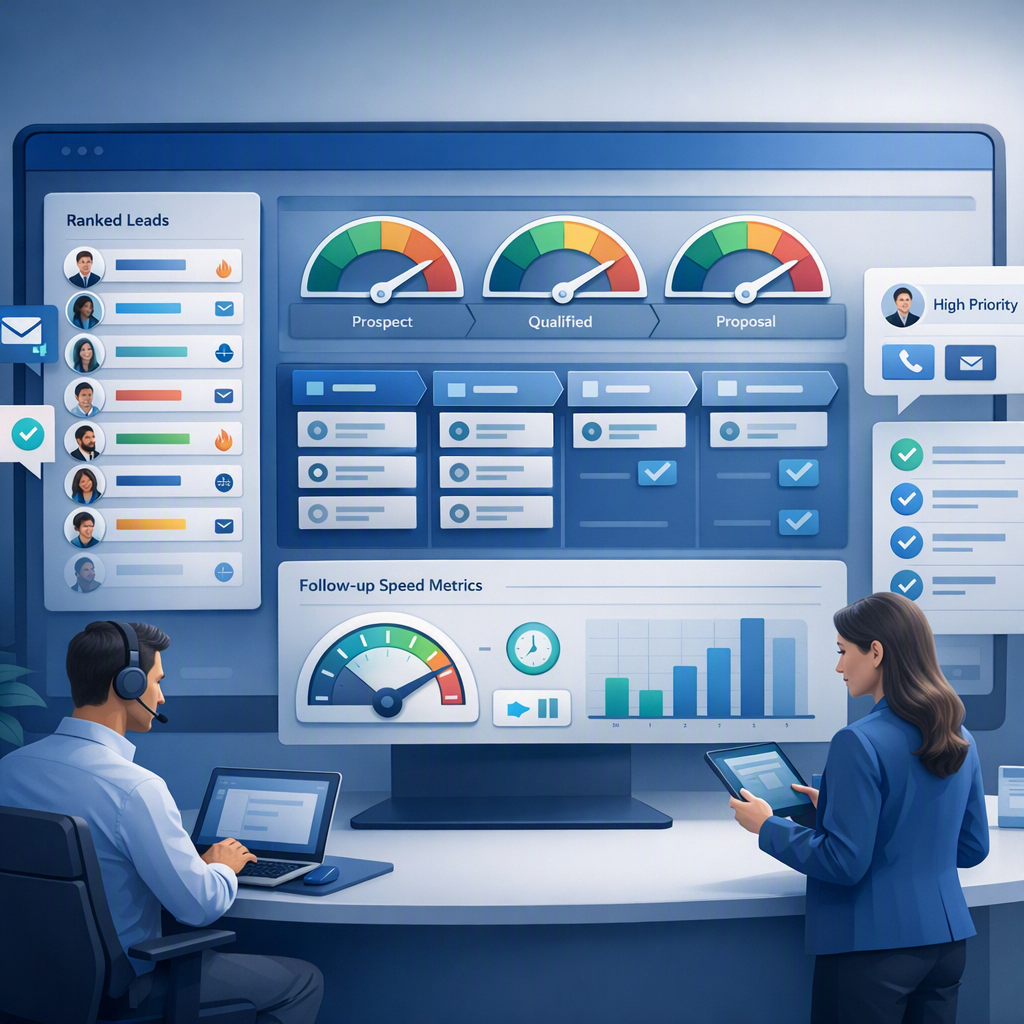
AI lead prioritization in CRM is the process of using artificial intelligence to rank, score, and route B2B leads based on real buying signals—such as form behavior, email engagement, page visits, source quality, and reply history—so sales teams contact the most likely buyers first with less manual sorting.
Teams that get this right do not just score leads. They build a system that turns buyer intent into action. In HelloGrowthCRM, that means combining AI CRM, AI Lead Scoring, routing logic, and Email Automation so reps know who to contact, when to contact them, and what to do next.
Key Takeaways
- AI lead prioritization works best when it uses multiple signals, not one score from one form fill.
- The most useful B2B signals usually include source quality, form depth, email engagement, high-intent page visits, and response history.
- Good prioritization does not stop at scoring. It should trigger routing, follow-up, alerts, and pipeline tasks automatically.
- The best model mixes fit signals and behavior signals, then decays stale activity over time.
- Small and mid-sized teams should avoid overbuilding. A simpler CRM-native setup often beats a complex RevOps stack.
- HelloGrowthCRM helps teams turn signals into action with built-in scoring, automation, and routing instead of patching together many tools.
What is AI lead prioritization in CRM?
AI lead prioritization in CRM is a method for ranking leads by combining firmographic fit, behavioral intent, and engagement history inside the CRM so teams can focus on the accounts most likely to convert now, not just the ones that entered the database most recently.
A basic lead score is often too shallow for B2B sales. A prospect who downloaded one ebook should not outrank a qualified buyer who visited pricing twice, replied to an email, and booked a meeting.
In practice, AI lead prioritization should answer three questions:
- Is this lead a good fit?
- Is this lead showing buying intent?
- Is this lead ready for action now?
That is why a modern model should pull signals from multiple CRM events, not just marketing automation. In HelloGrowthCRM, teams can connect those events through AI Lead Scoring, Smart Inbox, Meeting Scheduler, and AI Pipeline Management without building a separate data warehouse first.
In one rollout we did with a 12-person sales team, the biggest issue was not lead volume. It was false priority. Reps were calling fresh inbound leads with weak intent while demo-request leads sat untouched for hours. The fix was simple. We weighted pricing-page visits, response history, and source quality above generic email opens. Reply speed improved in the first week because reps trusted the queue again.
Which buying signals actually matter for B2B automation?
The buying signals that matter most for B2B automation are the ones that show both fit and timing: meaningful form behavior, strong acquisition source, repeat visits to high-intent pages, email replies, meeting activity, and recent response patterns that show a buyer is moving closer to a decision.
Not every signal deserves equal weight. Some are noisy. Some are highly predictive. The goal is not to collect more data. The goal is to identify signals that change rep behavior.
1. Form behavior
Form behavior matters because it shows declared interest. But quality depends on context.
Strong form signals include:
- Demo request submissions
- Contact sales forms
- Pricing inquiry forms
- Multi-step form completion
- Forms with detailed fields completed voluntarily
Weaker form signals include:
- Top-of-funnel content downloads
- Newsletter signups
- Very short forms with no context
A long form is not always better. The signal is stronger when the buyer gives high-intent information, such as team size, timeline, CRM in use, or revenue range. If you capture this data, AI Lead Scoring can weigh it directly.
2. Email engagement
Email engagement matters, but only some events are reliable.
Use these with caution:
- Opens
- Clicks on low-intent content
Trust these more:
- Direct replies
- Multiple clicks on product or pricing content
- Forwarded-thread behavior if tracked
- Positive sentiment in reply text
Apple Mail privacy changes made open rates much less reliable for prioritization. That is why response-based engagement matters more than vanity engagement.
3. Source quality
Source quality often predicts conversion better than marketers expect. A lead from a branded search ad, partner referral, or product comparison page usually deserves a different score than a broad social campaign lead.
When I have audited pipelines like this, source quality is one of the easiest wins. Teams often treat all inbound leads the same. That creates queue pollution. A simple source tier model usually improves prioritization fast.
4. Page visits and content path
Not all page visits show intent. Homepages and blog posts are often weak signals. Pricing, integrations, case studies, implementation, ROI, and comparison pages usually show stronger commercial intent.
Use page behavior like this:
- One pricing-page visit = moderate intent
- Repeat pricing-page visits within 7 days = strong intent
- Visits to integration pages like Salesforce or HubSpot = technical buying evaluation
- Visits to checkout, demo, or trial pages = action-ready interest
5. Response history
Response history is one of the most useful signals because it reflects active conversation. Leads who reply, reschedule, ask technical questions, or reopen a conversation after silence should rise in priority fast.
This is where CRM-native automation helps. With Email Automation, CRM Dialer, and Sales Task Boards, teams can trigger immediate follow-up based on response events instead of manual list reviews.
Why most lead scoring models fail
Most lead scoring models fail because they overweight noisy activity, ignore timing, and stop at a number instead of turning scores into routing and follow-up actions that sales teams can trust and use consistently.
The most common failure is static scoring. A lead downloads a guide once and keeps a high score for months. That is not prioritization. That is stale data with a label.
According to Gartner, CRM effectiveness depends heavily on data quality, workflow design, and user adoption, not just software features. That applies directly to AI prioritization.
Common mistakes to avoid
- Giving too many points to email opens
- Treating every form fill as equal
- Ignoring negative signals like unsubscribes or no-shows
- Not using score decay for older activity
- Failing to separate fit score from intent score
- Not connecting scoring to routing rules
A strong model usually has at least two layers:
- Fit score: industry, company size, geography, segment, role
- Intent score: page visits, replies, forms, meeting activity, recency
Then add negative signals:
- No response after repeated outreach
- Student or competitor domains
- Job seeker submissions
- Spam patterns
- Long inactivity windows
Manual scoring vs AI prioritization in CRM
AI lead prioritization in CRM beats manual scoring when teams need to process many signals quickly, apply score decay automatically, and trigger next steps in real time without spreadsheet work or rep-by-rep judgment calls.
| Approach | Best for | Main strength | Main weakness | Typical outcome |
|---|---|---|---|---|
| Manual lead scoring | Very small teams | Easy to start | Hard to maintain and inconsistent | Scores exist but action is slow |
| Rules-only automation | Teams with clear lead stages | Predictable logic | Rigid and brittle when buyer behavior changes | Better routing, limited learning |
| AI lead prioritization in CRM | Growing B2B teams | Combines many signals and updates fast | Needs clean event tracking | Better prioritization and faster follow-up |
This is also where HelloGrowthCRM has an advantage for lean RevOps teams. Instead of stitching together separate enrichment, scoring, routing, and inbox tools, teams can manage the workflow in one place through Features, All Integrations, and Managed RevOps if they need help setting up the model.
How should you weight buying signals in an AI lead prioritization model?
You should weight buying signals in an AI lead prioritization model by giving the most value to high-intent actions and recent engagement, moderate value to fit and source quality, and lower value to weak or privacy-distorted signals like opens or broad content consumption.
A simple weighting model works better than a complex one at first. If your team cannot explain the model, they will not trust it.
A practical weighting framework
Start with three score buckets:
Fit score
Examples:
- ICP match by industry
- Company size
- Geography
- Seniority
- Existing tech stack
Intent score
Examples:
- Demo request
- Pricing-page revisit
- Integration page visit
- Sales email reply
- Meeting booked
Priority modifiers
Examples:
- Activity in the last 7 days
- Negative intent
- Duplicate lead history
- Existing open opportunity
- Named account flag
A useful rule of thumb:
- High-intent direct actions get the highest points
- Recent activity gets more than old activity
- Replies beat opens
- Pricing beats blog visits
- Demo requests beat all content signals
A real sourced benchmark helps explain why speed matters here. Companies that respond to leads within an hour are nearly 7 times as likely to have meaningful conversations with decision-makers as those that wait even one hour longer, according to a widely cited Harvard Business Review summary of InsideSales research on lead response time here.
That is why prioritization and automation should work together. A score only matters if it speeds up action.
How to set up AI lead prioritization in CRM: Step-by-Step
Setting up AI lead prioritization in CRM means defining your ideal customer profile, selecting the few buying signals that predict movement, weighting them by intent and recency, then connecting scores to routing and follow-up automations so the system drives action without daily manual review.
- Define your ICP and segments
Start with company size, industry, geography, buyer role, and deal type. If enterprise and SMB buyers behave differently, create separate models. - List your real buying signals
Include form type, source, pricing-page visits, integration-page visits, email replies, meetings, and call outcomes. Keep the first version focused. - Separate fit from intent
Build one score for account fit and another for active buying behavior. This avoids overweighting a weak-fit lead that clicked a lot. - Apply recency and decay
Recent behavior should count more. Reduce the value of old activity after 7, 14, or 30 days based on your sales cycle. - Add negative signals
Lower priority for unsubscribes, bounced emails, repeated no-shows, spam patterns, or domains outside your target market. - Map score thresholds to actions
Example: high-priority leads go to an AE within minutes, medium-priority leads enter a nurture sequence, and low-priority leads stay with marketing. - Automate routing and follow-up
Use AI Lead Scoring, Email Automation, Meeting Scheduler, and Slack alerts to trigger next steps instantly. - Review conversion by signal, not just by total score
Check which signals actually correlate with meetings, pipeline creation, and closed-won deals. Remove noisy inputs fast. - Tune every 30 to 60 days
Sales motion changes. Campaign mix changes. Keep weights current, especially for new channels and new product pages.
If you want a fast starting point, HelloGrowthCRM teams often use Lead Scoring Calculator, Pipeline Health Score, and RevOps Maturity Assessment before building the live workflow.
How HelloGrowthCRM helps teams automate lead prioritization without a complex RevOps stack
HelloGrowthCRM helps teams automate lead prioritization without a complex RevOps stack by combining AI scoring, CRM workflows, inbox signals, routing logic, and rep task automation in one system, so growing B2B teams can launch practical prioritization faster and maintain it with less technical overhead.
This matters most for teams that are too advanced for spreadsheets but not ready for a custom data architecture.
What HelloGrowthCRM can do in this workflow
- Score leads using AI Lead Scoring
- Trigger follow-up through Email Automation
- Route owners by segment or territory with Territory Management
- Turn replies and conversations into action through Smart Inbox
- Prompt reps with AI Sales Copilot
- Flag risk or urgency with AI Deal Insights
- Connect inbound sources through Zapier, Gmail, and WhatsApp
Where this approach works best
This setup works especially well for:
- B2B SaaS teams with 3 to 50 reps
- Hybrid inbound and outbound motions
- Teams with one RevOps owner or none
- Companies that want CRM-native automation
There is a limitation worth stating clearly. If you have many product lines, multiple regions, and a complex enterprise assignment model, you may still need deeper customization. For many teams under 50 reps, though, a simpler CRM-native design is faster to deploy and easier to trust.
HelloGrowthCRM is our product, so that disclosure matters. I am biased toward this approach because I have seen how often fragmented stacks slow down simple operational fixes. In one implementation, we replaced four disconnected tools with one scoring and routing workflow. The sales manager stopped exporting CSVs every morning, and SLA compliance improved because alerts and task creation happened automatically.
If you want to see how this could work in your funnel, explore Pricing, book a Demo, or start a Free Trial to test AI lead prioritization in your own CRM.
About the author
Rohan Mehta is a Sales Operations Lead at HelloGrowthCRM with 9 years of experience in B2B SaaS revenue operations, CRM design, and automation. He has led scoring, routing, and lifecycle workflow projects for inbound and outbound sales teams across SMB and mid-market segments. One project that informed this article involved redesigning lead prioritization for a 12-rep SaaS team using source tiers, pricing-page intent, and reply-based scoring to improve speed-to-lead and meeting conversion. He writes from hands-on RevOps practice, not theory.
Frequently Asked Questions
Q: What is the difference between AI lead scoring and AI lead prioritization in CRM?
A: AI lead scoring gives leads points, while AI lead prioritization in CRM uses those scores plus timing, routing, and workflow rules to decide who sales should contact first. In practice, prioritization is more action-focused. It tells the team what to do next, not just how a lead ranks.
Q: Which buying signals are most important for B2B lead prioritization?
A: The most important buying signals for B2B lead prioritization are demo requests, pricing-page visits, email replies, strong source quality, meeting activity, and recent response history. These signals usually show more purchase intent than opens, pageviews, or broad content downloads alone.
Q: Should email opens be used in AI lead prioritization?
A: Email opens should be used carefully in AI lead prioritization because they are weaker and less reliable than replies, clicks, meetings, or form actions. Privacy changes also make opens less trustworthy. Use them as a light signal, not a core trigger.
Q: How often should we update our lead prioritization model?
A: You should update your lead prioritization model every 30 to 60 days when starting, then quarterly once performance stabilizes. Review conversion by signal, threshold, and segment. If campaign mix or sales motion changes, update faster.
Q: Can small B2B teams use AI lead prioritization without a RevOps team?
Frequently Asked Questions
Ready to put this into practice?
Set up your pipeline, WhatsApp follow-ups, and AI lead scoring in minutes — free, no credit card.
Try HelloGrowthCRM freeGet CRM tips in your inbox
Join thousands of sales professionals who get weekly insights on CRM strategy, AI automation, and pipeline optimization.

The HelloGrowthCRM team publishes guides on CRM strategy, AI sales tools, and revenue operations for small business sales teams.