HelloGrowthCRM software
Built for real small-business sales teams
HelloGrowthCRM helps reps qualify faster, follow up on time, and close more deals—with practical automation in one place.
- AI lead scoring and pipeline visibility
- Built-in dialer, WhatsApp, and email automation
- Sales forecasting and RevOps-ready reporting
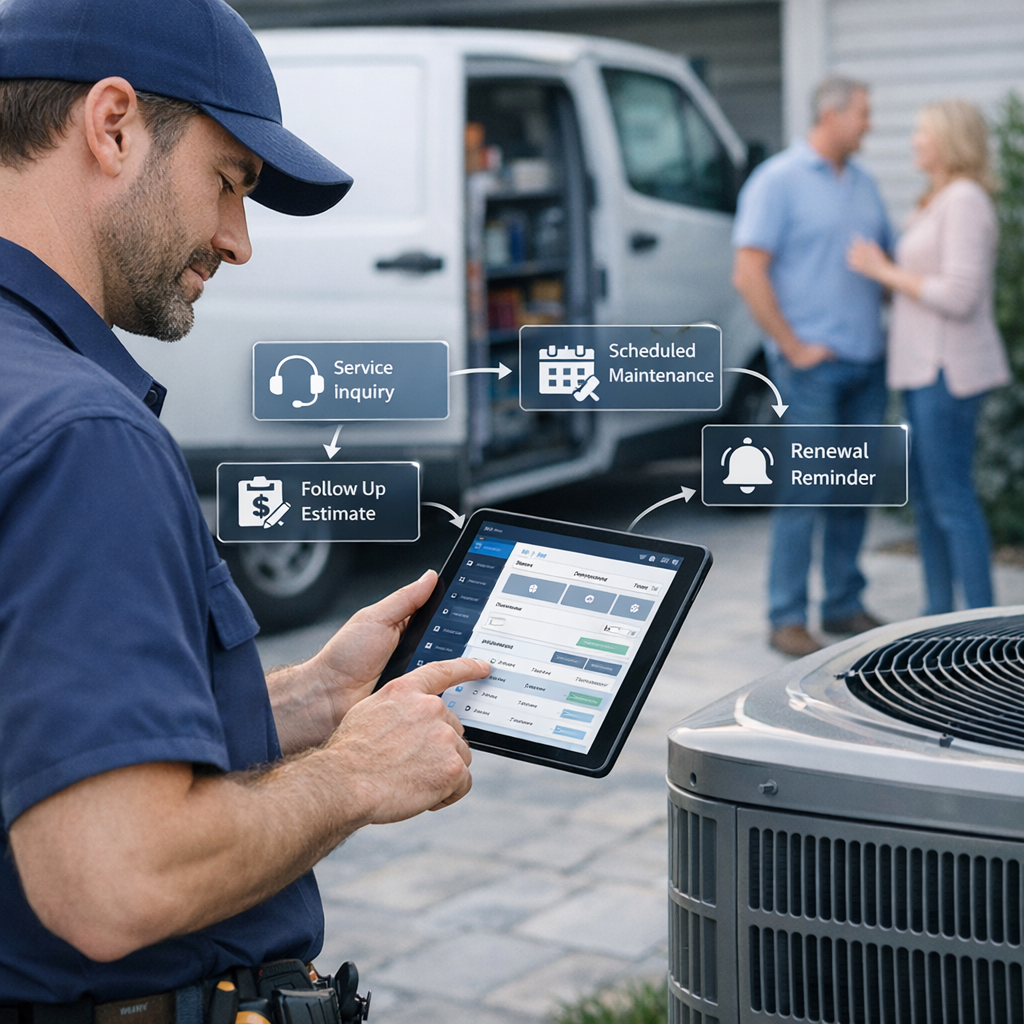
A crm for commercial hvac contractors is a revenue and operations system that captures service inquiries, manages estimate follow-up, coordinates dispatch handoffs, and drives maintenance renewals in one pipeline so sales, service, and field teams can work from the same customer record without losing jobs or recurring revenue.
Commercial HVAC contractors do not just need contact storage. They need a system that connects inbound demand, quoting, scheduling, technician updates, and contract renewal timing. That is where a workflow-focused CRM matters. With HelloGrowthCRM’s AI CRM, teams can track every handoff from first call to signed maintenance agreement.
Key Takeaways
- Commercial HVAC teams need one CRM that covers service requests, estimates, dispatch coordination, and maintenance renewals.
- The best setup uses separate but connected pipelines for new service work, quoted projects, and recurring contracts.
- Speed matters. Fast inquiry capture and estimate follow-up directly affect win rate and technician utilization.
- HelloGrowthCRM helps HVAC teams automate lead capture, route work, trigger reminders, and improve visibility with AI Pipeline Management.
- Field-heavy teams often need process help, not just software, which is why Managed RevOps can be valuable.
- A useful HVAC CRM must support sales and operations together, not treat dispatch as an afterthought.
Why commercial HVAC contractors need a specialized CRM workflow
A commercial HVAC contractor needs a specialized CRM workflow because the job is not a simple linear sale; it includes urgent service intake, site assessment, estimate follow-up, scheduling, technician handoff, and renewal management, all of which involve different teams, response times, and revenue moments that generic contact databases rarely handle well.
Commercial HVAC work has more moving parts than many B2B sales cycles. A property manager may call for an emergency rooftop unit issue. A facilities director may request a preventive maintenance quote. A general contractor may ask for a multi-site estimate with long approval cycles. These are different motions, but they often land in the same inbox.
If those requests stay in email, spreadsheets, or a dispatch board alone, teams lose visibility. Sales does not know which estimates went cold. Dispatch does not know what was promised. Leadership cannot see forecasted service revenue versus recurring contract renewals.
In practice, the best setup is a connected workflow with clear stages:
- New service inquiry
- Qualification and site details
- Estimate or scope creation
- Follow-up and approval
- Dispatch and work completion
- Contract renewal or upsell
In one rollout I did with a 12-person sales team and field coordinator group, the biggest problem was not lead volume. It was handoff failure. Quotes were sent, but no one owned follow-up after the estimator moved to the next site walk. Once we created stage ownership and automated reminders, stale estimates dropped fast.
A CRM built for this workflow should support:
- Fast lead capture from phone, web, email, and messaging
- Account-level history for buildings, sites, and contacts
- Quote and follow-up tracking
- Scheduling handoff visibility
- Recurring maintenance renewal triggers
- Reporting by source, job type, stage, and rep
For teams that want that full view, HelloGrowthCRM’s Features and Smart Inbox give both office and revenue teams a shared system of record.
What workflow should a CRM for commercial HVAC contractors manage?
The right workflow for a CRM for commercial HVAC contractors should manage the full customer lifecycle, including service inquiry intake, qualification, estimate creation, follow-up, dispatch coordination, post-job upsell, and maintenance renewal tracking, so no revenue event sits outside the system or depends on one person’s memory.
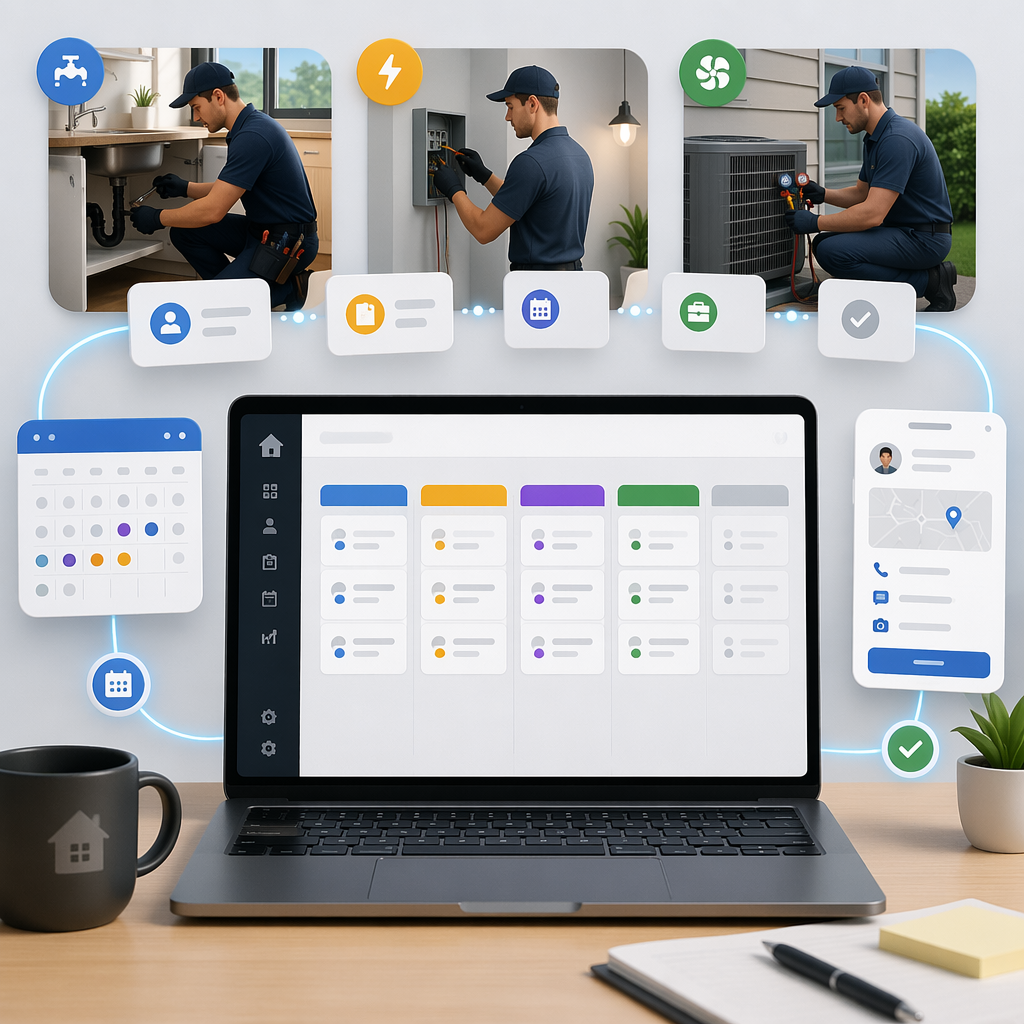
Think of the HVAC workflow as three connected pipelines rather than one giant board.
1. Service inquiry pipeline
This covers reactive work and new customer requests. Typical stages include:
- New inquiry received
- Contacted
- Site details collected
- Visit scheduled
- Estimate needed
- Closed won or closed lost
This pipeline benefits from Meeting Scheduler links, call logging, and fast routing. If you have web forms, phone calls, and inbox requests coming from many places, connect them through All Integrations or tools like Zapier.
2. Estimate and project pipeline
This is where many HVAC companies leak revenue. The estimator sends the quote, but follow-up becomes inconsistent. Your CRM should track:
- Estimate amount
- Quote sent date
- Next follow-up date
- Decision maker
- Building type
- Competitor status
- Expected close date
When I audit pipelines like this, I look for two specific metrics first: quote-to-win rate and days from estimate sent to next touch. If the second number is high, the first one usually suffers too.
3. Maintenance renewal pipeline
Recurring maintenance agreements deserve their own pipeline or renewal board. They should not be buried under one-off jobs.
Use renewal stages such as:
- Contract active
- Renewal due in 120 days
- Renewal outreach started
- Site review complete
- Proposal sent
- Renewal won or at risk
For this, Customer Health Score and Revenue Attribution help teams see which accounts are stable, expanding, or likely to churn.
How HelloGrowthCRM fits commercial HVAC sales and service operations
HelloGrowthCRM fits commercial HVAC sales and service operations by giving contractors one place to capture inbound requests, automate estimate follow-up, track dispatch handoffs, and manage renewals, while also providing AI-driven prioritization and managed process support for teams that do not have a full internal RevOps function.
HelloGrowthCRM is our product, so that should be clear up front. This article is based on real RevOps patterns we have seen across field-service and B2B sales workflows, but every HVAC business should still validate fit based on service complexity, technician count, and dispatch needs.
AI-powered intake and follow-up
Commercial HVAC demand often starts in messy channels. A property manager might email after hours. A building owner may fill out a web form. Another lead may call in directly. HelloGrowthCRM can centralize those touchpoints with Email Automation, Gmail, WhatsApp, and Twilio connections.
That matters because response speed is often the first competitive edge. Harvard Business Review has repeatedly highlighted the value of disciplined sales execution and follow-up in complex B2B selling. In HVAC, the same principle applies to service requests and quotes.
Pipeline visibility for office and field handoffs
The issue is rarely just “getting a CRM.” The issue is getting shared visibility across office staff, estimators, and field operations. HelloGrowthCRM’s Sales Task Boards and AI Deal Insights help teams see:
- Which estimates need follow-up now
- Which jobs are waiting on scheduling
- Which accounts have renewal risk
- Which reps or coordinators have bottlenecks
Managed support for process design
A lot of contractors do not have a revenue operations manager. They have an owner, service manager, dispatcher, estimator, and admin team wearing multiple hats. That is why Managed RevOps can matter as much as software. It helps define stages, routing rules, SLAs, and reporting without forcing the business to figure out the operating model alone.
Gartner notes that CRM success depends heavily on adoption and process alignment, not just feature count. That is especially true in field-service businesses.
Key CRM capabilities to prioritize for commercial HVAC contractors
The most important CRM capabilities for commercial HVAC contractors are fast lead capture, estimate tracking, dispatch handoff visibility, account history, and automated renewal workflows, because these functions directly affect response time, close rates, technician utilization, and recurring service revenue across multiple sites and stakeholders.
Not every CRM feature matters equally in this industry. Focus on the capabilities that match the workflow.
Lead capture and routing
Your CRM should capture inquiries from:
- Web forms
- Calls
- Referral partners
- Paid campaigns
- Existing customer requests
Use AI Lead Scoring to prioritize higher-value opportunities, such as multi-site contracts or large retrofit projects, instead of treating every inquiry the same.
Estimate follow-up automation
This is often the highest-ROI automation in HVAC. Build follow-up sequences for:
- 1 day after quote sent
- 3 days after quote sent
- 7 days after quote sent
- 14 days after quote sent
- Manager alert if no response
The U.S. Small Business Administration states that retaining customers costs less than acquiring new ones, which supports the business case for structured maintenance renewal workflows and account follow-up (SBA).
Dispatch and technician handoff tracking
A CRM is not a dispatch board by itself. But it should clearly signal when a sold job or approved service request is ready for scheduling. That handoff can run through internal tasks, status changes, or integration with an existing field tool via OpenAI, Slack, or All Integrations.
Account and site-level visibility
Commercial HVAC sales happen at the account level, but service happens at the site level. Your CRM should track:
- Parent account
- Site address
- Asset or equipment notes
- Contract dates
- Key contacts by role
- Open estimates and service history
CRM for commercial HVAC contractors vs generic CRM setup
A CRM for commercial HVAC contractors differs from a generic CRM setup because it must support job-driven workflows, time-sensitive dispatch handoffs, and recurring maintenance agreements, while a generic CRM often focuses only on contact storage and standard sales stages that do not reflect how commercial service businesses actually operate.
Here is the practical difference:
| Area | Generic CRM Setup | CRM for Commercial HVAC Contractors |
|---|---|---|
| Inquiry intake | Manual entry or simple forms | Multi-channel intake with routing by service type, urgency, or geography |
| Pipeline design | Basic lead-opportunity-close stages | Separate service, estimate, and renewal pipelines |
| Handoff to ops | Often unclear or manual | Defined dispatch-ready stages and internal ownership |
| Account structure | Single company/contact view | Parent account, site, asset, and contract context |
| Follow-up | Rep-dependent | Automated estimate and renewal sequences |
| Reporting | Top-line pipeline reports | Quote aging, service source, renewal risk, stage velocity |
| Fit for field teams | Limited | Built around office-to-field coordination |
If you are comparing systems, start with your process map before you compare software. Then review Pricing and request a Demo based on your actual workflow, not a generic sales template.
How to set up a CRM for commercial HVAC contractors: Step-by-Step
Setting up a CRM for commercial HVAC contractors means mapping your real service and sales motion first, then building separate pipelines, ownership rules, automations, and reports so inquiries, estimates, dispatch handoffs, and renewals move through one connected system without manual chasing.
- Map your current workflow
List every step from inbound request to completed job and renewal. Include who owns each step and where delays happen today. - Create separate pipelines
Build at least three pipelines for service inquiries, estimates/projects, and maintenance renewals. This keeps reactive work from hiding recurring revenue. - Define stage entry and exit rules
Write clear rules for each stage. For example, “Estimate Sent” should require amount, send date, and next follow-up date. - Assign ownership by handoff
Decide when responsibility moves from intake to estimator to dispatcher to account manager. This removes the “I thought someone else had it” problem. - Automate follow-up and alerts
Use Email Automation, task reminders, and AI Sales Copilot prompts to keep quotes and renewals moving. - Connect communication channels
Link inboxes, phone tools, and calendars. Tools like CRM Dialer, Google Meet, and Calendly reduce manual updates. - Build role-based dashboards
Sales leaders need quote aging and forecast views. Coordinators need dispatch-ready jobs. Owners need renewal pipeline and source performance. - Review data quality every week
Run a weekly check for missing next steps, stale estimates, and contracts without renewal dates. Use the Pipeline Health Score to spot gaps early.
Common mistakes HVAC contractors make with CRM rollout
Commercial HVAC contractors often struggle with CRM rollout when they try to force one generic pipeline onto every job type, skip handoff design, or fail to assign ownership for follow-up, which leads to poor adoption, unreliable reporting, and lost revenue hidden between sales and service teams.
The most common mistakes are predictable:
Using one pipeline for everything
Emergency service, quoted replacement projects, and annual maintenance renewals do not move at the same speed. One pipeline hides those differences.
Treating dispatch as outside the revenue process
If dispatch starts only after “closed won,” the CRM misses an important operating stage. That creates blind spots in scheduling and customer communication.
Not measuring the right metrics
Focus on metrics that fit HVAC operations:
- Inquiry-to-contact time
- Estimate-to-follow-up time
- Quote win rate
- Stage velocity in days
- Renewal rate
- Revenue by account type and source
Overbuilding before the team adopts it
Start simple. A team under 50 reps and coordinators usually does better with a focused setup. Above that size, expect more need for permissions, territories, and deeper integration. If you need that, Territory Management and process support become more important.
If your team wants to modernize intake, estimate follow-up, and maintenance renewals without stitching together separate tools, HelloGrowthCRM is built for exactly this kind of revenue workflow. You can explore the platform through a Free Trial, review the full Features, or book a Demo to map your commercial HVAC process with our team.
About the author
Rohan Mehta is a Sales Operations Lead at HelloGrowthCRM with 10 years of experience in B2B SaaS, RevOps, and CRM implementation. He has worked on pipeline design, automation, and forecasting programs for service-led revenue teams across field operations and inside sales. One project that informed this article was a CRM and handoff redesign for a regional commercial services company with estimators, dispatch coordinators, and recurring contract renewals spread across multiple sites. His work focuses on turning messy real-world workflows into systems teams actually use.
Frequently Asked Questions
Q: What is the best CRM for commercial HVAC contractors?
A: The best CRM for commercial HVAC contractors is one that manages service inquiries, estimates, dispatch handoffs, and maintenance renewals in one system. For teams that need sales and operations visibility together, HelloGrowthCRM is a strong fit because it combines automation, pipeline tracking, and RevOps support.
Q: Can a CRM help commercial HVAC companies with maintenance agreement renewals?
A: Yes, a CRM can help commercial HVAC companies with maintenance agreement renewals by tracking contract dates, triggering outreach, and showing at-risk accounts before renewal deadlines slip. The key is using a dedicated renewal pipeline instead of burying contracts under one-time jobs.
Q: How does a CRM improve estimate follow-up for HVAC contractors?
A: A CRM improves estimate follow-up for HVAC contractors by automating reminders, logging every touch, and making quote aging visible to managers. That helps teams follow up on time instead of relying on estimator memory or scattered inboxes.
Q: Should commercial HVAC contractors use one pipeline or multiple pipelines?
A: Commercial HVAC contractors should usually use multiple pipelines because service work, project estimates, and maintenance renewals move through different stages and timelines. Separate pipelines improve reporting, ownership, and automation without making the system harder to use.
Q: Can HelloGrowthCRM work for field-service businesses with dispatch teams?
Frequently Asked Questions
Ready to put this into practice?
Set up your pipeline, WhatsApp follow-ups, and AI lead scoring in minutes — free, no credit card.
Try HelloGrowthCRM freeGet CRM tips in your inbox
Join thousands of sales professionals who get weekly insights on CRM strategy, AI automation, and pipeline optimization.

The HelloGrowthCRM team publishes guides on CRM strategy, AI sales tools, and revenue operations for small business sales teams.