HelloGrowthCRM software
Built for real small-business sales teams
HelloGrowthCRM helps reps qualify faster, follow up on time, and close more deals—with practical automation in one place.
- AI lead scoring and pipeline visibility
- Built-in dialer, WhatsApp, and email automation
- Sales forecasting and RevOps-ready reporting
A crm for hvac contractors is a customer relationship management system built to track service inquiries, dispatch-ready site visits, estimates, follow-ups, won jobs, and recurring maintenance renewals in one connected workflow so HVAC teams can respond faster, stop lead leakage, and grow service revenue with less manual admin.
Key Takeaways
- HVAC contractors need one pipeline that covers inquiry, inspection, estimate, approval, job completion, and renewal.
- HelloGrowthCRM helps centralize calls, web forms, technician notes, and office follow-up in one place.
- Automation matters most in three places: lead routing, estimate reminders, and maintenance renewal sequences.
- HVAC teams should measure speed-to-lead, estimate-to-close rate, no-show rate, and renewal rate by source.
- Managed RevOps support helps contractors set up the process correctly, not just buy software.
Why HVAC contractors need a specialized CRM
A CRM for HVAC contractors is different from a generic CRM because it must handle urgent service requests, field-to-office handoffs, estimate follow-up timing, and recurring maintenance renewals in one system. HVAC businesses lose revenue when these steps live across phones, spreadsheets, inboxes, and dispatch notes instead of one tracked pipeline.
Most HVAC revenue comes from a mix of reactive demand and planned service. That creates operational complexity. One lead may need same-day dispatch. Another may need a site survey and a high-value replacement quote. A third may convert six months later after repeated follow-up.
A generic contact database does not solve that. HVAC teams need a workflow that connects:
- Inbound phone calls
- Web form inquiries
- Referral leads
- Technician findings from site visits
- Estimate creation and follow-up
- Maintenance agreement renewals
- Cross-sell opportunities for upgrades and replacements
In one rollout we did with a 12-person sales team, the biggest issue was not lead volume. It was handoff failure. The office logged the inquiry, the technician visited the site, and the estimate sat in someone’s inbox without a clear next step. Once we made estimate follow-up a visible stage with timed reminders, quote response rates improved within weeks.
That is where an industry-focused AI CRM helps. Instead of forcing HVAC teams to adapt to a generic pipeline, HelloGrowthCRM can map the real field workflow and support it with Managed RevOps so the setup matches how the business actually sells and services accounts.
What does a CRM for HVAC contractors need to manage?
A CRM for HVAC contractors needs to manage the full customer journey from first service inquiry through dispatch coordination, site visit notes, estimate tracking, job status, payment handoff, and maintenance renewal outreach. If any of these steps sit outside the CRM, teams lose visibility and follow-up consistency.
Service inquiry capture across channels
HVAC demand comes from many channels. A homeowner may call after a unit failure. A facilities manager may submit a web form. A returning customer may reply to an old email.
Your CRM should capture and route all of them from one place, including integrations with Gmail, WhatsApp, and Twilio. If your office staff still checks multiple inboxes and call logs manually, the first problem is intake fragmentation.
HelloGrowthCRM helps solve this with channel capture and a shared Smart Inbox, so office teams can see what came in, who owns it, and what happens next.
Site visit and technician handoff tracking
The field handoff is where many HVAC contractors lose momentum. The technician identifies the issue, confirms replacement scope, or recommends a maintenance plan, but that detail does not always return cleanly to sales or admin.
Your CRM should record:
- Visit date and outcome
- Equipment details
- Photos or notes
- Recommended next action
- Estimate value
- Urgency level
- Assigned follow-up owner
When I have audited pipelines like this, I usually find that technician notes are rich but trapped in text messages, paper forms, or job software comments. Sales cannot follow up well if context is missing. HelloGrowthCRM fixes that by giving teams a shared record and task workflow through Sales Task Boards.
Estimate follow-up and renewal workflow
Quote follow-up is a revenue engine. Maintenance renewals are a retention engine. Both need automation.
This matters because follow-up consistency drives outcomes. According to Harvard Business Review, many firms respond poorly or slowly to inbound leads, which directly reduces conversion opportunity (HBR).
For HVAC teams, the key is not just sending one estimate. It is building a repeatable cadence with the Follow-Up Cadence Builder and triggering renewal reminders before agreements lapse.
How HelloGrowthCRM fits the HVAC workflow
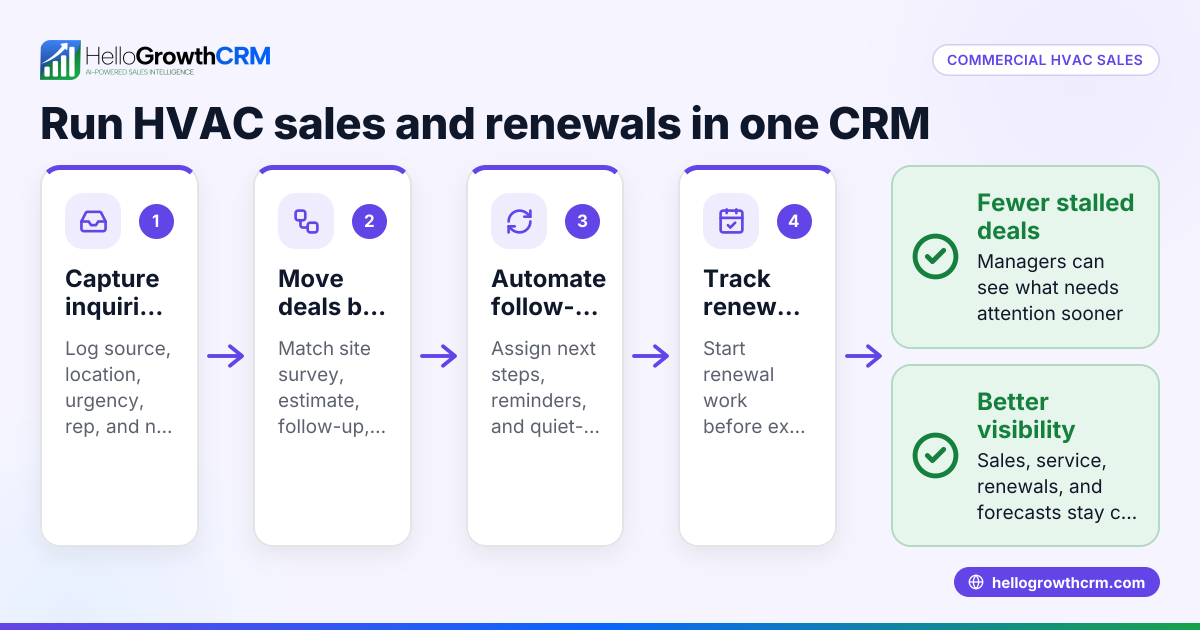
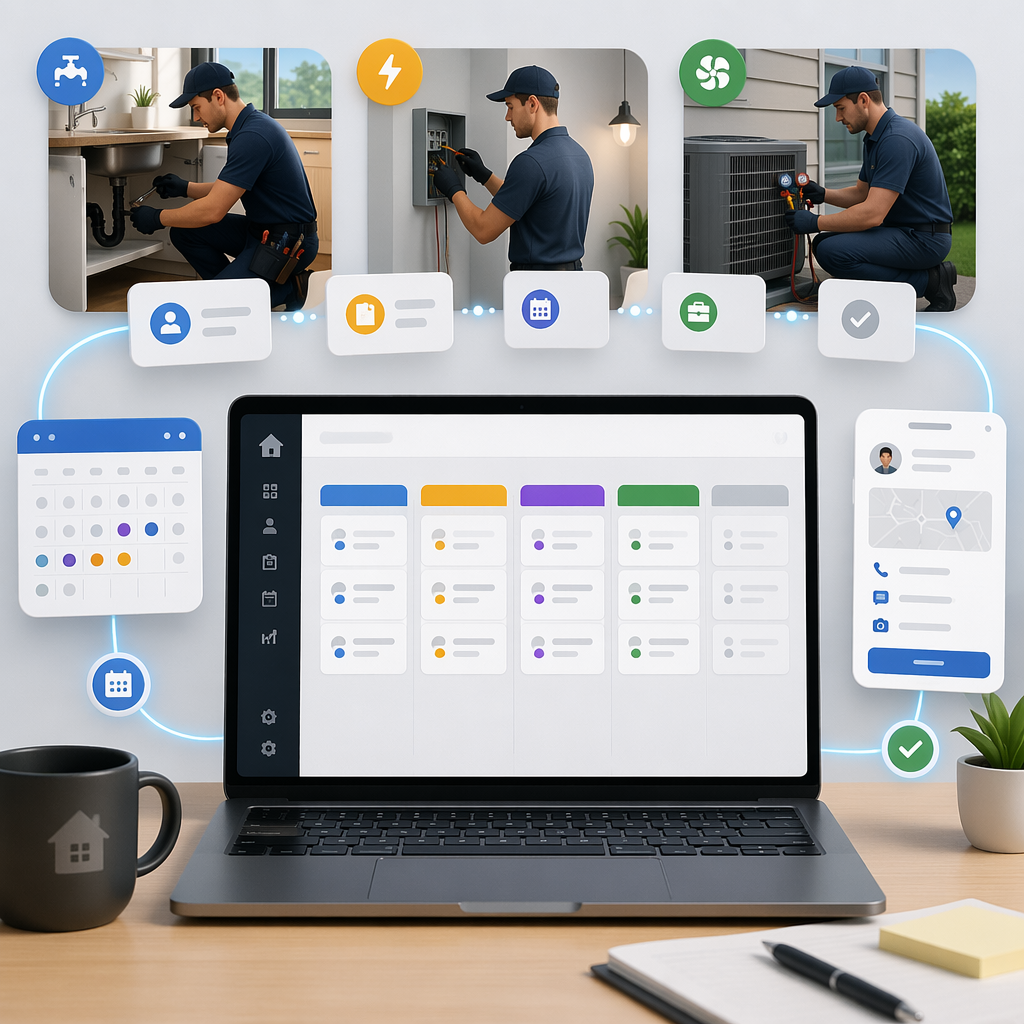
HelloGrowthCRM fits the HVAC workflow by connecting lead capture, qualification, technician handoff, estimate follow-up, and maintenance renewal in one revenue system. It gives office staff, sales reps, and service leaders one view of the customer while automating repetitive reminders, routing, and reporting.
One pipeline from inquiry to renewal
A strong HVAC pipeline should be simple enough for office staff to use every day. In practice, I recommend stages like:
- New inquiry
- Contacted
- Scheduled visit
- Site visit complete
- Estimate sent
- Follow-up in progress
- Won
- Lost
- Active maintenance plan
- Renewal due
HelloGrowthCRM supports pipeline design with AI Pipeline Management, so managers can track where opportunities stall and which stage needs tighter process control.
Faster response with routing and automation
Fast response wins in HVAC, especially for urgent repair or replacement inquiries. HelloGrowthCRM can route new leads by geography, service type, or job value using Territory Management and workflow rules.
That means you can:
- Send emergency repair inquiries to the right region
- Assign replacement estimates to senior reps
- Trigger immediate SMS or email confirmation through Email Automation and WhatsApp & SMS CRM
- Create call tasks automatically for office follow-up
- Book inspections with the Meeting Scheduler
Better visibility into deal quality and renewal risk
Not every HVAC opportunity deserves the same level of effort. A commercial retrofit, a residential replacement, and a low-margin service request have different economics.
With AI Lead Scoring, teams can rank opportunities by urgency, fit, and expected value. With AI Deal Insights, managers can review stalled estimates and identify which jobs need intervention. For recurring accounts, Customer Health Score helps flag maintenance customers who are likely to lapse before renewal.
HelloGrowthCRM vs generic CRM for HVAC contractors
HelloGrowthCRM vs a generic CRM for HVAC contractors comes down to workflow fit, speed of setup, and operational support. Generic tools can store contacts and tasks, but HVAC businesses usually need service-specific stages, technician handoffs, and renewal automation that require extra design work and ongoing process discipline.
| Capability | Generic CRM | HelloGrowthCRM for HVAC contractors |
|---|---|---|
| Service inquiry capture | Basic forms and contact records | Centralized multi-channel intake with routing workflows |
| Technician-to-office handoff | Often manual or custom | Shared pipeline notes, task ownership, and stage-based follow-up |
| Estimate reminder automation | Possible with setup effort | Built for timed follow-up using Email Automation and task triggers |
| Maintenance renewal tracking | Usually separate lists or manual reminders | Renewal stages, reminder sequences, and customer health monitoring |
| Lead prioritization | Limited or manual | AI Lead Scoring and pipeline visibility |
| RevOps support | Usually self-serve | Hands-on Managed RevOps support |
| Time to operational value | Varies widely | Faster when pipeline templates and support are used |
A fair limitation: if you are a very small contractor with one admin and no follow-up complexity, a lightweight tool may be enough at first. But once you have multiple lead sources, technicians, estimators, or maintenance contracts, disconnected systems start to cost more than they save.
According to Gartner, CRM software remains a core growth technology for sales organizations because it improves process visibility and customer management when properly adopted (Gartner).
The HVAC pipeline stages that matter most
The HVAC pipeline stages that matter most are the ones where deals commonly stall: first response, post-visit estimate delivery, estimate follow-up, and maintenance renewal timing. If you define these stages clearly and assign ownership, your CRM becomes a revenue system instead of a contact list.
Stage 1: New inquiry to first response
Measure speed-to-lead in minutes, not days. If the customer called about a failed system, waiting until tomorrow is often a lost opportunity.
Useful automations include:
- Auto-assignment by region
- Instant confirmation message
- Callback task creation
- Missed-call capture with CRM Dialer
Stage 2: Visit completed to estimate sent
This stage often breaks because the technician’s findings never become a structured next step. Create required fields after every visit, including system age, replacement need, urgency, and recommended package.
You can also standardize estimate generation with Proposal Builder, which helps reduce delays and keep quote formats consistent.
Stage 3: Estimate sent to close
Most HVAC contractors under-follow-up here. One email is not a process. You need a sequence.
A practical cadence is:
- Day 0: Estimate sent
- Day 1: SMS or call confirmation
- Day 3: Benefit-focused follow-up
- Day 7: Check-in call
- Day 14: final reminder or alternate option
This is where AI Sales Copilot can help reps stay on message and complete next steps without missing tasks.
Stage 4: Maintenance renewal and expansion
Renewal should start before the contract expires. Build reminders at 60, 30, and 7 days before lapse. Include options for annual service, upgrades, and system replacement planning where relevant.
If you also want to connect billing or subscription events, integrations like Stripe and QuickBooks can support cleaner handoffs.
How to set up a CRM for HVAC contractors: Step-by-Step
Setting up a CRM for HVAC contractors means mapping your real service and sales workflow, standardizing stages and ownership, connecting lead sources, automating follow-up, and measuring the few metrics that show whether inquiries, estimates, and renewals are moving. Start simple, then refine after two to four weeks of live use.
- Map your current workflow
Write down each step from inquiry to renewal. Include who owns the step, what tool they use now, and where delays happen. - Define your pipeline stages
Create clear stages such as new inquiry, scheduled visit, estimate sent, and renewal due. Avoid vague stages like “in progress.” - Connect lead sources
Bring phone, web, email, and messaging channels into one system. HelloGrowthCRM can centralize these through All Integrations and shared inbox workflows. - Set routing rules
Assign leads by geography, service type, customer segment, or urgency. This is especially important for multi-crew or multi-branch contractors. - Standardize visit outcomes
Require technicians or office staff to log structured notes after every site visit. Use the same fields every time. - Automate estimate follow-up
Build reminder sequences for quotes that are sent but not answered. Mix email, SMS, and call tasks based on deal value. - Create renewal workflows
Set maintenance renewal reminders before expiry. Add upsell paths for replacements, add-on services, or premium plans. - Track operating metrics weekly
Review speed-to-lead, estimate-to-close rate, average days in stage, no-show rate, and renewal rate. Use tools like the Pipeline Health Score and CRM ROI Calculator to quantify progress.
What metrics HVAC contractors should track in CRM
HVAC contractors should track CRM metrics that connect directly to response time, estimate conversion, service efficiency, and recurring revenue. The goal is not more dashboards. The goal is a short list of metrics that show where revenue leaks and which workflow fix will have the highest impact.
Track these first:
- Speed-to-lead by source
- Booking rate from inquiry to visit
- Visit-to-estimate rate
- Estimate-to-close rate
- Average days from visit to quote
- Follow-up activity per open estimate
- Maintenance renewal rate
- Revenue by source and campaign
If you want better source reporting, Revenue Attribution helps connect marketing channels to closed jobs and renewals. That matters when you are deciding whether paid search, referrals, or seasonal promotions are driving better-margin work.
One practical warning: this approach works very well for teams under 50 reps and service coordinators. Above that, expect more branching workflows, more permission controls, and more integration planning. That is exactly where Managed RevOps becomes valuable, because process complexity rises faster than most contractors expect.
If you are evaluating fit, review HelloGrowthCRM’s Features, compare plans on the Pricing page, or book a Demo to map your HVAC pipeline with a specialist.
HelloGrowthCRM helps HVAC contractors turn scattered inquiries, technician notes, estimates, and renewals into one visible pipeline. If you want faster follow-up, cleaner routing, and a CRM that matches how HVAC teams actually work, start a Free Trial or talk to our team about a tailored setup.
About the author
Ronan Hale is a Sales Operations Lead at HelloGrowthCRM with 10 years of experience in B2B SaaS, CRM design, and revenue operations. He has helped service businesses build pipeline workflows for inbound lead management, quote follow-up, and recurring revenue programs. One project that informed this article was a field-service rollout for a regional contractor with multi-tech handoffs and maintenance renewal automation across several territories. HelloGrowthCRM is the product Ronan works on, so this guide reflects both practitioner experience and product knowledge.
Frequently Asked Questions
Q: What is the best CRM for HVAC contractors?
A: The best CRM for HVAC contractors is one that tracks service inquiries, site visits, estimates, follow-ups, and maintenance renewals in one pipeline. For growing teams, HelloGrowthCRM stands out because it combines automation, lead routing, and managed RevOps support tailored to operational workflows.
Q: Can a CRM help HVAC contractors follow up on estimates?
A: Yes, a CRM can help HVAC contractors follow up on estimates by automating reminders, assigning tasks, and tracking quote status by stage. This reduces forgotten quotes and gives managers visibility into which estimates need action.
Q: Why do HVAC businesses lose leads without a CRM?
A: HVAC businesses lose leads without a CRM because inquiries, technician notes, and follow-up tasks get split across phones, inboxes, and spreadsheets. That creates slow response times, poor handoffs, and missed renewal opportunities.
Q: How should an HVAC sales pipeline be structured?
A: An HVAC sales pipeline should be structured around real workflow stages such as new inquiry, scheduled visit, site visit complete, estimate sent, follow-up, won, and renewal due. Clear ownership at each stage is what makes the pipeline useful.
Q: Can HelloGrowthCRM manage maintenance agreement renewals?
A: Yes, HelloGrowthCRM can manage maintenance agreement renewals with renewal stages, reminder workflows, and customer tracking. Teams can trigger outreach before expiry and create upsell paths for higher-value plans or replacement opportunities.
Q: Is HelloGrowthCRM only for large HVAC companies?
A: No, HelloGrowthCRM is not only for large HVAC companies; it works well for small and mid-sized teams that need better follow-up and visibility. Larger teams can also use it, but they often need more process design and integration planning.
Q: What metrics should HVAC contractors track in a CRM?
A: HVAC contractors should track speed-to-lead, booking rate, estimate-to-close rate, average time in stage, and maintenance renewal rate in a CRM. These metrics show where leads stall and where revenue is being lost.
Frequently Asked Questions
Ready to put this into practice?
Set up your pipeline, WhatsApp follow-ups, and AI lead scoring in minutes — free, no credit card.
Try HelloGrowthCRM freeGet CRM tips in your inbox
Join thousands of sales professionals who get weekly insights on CRM strategy, AI automation, and pipeline optimization.

The HelloGrowthCRM team publishes guides on CRM strategy, AI sales tools, and revenue operations for small business sales teams.