HelloGrowthCRM software
Built for real small-business sales teams
HelloGrowthCRM helps reps qualify faster, follow up on time, and close more deals—with practical automation in one place.
- AI lead scoring and pipeline visibility
- Built-in dialer, WhatsApp, and email automation
- Sales forecasting and RevOps-ready reporting
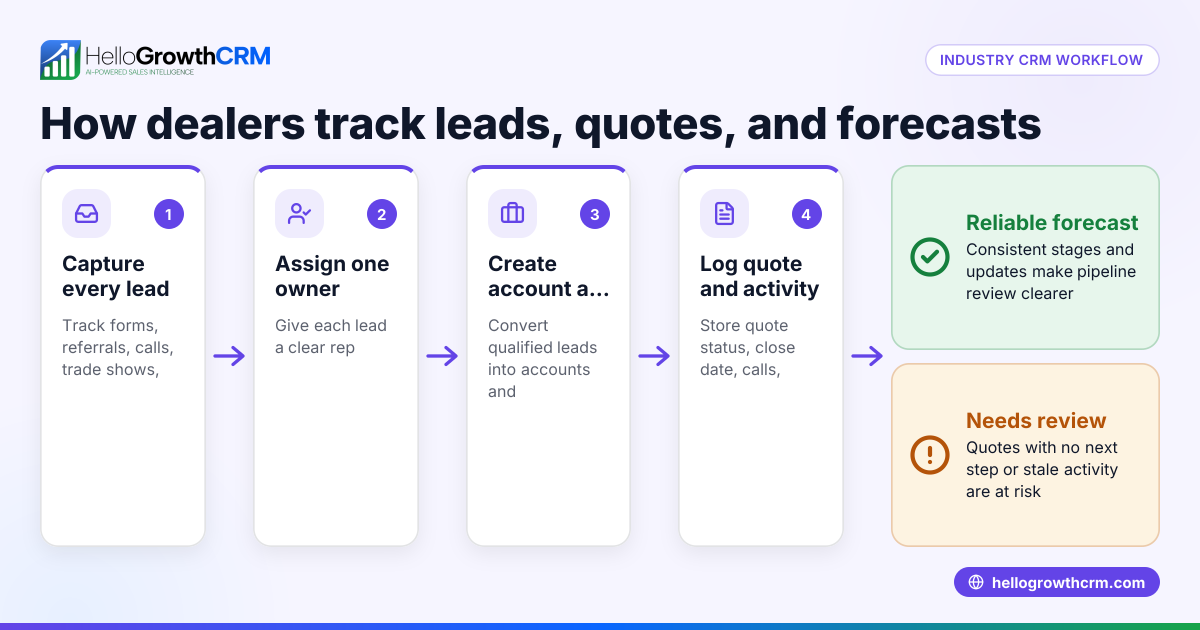
CRM for industrial equipment dealers is a customer relationship management system built to handle long-cycle, high-value equipment sales by tracking RFQs, site visits, quotations, approvals, distributor and direct leads, and after-sales follow-up in one shared workflow that sales, service, and management can trust.
Industrial equipment dealers rarely lose deals because of weak demand alone. They lose them because inquiries sit in inboxes, site visit notes stay in rep notebooks, quote versions get scattered, and service teams never see the promises made during the sale. That is exactly the gap HelloGrowthCRM is built to close.
Key Takeaways
- Industrial equipment dealers need CRM workflows that match RFQs, technical qualification, field inspections, quotation control, and post-sale service.
- A generic contact database is not enough for equipment sales with multiple stakeholders, long approvals, and distributor-direct channel overlap.
- HelloGrowthCRM helps centralize leads, automate rep handoffs, track quote status, and connect sales activity with service follow-up.
- Pipeline visibility matters most when deals depend on site visits, application fit, financing, procurement, and delivery windows.
- Managed RevOps can help dealers standardize stages, SLAs, ownership rules, and reporting when complex pipelines start to stall.
Why industrial equipment dealers need a specialized CRM
A CRM for industrial equipment dealers needs to do more than store contacts; it must manage RFQs, technical discovery, field activity, quote revisions, internal approvals, and service handoffs across long sales cycles so no deal progress, customer requirement, or post-sale commitment gets lost between teams.
Industrial equipment sales are operationally messy. A buyer may start with a website form, a distributor referral, a trade show scan, or a rep’s WhatsApp message. From there, the process often includes:
- application questions
- product fit checks
- site visits
- engineering input
- commercial negotiation
- credit or finance review
- order confirmation
- installation coordination
- warranty and service tracking
A basic CRM can store names and notes. It usually cannot control this workflow without heavy customization.
In practice, I have audited equipment pipelines where 30% of open opportunities had no next step date. The common cause was simple. The real deal activity lived outside the CRM in email threads, spreadsheets, and field rep memory. Once that happens, forecast quality falls fast.
According to Gartner’s CRM topic overview, CRM strategy is central to improving commercial execution, especially when customer interactions span multiple teams and channels. That matters even more in industrial distribution, where direct and partner-led deals often overlap.
Common pain points dealers face
Most industrial equipment dealers run into the same bottlenecks:
- RFQs arrive from too many channels
- lead ownership is unclear between branch, territory, and product specialists
- site visit findings are captured inconsistently
- quote versions are hard to track
- managers cannot see approval delays
- post-sale follow-up is disconnected from the original opportunity
With HelloGrowthCRM, teams can combine lead capture, Smart Inbox, Meeting Scheduler, and Sales Task Boards so the workflow stays visible from first inquiry to repeat order.
Why generic CRM setups fail here
Generic setups fail because they model a simple linear deal. Equipment sales are not linear. A deal may move forward commercially but pause technically. It may split into multiple quotation options. It may involve distributor pricing on one line and direct delivery on another.
That is why many dealers need an AI CRM with field-specific process control rather than just account storage.
What the ideal CRM workflow looks like for industrial equipment dealers
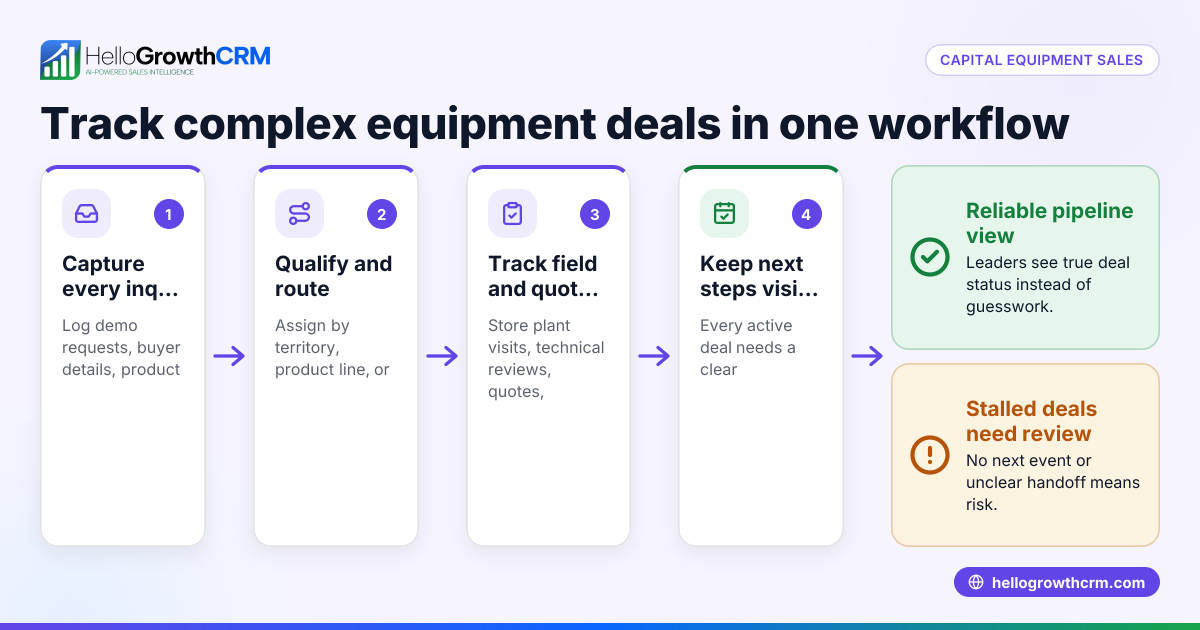
The ideal CRM workflow for industrial equipment dealers captures every commercial and technical milestone in sequence, from inquiry intake and qualification to site visit, quote creation, approval, negotiation, order confirmation, delivery, and after-sales follow-up, while keeping ownership, status, and next actions visible at every stage.
A strong workflow should feel simple to reps but structured enough for managers.
Stage 1: Capture RFQs from every source
Industrial buyers do not all use forms. Some email a PDF RFQ. Some message on WhatsApp. Some come through channel partners. Some call branch offices.
HelloGrowthCRM helps unify these inputs through Gmail, WhatsApp, Twilio, and All Integrations. That reduces the risk of missed inquiries and duplicate accounts.
A clean intake process should capture:
- company and site details
- equipment category
- application or use case
- quantity and budget range
- urgency and required delivery date
- source type: direct, distributor, referral, inbound marketing
Stage 2: Qualify for fit and urgency
Not every RFQ deserves the same speed or field time. Qualification needs exact criteria. In this industry, I prefer a practical framework built around application fit, installed base, urgency, budget realism, decision authority, and delivery constraints. If a deal is strategic, I add MEDDPICC-style checks for metrics, economic buyer, and decision process.
This is where AI Lead Scoring helps teams sort high-probability opportunities from low-fit inquiries.
Stage 3: Schedule and document site visits
For many industrial categories, site visits are not optional. Reps need to inspect layout, load conditions, utilities, access, operator workflow, and safety requirements.
In one rollout we did with a 12-person sales team selling processing equipment, the biggest win came from making site visit forms mandatory before quote creation above a certain deal size. Quote rework dropped because engineering got cleaner inputs from the field.
Use structured fields for:
- current equipment setup
- technical constraints
- photos and documents
- buyer pain points
- competitor installed base
- risk flags
- expected buying timeline
Stage 4: Control quotation versions and approvals
Quotes often branch. Option A may be standard configuration. Option B may include service. Option C may include financing or accessories. Without version control, sales managers lose visibility quickly.
With Proposal Builder, Revenue Attribution, and approval workflows inside HelloGrowthCRM, teams can track quote value, status, revisions, and win rate by product line and lead source.
Stage 5: Hand off to service and account growth
The sale is not over at PO receipt. Delivery, installation, warranty, training, AMC renewals, spare parts, and service response all affect lifetime value.
Harvard Business Review has repeatedly highlighted that revenue growth depends on coordinated customer-facing teams, not isolated selling motions, across its sales topic coverage. Industrial dealers see that every day. A poor handoff damages trust and future orders.
Core CRM features industrial equipment dealers should prioritize
The best CRM features for industrial equipment dealers are those that reduce response delays, standardize field data, make quote progress visible, and connect sales with service, because these are the exact points where complex equipment opportunities usually slow down or fail.
Feature lists can get abstract. For dealers, the real question is simpler: what removes friction from a live deal?
Lead routing and territory control
When direct and distributor channels overlap, ownership rules must be explicit. HelloGrowthCRM supports routing with Territory Management so inbound RFQs can go to the right branch, country manager, distributor owner, or product specialist.
Set routing by:
- geography
- product category
- key account status
- channel type
- deal size threshold
Activity capture across field and office teams
Reps in this sector work on the road. If the CRM cannot capture updates fast, it will not be used consistently.
That is why many dealers pair mobile-friendly logging with CRM Dialer, Email Automation, and Google Meet or Microsoft Teams for remote reviews and follow-ups.
Pipeline and quote visibility
Managers need to answer basic questions quickly:
- Which RFQs are aging?
- Which site visits are overdue?
- Which quotes are awaiting approval?
- Which deals have no next step?
- Which product lines are slipping forecast?
HelloGrowthCRM’s AI Pipeline Management, AI Deal Insights, and Sales Forecasting are useful here because they show bottlenecks before quarter-end surprises.
Post-sale follow-up and service coordination
After-sales is where dealers protect margin. Renewals, consumables, parts, upgrades, and referrals come from disciplined follow-up.
For teams with service-led expansion motions, Customer Health Score can help flag accounts that need proactive attention after delivery.
HelloGrowthCRM vs generic CRM for industrial equipment dealers
HelloGrowthCRM for industrial equipment dealers is better suited than a generic CRM when the sales process includes RFQs, site visits, quote revisions, channel handoffs, and service follow-up, because it combines revenue workflow structure with automation and managed RevOps support for complex B2B selling environments.
This is also where I should be clear: HelloGrowthCRM is our product, so this comparison reflects that perspective. The goal is not to claim every dealer needs the same setup. Small dealers with short cycles may need less process. Multi-branch or multi-country dealers usually need more.
| Capability | Generic CRM setup | HelloGrowthCRM for equipment dealers |
|---|---|---|
| RFQ intake from multiple channels | Often fragmented | Centralized with inbox and integrations |
| Site visit process | Usually manual notes | Structured tasks, forms, and ownership |
| Quote version tracking | Often outside CRM | Visible within deal workflow |
| Sales to service handoff | Weak by default | Shared record and follow-up workflow |
| Direct vs distributor ownership | Requires custom rules | Supported with routing and territory logic |
| Pipeline risk visibility | Basic stage view | AI-driven deal and pipeline insights |
| RevOps support | Internal team dependent | Can be supported by Managed RevOps |
A useful next step is to review Features and compare them with your current workflow gaps rather than buying based on brand recognition alone.
How to implement crm for industrial equipment dealers: Step-by-Step
Implementing CRM for industrial equipment dealers works best when you map the real equipment sales journey first, then define stages, ownership rules, RFQ fields, site visit standards, quote controls, and service handoffs before turning on automation, dashboards, and team-wide reporting.
1. Map your actual sales path
List every step from inquiry to after-sales service. Include channel partner handoffs, engineering reviews, finance checks, and installation milestones. Do not copy another company’s pipeline.
2. Define stage exit criteria
Set clear rules for when a deal moves stages. For example, “Site Visit Complete” should require visit date, technical notes, decision maker, and next action.
3. Standardize RFQ and site visit data
Create required fields for application, capacity, site constraints, urgency, and quote type. This is the foundation for reporting and rep handoffs.
4. Set ownership and SLA rules
Decide who owns direct leads, distributor leads, branch leads, and strategic accounts. Add response-time targets so RFQs do not sit untouched.
5. Build quote and approval workflows
Define when a rep can issue a quote, when manager approval is needed, and how revisions are tracked. This keeps pricing and margin discipline intact.
6. Connect communication channels
Integrate email, phone, meetings, and messaging. HelloGrowthCRM customers often use Slack, Calendly, and Zapier to reduce manual updates.
7. Launch dashboards that match leadership needs
Track RFQ response time, site visit completion rate, quote aging, stage velocity in days, conversion by product line, and service follow-up completion.
8. Review and improve monthly
When I have audited pipelines like this, the best gains came from monthly stage reviews. Teams usually find one broken handoff, one weak field, and one reporting blind spot that can be fixed fast.
Managed RevOps helps keep complex equipment pipelines moving
Managed RevOps helps industrial equipment dealers keep complex pipelines moving by turning scattered sales activity into a governed operating system with stage definitions, ownership rules, SLA tracking, reporting, and ongoing process tuning, especially when internal CRM administration time is limited.
Many dealers know what is broken. They just do not have time to fix it while running branches, field teams, and service operations.
That is where Managed RevOps can help. Instead of only deploying software, the focus shifts to the mechanics of revenue execution:
- lead routing logic
- stage hygiene
- quote approval paths
- forecast review cadence
- service handoff rules
- dashboard design
- rep adoption
For teams under 50 reps, this approach is usually enough to create consistency without overengineering. Above that size, expect to need deeper role-based workflows, stronger data governance, and more formal admin ownership.
Nucleus Research has found that CRM pays back meaningfully when adoption and process are strong, reporting an average return of $8.71 for every dollar spent on CRM in its research summary cited by Forbes. The exact return varies by deployment quality, but the lesson is clear: process discipline matters as much as software choice.
If your equipment sales process includes RFQs, site inspections, technical quotes, and after-sales coordination, HelloGrowthCRM gives you a practical way to run it in one system. You can explore Pricing, book a Demo, or start a Free Trial to see how it fits your team.
About the author
Arjun Mehta is a Sales Operations Lead at HelloGrowthCRM with 11 years of experience in B2B SaaS, CRM implementation, and revenue operations. He has worked with manufacturers, distributors, and dealer networks to design pipelines that connect lead intake, field sales activity, and after-sales follow-up. One project that informed this article was a CRM redesign for a multi-branch equipment seller that needed to unify distributor RFQs, site visit reporting, and quotation approvals across three regions. He writes from hands-on RevOps experience inside HelloGrowthCRM, the product discussed in this article.
Frequently Asked Questions
Q: What is the best CRM for industrial equipment dealers?
A: The best CRM for industrial equipment dealers is one that handles RFQs, site visits, quotation tracking, approvals, and after-sales follow-up in one workflow. For dealers with complex pipelines, HelloGrowthCRM stands out because it combines sales automation, visibility, and RevOps support.
Q: Why do industrial equipment dealers need a specialized CRM?
A: Industrial equipment dealers need a specialized CRM because their sales process includes technical qualification, field inspections, multi-step quotes, and service handoffs that generic CRM setups often miss. A specialized setup reduces delays, lost notes, and quote confusion.
Q: Can a CRM track RFQs and quotations for equipment sales?
A: Yes, a CRM can track RFQs and quotations for equipment sales when it is configured for inquiry intake, quote stages, revision history, and approval workflows. The key is to keep every RFQ, visit note, and quote status tied to the same opportunity record.
Q: How does HelloGrowthCRM help with site visits?
A: HelloGrowthCRM helps with site visits by assigning tasks, capturing structured visit notes, storing photos and technical details, and linking findings directly to the deal record. That makes handoffs to managers, engineering, and service teams much cleaner.
Q: How do dealers manage distributor and direct leads in one CRM?
A: Dealers manage distributor and direct leads in one CRM by setting clear ownership rules for territory, channel, product line, and account type. HelloGrowthCRM supports this with routing logic and territory controls so channel conflict is easier to manage.
Q: What metrics should industrial equipment dealers track in CRM?
A: Industrial equipment dealers should track RFQ response time, site visit completion rate, quote aging, stage velocity, win rate, forecast coverage, and post-sale follow-up completion. These metrics show where complex deals are slowing and where revenue is at risk.
Q: Is managed RevOps useful for industrial equipment dealers?
Frequently Asked Questions
Ready to put this into practice?
Set up your pipeline, WhatsApp follow-ups, and AI lead scoring in minutes — free, no credit card.
Try HelloGrowthCRM freeGet CRM tips in your inbox
Join thousands of sales professionals who get weekly insights on CRM strategy, AI automation, and pipeline optimization.

The HelloGrowthCRM team publishes guides on CRM strategy, AI sales tools, and revenue operations for small business sales teams.