HelloGrowthCRM software
Built for real small-business sales teams
HelloGrowthCRM helps reps qualify faster, follow up on time, and close more deals—with practical automation in one place.
- AI lead scoring and pipeline visibility
- Built-in dialer, WhatsApp, and email automation
- Sales forecasting and RevOps-ready reporting
A crm for it staffing firms is a customer relationship and workflow system built to manage the full staffing cycle in one place, from new job requisitions and candidate qualification to client submissions, interview coordination, recruiter follow-ups, and account growth, without forcing teams to stitch together disconnected tools.
Key Takeaways
- IT staffing firms need one shared system for recruiters, account managers, and leaders
- The best CRM for staffing tracks both client pipelines and candidate pipelines together
- Fast submittal speed depends on automation, structured stages, and clean recruiter handoffs
- HelloGrowthCRM helps firms centralize outreach, follow-ups, reporting, and workflow automation
- Managed RevOps support matters when agencies want scale without building a custom stack
- AI features can improve prioritization, but only if the underlying process is well defined
Why IT staffing firms need a specialized CRM
A CRM for IT staffing firms is different from a general sales CRM because staffing teams must manage two moving pipelines at once: open jobs and active candidates. The system has to connect requisitions, recruiter activity, submissions, interviews, client feedback, and post-submittal follow-up in one operational view.
Most general CRMs were built for linear B2B sales. IT staffing is not linear. You are balancing:
- Client relationships
- Open roles
- Candidate sourcing
- Screening steps
- Submission deadlines
- Interview loops
- Offer status
- Redeployment or backfill opportunities
That creates more objects, more handoffs, and more status changes than a standard account executive workflow.
In practice, I have seen staffing teams lose speed in three places. First, job details live in email or chat. Second, recruiter notes are stored in personal systems. Third, submittal status gets updated too late. When that happens, leadership cannot trust pipeline reports, and clients feel slow response times.
A specialized setup in HelloGrowthCRM fixes this by giving sales and recruiting one operating system. Account managers can log requisitions, recruiters can work candidate stages, and leaders can review stage conversion, submission aging, and follow-up compliance from one dashboard.
This matters because speed is a competitive advantage in staffing. Firms that submit qualified candidates quickly usually win more business, even when rates are similar.
What workflows should a CRM for IT staffing firms cover?
A CRM for IT staffing firms should cover the core staffing workflow from job intake to client follow-up, including requisition capture, candidate screening, submission tracking, interview scheduling, feedback logging, and account management. If any of those steps happen outside the CRM, reporting breaks and execution slows down.
At minimum, your CRM should support five connected workflows.
1. Job requisition intake
Every req should capture the same fields:
- Client name
- Hiring manager
- Role title
- Skills needed
- Location and work model
- Bill rate or salary band
- Priority level
- Submission deadline
- Interview process
- Compliance notes
A clean intake form reduces back-and-forth. It also gives recruiters better search context.
2. Candidate pipeline management
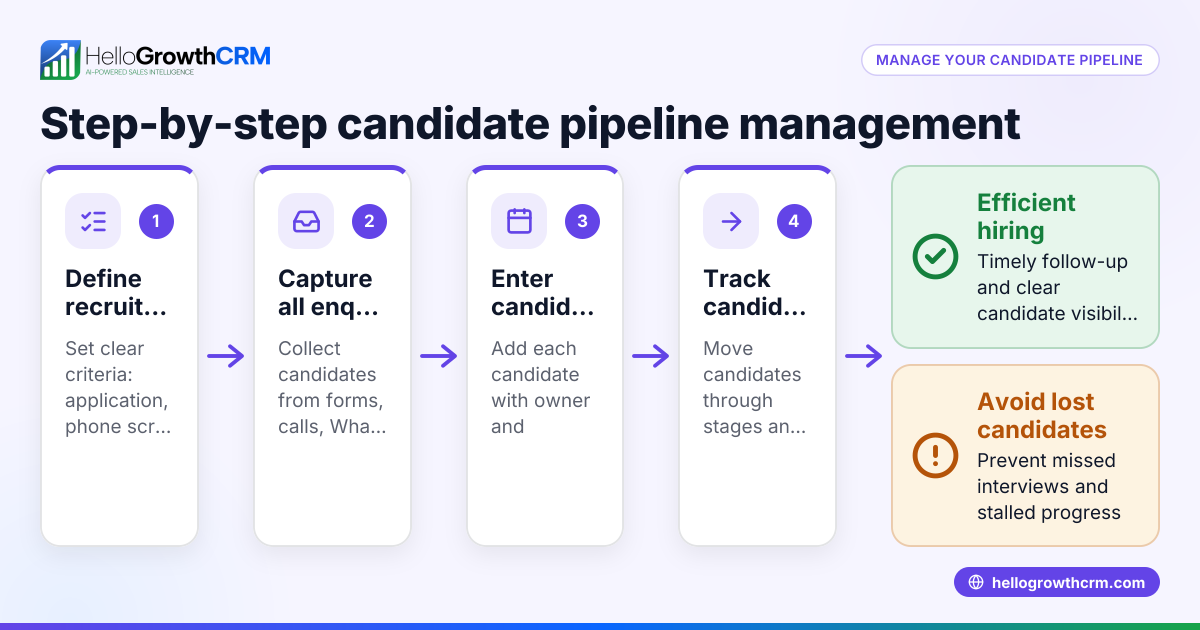
Recruiters need a stage-based flow for each candidate tied to each role. Common stages include:
- Sourced
- Contacted
- Screening scheduled
- Qualified
- Submitted
- Interviewing
- Offer
- Placed
- Rejected
- On hold
With Sales Task Boards, teams can work these stages visually and see stalled records fast.
3. Submission tracking
Submission tracking is where many firms break. A recruiter says a profile was sent. The account manager says the client never saw it. Leadership sees neither side clearly.
Your CRM should record:
- Submission date and time
- Resume version
- Client contact
- Submission channel
- Notes sent with profile
- SLA to client response
- Feedback status
In one rollout we did with a 12-person sales team and 18 recruiters, simply forcing a required submission date and feedback status field cut weekly “where is this candidate?” Slack traffic by more than half. The win was not flashy AI. It was process discipline.
4. Interview coordination and follow-up
Interview scheduling often touches email, calendar, phone, and messaging. That means your CRM must connect with tools like Gmail, Google Meet, Microsoft Teams, and Calendly so the timeline stays complete.
5. Client growth and redeployment
A staffing CRM should not stop at the placement. It should help teams manage renewals, backfills, new reqs, and expansion into other departments. That is where account management and recruiting performance finally connect to revenue.
Which CRM features matter most for IT staffing firms?
The most important CRM features for IT staffing firms are shared recruiter-sales records, custom pipelines, automation, activity capture, reporting, and integrations. These features matter because staffing performance depends on response time, handoff quality, and visibility into every requisition, submission, interview, and client touchpoint.
Here are the features that usually matter most.
Shared client and candidate visibility
Recruiters and sales teams should work from the same record. That includes emails, call notes, meetings, tasks, and status updates. Smart Inbox helps teams keep communication visible instead of buried in personal inboxes.
Automation for repetitive follow-up
Staffing teams repeat the same motions every day:
- Acknowledge new reqs
- Remind recruiters to screen candidates
- Confirm submissions
- Chase client feedback
- Nudge candidates before interviews
- Follow up after interviews
That is where Email Automation and Meeting Scheduler save time.
AI-assisted prioritization
AI helps most when volume is high. AI Lead Scoring can help account teams prioritize active clients or inbound opportunities. AI Pipeline Management and AI Deal Insights can surface stuck reqs, aging submissions, or accounts with weak follow-up patterns.
Forecasting and staffing operations reporting
Leaders need more than total pipeline. They need operational metrics like:
- Req aging by client
- Recruiter response time
- Time from req open to first submission
- Submission-to-interview rate
- Interview-to-offer rate
- Fill rate
- Client follow-up compliance
Sales Forecasting becomes more useful when these operational signals are captured correctly.
Managed support when internal ops is thin
Many staffing firms know what they want but do not have a dedicated RevOps team to build it. Managed RevOps gives firms help with process design, pipeline setup, lifecycle reporting, and automation without hiring a full in-house operations team.
HelloGrowthCRM vs a generic CRM stack for staffing firms
HelloGrowthCRM is a better fit than a generic CRM stack for many IT staffing firms because it centralizes sales, recruiting follow-up, automation, and reporting without requiring a heavy custom build. It works best for agencies that need speed, visibility, and RevOps support more than endless configuration.
A generic stack often looks flexible on paper. In reality, firms end up combining a CRM, spreadsheets, email tools, task apps, meeting tools, and manual reports. That creates duplicate data and weak accountability.
Here is a practical comparison.
| Criteria | HelloGrowthCRM | Generic CRM + add-ons |
|---|---|---|
| Job requisition tracking | Customizable and centralized in one workflow | Often requires custom objects or workarounds |
| Candidate submission tracking | Easy to tie to client follow-up and tasks | Usually split across tools |
| Recruiter and sales visibility | Shared timelines and dashboards | Often siloed by team |
| Follow-up automation | Built into CRM workflows | Needs extra tools or manual setup |
| AI assistance | Available through AI CRM and agents | Varies by vendor and add-on |
| RevOps support | Includes Managed RevOps option | Usually self-serve or consultant-led |
| Time to launch | Faster for lean teams | Longer if heavily customized |
| Best fit | IT staffing firms that want operational simplicity | Teams with large internal admin resources |
To be transparent, HelloGrowthCRM is our product. It is not the right fit for every agency. If you run a very large enterprise staffing operation with deeply specialized ATS requirements and a full internal systems team, you may still need a more complex architecture. But for many small to mid-sized firms, simpler wins.
How HelloGrowthCRM supports the staffing lifecycle
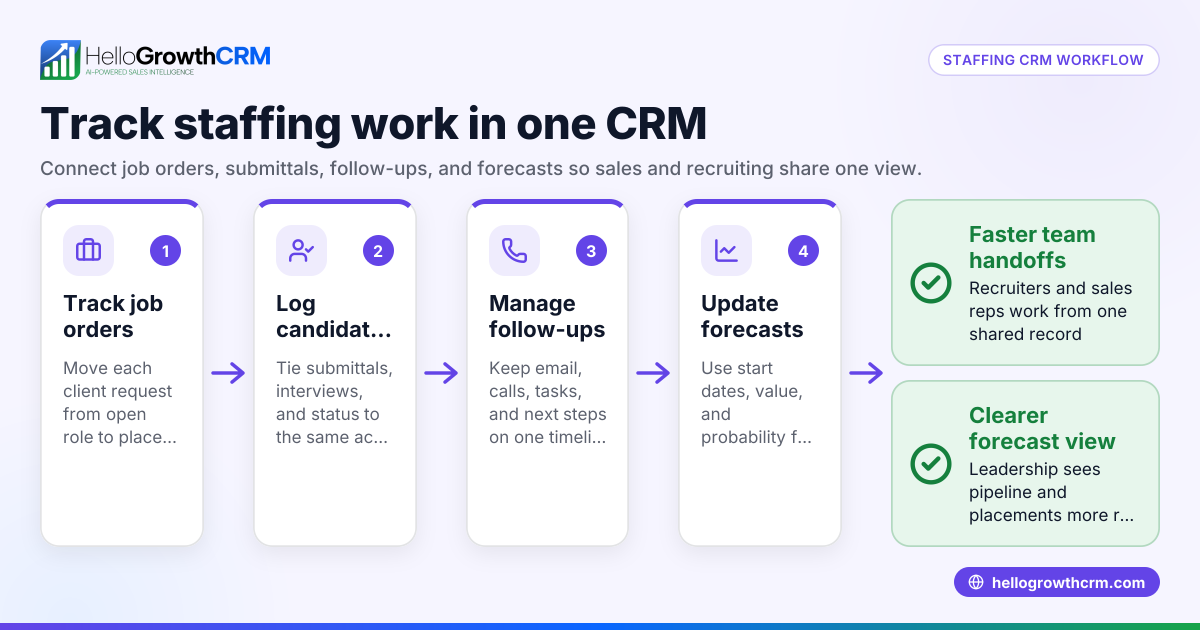
HelloGrowthCRM supports the staffing lifecycle by connecting each stage of the client and candidate journey in one system, so teams can move faster from requisition intake to submission and follow-up. The platform helps staffing firms reduce manual work, standardize process, and make pipeline data more reliable.
From req open to recruiter action
New reqs can trigger assignments, tasks, notifications, and follow-up sequences. With Slack and Zapier, firms can route updates into existing workflows while keeping the CRM as the source of truth.
From candidate outreach to interview scheduling
Recruiters can use CRM Dialer, WhatsApp & SMS CRM, and email automation to reach candidates across channels. That matters in IT staffing where response windows are short and candidate drop-off is real.
From interview to client update
After interviews, teams can log feedback, assign next steps, and trigger reminders for both client and candidate communication. AI Sales Copilot and the Post-Call Agent can help capture notes faster after calls.
From account management to revenue reporting
Client follow-up should not depend on memory. HelloGrowthCRM can trigger touchpoint reminders after submissions, interviews, placements, and periods of inactivity. That helps teams protect existing accounts while hunting for new reqs.
According to the U.S. Bureau of Labor Statistics, employment of software developers is projected to grow 17% from 2023 to 2033, much faster than average for all occupations, which keeps technical hiring demand structurally important for staffing firms source.
Gartner describes CRM as technology that manages a company’s interactions and relationships across the customer lifecycle, which is especially relevant in staffing where each req creates repeated client touchpoints and operational dependencies source.
How to implement a CRM for IT staffing firms: Step-by-Step
Implementing a CRM for IT staffing firms works best when you map the real staffing workflow first, then build the system around stage definitions, handoffs, automation, and reporting. The goal is not to recreate every old spreadsheet. The goal is to make req-to-submittal execution faster and more measurable.
- Map your current workflow
Document how a req moves from intake to fill. Include every handoff, status change, and communication checkpoint. - Define standard stages
Create clear stages for requisitions, candidates, submissions, interviews, and account follow-up. Use stage exit criteria, not vague labels. - Set required fields
Decide what must be captured at req open, candidate qualification, submission, and interview stages. This is where data quality starts. - Build task and follow-up automation
Trigger reminders for recruiter screening, client updates, interview prep, and feedback follow-up. Use Follow-Up Cadence Builder if you need a starting framework. - Connect your core tools
Sync email, calendar, meetings, and communication apps through All Integrations. This keeps activity history complete. - Create role-based dashboards
Recruiters, sales managers, and leadership need different views. Start with submittal speed, stage aging, and follow-up compliance. - Pilot with one team first
Do not launch across the whole agency on day one. Start with one pod, fix stage definitions, then expand. - Measure weekly and refine
Review fill rate, time to first submission, and interview conversion every week. Use Pipeline Health Score and CRM ROI Calculator to track improvement.
When I have audited pipelines like this, the biggest issue is usually not software. It is inconsistent stage behavior. One recruiter marks “submitted” when a resume is sent. Another marks it only after the client confirms receipt. If you do not standardize that, every report lies.
Common mistakes staffing firms make with CRM rollouts
Staffing firms fail with CRM rollouts when they copy a generic sales process, skip stage definitions, or over-customize too early. The result is usually poor adoption, unreliable reports, and more manual work than before. A good rollout stays close to the actual staffing workflow and daily user behavior.
Mistake 1: Treating recruiting and sales as separate systems
That creates blind spots. Recruiters cannot see client context. Sales cannot see candidate progress. Shared visibility matters more than perfect system purity.
Mistake 2: Measuring only placements
Placements are lagging indicators. Leading indicators matter more in staffing operations:
- Time to first recruiter touch
- Time to first qualified candidate
- Time to first submission
- Submission-to-interview conversion
- Client feedback delay
Mistake 3: Automating a broken process
Automation should follow process clarity. It should not replace it.
Mistake 4: Ignoring change management
You need training, stage rules, and manager inspection. A clean Demo helps stakeholders align early, and a guided Free Trial helps teams validate the workflow before full rollout.
The best CRM for IT staffing firms is the one your team will actually use
The best CRM for IT staffing firms is the one that matches real staffing work, gets adopted by recruiters and account managers, and gives leaders accurate visibility into reqs, submissions, interviews, and follow-ups. Ease of use and process fit matter more than feature volume alone.
If your firm is growing, the real question is simple: can your current system help you submit faster, follow up consistently, and spot stalled reqs before clients notice?
HelloGrowthCRM is built for teams that want one place to run sales and staffing execution. You can centralize requisitions, automate recruiter and client follow-up, improve reporting, and add Managed RevOps support without building a complex custom stack. Explore Pricing, review the full Features, or start a Free Trial to see how it fits your agency.
About the author
Avery Cole is a Sales Operations Lead at HelloGrowthCRM with 9 years of experience in B2B SaaS, RevOps, and CRM implementation. Avery works with growth-stage service businesses to design practical pipelines, automation, and forecasting systems that sales and delivery teams will actually use. One project that informed this article was a staffing workflow redesign for a multi-region recruiting firm that needed to unify requisition tracking, submission reporting, and client follow-up across 30 users.
Frequently Asked Questions
Q: What is the best CRM for IT staffing firms?
A: The best CRM for IT staffing firms is the one that manages requisitions, candidate pipelines, submissions, interviews, and client follow-up in one system. For many agencies, HelloGrowthCRM fits well because it combines workflow flexibility, automation, and RevOps support without a heavy custom build.
Q: Can a CRM replace an ATS for an IT staffing agency?
A: A CRM cannot always replace an ATS for an IT staffing agency, because some firms need deep applicant tracking and compliance workflows. For many small and mid-sized firms, though, a CRM can handle much of the client, recruiter, and submission workflow that drives daily execution.
Q: How does a CRM help recruiters submit candidates faster?
A: A CRM helps recruiters submit candidates faster by standardizing req intake, tracking candidate stages, and automating reminders and follow-ups. When job details, communication history, and next steps live in one place, recruiters spend less time chasing information and more time moving candidates.
Q: Should recruiters and sales reps use the same CRM in staffing?
A: Yes, recruiters and sales reps should usually use the same CRM in staffing because the workflow is tightly connected. Shared visibility improves handoffs, reduces duplicate work, and makes client reporting more reliable.
Q: What features should an IT staffing CRM have?
Frequently Asked Questions
Ready to put this into practice?
Set up your pipeline, WhatsApp follow-ups, and AI lead scoring in minutes — free, no credit card.
Try HelloGrowthCRM freeGet CRM tips in your inbox
Join thousands of sales professionals who get weekly insights on CRM strategy, AI automation, and pipeline optimization.

The HelloGrowthCRM team publishes guides on CRM strategy, AI sales tools, and revenue operations for small business sales teams.