HelloGrowthCRM software
Built for real small-business sales teams
HelloGrowthCRM helps reps qualify faster, follow up on time, and close more deals—with practical automation in one place.
- AI lead scoring and pipeline visibility
- Built-in dialer, WhatsApp, and email automation
- Sales forecasting and RevOps-ready reporting
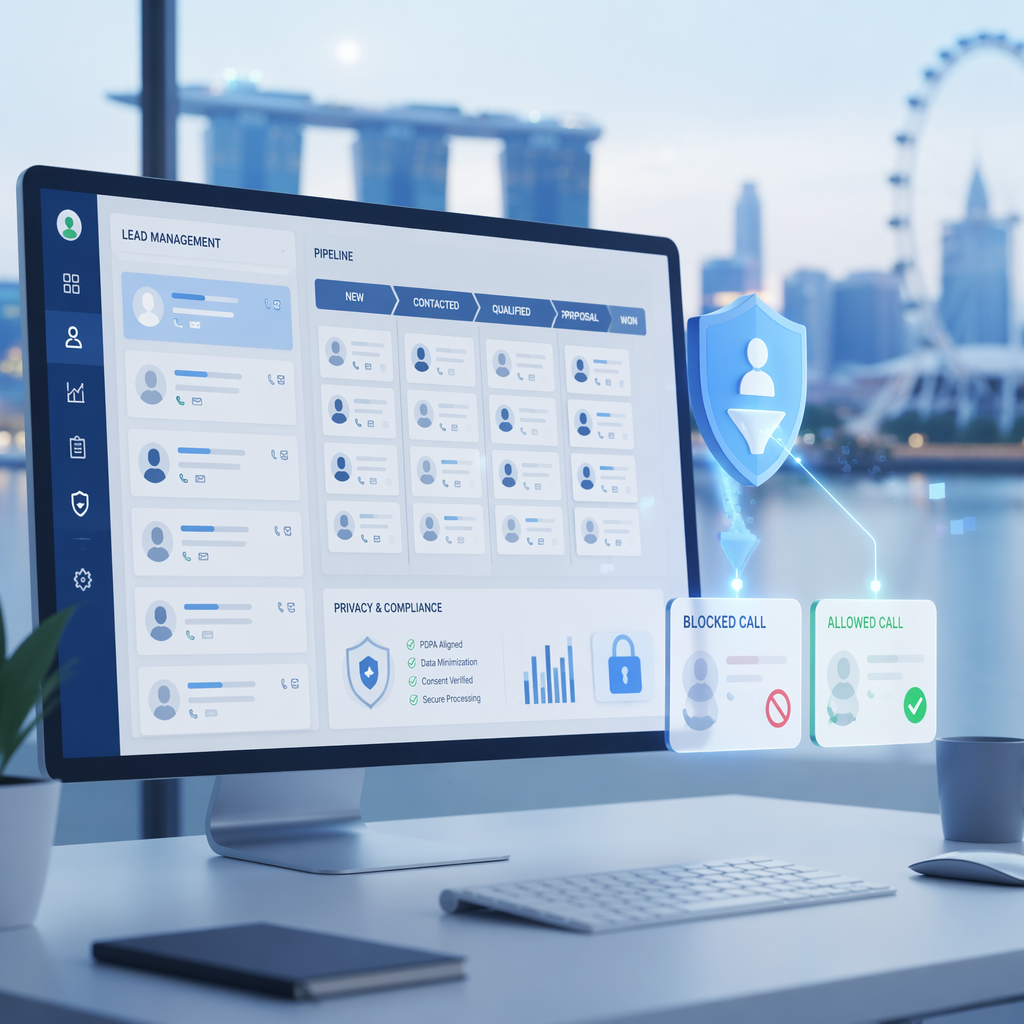
Managing pdpa dnc compliant crm singapore consent tracking means using a CRM system that records customer consent, checks the Singapore Do Not Call (DNC) registry, stores proof of permission, and automatically suppresses contacts who opted out—so B2B sales teams can run outbound campaigns without violating PDPA rules or PDPC enforcement guidelines.
Key Takeaways
- Singapore’s PDPA requires organisations to track marketing consent and respect the national Do Not Call registry before sending marketing messages.
- A CRM with built‑in consent tracking helps sales teams log permission, manage opt‑outs, and maintain audit trails.
- HelloGrowthCRM templates automate suppression lists, outreach rules, and compliant follow‑ups for B2B teams.
- Automated checks reduce risk when running outbound campaigns across Singapore locations like the CBD, Jurong East, and Tampines.
- Integrating consent workflows with tools like Email Automation and WhatsApp & SMS CRM keeps outreach compliant while maintaining pipeline growth.
What Does PDPA and DNC Compliance Mean for Singapore B2B Sales Teams?
PDPA and DNC compliance in Singapore means businesses must obtain valid consent before sending marketing messages and must check the national Do Not Call registry to ensure recipients have not opted out of telemarketing, SMS, or fax promotions before contacting them.
Singapore’s Personal Data Protection Act (PDPA) governs how organisations collect, use, and disclose personal data. For outbound sales teams, the most relevant rules involve marketing consent and the Do Not Call registry.
The DNC registry lets individuals opt out of receiving:
- Marketing calls
- SMS or MMS marketing messages
- Fax advertisements
Before sending promotional messages, organisations must check whether the phone number appears on the registry. The official PDPC guidance states organisations must check the registry within 30 days before sending the message.
https://www.pdpc.gov.sg/individuals/do-not-call-registry
For sales teams working out of Singapore’s CBD or technology hubs like Jurong East, this rule applies to everyday activities such as:
- Cold outreach campaigns
- SMS promotions
- WhatsApp marketing
- Telemarketing calls
Without proper tracking, it becomes easy for a team member to message someone who opted out months earlier.
That’s why compliant outbound teams rely on a CRM system that records consent and automatically prevents outreach when permission is missing.
Inside platforms like AI CRM, consent data sits alongside leads, deals, and communication history. This creates a single source of truth for sales and compliance teams.
Why Consent Tracking Is Critical for PDPA Compliance
Consent tracking is critical for PDPA compliance because organisations must be able to prove when and how an individual gave permission for marketing communications, maintain records of withdrawals, and ensure marketing messages are only sent to contacts with valid consent status.
Under the PDPA, consent must be:
- Clear — the person understands what they are agreeing to
- Purpose‑specific — the use of data must be explained
- Revocable — individuals can withdraw consent anytime
This creates operational challenges for B2B sales teams.
Typical outbound workflows involve:
- LinkedIn lead generation
- Website demo requests
- Event registrations
- Email follow‑ups
- WhatsApp messages
- Sales calls
Each of these touchpoints may generate consent differently.
The Compliance Problem Most Sales Teams Face
In many organisations, consent data is scattered across tools:
- marketing forms in a marketing platform
- lead spreadsheets
- SMS tools
- CRM notes
- event registration systems
When I have audited pipelines for mid‑size SaaS companies, I often see three different consent records for the same contact. None of them match.
That creates real risk.
If a contact withdraws consent via email but the sales team continues messaging them through WhatsApp, the organisation may breach PDPA obligations.
What Proper Consent Tracking Includes
A compliant CRM should track:
- Consent source (form, event, call, etc.)
- Timestamp of consent
- Purpose of consent
- Opt‑out records
- DNC registry status
- Communication channel permissions
In HelloGrowthCRM, these fields are stored directly in the contact record and tied to messaging tools like Smart Inbox and CRM Dialer. If a number is restricted, outreach is automatically blocked.
This removes manual compliance guesswork.
How HelloGrowthCRM Handles PDPA and DNC Consent Tracking
HelloGrowthCRM handles PDPA and DNC consent tracking by storing structured consent fields inside every contact record, automating suppression lists for restricted contacts, logging consent events from forms and communications, and blocking outreach through email, SMS, WhatsApp, or calling tools when consent requirements are not met.
Outbound compliance should not depend on individual sales reps remembering rules.
Instead, it should be automated inside the CRM workflow.
HelloGrowthCRM approaches this with three layers:
- Consent capture
- Compliance checks
- Automated suppression
1. Consent Capture Templates
Sales and marketing teams can use predefined templates for:
- website demo forms
- gated content
- webinar registrations
- outbound follow‑up confirmation
Each template records:
- consent checkbox text
- timestamp
- communication channels allowed
- source of consent
When integrated with tools like Gmail or Google Meet, consent events from meetings and email confirmations are logged automatically.
2. Automated Suppression Lists
If a contact:
- appears on the DNC registry
- withdraws consent
- flags a message as unwanted
HelloGrowthCRM automatically moves them to a suppression list.
These suppression lists sync with outreach tools including:
Reps cannot accidentally message restricted contacts.
3. Compliance Audit Trail
Every consent action is recorded in the activity timeline.
That includes:
- consent given
- consent withdrawn
- DNC checks
- communication attempts
This creates an audit log useful during compliance reviews.
When we rolled this out with a 12‑person outbound sales team targeting manufacturing firms in Jurong East, the biggest improvement was operational clarity. Reps no longer asked, “Can I message this lead?” The CRM answered that automatically.
Manual Compliance vs CRM-Based Consent Tracking
Manual compliance processes rely on spreadsheets and individual checks, while CRM-based consent tracking centralizes consent data, automates registry checks, blocks non-compliant outreach, and maintains audit logs—dramatically reducing compliance risk and operational overhead for Singapore B2B sales teams.
| Compliance Factor | Manual Process | CRM-Based Tracking (HelloGrowthCRM) |
|---|---|---|
| Consent storage | Multiple spreadsheets | Single contact record |
| DNC checks | Manual lookup | Automated suppression |
| Opt-out tracking | Often missed | Logged automatically |
| Outreach protection | Depends on rep discipline | System blocks restricted contacts |
| Audit trail | Hard to prove | Full communication history |
| Integration with sales tools | None | Integrated with messaging and pipeline tools |
Manual systems may work for very small teams. But once a company runs outbound campaigns across multiple channels, the risk increases quickly.
For companies with fewer than 10 reps, manual processes can sometimes hold. Beyond that, automated workflows become essential.
How to Set Up PDPA and DNC–Safe Outreach in HelloGrowthCRM
Setting up PDPA and DNC–safe outreach in HelloGrowthCRM involves creating consent fields, connecting outreach channels, automating DNC suppression checks, and building outbound workflows that prevent messages from sending unless valid consent and registry status conditions are satisfied.
1. Create Consent Fields
Define structured fields inside the CRM:
- marketing consent status
- consent source
- consent timestamp
- allowed communication channels
These fields appear on every lead and contact record.
2. Build Consent Capture Templates
Create templates for:
- website lead forms
- webinar registrations
- sales call follow‑ups
These templates standardise how consent language appears.
3. Integrate Messaging Channels
Connect outreach channels through integrations like:
This allows the CRM to enforce consent checks before sending messages.
4. Enable Automated Suppression Lists
Configure rules that automatically restrict contacts who:
- withdraw consent
- appear in DNC registry
- request marketing removal
Suppression lists sync with all outbound tools.
5. Build Compliant Outreach Workflows
Sales teams can run outreach sequences using:
Each step checks consent status before sending.
6. Track Compliance in Pipeline Reports
Managers can monitor compliance through dashboards powered by tools like AI Pipeline Management.
This shows:
- consent coverage
- suppressed contacts
- outreach activity logs
Aligning CRM Outreach With Singapore’s Regulatory Environment
Aligning CRM outreach with Singapore regulations means embedding PDPA consent rules, Do Not Call registry checks, and data protection practices directly into sales workflows so marketing and sales teams can operate efficiently while staying compliant with PDPC guidance and national digital governance standards.
Singapore has one of the most structured data protection environments in Southeast Asia.
The Personal Data Protection Commission (PDPC) provides guidance on consent, marketing practices, and enforcement.
https://www.pdpc.gov.sg/
Meanwhile, digital adoption programs led by the Infocomm Media Development Authority (IMDA) encourage businesses to adopt trusted digital tools and data governance practices.
https://www.imda.gov.sg/
For B2B organisations operating across Singapore:
- sales teams in the CBD
- industrial companies in Jurong
- technology startups in One‑North
- SMEs in Tampines
PDPA‑aligned CRM workflows provide both operational efficiency and regulatory protection.
Additional Compliance Considerations
Singapore teams should also account for:
- PEPPOL e‑invoicing records for B2B transactions
- internal data retention policies
- consent withdrawal procedures
Modern CRM systems help unify these processes.
For example, HelloGrowthCRM integrates compliance workflows with tools like Revenue Attribution and Customer Health Score, ensuring data governance remains consistent across marketing, sales, and customer success.
Start Running PDPA‑Safe Outbound Campaigns With HelloGrowthCRM
Outbound sales in Singapore does not have to slow down because of compliance requirements.
With the right CRM workflow, consent tracking, DNC checks, and outreach automation can run in the background while your team focuses on closing deals.
HelloGrowthCRM provides built‑in consent templates, suppression rules, and automated messaging controls designed for Singapore’s regulatory environment. You can explore the platform through a Free Trial, review full Features, or book a personalised Demo to see how compliant outbound campaigns work in practice.
About the author
Daniel Tan is a Revenue Operations Lead at HelloGrowthCRM with 11 years of experience building CRM and outbound sales systems for B2B SaaS teams in Southeast Asia. He has implemented CRM workflows for startups and mid‑market companies across Singapore. In one project, he led a PDPA‑aligned CRM rollout for a 25‑person sales organisation targeting logistics firms across Jurong and the Singapore CBD.
Frequently Asked Questions
Q: What is PDPA and DNC compliant CRM consent tracking in Singapore?
A: PDPA and DNC compliant CRM consent tracking in Singapore means storing customer marketing consent, checking the national Do Not Call registry before outreach, recording opt‑outs, and maintaining an audit trail to prove compliance with Personal Data Protection Act requirements.
A CRM system centralises these records so sales teams cannot accidentally contact restricted numbers.
Q: Do B2B companies in Singapore need to follow the Do Not Call registry?
A: Yes, B2B companies in Singapore must still follow the Do Not Call registry when sending marketing messages to Singapore phone numbers. The PDPA does not exempt organisations simply because outreach targets business contacts.
However, certain transactional or relationship messages may be allowed depending on context.
Q: How often must organisations check the Singapore DNC registry?
A: Organisations must check the Singapore Do Not Call registry within 30 days before sending marketing messages to a phone number. This requirement ensures companies do not contact individuals who recently registered their numbers on the opt‑out list.
Automated CRM checks make this process easier.
Q: How does HelloGrowthCRM prevent non-compliant outreach?
A: HelloGrowthCRM prevents non-compliant outreach by enforcing consent rules before messages are sent. If a contact appears on a suppression list or lacks valid consent, the CRM blocks email, SMS, WhatsApp, or call attempts automatically.
This reduces compliance risk for sales teams.
Q: Can a CRM store proof of marketing consent?
A: Yes, a CRM can store proof of marketing consent by logging the source, timestamp, and context of permission. These records help organisations demonstrate compliance during audits or regulatory reviews.
Consent logs should be attached directly to contact records.
Q: What happens if someone withdraws consent?
A: If someone withdraws consent, organisations must stop sending marketing messages to that individual. A compliant CRM should update suppression lists immediately and prevent further outreach.
Maintaining accurate opt‑out records is a core PDPA obligation.
Q: Is WhatsApp outreach allowed under Singapore PDPA?
A: WhatsApp outreach can be allowed under Singapore PDPA if valid consent exists and the number is not registered on the Do Not Call registry for SMS messages. Companies must still provide a clear opt‑out option.
CRM systems help enforce these rules automatically.
Q: How can small Singapore sales teams stay compliant while doing outbound sales?
A: Small Singapore sales teams can stay compliant by centralising outreach inside a CRM that tracks consent, runs DNC checks, and blocks restricted contacts. Automating these controls reduces manual errors and simplifies PDPA compliance.
This approach works especially well for teams under 50 sales reps.
Frequently Asked Questions
Ready to put this into practice?
Set up your pipeline, WhatsApp follow-ups, and AI lead scoring in minutes — free, no credit card.
Try HelloGrowthCRM freeGet CRM tips in your inbox
Join thousands of sales professionals who get weekly insights on CRM strategy, AI automation, and pipeline optimization.

The HelloGrowthCRM team publishes guides on CRM strategy, AI sales tools, and revenue operations for small business sales teams.