HelloGrowthCRM software
Built for real small-business sales teams
HelloGrowthCRM helps reps qualify faster, follow up on time, and close more deals—with practical automation in one place.
- AI lead scoring and pipeline visibility
- Built-in dialer, WhatsApp, and email automation
- Sales forecasting and RevOps-ready reporting
A UK GDPR consent tracker template for B2B lead capture is a structured record inside your CRM that logs who consented, what they were told, when and how they opted in, which lawful basis applies, and how that evidence supports PECR-safe follow-ups and future audit checks.
Key Takeaways
- A consent tracker should store the contact, purpose, channel, timestamp, source form, policy version, and proof of the opt-in event.
- UK teams must treat UK GDPR, the Data Protection Act 2018, and PECR as connected rules, not separate admin tasks.
- HelloGrowthCRM helps sales and marketing teams capture consent from forms, cookie preferences, and follow-up workflows without losing speed.
- B2B outreach still needs care under PECR, especially for email and SMS marketing, and auditability matters when contacts object or unsubscribe.
- Companies House enrichment can improve account context, but it should not overwrite or invent consent status.
- The safest setup is one shared system that ties consent records to campaigns, automations, and rep activity.
What is a UK GDPR consent tracker template for B2B lead capture?
A UK GDPR consent tracker template for B2B lead capture is a repeatable CRM framework that records consent evidence and related privacy data for every lead, so your team can prove what happened, respect preferences, and send PECR-safe follow-ups without relying on spreadsheets or rep memory.
In practice, the template should answer six questions fast:
- Who is the person?
- What did they consent to?
- When did they consent?
- How did they consent?
- What wording did they see?
- What should happen next?
For British teams, that matters because consent is not just a tick box. It is an evidence trail. The ICO guidance on consent is clear that consent must be freely given, specific, informed, and unambiguous. If you cannot prove that, you are in a weak position.
Inside HelloGrowthCRM, this template fits naturally with AI CRM, Email Automation, Smart Inbox, and Revenue Attribution. That means your data model and your outbound execution stay aligned.
When I have audited pipelines like this, the biggest risk is not bad intent. It is fragmented tooling. Marketing has form data. Sales has inbox data. Operations has a spreadsheet. Nobody can show one trusted consent record in under 30 seconds.
What the template should include
Your consent tracker template should include these fields:
- Lead full name
- Work email
- Company name
- Job title
- Country or region
- Consent status
- Consent purpose
- Communication channels allowed
- Consent timestamp
- Capture source
- Form or landing page ID
- Privacy notice version
- Cookie preference status where relevant
- Lawful basis note
- Unsubscribe timestamp
- Withdrawal source
- Record owner
- Last compliance review date
If you want a fast way to model this in your own process, map it alongside your RevOps Maturity Assessment and CRM ROI Calculator work. Good consent design reduces both risk and wasted follow-up effort.
Why do UK B2B teams need a consent tracker for PECR-safe follow-ups?
UK B2B teams need a consent tracker for PECR-safe follow-ups because website forms, email nurtures, SMS, and cookie-led retargeting often create different records of permission, and without one audit trail your team can send messages that are hard to justify or impossible to defend later.
The legal and practical issue is simple. UK GDPR governs personal data handling. The Data Protection Act 2018 overview sits alongside it in UK law. PECR adds extra rules for electronic marketing and cookies. So a lead capture flow is never just a form design task.
The ICO guide to PECR explains that the rules apply to electronic marketing messages and the use of cookies and similar technologies. That is why your website form, cookie banner, and outbound sequence should not live in separate compliance worlds.
Where teams usually go wrong
I see the same four mistakes in London and Manchester B2B teams:
- They store a single “opted in = yes” field with no proof
- They mix sales follow-up logic with marketing consent logic
- They enrich a lead and assume that means they can market freely
- They cannot tell which privacy notice version a contact saw
In one rollout we did with a 12-person sales team, reps were moving quickly after demo requests, but marketing was also dropping the same contacts into a nurture stream. The contact records had source data, but not channel-specific permission data. We fixed it by creating separate fields for email marketing consent, sales contact basis, and unsubscribe evidence.
Why this matters commercially
Poor consent tracking does not just create legal risk. It hurts revenue operations:
- Reps lose time checking who can be contacted
- Marketing suppresses too many leads out of caution
- Attribution becomes unreliable
- Unsubscribe handling gets messy across tools
If you centralise the record in HelloGrowthCRM and connect your Meeting Scheduler, WhatsApp & SMS CRM, Gmail, and Slack workflows, the team can move faster with fewer edge-case mistakes.
What should HelloGrowthCRM’s consent tracker template record?
HelloGrowthCRM’s consent tracker template should record identity, source, purpose, proof, policy version, channel permissions, and change history so a UK team can prove consent, honour withdrawals, and control automations from one reliable CRM record instead of scattered systems.
Here is the practical structure I recommend.
Core identity and source fields
Use fields that identify the person and the origin of the lead:
- Contact ID
- Full name
- Work email
- Company
- Domain
- Source channel
- Original campaign
- Landing page URL
- Form name
- UTM parameters
These fields matter because evidence without source context is weak.
Consent evidence fields
These are the fields that most teams miss:
- Consent captured: yes or no
- Consent captured at: date and time
- Consent channel: web form, chatbot, event scan, call, meeting booking
- Consent statement shown: exact wording ID
- Privacy policy version
- Cookie banner state if relevant
- Double opt-in status if used
- IP address or event log reference where appropriate
- User action: checkbox, toggle, submit action
Permission and suppression fields
Keep permission and suppression clear:
| Field group | Example value | Why it matters |
|---|---|---|
| Email marketing consent | Granted | Controls nurture and newsletters |
| SMS consent | Not granted | Prevents PECR issues on mobile channels |
| Phone preference | Allowed for sales follow-up | Helps reps handle outreach correctly |
| Unsubscribe status | Withdrawn on 14 May 2026 | Stops future automation |
| Suppression reason | User opted out | Creates audit clarity |
| Legal hold note | Complaint review open | Prevents accidental edits |
Enrichment fields are not consent fields
Companies House data can support segmentation and account planning, but it is not consent evidence. The Companies House service is useful for company number, registered office, and filing context. It should support your account record, not rewrite your permission logic.
That is why HelloGrowthCRM separates enrichment from consent-sensitive workflow triggers. Your team can enrich account records through All Integrations or custom workflows, while keeping marketing permission fields locked and auditable.
How does HelloGrowthCRM support auditability without slowing follow-up speed?
HelloGrowthCRM supports auditability without slowing follow-up speed by tying form capture, consent fields, automation rules, and rep activity into one record, so teams can trigger the right follow-up fast while keeping a clear proof trail for ICO checks, customer objections, and internal reviews.
This is where product design matters. A policy-compliant process only works if reps and marketers will actually use it.
The workflow inside HelloGrowthCRM
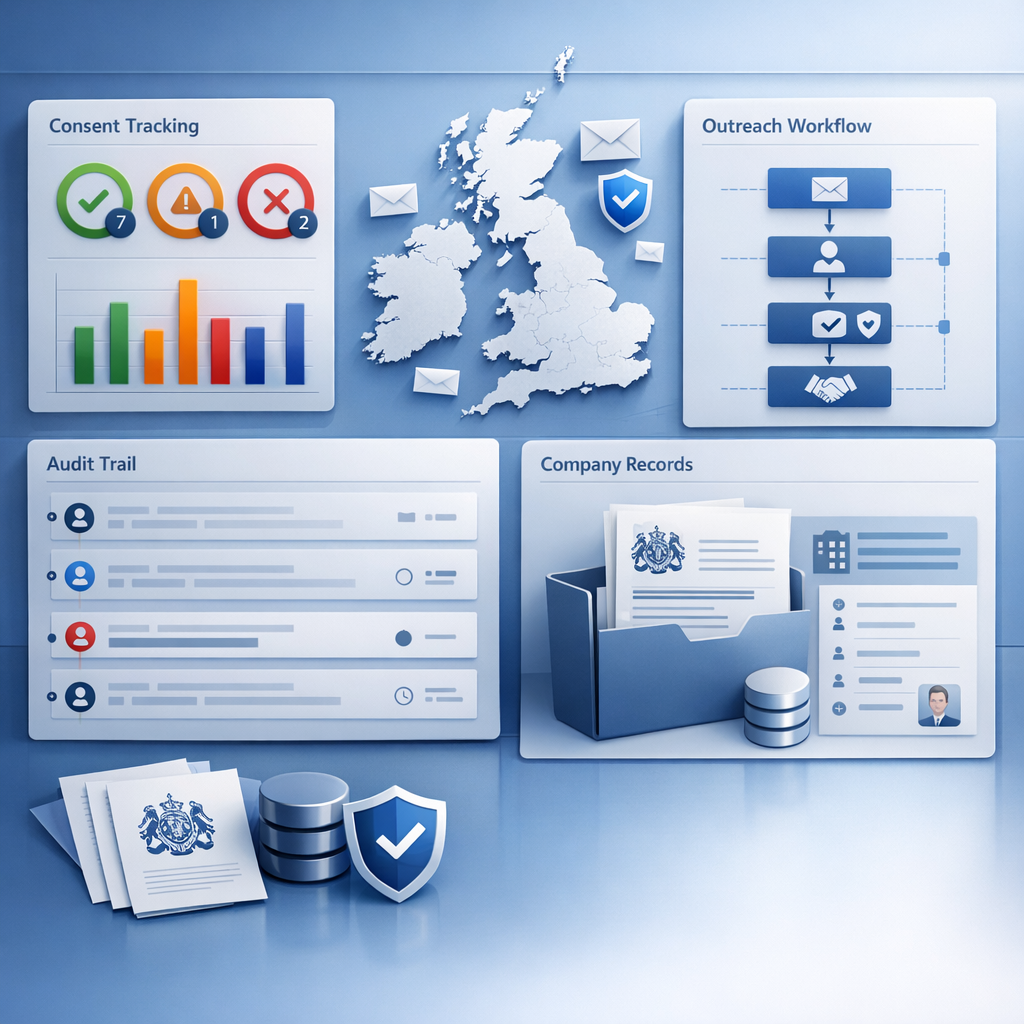
A strong setup usually looks like this:
- A form captures the lead and consent choices
- The CRM stores the event timestamp and source
- Automation checks consent fields before email nurture starts
- Sales sees a clear permission summary in the record
- Unsubscribes sync back into the master contact
- Managers can audit changes in the timeline
You can support this using Features, Email Automation, Smart Inbox, and AI Pipeline Management. If your team wants guided setup, Managed RevOps is the fastest route.
Why one system beats spreadsheets
A spreadsheet can list opt-ins. It cannot reliably control actions.
HelloGrowthCRM can use field logic to:
- block a nurture send
- route a lead to sales only
- trigger a permission refresh campaign
- mark a record for review
- sync unsubscribes across channels
In one implementation for a Manchester software firm, we reduced manual consent checks by moving form source, permission logic, and unsubscribe status into one CRM record. Reps stopped asking operations for ad hoc clearance before every follow-up.
A sourced benchmark on data quality pressure
Poor data quality costs organisations an average of $12.9 million per year, according to Gartner.
That number is broad, not consent-specific. Still, it shows why fragmented records become expensive fast.
How to use the HelloGrowthCRM UK GDPR consent tracker template: Step-by-Step
Using the HelloGrowthCRM UK GDPR consent tracker template means defining your consent fields, mapping every capture point, separating permission from enrichment, and connecting automation rules to those fields so your London, Manchester, or Edinburgh team can follow up quickly with a defendable audit trail.
- Define your consent model
Decide which channels need explicit permission tracking. At minimum, separate email marketing, SMS, phone preference, and general privacy acknowledgement. - Create standard fields in HelloGrowthCRM
Build required fields for source, timestamp, wording version, and withdrawal status. Keep naming consistent across forms and workflows. - Map every lead capture point
Include website forms, demo requests, content downloads, event forms, chat widgets, and scheduler flows. If a source captures leads, it must also map consent metadata. - Connect cookie and preference context where relevant
If lead capture depends on cookies or preference settings, store a reference to the choice state. This matters for retargeting and broader privacy review. - Separate enrichment from consent
Pull in company context from Companies House or your enrichment stack, but never infer consent from public company data or prior sales notes. - Build automation guardrails
Use Email Automation and AI Lead Scoring carefully. Score and route leads as needed, but only trigger marketing actions when permission fields allow it. - Make the record visible to reps
Add a compact consent summary to the contact view. Reps should know in seconds whether they can send a nurture email, place a call, or book a meeting. - Track unsubscribes and objections centrally
Every unsubscribe, opt-out, or complaint should write back to the main contact. Use Smart Inbox and WhatsApp or Twilio integrations where needed. - Audit monthly
Review a sample of records for missing timestamps, wrong source mapping, and broken suppression rules. If you want a practical benchmark, run the Pipeline Health Score alongside your compliance review.
Template workflow example for a London or Manchester B2B team
A London or Manchester B2B team should use the template by capturing consent at the first form touchpoint, preserving the exact wording shown, enriching the account separately, and letting automation branch by permission status so sales can respond fast without creating avoidable PECR risk.
Here is a simple example:
Example: SaaS lead from a webinar landing page
A prospect from London downloads a guide and books a meeting.
The workflow should do this:
- Create the contact record
- Save form source and campaign
- Store consent checkbox status and wording version
- Log meeting booking event
- Route to the right SDR queue
- Start only the automations that match permission status
If the contact did not opt into marketing email, the SDR can still see the enquiry context and act within your approved process. But the newsletter or nurture sequence should stay off.
Example: Manchester manufacturer with Companies House enrichment
A manufacturing prospect from Manchester fills out a “request pricing” form. HelloGrowthCRM enriches the account with company details and flags the firm size for routing. Consent fields remain unchanged. That protects auditability while still helping the rep prioritise the opportunity.
This is also where Territory Management, Sales Task Boards, and Sales Forecasting help. You can run a faster handoff without hiding the privacy trail.
HelloGrowthCRM template vs a spreadsheet or generic form tool
HelloGrowthCRM’s consent tracker template is stronger than a spreadsheet or generic form tool because it does not just store consent evidence; it uses that evidence to control automation, rep actions, and audit history inside the same operational system your UK team already uses to manage pipeline.
| Option | Strength | Main weakness | Best fit |
|---|---|---|---|
| Spreadsheet tracker | Cheap to start | Weak audit trail and no workflow control | Very small teams |
| Generic form tool only | Good form capture | Consent data stays disconnected from follow-up | Marketing-only use cases |
| HelloGrowthCRM consent tracker template | Unified evidence, routing, suppression, and reporting | Needs proper initial setup | Growth-stage B2B teams that need speed and control |
I should be clear here: HelloGrowthCRM is our product, so this comparison reflects our bias toward an integrated RevOps setup. Still, for teams under 50 reps, I have seen unified CRM-based consent tracking work far better than patching three separate systems together. Above that size, you may need deeper governance, permission controls, and legal review.
If you want to see the setup in your own stack, book a Demo, explore Pricing, or start a Free Trial.
For British teams that need faster lead follow-up without losing privacy evidence, HelloGrowthCRM gives you one place to capture, store, prove, and act on consent. If you want a PECR-safer lead capture workflow that your sales team will actually use, try HelloGrowthCRM today.
About the author
Daniel Reeves is a Sales Operations Lead at HelloGrowthCRM with 10 years of experience in B2B SaaS revenue operations, CRM architecture, and compliance-aware sales automation. He has led CRM and lead-routing projects for UK software and services teams, including a consent and suppression redesign for a 12-person sales team handling inbound demand across London and Manchester. That project shaped the workflow and field structure used in this article.
Frequently Asked Questions
Q: What is the best UK GDPR consent tracker template for B2B lead capture?
A: The best UK GDPR consent tracker template for B2B lead capture records consent status, source, timestamp, wording version, channel permissions, and withdrawals in one CRM record. For most growth-stage UK teams, a CRM-based template works better than a spreadsheet because it can also control follow-up actions.
Q: Do B2B companies in the UK always need consent before sending emails?
A: Whether B2B companies in the UK always need consent before sending emails depends on the message type, recipient type, and PECR context. Teams should not assume every business email is automatically safe. Review your lawful basis, message purpose, and ICO guidance before sending campaigns.
Q: Can I use Companies House data as proof of consent?
A: No, you cannot use Companies House data as proof of consent. Companies House data helps with company enrichment and account validation, but it does not show that a person agreed to receive marketing or accepted a specific privacy notice.
Frequently Asked Questions
Ready to put this into practice?
Set up your pipeline, WhatsApp follow-ups, and AI lead scoring in minutes — free, no credit card.
Try HelloGrowthCRM freeGet CRM tips in your inbox
Join thousands of sales professionals who get weekly insights on CRM strategy, AI automation, and pipeline optimization.

The HelloGrowthCRM team publishes guides on CRM strategy, AI sales tools, and revenue operations for small business sales teams.