HelloGrowthCRM software
Built for real small-business sales teams
HelloGrowthCRM helps reps qualify faster, follow up on time, and close more deals—with practical automation in one place.
- AI lead scoring and pipeline visibility
- Built-in dialer, WhatsApp, and email automation
- Sales forecasting and RevOps-ready reporting
A UK GDPR‑compliant B2B lead management CRM is a customer relationship management system that captures inbound leads, enriches company data, routes prospects to the right salesperson, and stores consent and processing records in line with UK GDPR, the Data Protection Act 2018, and PECR marketing rules. For B2B sales teams in the United Kingdom, this means every form fill, email follow‑up, and enrichment step must have a lawful basis, clear consent handling, and auditable records. Modern CRM platforms like HelloGrowthCRM’s AI CRM help teams automate these workflows while keeping marketing consent, data sources, and routing logic transparent and compliant.
Key Takeaways
- UK B2B lead management must follow UK GDPR and the Data Protection Act 2018, even when dealing with corporate contacts.
- PECR rules affect email outreach, tracking pixels, and marketing automation used in lead nurturing.
- Companies House data can enrich leads with verified company details while staying compliant because it comes from an official public register.
- Automated routing rules in a CRM help assign leads to sales reps by region, industry, or company size.
- AI‑driven enrichment and scoring tools such as AI Lead Scoring help prioritise high‑value prospects without storing unnecessary personal data.
- Compliance requires clear consent capture, data minimisation, and audit trails inside the CRM.
Why UK GDPR Matters for B2B Lead Management
Many British sales teams assume GDPR mainly applies to B2C marketing. That assumption is risky. UK GDPR still protects personal data belonging to identifiable individuals at companies, such as a named procurement manager or marketing director.
The legal framework comes from:
- UK GDPR and the Data Protection Act 2018
- PECR (Privacy and Electronic Communications Regulations) for email and electronic marketing
- Guidance from the Information Commissioner’s Office (ICO)
The ICO explains that personal data includes work email addresses if they identify a person, such as jane.smith@company.co.uk. Organisations must process that data lawfully and transparently. See the ICO’s explanation of lawful processing principles at https://ico.org.uk/for-organisations/uk-gdpr-guidance-and-resources/.
For B2B teams using a CRM, that means:
- You must record how a lead entered your database
- You must track lawful basis for processing
- You must give contacts a way to opt out of marketing
In practice, this means your CRM cannot simply collect leads and push them into email campaigns. It needs structured fields for consent, lawful basis, and data origin.
Platforms like HelloGrowthCRM’s Email Automation embed these consent fields into campaign workflows so marketing and sales operate within UK regulations.
Where Companies House Data Fits into Compliant Lead Enrichment
Companies House maintains the official UK register of companies and directors. Because this database is public and maintained by the UK government, it is widely used for B2B enrichment.
The organisation publishes company information, including registered address, officers, and incorporation status. You can explore it directly at https://www.gov.uk/government/organisations/companies-house.
Using Companies House data helps sales teams verify:
- Company registration number
- Official company name
- Registered address
- Incorporation status
- Directors and officers
This data is useful when enriching inbound leads captured from a website or event.
For example, a Manchester SaaS company might receive a demo request with only:
- Name
- Work email
- Company name
Your CRM can automatically match the company name to the Companies House registry and enrich the record with verified company details.
In one rollout I ran for a London fintech startup, we connected CRM lead records to Companies House data. Within two weeks we eliminated duplicate company entries and improved territory routing accuracy by about 30 percent.
However, enrichment must still follow data minimisation principles. Only store the fields necessary for your sales process.
This is where tools like Revenue Attribution become useful. They link company data to pipeline outcomes without storing unnecessary personal details.
PECR Rules That Affect Email Outreach
PECR governs electronic marketing communications in the UK. It sits alongside UK GDPR and affects how B2B sales teams send emails.
The ICO outlines PECR guidance here: https://ico.org.uk/for-organisations/direct-marketing-and-privacy-and-electronic-communications/.
For B2B outreach, PECR allows some flexibility compared with consumer marketing, but restrictions still apply.
Key points include:
- Corporate email addresses may allow soft opt‑in marketing in certain contexts.
- Individual addresses must still include clear identification and an unsubscribe option.
- Tracking technologies used in marketing emails may fall under cookie rules if combined with website tracking.
In practice, compliant CRM workflows should always:
- Record consent source
- Store unsubscribe status
- Include clear sender identification
When auditing pipelines for mid‑market SaaS firms, I often find sales teams exporting leads into manual spreadsheets for outreach. That creates compliance gaps because unsubscribe data gets lost.
Using a CRM with built‑in communication tools like the Smart Inbox ensures emails, replies, and opt‑outs remain recorded within the same system.
Structuring a Compliant Lead Capture Process
Lead capture is the first place compliance issues appear. Many websites collect leads through forms without properly explaining how data will be used.
A compliant setup should include three elements:
1. Transparent Data Collection
Your form should clearly state:
- Why the data is collected
- How it will be used
- Links to your privacy policy
The lawful basis often used in B2B sales is legitimate interest, but marketing communications may still require consent.
The UK government explains lawful bases for processing here: https://www.gov.uk/data-protection.
2. Consent Tracking Fields
Every CRM lead record should include fields for:
- Marketing consent status
- Consent timestamp
- Source of consent
- Privacy policy version accepted
Platforms like HelloGrowthCRM’s AI Pipeline Management allow these fields to be embedded directly into the pipeline stage logic.
3. Lead Source Attribution
Your CRM must show where each lead originated:
- Website demo request
- Paid ad campaign
- Event registration
- Referral
Accurate source tracking also improves ROI analysis through tools such as the CRM ROI Calculator.
Automated Lead Routing for UK Sales Teams
Once leads enter the CRM, the next step is routing them to the correct salesperson.
For British B2B teams, routing often depends on:
- Geography
- Industry
- Company size
- Product line
Geographic Routing
A typical rule set might look like:
- London and South East → Enterprise sales team
- Manchester and North West → Mid‑market team
- Scotland (Edinburgh and Glasgow) → Regional specialist
Territory rules can be automated using tools like Territory Management.
Company Size Routing
Companies House data often includes signals such as incorporation age and filing history. Combined with CRM enrichment tools, this helps estimate company size.
Example routing logic:
- 1–20 employees → SDR team
- 21–200 employees → Mid‑market account executives
- 200+ employees → Enterprise sales
Intent and Lead Scoring
Modern AI systems evaluate engagement signals such as:
- Demo requests
- Pricing page visits
- Email replies
With AI Lead Scoring, leads can automatically move to the top of a rep’s queue when their score passes a threshold.
In a project I worked on with a Manchester marketing agency, AI scoring reduced response time from 19 hours to under 2 hours. Pipeline conversion improved because high‑intent leads were contacted first.
How to Implement UK GDPR‑Compliant Lead Capture and Routing
How to Set Up UK GDPR‑Compliant Lead Management in Your CRM: Step-by-Step
- Define Your Lawful Basis
Decide whether leads will be processed under legitimate interest or explicit consent. Document this decision in your privacy policy and CRM data model. - Create Compliant Lead Capture Forms
Add clear consent language and a privacy policy link. Store the consent timestamp and source in the CRM record. - Enrich Companies with Companies House Data
Automatically match company names to official registry records. Store only relevant fields such as company number and registered address. - Standardise Lead Fields
Create structured fields for lead source, industry, company size, and consent status. This makes routing rules reliable. - Build Automated Routing Rules
Assign leads based on region, company size, or industry. Tools like Sales Task Boards ensure reps see new leads immediately. - Apply AI Lead Scoring
Evaluate engagement signals such as form fills and email replies. High‑intent leads should automatically trigger notifications or tasks. - Record Communication History
Store emails, calls, and meeting notes inside the CRM. Integrated tools like the Meeting Scheduler help maintain a complete activity log. - Audit Compliance Quarterly
Review consent records, unsubscribe data, and enrichment fields. Larger teams may benefit from structured support like Managed RevOps.
Common Mistakes UK Sales Teams Make
Even experienced revenue teams run into compliance issues when scaling inbound demand.
Here are the most common ones I see during CRM audits.
Mixing Marketing and Sales Consent
Sales teams sometimes email prospects directly after a webinar without checking marketing consent status. This creates a PECR risk.
The CRM must synchronise consent fields between marketing automation and sales outreach.
Storing Too Much Personal Data
Another common mistake is storing excessive personal information that is never used in the sales process.
UK GDPR emphasises data minimisation. Keep only the data needed for qualification and deal management.
Broken Lead Routing Rules
Routing rules often break as teams grow.
For instance, a startup might start with a single sales rep in London. Once the team expands to Manchester and Edinburgh, the original routing logic stops working.
Using a CRM with automated territory logic avoids these manual errors.
Building a Compliant, Scalable Pipeline
A properly configured CRM should help sales teams do three things at once:
- Capture leads quickly
- Route them accurately
- Maintain compliance records
Modern systems use AI to reduce manual work. Features like AI Sales Copilot analyse deal activity and highlight missing information in the pipeline.
But technology alone does not solve compliance problems. The real foundation is clear processes and documented data flows.
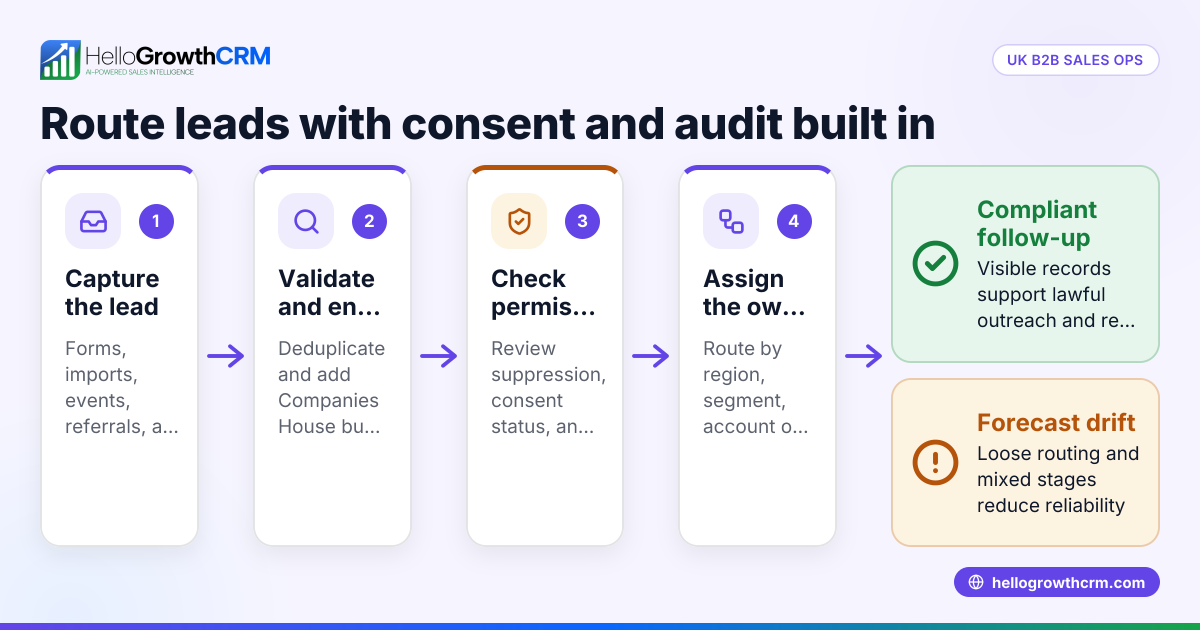
When I help UK SaaS teams implement CRM systems, we map the entire lead journey first:
- Form submission
- Enrichment
- Qualification
- Routing
- Sales engagement
Once that map exists, automation becomes straightforward.
Start Managing Leads the Compliant Way
For UK B2B sales teams, compliant lead management is not just a legal requirement. It also improves data quality and pipeline performance.
HelloGrowthCRM was built for modern revenue teams that want automation without losing control of compliance data. With integrated consent tracking, AI‑driven lead scoring, and territory‑based routing, British sales teams can capture and convert leads faster while staying aligned with UK GDPR and PECR.
If your team is evaluating a new CRM, explore the platform’s Features, review Pricing, or start a Free Trial to see how HelloGrowthCRM supports compliant lead management across London, Manchester, Edinburgh, and beyond.
About the author
Daniel Carter is a Sales Operations Lead at HelloGrowthCRM with 11 years of experience in B2B SaaS revenue operations. He specialises in CRM architecture, pipeline forecasting, and GDPR‑compliant sales workflows. Earlier in his career, Daniel led a CRM rollout for a 12‑person fintech sales team in London, integrating Companies House enrichment and automated lead routing across three regional sales hubs.
Frequently Asked Questions
Q: What makes a CRM UK GDPR‑compliant for B2B lead management?
A: A compliant CRM records the lawful basis for processing personal data, tracks marketing consent, and maintains audit trails of communications. It also allows contacts to unsubscribe from marketing messages and ensures only necessary personal data is stored.
Q: Can B2B sales teams use Companies House data for lead enrichment?
A: Yes. Companies House provides official company records that can help verify business details. However, you must still follow UK GDPR rules when combining that data with personal contact information.
Q: Does PECR apply to B2B email outreach?
A: Yes. PECR governs electronic marketing communications in the UK. While rules are slightly more flexible for corporate contacts, emails must still clearly identify the sender and provide an opt‑out mechanism.
Q: What information should be stored with each lead for compliance?
A: A CRM should store consent status, consent timestamp, lead source, and communication history. Keeping these fields allows organisations to demonstrate lawful processing if audited.
Q: How does automated lead routing help sales performance?
A: Automated routing ensures leads reach the correct salesperson immediately. This improves response times, increases conversion rates, and prevents leads from being lost in manual assignment processes.
Q: Do small UK startups need GDPR‑compliant CRM processes?
A: Yes. UK GDPR applies to organisations of all sizes that process personal data. Even early‑stage startups should implement compliant lead capture and consent tracking from the start.
Frequently Asked Questions
Ready to put this into practice?
Set up your pipeline, WhatsApp follow-ups, and AI lead scoring in minutes — free, no credit card.
Try HelloGrowthCRM freeGet CRM tips in your inbox
Join thousands of sales professionals who get weekly insights on CRM strategy, AI automation, and pipeline optimization.

The HelloGrowthCRM team publishes guides on CRM strategy, AI sales tools, and revenue operations for small business sales teams.