Intelligent Call Routing — Direct Every Call to the Right Rep
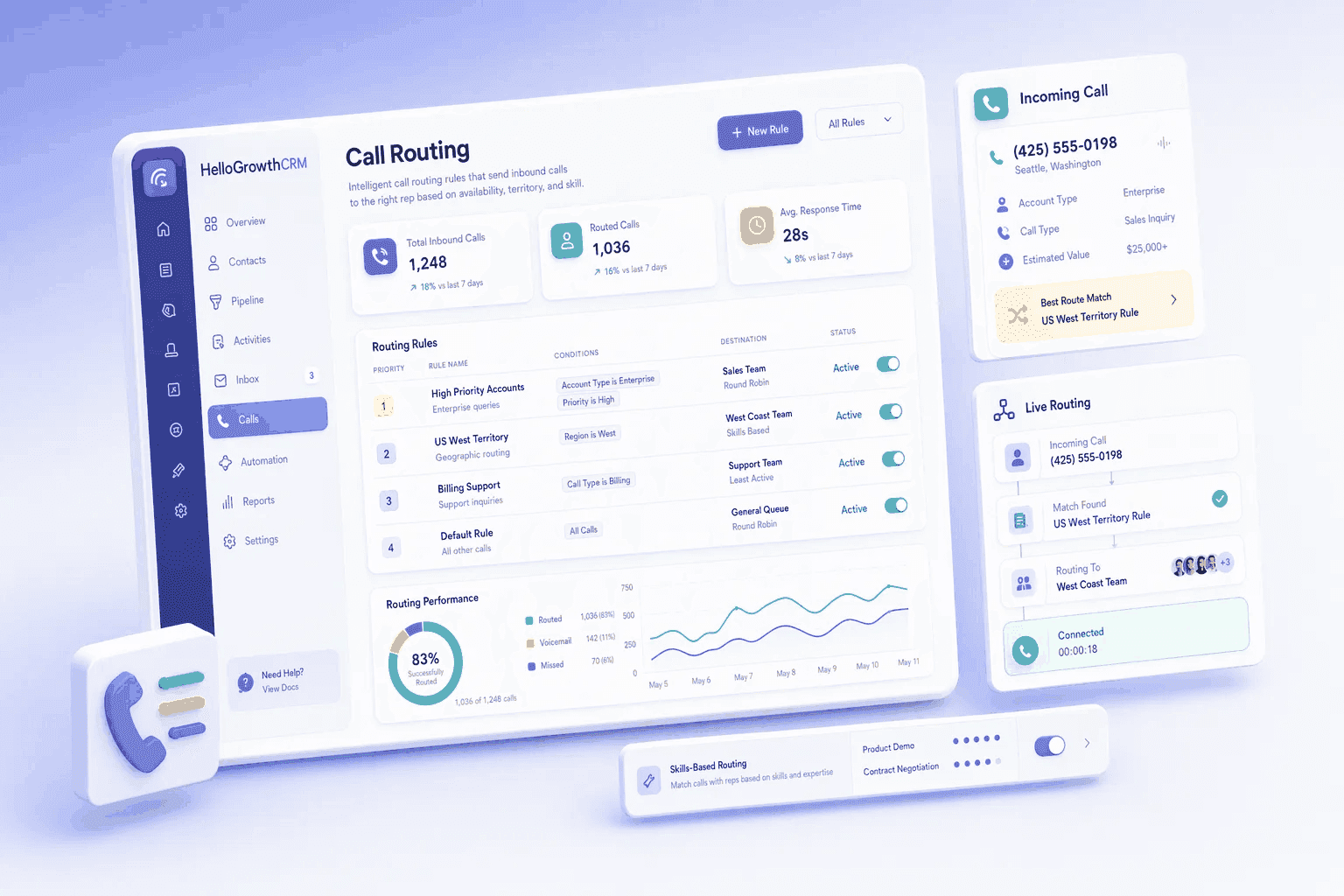
Route inbound calls to the correct sales rep or team based on IVR selection, caller ID, CRM record match, business hours, or availability. No missed calls. No wrong transfers.
Why teams evaluate call routing
Call Routing usually becomes important when a repeated part of the revenue workflow is creating too much manual work, too little visibility, or too much tool-switching. Teams are rarely shopping for a feature in isolation. They are usually trying to make one meaningful workflow cleaner, faster, and easier to inspect.
That is why buyers usually look beyond the headline capability and inspect the surrounding details: IVR menu builder, CRM record match routing (route to deal owner), Skills-based routing, Round-robin queue distribution. Those details determine whether the feature actually improves day-to-day execution or simply adds another surface area to manage.
Where call routing fits in the workflow
Most teams adopt this capability as part of practical motions such as inbound sales call routing, customer support tier routing, after-hours voicemail. The value tends to show up fastest when the workflow is tied to a clear owner, a clear next action, and a visible outcome that managers can review later.
It also matters how this page connects to the rest of the stack. The strongest implementations keep data, communication, and handoffs in sync instead of forcing the team to rebuild the process across disconnected tools.
What a strong rollout looks like for call routing
The best rollout usually starts small: one high-value workflow, one clear ownership model, and one review rhythm for adoption. Once the team is consistently using the feature, managers can expand into deeper automation, reporting, or cross-functional handoffs without rebuilding the foundation.
In practice, that means evaluating not only what the feature can do, but also whether the team can maintain the process around it. Ease of use, reporting trust, and manager visibility matter just as much as the feature checklist itself.
- Use it first for inbound sales call routing if that is the workflow creating the most friction today.
- Use it first for customer support tier routing if that is the workflow creating the most friction today.
- Use it first for after-hours voicemail if that is the workflow creating the most friction today.
- Use it first for geographic call distribution if that is the workflow creating the most friction today.
How It Works
Get started in three simple steps
Key Features
Use Cases
Inbound sales call routing
Route all inbound sales calls to available reps with skills matching the caller's request. Queue calls during busy times with hold music.
What teams care about
- Fast adoption with less manual cleanup for managers and reps.
- Clear visibility into workflow execution, outcomes, and accountability.
- Reliable handoffs into the CRM record so downstream teams keep full context.
Deep dive
Open the sections that matter most instead of scrolling through a long uninterrupted text block.
Why intelligent call routing is critical for inbound sales
Most inbound sales calls fail because they either go to the wrong person, go unanswered, or sit in a generic queue. That kills conversion because reps hate cold transfers, and callers hate being transferred. Intelligent call routing solves this by directing every call to the right person immediately.
When routing is smart — based on CRM records, skills, and availability — calls get answered faster, transferred less, and connected with more qualified reps. That directly increases conversion and reduces call abandonment.
How CRM-aware call routing works
HelloGrowthCRM call routing doesn't just ring phones randomly. It matches the caller to a CRM record and can route directly to the rep assigned to that opportunity. If that rep is busy, it uses skills-based routing or round-robin distribution to find the next best match.
Your business hours and holiday rules ensure calls don't go to voicemail during slow periods or send customers to the wrong queue. The result is faster connections, fewer transfers, and better customer experience.
Most inbound sales calls fail because they either go to the wrong person, go unanswered, or sit in a generic queue. That kills conversion because reps hate cold transfers, and callers hate being transferred. Intelligent call routing solves this by directing every call to the right person immediately.
When routing is smart — based on CRM records, skills, and availability — calls get answered faster, transferred less, and connected with more qualified reps. That directly increases conversion and reduces call abandonment.
Buyer playbook
Compare, launch, and govern the workflow with an interactive overview instead of four long generic essays.
How teams evaluate call routing
The best pages help buyers understand fit quickly instead of forcing them through long walls of copy.
Check whether the product covers the capabilities you actually care about, such as IVR menu builder, CRM record match routing (route to deal owner), Skills-based routing, Round-robin queue distribution.
Test if it supports real execution scenarios like Inbound sales call routing, Customer support tier routing, After-hours voicemail.
Confirm the workflow stays connected to the rest of your sales stack so reporting and handoffs remain reliable.
Frequently Asked Questions
What is Intelligent Call Routing?
HelloGrowthCRM's call routing system ensures every inbound call reaches the right person — the first time. Using CRM record matching, IVR menus, skills-based logic, and business hours rules, the system automatically directs callers to their assigned rep, the best available agent, or a fallback queue — all without manual intervention from a receptionist or team lead.
Missed or misrouted calls are one of the most common sales team complaints in India. Prospects call a sales number, wait on hold, get transferred twice, and give up. Existing customers reach a rep who does not know their account history. HelloGrowthCRM's CRM-aware routing solves both problems: known callers are recognised by phone number and connected directly to their assigned rep; unknown callers are routed based on IVR selection and rep availability. Every call outcome is logged to the CRM automatically.
Key Capabilities
- CRM Record Matching on Inbound Calls: When a known number calls in, HelloGrowthCRM looks up their contact record and routes directly to the assigned rep — bypassing the IVR entirely for existing customers.
- Multi-Level IVR Builder: Build IVR menus visually — welcome message, department selection, language selection — and connect each option to a rep, team, or queue. No coding or telephony configuration required.
- Skills-Based Routing: Assign skill tags to reps (enterprise, SME, Hindi, Tamil, product expertise) and route calls to the best-matched available rep. Prevents callers from being transferred after connecting.
- Business Hours and Holiday Routing: Configure routing rules per business hours schedule. Out-of-hours calls go to voicemail, WhatsApp bot, or an on-call number. Holiday calendars apply automatically.
- Call Queue with Wait Time Announcements: Queue callers when all reps are busy with position and estimated wait time. Managers monitor queue length in real time and can add temporary agents to clear backlogs.
- Overflow and Failover Rules: If queue wait exceeds a threshold, reroute to a secondary team, overflow number, or voicemail. Ensures no call is permanently abandoned.
- Missed Call Auto-Callback Tasks:Every missed call automatically creates a follow-up task for the assigned rep with the caller's CRM record linked. No missed call goes unactioned.
- Real-Time Routing Dashboard: Managers see live call queue length, agent status (available, on call, offline), and average wait time. Intervene in real time to reroute or answer high-priority calls.
How Indian Businesses Use It
- Real Estate Developer Enquiry Line: A Mumbai developer configured HelloGrowthCRM to route inbound calls on their project launch number by IVR — selecting which project the caller is enquiring about. Each project team gets their own queue. Conversion from inbound call to site visit improved because callers always reached a rep with knowledge of the specific project they were interested in.
- Multi-Language Support Teams:An insurance aggregator serves customers across Maharashtra, Gujarat, and Tamil Nadu. HelloGrowthCRM routes calls based on the caller's registered language preference in their CRM record — Marathi-speaking customers reach Marathi-speaking agents automatically, improving first-call resolution rates.
- SMB SaaS Support and Sales: A Hyderabad SaaS company routes free trial users to sales reps and paid customers to customer success — determined by their plan tier in the CRM record. The trial user always reaches a sales rep ready to discuss conversion; the paid customer reaches their dedicated CSM.
Designing Routing Rules That Age Well
Good routing starts from the caller's intent, not your org chart. Map the three or four reasons people actually call — new enquiry, existing order, support, payments — and build the IVR around those, keeping it to one level and four options wherever possible. Every menu layer you add loses callers. Let CRM matching do the heavy lifting for repeat callers so the IVR only ever greets strangers, and set the out-of-hours path deliberately: a WhatsApp auto-response that captures the enquiry beats a voicemail nobody checks.
Review the routing dashboard monthly with three questions. Where do callers abandon — in the queue, or inside the menu? Which reps carry a disproportionate share of calls, suggesting a skills tag or availability rule needs adjusting? And how many missed-call callback tasks are actually completed the next day? That last number is the one that shows up in revenue: a returned missed call is a warm conversation, an unreturned one is a lead your competitor answered. Because HelloGrowthCRM logs every leg of the call — including the recording and AI call summary — the review takes minutes, not a day of pulling telephony reports.
Frequently Asked Questions
- What is CRM-aware call routing and how is it different from a standard IVR?
- A standard IVR routes calls based on the option the caller selects. CRM-aware call routing goes further — HelloGrowthCRM identifies the caller by phone number, looks up their CRM record, and routes directly to their assigned rep or account manager. No IVR menu needed for existing customers. New callers follow the standard IVR flow.
- Can HelloGrowthCRM route calls based on skills or product expertise?
- Yes. Skills-based routing assigns tags to reps (for example, enterprise accounts, Hindi-speaking, or product-specific expertise) and routes calls to the rep with the matching skill who has the shortest queue. This ensures callers reach someone who can actually help them, not just the next available agent.
- What happens to calls that come in outside business hours?
- HelloGrowthCRM's business hours configuration routes out-of-hours calls to a voicemail, a WhatsApp automated response, or an overflow number. The caller receives a response on their preferred channel, and the missed call is logged to their CRM record with a follow-up task created for the next business day.
- How does HelloGrowthCRM handle high call volumes and queues?
- When all reps are busy, HelloGrowthCRM queues inbound calls with position announcements and estimated wait times. Managers see real-time queue length in the CRM dashboard. If a caller hangs up while queued, a callback task is created automatically for the assigned rep.
Call routing is available on HelloGrowthCRM's Growth and Enterprise plans. Compare plans. Pair with the CRM dialer for outbound calling, or learn how insurance teams manage inbound call volumes.