HelloGrowthCRM software
Built for real small-business sales teams
HelloGrowthCRM helps reps qualify faster, follow up on time, and close more deals—with practical automation in one place.
- AI lead scoring and pipeline visibility
- Built-in dialer, WhatsApp, and email automation
- Sales forecasting and RevOps-ready reporting
HubSpot vs Pipedrive in the UK is a comparison between an all-in-one growth platform with deeper marketing, service, and reporting capabilities and a sales-first CRM with simpler pipeline management, lower starting costs, and faster rep adoption, where the best choice depends on compliance needs, automation depth, reporting complexity, and total cost in GBP.
Key Takeaways
- HubSpot usually fits UK teams that need stronger reporting, broader automation, and one platform across sales, marketing, and service.
- Pipedrive usually fits UK teams that want a simpler sales CRM, faster setup, and lower upfront cost for pipeline-focused use cases.
- UK buyers should assess more than licence price. You also need to check UK GDPR workflows, PECR implications, consent capture, and data governance.
- Companies House enrichment matters for British B2B teams because legal entity accuracy improves territory planning, deduplication, and finance handoff.
- Microsoft 365, Xero, and lead source syncing often shape the real buying decision more than headline features.
- If you want modern automation without enterprise complexity, it is worth comparing both tools with HelloGrowthCRM, especially for UK revenue teams that need sales execution and RevOps control together.
Which CRM is better for UK B2B sales teams: HubSpot or Pipedrive?
HubSpot vs Pipedrive for UK B2B sales teams comes down to breadth versus simplicity: HubSpot is usually better for multi-team processes, advanced reporting, and lifecycle automation, while Pipedrive is often better for straightforward pipeline execution, rep usability, and lower-cost deployment for smaller commercial teams.
For most buyers in London, Manchester, and Birmingham, the decision is not just about CRM screens. It is about how the system fits the way your revenue team actually works.
In practice, I look at five buying criteria first:
- Pipeline usability for account executives and SDRs
- Workflow automation depth
- Reporting for managers and RevOps
- Compliance support for UK operations
- Total cost after add-ons, onboarding, and admin time
In one rollout we did with a 12-person sales team selling into mid-market manufacturers across the Midlands, the reps preferred the simpler pipeline flow first. But the leadership team later needed attribution, lifecycle reporting, and handoff visibility. That is where a broader platform became more valuable than the early usability win.
A useful rule of thumb:
- Choose HubSpot if you need one system across inbound, outbound, renewals, and reporting
- Choose Pipedrive if your immediate need is a clean sales pipeline with light admin
- Compare both against a purpose-built revenue platform like AI CRM if you want modern AI workflows without stitching multiple tools together
HubSpot vs Pipedrive at a glance
HubSpot vs Pipedrive at a glance is a trade-off between a broader platform and a narrower sales CRM: HubSpot gives more native capability across marketing, service, and analytics, while Pipedrive gives a cleaner sales experience with less overhead for teams that mainly need deal and activity management.
| Category | HubSpot | Pipedrive |
|---|---|---|
| Best for | Cross-functional growth teams | Sales-first SMB teams |
| Ease of use | Good, but broader UI | Very strong for reps |
| Pipeline management | Strong, flexible | Excellent and simple |
| Workflow automation | Deeper across teams | Good for core sales flows |
| Reporting depth | Stronger native analytics | More limited without add-ons or exports |
| Marketing capability | Much broader | Lighter native marketing |
| UK compliance fit | Depends on setup and governance | Depends on setup and governance |
| Companies House enrichment workflow | Usually handled via integrations or imports | Usually handled via integrations or imports |
| Microsoft 365 fit | Common and workable | Common and workable |
| Xero fit | Typically integration-led | Typically integration-led |
| Cost structure | Can rise quickly with hubs and seats | Lower entry cost, but add-ons still matter |
| Admin overhead | Higher | Lower |
This table simplifies a more detailed reality. Both systems can work for British B2B teams. The better answer depends on process complexity, not brand popularity.
How do HubSpot and Pipedrive compare on compliance for UK teams?
HubSpot and Pipedrive can both be used compliantly in the UK, but neither platform makes a team automatically compliant; UK GDPR, the Data Protection Act 2018, PECR, consent capture, lawful basis, retention rules, and cookie controls still depend on your configuration, internal processes, and governance.
For UK buyers, this section matters more than feature checklists.
The UK GDPR and the Data Protection Act 2018 set the rules for handling personal data in the UK. The UK government’s overview is here: Guide to Data Protection. For marketing consent and electronic communications, the most practical regulator guidance comes from the ICO.
What UK sales leaders should verify
Before you choose either platform, check:
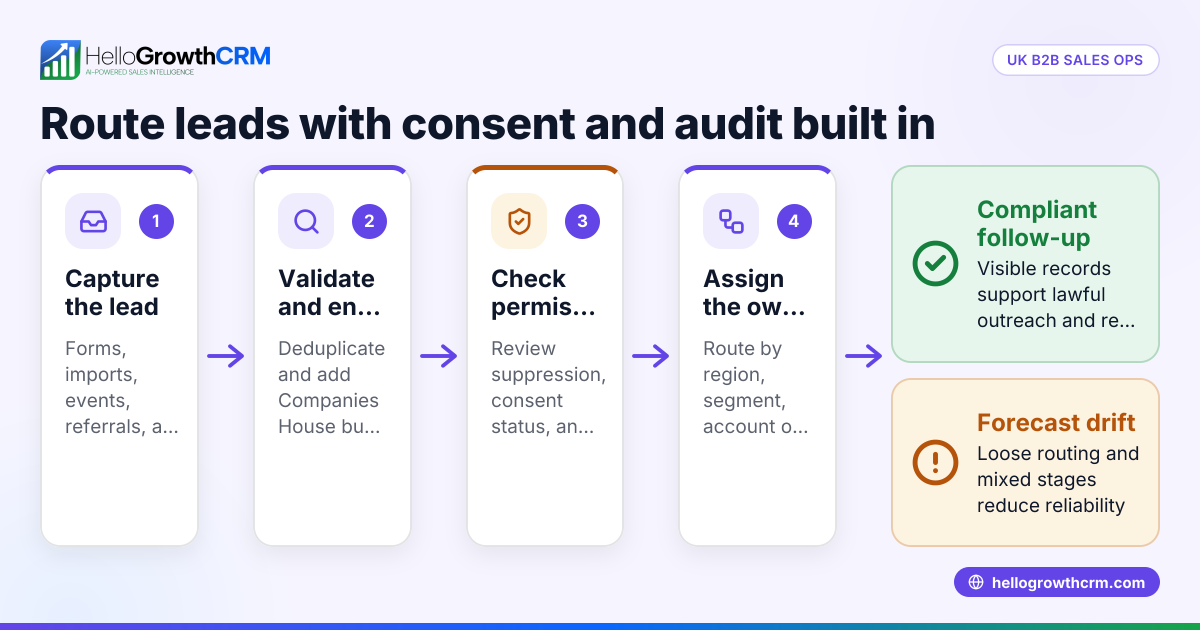
- How consent fields are stored and surfaced to reps
- Whether lawful basis is recorded at contact level
- How unsubscribe and suppression logic works
- Whether cookie consent tooling is native or external
- How data exports, deletions, and retention requests are handled
- Whether audit logs meet your internal controls
PECR sits alongside data protection law for email, SMS, and cookie-based marketing. That matters if your team runs outbound email, web forms, or retargeting.
The ICO states that PECR covers electronic marketing and the use of cookies and similar technologies, with specific rules that sit alongside data protection law: ICO PECR guide.
Practical compliance difference
The real difference is often operational, not legal. HubSpot tends to suit teams that want more structured lifecycle and marketing consent processes in one place. Pipedrive tends to suit sales-led teams, but may rely more on connected tools for forms, cookie consent, and broader campaign governance.
When I have audited pipelines like this, the compliance risk usually came from process gaps, not from the CRM vendor. Common issues included reps sending follow-ups from disconnected inboxes, stale contact records, and missing suppression logic between forms and outreach sequences. Tools like Smart Inbox and Email Automation can help centralise that control if you want fewer grey areas.
How do pricing and total cost compare in GBP?
HubSpot and Pipedrive differ more in total cost than list price because UK teams often add seats, reporting needs, enrichment tools, and integrations, so the cheapest monthly licence rarely reflects the real annual spend once sales ops, marketing, and finance requirements are included.
For a buyer, “cost” should mean:
- Core licence cost in GBP
- Seat growth over 12 months
- Paid onboarding or admin time
- Add-ons for reporting or automation
- Enrichment and integration cost
- Cost of workarounds
HubSpot cost pattern
HubSpot often starts reasonably for small teams, then rises as you add functionality across hubs, users, automation, and reporting needs. That does not make it bad value. It just means your cost curve can steepen fast if your GTM model grows.
This is where it helps to model payback. A team comparing systems should run a baseline with a CRM ROI Calculator and test admin hours, conversion uplift, and rep productivity.
Pipedrive cost pattern
Pipedrive usually offers a lower and simpler entry point. For founder-led sales teams or smaller UK B2B teams, that can be attractive. But total cost still rises if you need external marketing tools, deeper BI, or more complex routing and lifecycle management.
A lower starting price can still become expensive if your ops team spends too much time exporting data, fixing duplicates, and manually joining lead, account, and finance records.
Cost questions to ask vendors
Ask both vendors:
- What will 15 users cost in GBP after one year?
- Which reporting features require higher tiers?
- What is the expected admin effort per month?
- How will Microsoft 365, Xero, and enrichment tools be billed?
- What functions still need third-party apps?
If you want one benchmark, compare both with Pricing from HelloGrowthCRM and assess whether fewer bolt-ons reduce your effective spend.
Which platform is easier to use for reps and managers?
Pipedrive is usually easier for reps to learn quickly, while HubSpot is usually better for managers who need broader visibility and cross-functional workflows, so ease of use depends on whether your priority is daily seller adoption or management control across the full revenue process.
Pipedrive has long been popular because the pipeline view feels intuitive. Reps can update deals fast. That matters in fast-moving teams.
HubSpot is still usable, but its wider feature set means there is more to configure and more for users to learn. For many teams, that is a fair trade.
For sales reps
Pipedrive often wins on:
- Fast deal updates
- Cleaner visual pipelines
- Lower training time
- Simpler activity management
HubSpot often wins on:
- Unified contact history
- Better handoff between marketing and sales
- More context across lifecycle stages
- Stronger playbook potential
For managers and RevOps
Managers usually care about:
- Forecast accuracy
- Stage conversion
- Stage-velocity in days
- Source-to-revenue reporting
- Rep activity quality, not just quantity
That is where broader reporting and automation matter. A platform with Sales Forecasting, AI Pipeline Management, and Revenue Attribution can reduce spreadsheet dependence.
In one Manchester SaaS rollout I supported, reps adopted the simpler CRM faster, but the sales manager still ran weekly forecasting in a spreadsheet because the native views were too shallow for board reporting. That hidden admin cost changed the buying decision six months later.
How do HubSpot and Pipedrive compare on reporting and automation?
HubSpot generally provides deeper native reporting and broader workflow automation than Pipedrive, while Pipedrive handles core sales automation well but can feel lighter when UK teams need lifecycle analytics, attribution, multi-step routing, or more advanced management reporting beyond simple pipeline tracking.
If your board pack includes more than pipeline value and win rate, test reporting early.
Reporting depth
HubSpot is usually stronger for:
- Funnel conversion by lifecycle stage
- Campaign and source reporting
- Cross-team dashboards
- Customer journey analysis
- More mature executive dashboards
Pipedrive is usually fine for:
- Pipeline movement
- Activity tracking
- Deal progress
- Basic conversion reporting
This difference matters once your finance, marketing, and sales leaders want one version of revenue truth. If that is your direction, you may also want to review Managed RevOps support rather than treating CRM selection as a pure software choice.
Workflow automation
Both platforms support automation. The question is how far you need to go.
Consider whether you need:
- Lead routing by territory and account owner
- MEDDPICC field completion prompts
- Reminder sequences after no-response windows
- Meeting follow-up creation
- Deal risk flags based on inactivity
- Renewal workflows tied to billing events
Those use cases become stronger with AI-led capability such as AI Lead Scoring, AI Deal Insights, and a Deal Risk Agent.
How well do HubSpot and Pipedrive fit Companies House enrichment and UK tools?
HubSpot and Pipedrive both support Companies House enrichment workflows through integrations, imports, or custom processes, and both can fit common UK tools such as Microsoft 365 and Xero, but neither offers magical out-of-the-box UK data operations without thoughtful field mapping and governance.
Companies House matters because it improves legal entity accuracy, registered address quality, and company status checks for British B2B teams. The official source is Companies House.
Why Companies House data matters in practice
Good enrichment helps you:
- Reduce duplicate accounts
- Match subsidiaries to the right parent
- Improve invoicing handoff
- Set cleaner territories
- Validate legal names before proposals and contracts
In one Birmingham deployment, we found three versions of the same buyer account across old imports because the trading name and registered entity had been mixed. Fixing that improved territory assignment and reduced finance disputes.
Microsoft 365 and Xero fit
For many UK teams, the key stack questions are simple:
- Does email and calendar sync cleanly with Microsoft 365?
- Can finance handoff reach Xero without rekeying data?
- Will meeting, task, and contact history stay complete?
When evaluating alternatives, ask vendors to show the full workflow, not just the integration tile. HelloGrowthCRM connects with tools like Gmail, Microsoft Teams, and All Integrations, and buyers should expect the same workflow clarity from any shortlisted CRM.
How to choose between HubSpot and Pipedrive for your UK team: Step-by-Step
Choosing between HubSpot and Pipedrive for a UK B2B team works best when you score each option against your real sales process, compliance duties, reporting needs, and integration stack, then test the workflows your reps, managers, and RevOps staff will actually use every week.
- Map your current process
List your stages, qualification method, handoffs, and KPIs. Include metrics like stage-velocity in days, win rate, and average sales cycle. - Define UK compliance requirements
Document how you capture consent, manage suppression, handle subject access requests, and control cookie-based marketing in line with UK rules. - Score must-have workflows
Test lead routing, meeting booking, quote creation, reminders, and manager forecasting. Include admin effort, not just front-end usability. - Check your UK stack fit
Validate Microsoft 365, Xero, and enrichment workflows. If you rely on scheduling, test Meeting Scheduler style flows and handoff reliability. - Run a 90-day cost model
Include licences, setup, integrations, reporting gaps, and ops time. Use realistic user counts and likely add-ons. - Pilot with live users
Put real reps and managers into the trial. Watch where fields get skipped, reports break, and follow-ups slow down. - Compare with a third option
Do not stop at two brands. Compare both against Free Trial access to HelloGrowthCRM if you want stronger sales execution, AI support, and a UK-friendly RevOps setup.
For British teams that want a CRM built for revenue execution rather than tool sprawl, HelloGrowthCRM is worth a serious look. You can explore Features, book a Demo, or start a Free Trial to see how UK sales teams can manage pipeline, automation, and reporting in one place.
About the author
Oliver Bennett is a Sales Operations Lead at HelloGrowthCRM with 11 years of experience in B2B SaaS, RevOps, and CRM implementation for UK growth teams. He has led CRM audits and rollouts for sales teams in London, Manchester, and Birmingham, with a focus on pipeline design, compliance workflows, and forecasting accuracy. A recent project involved rebuilding account and territory structures for a 12-person UK sales team using Companies House-based enrichment rules to reduce duplicates and improve finance handoff.
Frequently Asked Questions
Q: Is HubSpot or Pipedrive better for a small UK B2B sales team?
A: HubSpot or Pipedrive is better for a small UK B2B sales team depending on complexity, but Pipedrive usually suits simpler sales processes while HubSpot suits teams that also need marketing, service, and stronger reporting. If your team is under 10 reps, start by testing admin burden and reporting needs.
Q: Is HubSpot more expensive than Pipedrive in the UK?
A: HubSpot is usually more expensive than Pipedrive in the UK once you add broader features, extra users, and higher reporting needs. Pipedrive often has a lower starting cost, but your true annual spend depends on integrations, workarounds, and operations time.
Q: Can HubSpot and Pipedrive support UK GDPR compliance?
Frequently Asked Questions
Ready to put this into practice?
Set up your pipeline, WhatsApp follow-ups, and AI lead scoring in minutes — free, no credit card.
Try HelloGrowthCRM freeGet CRM tips in your inbox
Join thousands of sales professionals who get weekly insights on CRM strategy, AI automation, and pipeline optimization.

The HelloGrowthCRM team publishes guides on CRM strategy, AI sales tools, and revenue operations for small business sales teams.