HelloGrowthCRM software
Built for real small-business sales teams
HelloGrowthCRM helps reps qualify faster, follow up on time, and close more deals—with practical automation in one place.
- AI lead scoring and pipeline visibility
- Built-in dialer, WhatsApp, and email automation
- Sales forecasting and RevOps-ready reporting
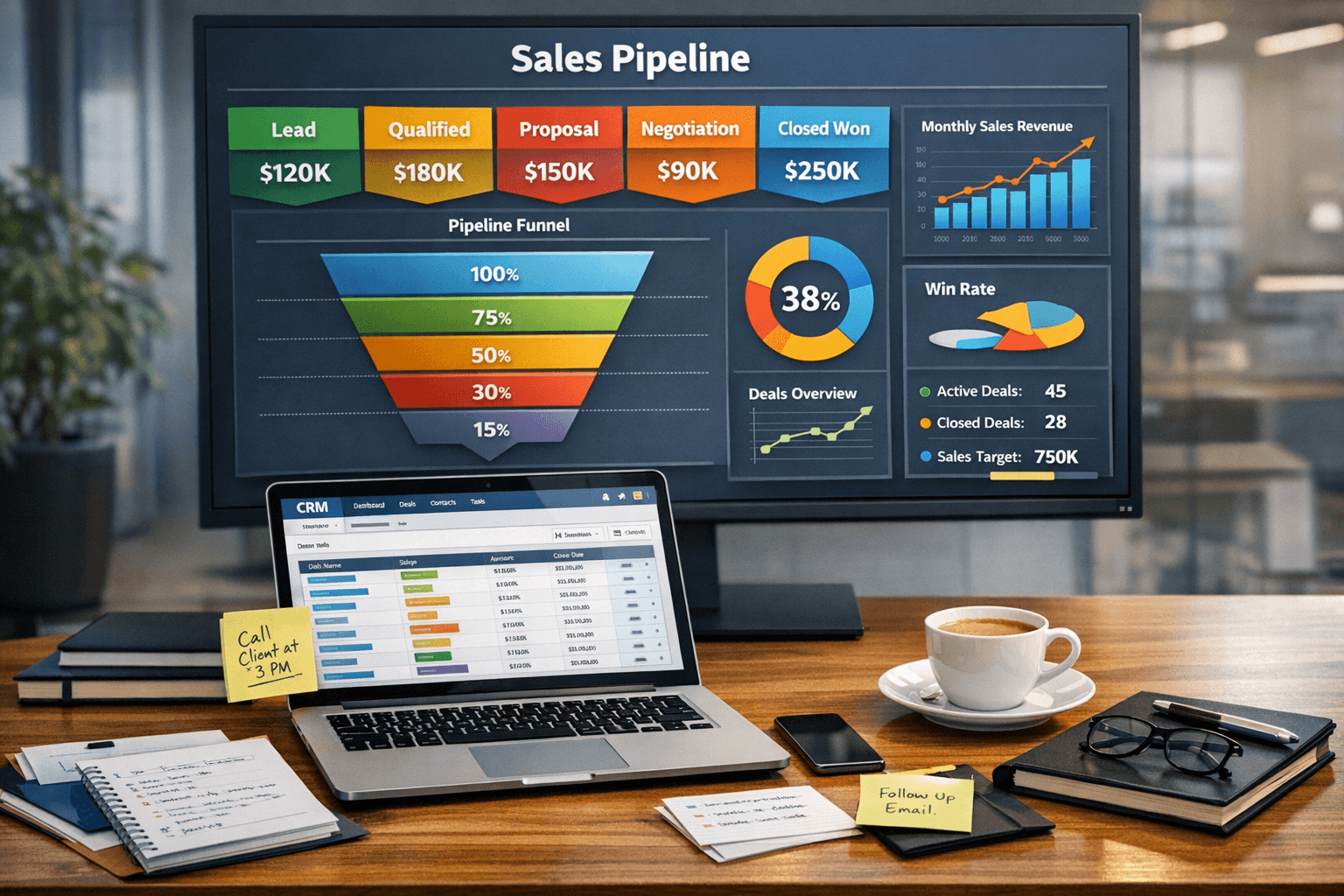
Creating an effective sales pipeline is essential for any organization aiming to boost its conversion rates and streamline lead management. A sales pipeline refers to the visual representation of the stages that leads go through as they transition from potential prospects to closed customers. It encompasses all phases of the sales process, helping sales teams understand where each lead stands and which actions are necessary to move them forward.
With HelloGrowthCRM's customizable sales pipeline templates, managing these stages efficiently has never been easier. These templates not only save time but also personalize the experience based on specific business needs, enabling teams to optimize their sales processes for enhanced outcomes. In this blog post, we’ll delve into how you can harness the power of HelloGrowthCRM’s templates to create effective sales pipelines that drive results.
Understanding the Importance of Sales Pipeline Templates
Customizable sales pipeline templates serve as a crucial resource in modern sales strategies. They provide a structured framework to track leads systematically, making it easier to manage potential clients at various stages. The benefits are manifold:
- Increased Efficiency: Templates encourage a standardized approach, reducing time spent on repetitive tasks.
- Improved Visibility: They offer a clear view of where each lead lies in the sales process, allowing for informed decision-making.
- Enhanced Tracking: With distinct stages, it becomes easier to monitor lead conversions and adjust strategies based on performance data.
How HelloGrowthCRM's Sales Pipeline Templates Work
HelloGrowthCRM provides a suite of customizable templates that allow sales teams to streamline their workflow effectively. Here’s how these templates enhance your sales pipeline:
Easy Customization
Every business has its unique sales process. HelloGrowthCRM understands this, which is why our sales pipeline templates are fully customizable. You can:
- Add or remove stages to match your sales cycle.
- Rename stages to reflect your team's terminology.
- Set criteria for each pipeline stage based on lead characteristics and behaviors.
Automated Workflow Integration
To ensure a seamless process, HelloGrowthCRM allows you to integrate your sales pipeline with various Sales Tools and automation features, including Email Automation. This automation ensures that:
- Leads receive timely follow-ups based on where they are in the pipeline.
- Task assignments can be automated for team members to handle leads efficiently.
- Your team can focus on nurturing high-potential leads through informed actions.
Real-Time Analytics and Reporting
Tracking pipeline performance is critical for optimizing sales strategies. HelloGrowthCRM incorporates real-time analytics within its templates, enabling your team to:
- View lead status and performance metrics at a glance.
- Access insightful reports that highlight conversion rates, average deal size, and the length of the sales cycle.
- Utilize robust Sales Forecasting capabilities to predict revenue and make data-driven decisions.
Steps to Create an Effective Sales Pipeline with HelloGrowthCRM
Creating an effective sales pipeline might seem daunting, but with HelloGrowthCRM's templates, the process can be streamlined into a series of manageable steps. Here’s how:
Step 1: Define Your Stages
Start by identifying the distinct stages of your sales process. Typical stages include:
- Lead Generation: Identifying potential leads.
- Lead Qualification: Assessing the leads’ fit for your product/service.
- Needs Analysis: Understanding the lead's challenges and needs.
- Proposal: Presenting your solution to the lead.
- Negotiation: Discussing terms and addressing any objections.
- Closed Won/Lost: Marking the outcome of the sales process.
Step 2: Customize Your Template
Use HelloGrowthCRM to create a template that reflects the stages you’ve defined. You can modify stage names and criteria or even add custom fields for better tracking.
Step 3: Automate Your Processes
Leverage Email Automation and task assignments to ensure nothing falls through the cracks. Set up automated emails for lead nurturing at each stage based on your lead categorization.
Step 4: Use AI Insights for Scoring Leads
Incorporating AI Lead Scoring will help prioritize leads based on their likelihood to convert. You can set scoring parameters according to engagement, characteristics, and other relevant metrics.
Step 5: Monitor and Adjust
Regularly check the performance metrics that HelloGrowthCRM provides. Determine what works, what doesn’t, and adjust your pipeline accordingly. Continuous optimization can drastically improve your conversion rates.
Best Practices for Using Sales Pipeline Templates
While the templates themselves are powerful tools, their utility can be maximized when complemented by best practices:
Stay Consistent with Updates
Regularly update your pipeline stages and status to ensure you have the most current information. This consistency helps the team make informed decisions and enhances overall productivity.
Encourage Collaboration
Using HelloGrowthCRM’s features, foster collaboration among team members. Share insights and feedback during regular meetings, ensuring everyone is aligned.
Focus on Engagement
Use personalized follow-ups and check-ins, and maintain engagement with leads throughout the pipeline. Tailored communications help nurture relationships and encourage leads to move through the pipeline efficiently.
Analyze Performance Metrics
Take full advantage of HelloGrowthCRM’s reporting capabilities. Analyze lead conversion rates, bottlenecks, and performance at each stage. These insights can help you refine your pipeline and improve overall strategy.
Common Mistakes to Avoid
To ensure the success of your sales pipeline, be aware of these common pitfalls:
- Neglecting Data Quality: Ensure your data is always current and detailed. Inaccurate or outdated data can hinder your decision-making process.
- Overloading Stages: Too many stages can complicate the pipeline and confuse team members. Keep your process clear and straightforward.
- Failing to Utilize Automation: Don’t overlook the power of automation to save time and reduce manual workload. Automate follow-ups and task management where feasible.
FAQs
What are sales pipeline templates, and why are they important?
Sales pipeline templates are structured frameworks that outline the stages leads go through in the sales process. They are essential because they provide clarity, improve team efficiency, and enhance tracking of lead progress.
How can HelloGrowthCRM help optimize my sales pipeline?
HelloGrowthCRM offers customizable sales pipeline templates, real-time analytics, and automation features like Email Automation and AI Lead Scoring that improve lead management and increase conversion rates.
What types of sales stages should I include in my pipeline?
Typical sales stages include Lead Generation, Lead Qualification, Needs Analysis, Proposal, Negotiation, and Closed Won/Lost. However, customize them to fit your specific sales process.
Can I automate tasks within my sales pipeline using HelloGrowthCRM?
Yes, HelloGrowthCRM allows you to automate various tasks such as follow-ups, emails, and task assignments, which can significantly enhance efficiency.
How often should I review my sales pipeline performance?
It’s best to review your sales pipeline performance regularly—weekly or monthly—so that you can make timely adjustments based on actionable insights.
Is there a free trial available for HelloGrowthCRM to test the templates?
Absolutely! You can sign up for a Free Trial to explore HelloGrowthCRM and discover how its features can enhance your sales pipeline.
In conclusion, creating effective sales pipelines through HelloGrowthCRM's customizable templates isn't just about increasing efficiency; it's about optimizing your overall sales strategy for better results. By streamlining processes, leveraging automation, and continuously monitoring performance, you can convert leads more successfully and drive your business forward.
Ready to revolutionize your sales process? Try HelloGrowthCRM today, and unlock the potential of your sales pipeline!
Implementation Checklist for Creating Effective Sales Pipelines with HelloGrowthCRM Templates
Teams researching sales pipeline templates usually need more than a high-level definition. They need a repeatable process, clear ownership, and a way to connect day-to-day execution back to pipeline quality and revenue outcomes. That is why the most useful version of this topic is practical: it should help a team decide what to standardize, what to automate, and what to measure first.
Start by deciding where sales pipeline templates fits in the revenue workflow. For some teams it belongs near lead qualification, because better prioritization affects who gets attention first. For others it belongs in pipeline management, because the real problem is inconsistent stage movement, poor follow-up discipline, or weak forecast confidence. The exact placement matters because it determines which records, fields, and manager reviews should change after the process is introduced.
Step-by-step rollout model
- Define the business outcome the team wants from sales pipeline templates. That could be faster speed-to-lead, better conversion from demo to opportunity, cleaner qualification, or fewer stalled deals.
- Identify which team owns the process day to day. A workflow with no owner usually becomes a dashboard topic instead of an execution habit.
- Decide which fields or signals are required. Keep the list narrow enough that reps can maintain it without turning the CRM into admin overhead.
- Add automations only after the workflow is clear. Good automation reduces repetitive work, but bad automation hides process problems and makes reporting less trustworthy.
- Review performance weekly. Teams improve faster when they inspect real records, not just summary charts.
What strong teams usually standardize
- A clear definition of when a lead, account, or deal qualifies for the next step
- Required fields that support follow-up, segmentation, and reporting
- Ownership rules for handoffs, reminders, and stage progression
- Manager review checkpoints for aging, conversion, and execution quality
- An escalation path for records that are blocked, stale, or missing context
Metrics to watch after rollout
When a team implements sales pipeline templates well, performance should change in ways that are visible. Look at conversion rate between stages, response time, meeting creation, pipeline age, follow-up completion, and forecast confidence. If those numbers do not move after implementation, the process may be too theoretical, too hard to use, or not connected tightly enough to how reps actually work inside the CRM.
It is also useful to separate activity metrics from quality metrics. A team can appear busy while still failing to improve outcomes. Measuring both helps leadership understand whether sales pipeline templates is increasing output only, or improving the quality of decisions and follow-through as well.
How HelloGrowthCRM supports this workflow
HelloGrowthCRM is most effective when the team uses it as an operating system rather than a contact database. The platform helps centralize lead records, activity history, communication, automation triggers, reporting, and follow-up actions in one place. That matters for sales pipeline templates because it reduces the gap between strategy and execution. Reps can see the context, managers can inspect progress, and leaders can connect the process back to revenue performance.
For example, a team may start with a simple scoring or qualification framework, then connect it to follow-up tasks, reporting views, internal alerts, and manager dashboards. Another team may apply the same principle to messaging, meeting scheduling, outbound sequencing, or account prioritization. In each case, the system works best when the workflow is inspectable and the next step is obvious.
Common mistakes that reduce content quality and execution quality
One common mistake is treating sales pipeline templates as a one-time setup instead of an ongoing operating discipline. Teams launch the framework, create a dashboard, and assume the problem is solved. In reality, the process needs feedback loops. Inputs drift, rep behavior changes, and the market evolves. Without review, even a good workflow loses accuracy.
Another mistake is overcomplicating the first version. Teams sometimes try to capture too many fields, too many exceptions, or too many automations before the basic operating model is stable. That creates resistance and lowers adoption. A better approach is to launch the smallest version that still produces measurable decisions, then add sophistication after the team trusts the workflow.
Practical FAQ extension
How long should a team give this process before judging results?
Most teams need a few weeks of consistent use before they can evaluate whether sales pipeline templates is improving execution. The exact timing depends on deal cycle length and lead volume, but a workflow should usually be reviewed across multiple reporting intervals before large conclusions are drawn.
Does sales pipeline templates matter only for large sales teams?
No. Smaller teams often benefit even more because a clear workflow prevents follow-up gaps and makes performance easier to inspect without adding management layers. The key is to keep the process proportional to team size.
What is the best first improvement to make?
Usually the best first improvement is clarity. Define the next step, the owner, and the required information. Once those are stable, automation and reporting become much more valuable.
Final execution notes for Creating Effective Sales Pipelines with HelloGrowthCRM Templates
sales pipeline templates becomes commercially valuable when it helps a team move faster with more confidence, not when it just adds vocabulary. The teams that get the best results usually connect workflow design, data hygiene, automation, and manager inspection into one rhythm. That is the lens readers should use when evaluating any approach connected to HelloGrowthCRM.
Frequently Asked Questions
Ready to put this into practice?
Set up your pipeline, WhatsApp follow-ups, and AI lead scoring in minutes — free, no credit card.
Try HelloGrowthCRM freeGet CRM tips in your inbox
Join thousands of sales professionals who get weekly insights on CRM strategy, AI automation, and pipeline optimization.

The HelloGrowthCRM team publishes guides on CRM strategy, AI sales tools, and revenue operations for small business sales teams.