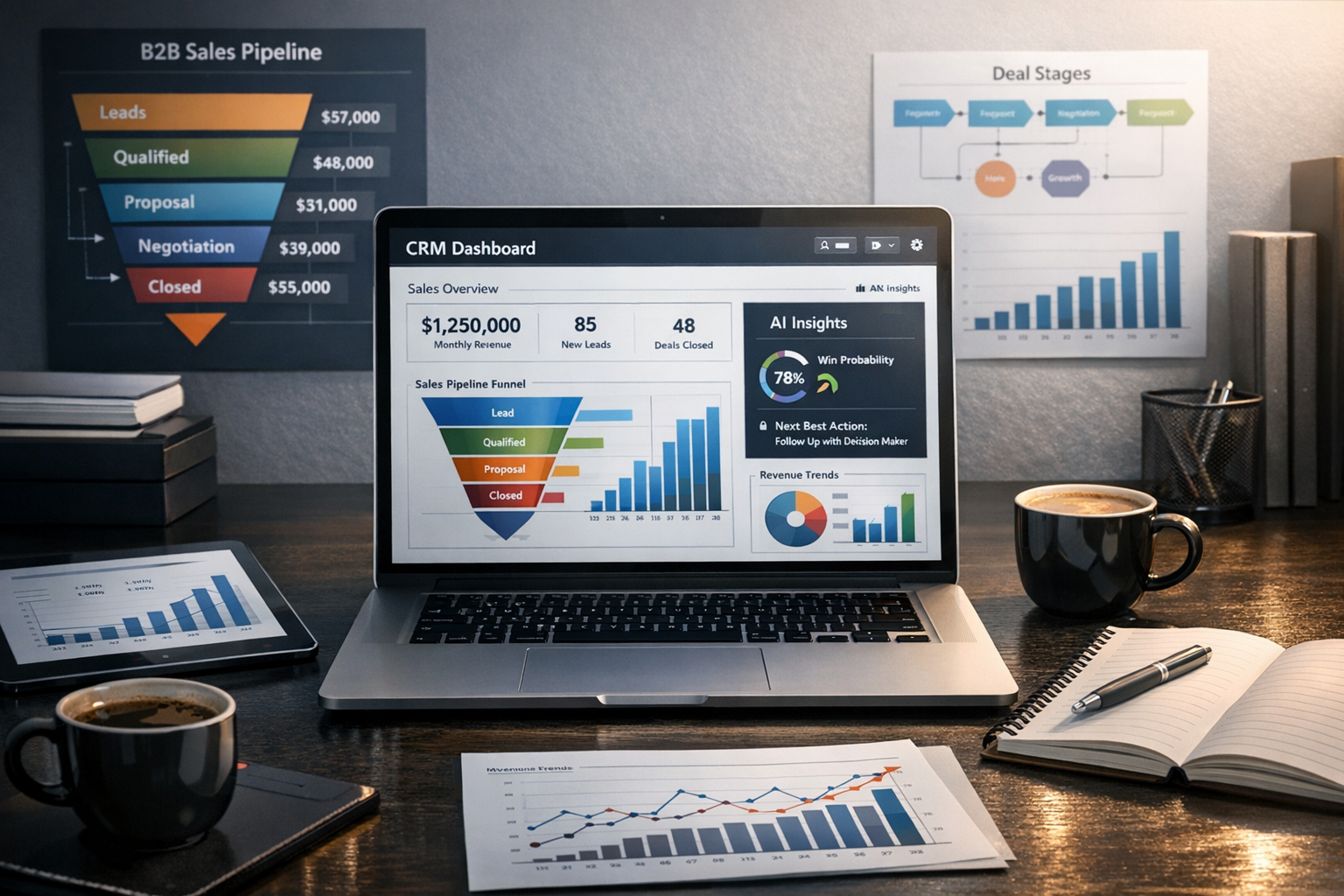
HelloGrowthCRM software
Built for real small-business sales teams
HelloGrowthCRM helps reps qualify faster, follow up on time, and close more deals—with practical automation in one place.
- AI lead scoring and pipeline visibility
- Built-in dialer, WhatsApp, and email automation
- Sales forecasting and RevOps-ready reporting
Mastering B2B Sales Forecasting with AI-Driven CRM Strategies
B2B sales forecasting is the process of predicting future sales performance based on historical data, market trends, and other relevant factors. It is a critical component for businesses looking to optimize their sales strategies, improve decision-making, and align sales efforts with revenue goals. In today's rapidly changing market, traditional methods of sales forecasting can often fall short. This is where AI-driven CRM (Customer Relationship Management) strategies come into play, offering tools and insights that can significantly enhance forecasting accuracy and streamline your sales pipeline management.
The Importance of Accurate B2B Sales Forecasting
Accurate sales forecasting is essential for several reasons:
- Resource Allocation: Proper forecasting allows sales teams to allocate resources more effectively, ensuring that efforts are concentrated on the most promising leads.
- Operational Efficiency: Enhanced forecasting aids in inventory management, staffing decisions, and overall operational strategies based on predicted sales.
- Strategic Planning: Executives can make informed strategic decisions regarding market expansion, product development, and partnerships based on solid revenue projections.
- Performance Benchmarking: Sales teams can measure performance against established forecasts, identifying areas for improvement or intervention.
Inaccurate forecasting, on the other hand, can lead to missed revenue opportunities, overstock situations, or inadequate staffing.
Traditional Sales Forecasting Challenges
Traditional sales forecasting methods often rely on intuition, historical performance, and manual data entry. These approaches can be prone to various challenges:
- Subjective Analysis: Sales reps might rely on gut feelings rather than data-driven evidence, leading to unreliable forecasts.
- Data Silos: Disparate data sources can lead to incomplete insights, preventing sales teams from seeing the whole picture.
- Inefficiency: Manually aggregating and analyzing data can be time-consuming, diverting attention from core selling activities.
- Lagging Indicators: Historical data can create an illusion of accuracy when market conditions are rapidly evolving.
These challenges underscore the need for a more sophisticated approach to B2B sales forecasting—one that leverages the capabilities of AI.
The Role of AI in Sales Forecasting
Artificial Intelligence (AI) can transform how businesses approach sales forecasting through data analysis, predictive modeling, and automation. Here are some of its key advantages:
Enhanced Data Analysis
AI-driven CRMs, such as HelloGrowthCRM, integrate various data sources, allowing for comprehensive analysis of customer interactions, buying patterns, and market trends. This capability enables:
- Automated data collection: Consolidating data from multiple channels for consistent insights.
- Advanced pattern recognition: Identifying trends that may not be immediately apparent through human analysis.
Predictive Analytics
AI can analyze historical data to create predictive models that forecast future sales with remarkable accuracy. These models consider numerous variables, including:
- Seasonality and market trends
- Customer behavior and purchasing history
- Competitive landscape
By understanding potential sales trajectories, teams can be more strategic in their planning.
Automation and Efficiency
AI helps to automate various aspects of the forecasting process, minimizing human error and freeing up time for sales teams. This includes:
- Automatic updates and recalibrations: Adapt forecasts in real-time as new data comes in.
- Seamless reporting: Generate reports and insights without manual effort.
Improved Collaboration
AI-driven CRM solutions enhance collaboration between sales and marketing teams by ensuring that everyone has access to the same data and insights. This unified approach helps align strategies, creating a more coherent go-to-market execution.
Best Practices for Implementing AI-Driven CRM in B2B Sales Forecasting
Implementing AI-driven CRM strategies can enhance your B2B sales forecasting, but certain best practices should be followed to maximize success:
1. Establish Clear Objectives
Defining your objectives for sales forecasting is essential. Consider what you want to achieve:
- Do you want to improve accuracy?
- Analyze specific markets?
- Align sales and marketing efforts?
Establishing clear objectives sets the stage for the entire forecasting process.
2. Integrate Data Sources
Ensure that your CRM can integrate various data sources, including:
- Customer Relationship History
- Market and Competitive Data
- Financial Information
This integrated approach offers a holistic view, allowing for better forecasting.
3. Invest in AI Tools
Choose an AI-driven CRM that not only fits your current needs but also has the potential for growth. HelloGrowthCRM is equipped with AI capabilities that enhance forecasting efficiency. Explore our Features to learn more.
4. Train Your Team
Even the best tools are ineffective without a knowledgeable team. Provide training on how to leverage AI insights effectively. Encourage sales teams to continually use AI-driven forecasts to inform their strategies.
5. Monitor and Adjust
Sales forecasting is not a one-time effort. Continuously monitor the accuracy of your forecasts and make adjustments to your processes as needed. Metrics to watch include:
- Accuracy of past forecasts
- Changes in market conditions
- Customer feedback
By regularly adjusting your approach, you can adapt to evolving sales landscapes.
Leveraging HelloGrowthCRM for Enhanced Sales Forecasting
HelloGrowthCRM stands out in the crowded CRM market thanks to its robust capabilities designed specifically for B2B sales teams. By utilizing our AI CRM Product, organizations can:
- Automate data collection and reporting.
- Gain insights tailored to their industry.
- Benefit from real-time updates and powerful predictive analytics.
Ultimately, HelloGrowthCRM provides the tools necessary to enhance collaboration and streamline the B2B sales forecasting process, making it easier for teams to adapt and excel in a competitive landscape.
Conclusion
Mastering B2B sales forecasting requires a strategic approach that integrates modern technology, particularly AI-driven CRM solutions. By leveraging data insights and predictive analytics, businesses can navigate the complexities of the current market and make informed decisions that drive revenue growth.
If you are looking to enhance your B2B sales forecasting accuracy and streamline your sales pipeline management, consider trying HelloGrowthCRM. Sign up for a Free Trial or schedule a Demo today to experience first-hand how our tools can transform your sales strategies.
Frequently Asked Questions
- What is B2B sales forecasting?
B2B sales forecasting is the process of predicting future sales performance based on historical data, market trends, and other relevant factors. - How can AI improve sales forecasting?
AI enhances sales forecasting through advanced data analysis, predictive analytics, and automation, thereby increasing the accuracy and efficiency of forecasts. - What are the challenges of traditional sales forecasting?
Traditional methods often rely on subjective analysis, data silos, inefficiency, and lagging indicators, making them less accurate than AI-based approaches. - What best practices can help in implementing AI-driven CRM?
Establish clear objectives, integrate data sources, invest in AI tools, train your team, and continuously monitor and adjust your processes. - How does HelloGrowthCRM support B2B sales forecasting?
HelloGrowthCRM offers AI capabilities that automate data collection, provide predictive insights, and streamline the sales process, all tailored for B2B needs. - What resources are available for further understanding of AI-driven CRM?
Visit our Features and Pricing pages to learn more about how HelloGrowthCRM can enhance your B2B sales strategies.
By adopting AI-driven CRM strategies and understanding the nuances of B2B sales forecasting, companies can position themselves for greater success in an increasingly competitive environment.
Implementation Checklist for Mastering B2B Sales Forecasting with AI-Driven CRM Strategies
Teams researching B2B sales forecasting, AI CRM usually need more than a high-level definition. They need a repeatable process, clear ownership, and a way to connect day-to-day execution back to pipeline quality and revenue outcomes. That is why the most useful version of this topic is practical: it should help a team decide what to standardize, what to automate, and what to measure first.
Start by deciding where B2B sales forecasting, AI CRM fits in the revenue workflow. For some teams it belongs near lead qualification, because better prioritization affects who gets attention first. For others it belongs in pipeline management, because the real problem is inconsistent stage movement, poor follow-up discipline, or weak forecast confidence. The exact placement matters because it determines which records, fields, and manager reviews should change after the process is introduced.
Step-by-step rollout model
- Define the business outcome the team wants from B2B sales forecasting, AI CRM. That could be faster speed-to-lead, better conversion from demo to opportunity, cleaner qualification, or fewer stalled deals.
- Identify which team owns the process day to day. A workflow with no owner usually becomes a dashboard topic instead of an execution habit.
- Decide which fields or signals are required. Keep the list narrow enough that reps can maintain it without turning the CRM into admin overhead.
- Add automations only after the workflow is clear. Good automation reduces repetitive work, but bad automation hides process problems and makes reporting less trustworthy.
- Review performance weekly. Teams improve faster when they inspect real records, not just summary charts.
What strong teams usually standardize
- A clear definition of when a lead, account, or deal qualifies for the next step
- Required fields that support follow-up, segmentation, and reporting
- Ownership rules for handoffs, reminders, and stage progression
- Manager review checkpoints for aging, conversion, and execution quality
- An escalation path for records that are blocked, stale, or missing context
Metrics to watch after rollout
When a team implements B2B sales forecasting, AI CRM well, performance should change in ways that are visible. Look at conversion rate between stages, response time, meeting creation, pipeline age, follow-up completion, and forecast confidence. If those numbers do not move after implementation, the process may be too theoretical, too hard to use, or not connected tightly enough to how reps actually work inside the CRM.
It is also useful to separate activity metrics from quality metrics. A team can appear busy while still failing to improve outcomes. Measuring both helps leadership understand whether B2B sales forecasting, AI CRM is increasing output only, or improving the quality of decisions and follow-through as well.
How HelloGrowthCRM supports this workflow
HelloGrowthCRM is most effective when the team uses it as an operating system rather than a contact database. The platform helps centralize lead records, activity history, communication, automation triggers, reporting, and follow-up actions in one place. That matters for B2B sales forecasting, AI CRM because it reduces the gap between strategy and execution. Reps can see the context, managers can inspect progress, and leaders can connect the process back to revenue performance.
For example, a team may start with a simple scoring or qualification framework, then connect it to follow-up tasks, reporting views, internal alerts, and manager dashboards. Another team may apply the same principle to messaging, meeting scheduling, outbound sequencing, or account prioritization. In each case, the system works best when the workflow is inspectable and the next step is obvious.
Common mistakes that reduce content quality and execution quality
One common mistake is treating B2B sales forecasting, AI CRM as a one-time setup instead of an ongoing operating discipline. Teams launch the framework, create a dashboard, and assume the problem is solved. In reality, the process needs feedback loops. Inputs drift, rep behavior changes, and the market evolves. Without review, even a good workflow loses accuracy.
Another mistake is overcomplicating the first version. Teams sometimes try to capture too many fields, too many exceptions, or too many automations before the basic operating model is stable. That creates resistance and lowers adoption. A better approach is to launch the smallest version that still produces measurable decisions, then add sophistication after the team trusts the workflow.
Practical FAQ extension
How long should a team give this process before judging results?
Most teams need a few weeks of consistent use before they can evaluate whether B2B sales forecasting, AI CRM is improving execution. The exact timing depends on deal cycle length and lead volume, but a workflow should usually be reviewed across multiple reporting intervals before large conclusions are drawn.
Does B2B sales forecasting, AI CRM matter only for large sales teams?
No. Smaller teams often benefit even more because a clear workflow prevents follow-up gaps and makes performance easier to inspect without adding management layers. The key is to keep the process proportional to team size.
What is the best first improvement to make?
Usually the best first improvement is clarity. Define the next step, the owner, and the required information. Once those are stable, automation and reporting become much more valuable.
Final execution notes for Mastering B2B Sales Forecasting with AI-Driven CRM Strategies
B2B sales forecasting, AI CRM becomes commercially valuable when it helps a team move faster with more confidence, not when it just adds vocabulary. The teams that get the best results usually connect workflow design, data hygiene, automation, and manager inspection into one rhythm. That is the lens readers should use when evaluating any approach connected to HelloGrowthCRM.
Frequently Asked Questions
Ready to put this into practice?
Set up your pipeline, WhatsApp follow-ups, and AI lead scoring in minutes — free, no credit card.
Try HelloGrowthCRM freeGet CRM tips in your inbox
Join thousands of sales professionals who get weekly insights on CRM strategy, AI automation, and pipeline optimization.

The HelloGrowthCRM team publishes guides on CRM strategy, AI sales tools, and revenue operations for small business sales teams.