HelloGrowthCRM software
Built for real small-business sales teams
HelloGrowthCRM helps reps qualify faster, follow up on time, and close more deals—with practical automation in one place.
- AI lead scoring and pipeline visibility
- Built-in dialer, WhatsApp, and email automation
- Sales forecasting and RevOps-ready reporting
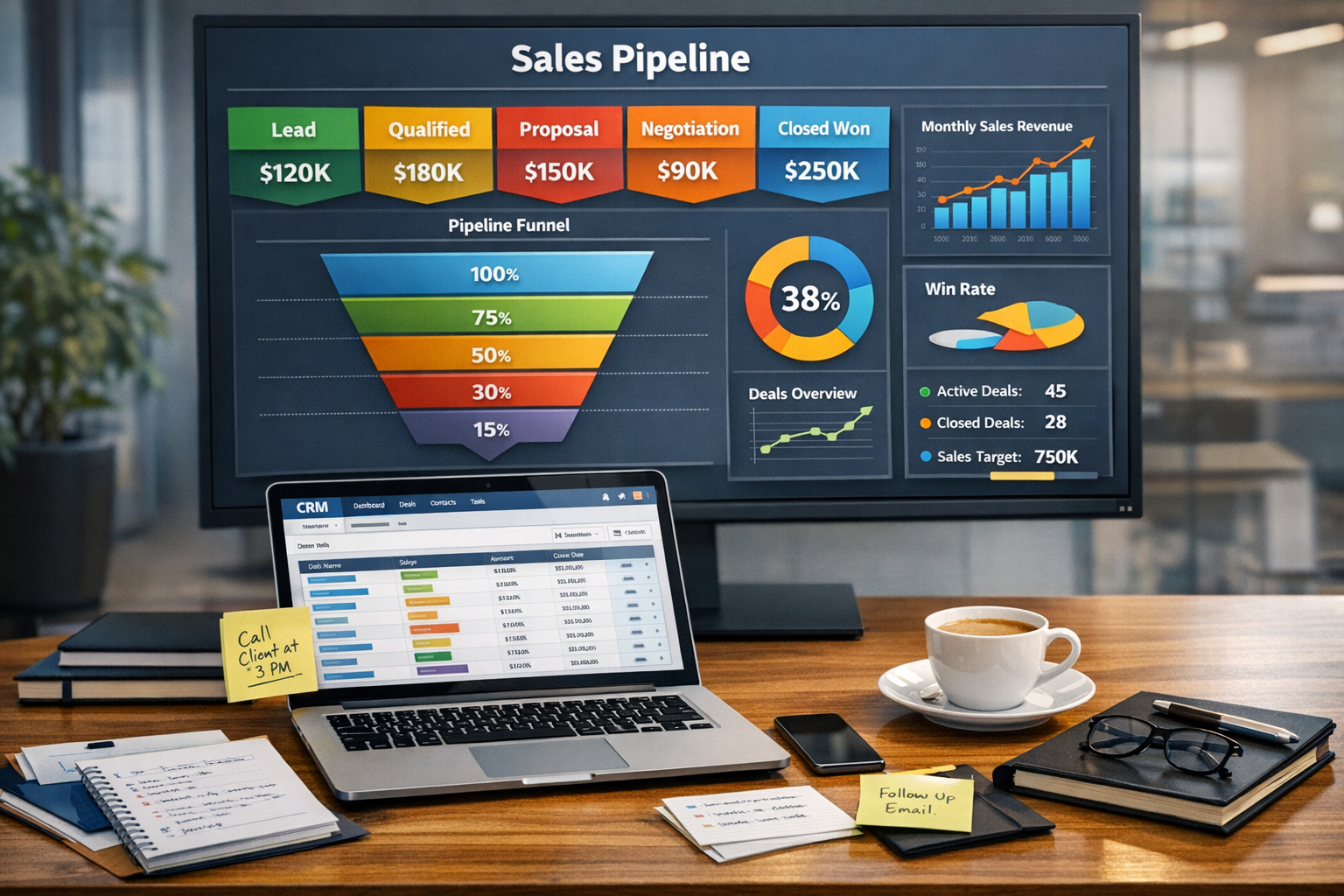
Understanding and implementing effective sales pipeline stages is crucial for B2B teams looking to enhance their sales process. A sales pipeline represents the journey that potential customers go through from the initial contact to closing a deal. Each stage is pivotal in nurturing leads and ensuring conversion. By utilizing a robust solution like HelloGrowthCRM, teams can streamline each step of the sales pipeline, improving revenue growth while maintaining effective lead management.
What Are Sales Pipeline Stages?
Sales pipeline stages outline the specific steps a sales team must follow to convert prospective clients into customers. These stages help a B2B organization visualize and track the progress of sales opportunities throughout the sales process. Establishing well-defined sales pipeline stages allows teams to:
- Clearly understand where each lead is in the sales process.
- Measure performance and productivity.
- Identify areas for improvement in lead management or sales strategies.
An effective sales pipeline is not just about closing deals; it's a strategic tool that enables teams to focus their efforts on leads that are most likely to convert, leveraging insights from Sales Tools and analytics.
Essential Sales Pipeline Stages
Every sales pipeline will have unique stages based on the business model and target market. However, certain stages are generally applicable across B2B sales. Here are the essential sales pipeline stages that every B2B sales team should implement:
1. Lead Generation
This is the initial stage of the sales process where potential leads are identified. Lead generation can involve various tactics, including:
- Content marketing
- Webinars and events
- Trade shows
- Networking
- Social media outreach
Why It Matters: This stage is crucial because without leads, there is no sales activity. Innovative strategies such as Email Automation can help you reach a wider audience, capturing leads through engaging content and compelling calls to action.
2. Lead Qualification
Not all leads are created equal, and prioritizing them is essential for efficient resource allocation. During the lead qualification stage, your team should assess:
- The lead's fit with your ideal customer profile (ICP).
- Their level of interest and engagement.
- Their budget and purchasing authority.
Using AI Lead Scoring features in HelloGrowthCRM helps in achieving a quick and data-driven assessment of leads, allowing your sales team to focus on high-potential prospects.
3. Needs Assessment
Your team should aim to fully understand the needs and pain points of qualified leads. This stage involves:
- Conducting discovery calls.
- Asking open-ended questions to uncover challenges.
- Evaluating the lead's business objectives.
Why It Matters: A detailed needs assessment ensures that your sales pitch resonates with the prospect, making it easier to demonstrate how your solution aligns with their needs.
4. Proposal Development
Once you understand the lead's requirements, you can craft a tailored proposal. This step should include:
- Clear outlines of your offerings.
- Pricing details.
- Custom solutions designed around the prospect's specific needs.
The proposal stage is crucial, as a professional, well-written proposal can differentiate your business from the competition.
5. Negotiation
Negotiation typically includes discussions around:
- Pricing adjustments.
- Terms of service.
- Delivery timelines.
Effective negotiation requires strong communication skills and a deep understanding of what both parties need. Employing clear sales metrics and using insights from Sales Forecasting can facilitate a more data-driven approach.
6. Closing
This is the final stage of the sales pipeline where both parties agree and finalize the deal. Essential elements include:
- Renewing discussions to finalize terms.
- Getting the signed contract.
- Processing the payment.
Why Is Closing Crucial? According to industry standards, B2B sales teams should maintain a high close ratio. Leveraging tools that streamline the closing process, such as integrated Integrations with accounting software, can save time and enhance efficiency.
7. Post-Sale Follow-Up
Your relationship with a client shouldn’t end after closing. Follow-ups are vital for:
- Ensuring satisfactory product/service delivery.
- Identifying opportunities for upsell or cross-sell.
- Gathering feedback to enhance future offerings.
Utilizing a CRM like HelloGrowthCRM enables ongoing relationship management, ensuring that you stay connected and continue to provide value to your customers.
Benefits of Streamlining Sales Pipeline Stages with HelloGrowthCRM
Implementing and streamlining effective sales pipeline stages through a comprehensive CRM like HelloGrowthCRM provides several advantages:
Enhanced Visibility
A centralized dashboard allows team members to view the status of all leads in real time. Teams can monitor which stage leads are in, identify bottlenecks, and adjust strategies accordingly.
Improved Collaboration
HelloGrowthCRM encourages collaboration among team members. With shared access to lead information, everyone is aligned, and efforts can be better coordinated. This facilitates smoother handoffs as leads progress through the pipeline stages.
Data-Driven Insights
Through built-in analytics, HelloGrowthCRM allows sales teams to track their performance effectively. Teams can evaluate what stages are most successful or where leads tend to stall, allowing for data-driven decision-making.
Efficient Lead Management
With features tailored to Managed RevOps, HelloGrowthCRM streamlines lead management processes. Automatic lead assignments based on team availability or expertise make sure that leads are promptly addressed.
Scalability
As your business grows, so too can your sales pipeline. HelloGrowthCRM is designed to scale alongside your business, facilitating the addition of new stages and processes as required.
How to Monitor Your Sales Pipeline Efficiency
Continuous assessment of the sales pipeline is critical to optimizing the sales process. Here are methodologies to help you monitor its efficiency:
- Conversion Rates by Stage: Track the percentage of leads that convert from one stage to the next. A sudden drop-off could indicate an underlying issue.
- Cycle Time: Measure the average time leads spend in the pipeline and identify areas where processes can be expedited.
- Lead Source Effectiveness: Analyze which lead sources yield the highest conversion rates to inform future lead generation efforts.
Automated reports generated by HelloGrowthCRM can help your team visualize these metrics so that decisions can be made swiftly and effectively.
Best Practices for Implementing Sales Pipeline Stages
To successfully implement effective sales pipeline stages, consider the following best practices:
- Define Clear Stages: Ensure everyone on the team understands the pipeline's stages and definitions.
- Utilize Technology: Use CRM tools to automate processes wherever possible, freeing up your team for high-value activities.
- Regular Training: Provide ongoing training and resources to ensure team members are familiar with best practices and new features.
- Consistent Review: Schedule regular team meetings to review the sales pipeline and strategies, identifying areas for improvement collectively.
FAQs on Sales Pipeline Stages
1. What is a sales pipeline?
A sales pipeline is a visual representation of the steps that your sales team follows to convert leads into customers.
2. How many stages should a sales pipeline have?
While it can vary, a typical sales pipeline includes 6 to 7 stages, but it should be tailored to your specific business needs.
3. How can HelloGrowthCRM help improve my sales pipeline?
HelloGrowthCRM offers tools for lead tracking, analytics, and automated processes, helping sales teams close deals more effectively.
4. What are some common issues in sales pipelines?
Bottlenecks, unclear qualification criteria, and lack of regular updates are common issues that can impact sales efficiency.
5. How does lead scoring work?
Lead scoring assigns a numerical value to leads based on their behavior and fit with your ideal customer profile, helping prioritize high-potential prospects.
6. Why is follow-up important in the sales process?
Following up with prospects can foster relationships, address concerns, and increase the likelihood of closing a deal.
Conclusion
An effective sales pipeline is a cornerstone of any successful B2B sales strategy. By clearly defining and streamlining each stage, businesses can enhance their ability to convert leads into loyal customers. HelloGrowthCRM provides the tools necessary for managing your sales pipeline efficiently, from lead generation to post-sale follow-up.
Ready to take your sales strategy to the next level? Start your Free Trial of HelloGrowthCRM today and experience the difference for yourself!
Implementation Checklist for Effective Sales Pipeline Stages Every B2B Team Should Implement
Teams researching sales pipeline stages usually need more than a high-level definition. They need a repeatable process, clear ownership, and a way to connect day-to-day execution back to pipeline quality and revenue outcomes. That is why the most useful version of this topic is practical: it should help a team decide what to standardize, what to automate, and what to measure first.
Start by deciding where sales pipeline stages fits in the revenue workflow. For some teams it belongs near lead qualification, because better prioritization affects who gets attention first. For others it belongs in pipeline management, because the real problem is inconsistent stage movement, poor follow-up discipline, or weak forecast confidence. The exact placement matters because it determines which records, fields, and manager reviews should change after the process is introduced.
Step-by-step rollout model
- Define the business outcome the team wants from sales pipeline stages. That could be faster speed-to-lead, better conversion from demo to opportunity, cleaner qualification, or fewer stalled deals.
- Identify which team owns the process day to day. A workflow with no owner usually becomes a dashboard topic instead of an execution habit.
- Decide which fields or signals are required. Keep the list narrow enough that reps can maintain it without turning the CRM into admin overhead.
- Add automations only after the workflow is clear. Good automation reduces repetitive work, but bad automation hides process problems and makes reporting less trustworthy.
- Review performance weekly. Teams improve faster when they inspect real records, not just summary charts.
What strong teams usually standardize
- A clear definition of when a lead, account, or deal qualifies for the next step
- Required fields that support follow-up, segmentation, and reporting
- Ownership rules for handoffs, reminders, and stage progression
- Manager review checkpoints for aging, conversion, and execution quality
- An escalation path for records that are blocked, stale, or missing context
Metrics to watch after rollout
When a team implements sales pipeline stages well, performance should change in ways that are visible. Look at conversion rate between stages, response time, meeting creation, pipeline age, follow-up completion, and forecast confidence. If those numbers do not move after implementation, the process may be too theoretical, too hard to use, or not connected tightly enough to how reps actually work inside the CRM.
It is also useful to separate activity metrics from quality metrics. A team can appear busy while still failing to improve outcomes. Measuring both helps leadership understand whether sales pipeline stages is increasing output only, or improving the quality of decisions and follow-through as well.
How HelloGrowthCRM supports this workflow
HelloGrowthCRM is most effective when the team uses it as an operating system rather than a contact database. The platform helps centralize lead records, activity history, communication, automation triggers, reporting, and follow-up actions in one place. That matters for sales pipeline stages because it reduces the gap between strategy and execution. Reps can see the context, managers can inspect progress, and leaders can connect the process back to revenue performance.
For example, a team may start with a simple scoring or qualification framework, then connect it to follow-up tasks, reporting views, internal alerts, and manager dashboards. Another team may apply the same principle to messaging, meeting scheduling, outbound sequencing, or account prioritization. In each case, the system works best when the workflow is inspectable and the next step is obvious.
Common mistakes that reduce content quality and execution quality
One common mistake is treating sales pipeline stages as a one-time setup instead of an ongoing operating discipline. Teams launch the framework, create a dashboard, and assume the problem is solved. In reality, the process needs feedback loops. Inputs drift, rep behavior changes, and the market evolves. Without review, even a good workflow loses accuracy.
Another mistake is overcomplicating the first version. Teams sometimes try to capture too many fields, too many exceptions, or too many automations before the basic operating model is stable. That creates resistance and lowers adoption. A better approach is to launch the smallest version that still produces measurable decisions, then add sophistication after the team trusts the workflow.
Practical FAQ extension
How long should a team give this process before judging results?
Most teams need a few weeks of consistent use before they can evaluate whether sales pipeline stages is improving execution. The exact timing depends on deal cycle length and lead volume, but a workflow should usually be reviewed across multiple reporting intervals before large conclusions are drawn.
Does sales pipeline stages matter only for large sales teams?
No. Smaller teams often benefit even more because a clear workflow prevents follow-up gaps and makes performance easier to inspect without adding management layers. The key is to keep the process proportional to team size.
What is the best first improvement to make?
Usually the best first improvement is clarity. Define the next step, the owner, and the required information. Once those are stable, automation and reporting become much more valuable.
Final execution notes for Effective Sales Pipeline Stages Every B2B Team Should Implement
sales pipeline stages becomes commercially valuable when it helps a team move faster with more confidence, not when it just adds vocabulary. The teams that get the best results usually connect workflow design, data hygiene, automation, and manager inspection into one rhythm. That is the lens readers should use when evaluating any approach connected to HelloGrowthCRM.
Frequently Asked Questions
Ready to put this into practice?
Set up your pipeline, WhatsApp follow-ups, and AI lead scoring in minutes — free, no credit card.
Try HelloGrowthCRM freeGet CRM tips in your inbox
Join thousands of sales professionals who get weekly insights on CRM strategy, AI automation, and pipeline optimization.

The HelloGrowthCRM team publishes guides on CRM strategy, AI sales tools, and revenue operations for small business sales teams.