HelloGrowthCRM software
Built for real small-business sales teams
HelloGrowthCRM helps reps qualify faster, follow up on time, and close more deals—with practical automation in one place.
- AI lead scoring and pipeline visibility
- Built-in dialer, WhatsApp, and email automation
- Sales forecasting and RevOps-ready reporting
A CRM for B2B SaaS startups trial to PQL pipeline is a system that tracks user activity during product trials, automatically identifies product‑qualified leads (PQLs) based on real usage signals, and routes those accounts to sales teams for structured follow‑up conversations that convert product adoption into measurable revenue.
Key Takeaways
- B2B SaaS startups need a single pipeline that connects trial signup, product usage data, PQL scoring, and sales outreach.
- Product‑qualified leads (PQLs) are triggered by meaningful product activity such as feature usage, seat expansion, or integrations.
- Automated scoring and alerts reduce the delay between product engagement and sales follow‑up.
- A CRM that integrates with product data and messaging channels improves conversion from free trials to paid accounts.
- HelloGrowthCRM combines PQL scoring, pipeline tracking, and AI-driven deal insights in one system designed for SaaS teams.
Why B2B SaaS Startups Need a Trial-to-PQL CRM Pipeline
A trial‑to‑PQL CRM pipeline for B2B SaaS startups connects product usage data, lead scoring, and sales workflows so that trial users who demonstrate real buying intent automatically move into sales engagement stages rather than being treated like generic marketing leads.
Most early-stage SaaS companies launch with a free trial or freemium model. That means prospects interact with the product before speaking to a salesperson.
The problem appears when the product team, marketing team, and sales team each track different data sources.
Typical early‑stage stack problems include:
- Product analytics in one platform
- CRM contacts in another
- Trial events tracked separately
- Sales reps manually checking user activity
This fragmentation slows down revenue conversations.
Product‑qualified leads solve this problem. A PQL is a prospect who demonstrates buying intent through product behavior rather than form fills or demo requests.
Harvard Business Review has highlighted that companies using product‑led growth models increasingly rely on usage data rather than traditional lead scoring systems.
https://hbr.org/2022/04/what-product-led-growth-really-means
But identifying PQLs alone is not enough. You must connect them to a sales pipeline.
That is where a CRM built for product‑led SaaS becomes critical.
With an AI-driven platform like AI CRM, startups can combine:
- trial signup data
- feature usage events
- account-level activity
- deal pipelines
- automated outreach
The result is a clean handoff from product usage to revenue conversations.
Common Trial Funnel Breakdowns
In dozens of SaaS pipeline audits I have done over the past decade, the same problems appear again and again:
- Sales reps only contact users who request demos
- Product teams track usage but never share signals with sales
- Trial users convert quietly without pipeline visibility
- High-intent accounts churn before outreach
In one rollout I led with a 12‑person SaaS sales team, we discovered that 38% of converted customers had never spoken to sales before upgrading. The company had no visibility into which accounts were expanding seats during trials.
Once we introduced automated PQL scoring and CRM alerts, sales conversations started earlier and deal sizes increased.
What Is a Product-Qualified Lead (PQL) in SaaS?
A product‑qualified lead (PQL) in SaaS is a trial or freemium user who has demonstrated strong buying intent through product usage signals such as activating key features, inviting teammates, integrating tools, or reaching usage limits that indicate readiness to purchase.
Unlike marketing‑qualified leads (MQLs), PQLs are based on real product engagement.
Typical SaaS PQL signals include:
- Reaching a usage milestone (for example exporting 100 reports)
- Adding additional users or team members
- Integrating external tools such as Slack or Google Meet
- Creating multiple projects or workflows
- Repeated logins over several days
These behaviors show the product is solving a real problem.
Why PQLs Convert Faster
Product engagement reduces sales friction.
When a prospect already understands the product, sales conversations shift from explaining features to discussing value and pricing.
This aligns with findings from Forrester that product‑led growth models increasingly depend on product data to guide revenue teams.
https://www.forrester.com/blogs/category/sales/
Sales teams can then focus on:
- expanding usage
- solving blockers
- negotiating contracts
Instead of starting from zero.
PQL vs Traditional Lead Scoring
| Lead Type | Signal Source | Sales Readiness | Example Trigger |
|---|---|---|---|
| MQL | Marketing engagement | Early stage | Ebook download |
| SQL | Sales qualification | Mid stage | Demo request |
| PQL | Product usage behavior | High intent | Invites teammates or activates core feature |
For SaaS startups, PQLs often convert faster because they already see value.
Platforms like AI Lead Scoring can automatically detect these usage patterns and trigger pipeline movement inside the CRM.
How HelloGrowthCRM Connects Trials, PQLs, and Sales Pipelines
HelloGrowthCRM connects trial activity, product‑qualified lead scoring, and revenue pipeline management by ingesting product usage signals, automatically identifying high‑intent accounts, and routing them into structured sales workflows where reps receive alerts, deal insights, and outreach automation.
Many CRMs focus only on contact management.
That approach breaks down in product‑led SaaS.
What SaaS startups actually need is a revenue pipeline connected to product behavior.
HelloGrowthCRM bridges that gap through three core capabilities.
1. Trial Activity Tracking
Trial users generate valuable engagement signals.
HelloGrowthCRM can ingest activity from product events or integrations and associate those events with accounts.
Sales teams can see:
- feature usage trends
- login frequency
- team invitations
- integration activity
These signals appear directly inside the deal pipeline.
2. Automated PQL Identification
The platform’s AI Lead Scoring analyzes behavioral signals to flag accounts likely to convert.
Instead of manually reviewing analytics dashboards, sales teams receive automated alerts when a trial account becomes a PQL.
Example triggers include:
- multiple active users within an account
- high frequency usage during the trial
- key feature adoption
3. Structured Sales Handoff
Once a PQL is detected, the CRM automatically moves the account into the pipeline and assigns it to a sales rep.
From there, tools such as:
allow reps to contact high‑intent users immediately.
In one SaaS pipeline audit I ran last year, trial users often waited three to five days before receiving a sales follow‑up. After automating the handoff workflow, response times dropped to under one hour.
That speed often determines whether a trial converts.
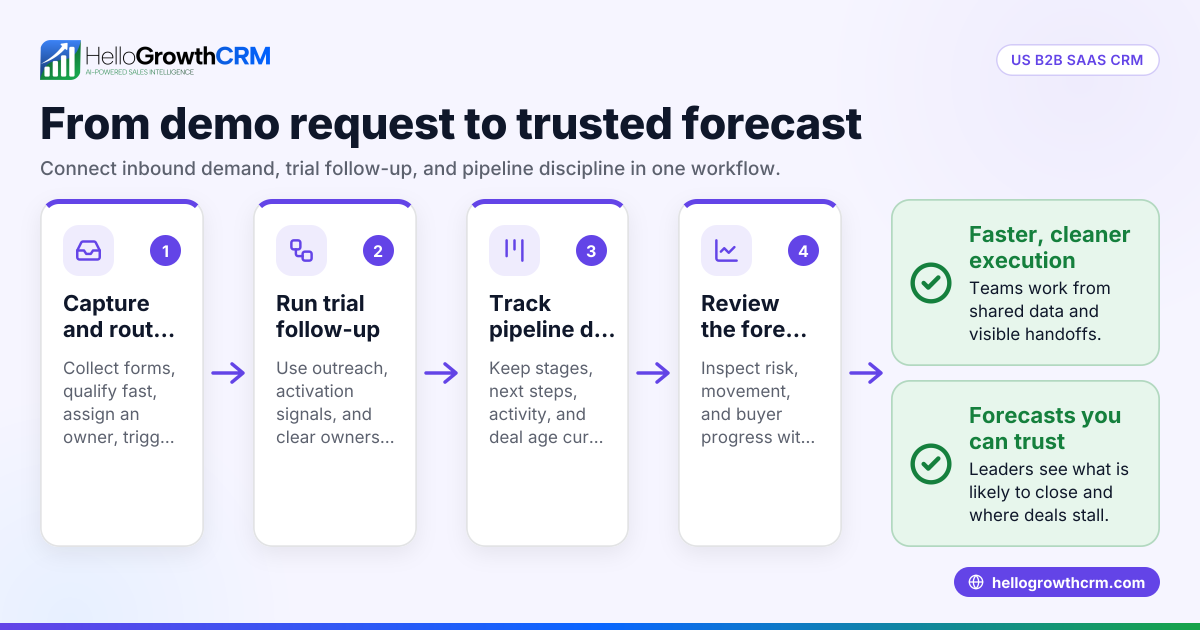
CRM Workflow for Managing Trial Signups in SaaS
A CRM workflow for managing trial signups in SaaS tracks each account from signup to activation, monitors product usage events, identifies high‑intent behaviors, and triggers automated outreach or sales handoffs so that engaged users move smoothly from product exploration to commercial conversations.
Most SaaS trial funnels contain four core stages.
Stage 1: Trial Signup
New users create accounts.
The CRM captures:
- email domain
- company name
- team size
- signup source
These details help identify potential ICP matches.
Stage 2: Product Activation
Activation happens when users reach the “aha moment.”
Examples include:
- creating their first project
- uploading data
- inviting teammates
Tracking these events helps identify engaged users early.
Stage 3: PQL Trigger
When users hit predefined usage thresholds, the CRM flags them as PQLs.
Tools like AI Pipeline Management can automatically create deals at this stage.
Stage 4: Sales Engagement
Sales teams then reach out using contextual messaging.
Instead of generic outreach, reps reference real product activity.
Example:
“Noticed your team created five workflows this week. Want help scaling that setup?”
This approach feels helpful rather than intrusive.
How to Build a Trial-to-PQL Pipeline in HelloGrowthCRM: Step-by-Step
Building a trial‑to‑PQL pipeline in HelloGrowthCRM involves defining trial events, connecting product data to the CRM, creating automated PQL scoring rules, routing qualified accounts to sales representatives, and tracking revenue outcomes through pipeline stages and attribution dashboards.
- Define Your PQL Signals
Identify behaviors that indicate real product value. Examples include team invitations, usage milestones, or integrations with tools like Slack. - Connect Product Data to the CRM
Use integrations or APIs to send usage events into the CRM. These signals become visible in the contact and account timeline. - Configure AI Lead Scoring
Use AI Lead Scoring to assign weighted scores to behaviors such as feature adoption or frequent logins. - Create a PQL Pipeline Stage
Add a dedicated stage between trial activation and sales qualification so reps can prioritize high‑intent users. - Automate Sales Alerts and Tasks
Use Sales Task Boards to automatically create follow‑up tasks when PQL thresholds are reached. - Track Conversion and Revenue Attribution
Monitor how many PQLs convert to customers using Revenue Attribution dashboards.
This structured process helps startups move from guesswork to predictable revenue growth.
HelloGrowthCRM vs Generic CRMs for SaaS Trial Pipelines
A HelloGrowthCRM vs generic CRM comparison for SaaS trial pipelines shows that traditional CRMs track contacts and deals but often lack deep product‑usage signals, while platforms designed for SaaS integrate trial activity, PQL scoring, and AI-driven pipeline insights to convert product engagement into revenue faster.
Many early‑stage startups start with generic CRMs.
Those systems work for basic contact management but struggle with product‑led funnels.
| Capability | Generic CRM | HelloGrowthCRM |
|---|---|---|
| Trial usage tracking | Limited | Native product signal tracking |
| Product‑qualified lead detection | Manual or external tools | Built‑in AI Lead Scoring |
| Sales follow‑up automation | Basic workflows | Advanced Email Automation and dialer |
| Pipeline insights | Static reporting | AI‑driven AI Deal Insights |
| Revenue attribution | Partial | Built‑in Revenue Attribution |
Disclosure: HelloGrowthCRM is the platform referenced in this article, so the comparison reflects our product capabilities.
However, the underlying principle remains true regardless of platform choice: SaaS companies need CRM pipelines connected to product data.
Without that connection, the sales team operates blindly.
The Revenue Impact of Connecting Product Usage to Sales
Connecting product usage data to CRM pipelines allows revenue teams to identify buying intent earlier, prioritize the right accounts, and reduce time‑to‑conversion because sales outreach happens at the moment when users already experience value from the product.
This shift changes the role of sales.
Instead of persuading skeptical buyers, sales teams help active users scale their success.
Benefits include:
- shorter sales cycles
- higher conversion from trial to paid
- larger expansion opportunities
- better pipeline forecasting
Tools like Sales Forecasting become more accurate because deals are based on observable behavior.
When I have audited SaaS pipelines, the biggest improvement usually comes from timing.
Reaching out when a team just invited five colleagues is dramatically more effective than sending a cold message days later.
AI tools such as the Deal Risk Agent can also warn sales teams when engagement drops during trials.
That early warning helps prevent churn before it happens.
Start building a smarter SaaS revenue pipeline by connecting product trials, PQL scoring, and sales workflows inside one system. Explore HelloGrowthCRM’s Features, start a Free Trial, or book a guided Demo to see how the platform turns product engagement into predictable revenue.
About the author
Daniel Reyes is a Sales Operations Lead in B2B SaaS with 11 years of experience building CRM and revenue operations systems. He has led multiple RevOps transformations for product‑led SaaS startups. One project included designing a PQL scoring model for a 12‑person SaaS sales team that increased trial‑to‑paid conversion visibility across product, marketing, and sales teams.
Frequently Asked Questions
Q: What is a trial-to-PQL pipeline in B2B SaaS?
A: A trial‑to‑PQL pipeline in B2B SaaS is a CRM workflow that tracks trial user activity, identifies product‑qualified leads based on engagement signals, and routes those high‑intent accounts to sales teams for conversion conversations. It connects product analytics with sales pipeline management.
Q: What defines a product-qualified lead (PQL)?
A: A product‑qualified lead is a user who shows strong purchase intent through product usage, such as activating core features, inviting teammates, or integrating tools. These behaviors indicate the product is already delivering value.
Q: How do SaaS startups track trial user activity in a CRM?
A: SaaS startups track trial activity in a CRM by sending product usage events into the platform, linking them to accounts, and using automated scoring rules to identify engagement patterns that indicate readiness for sales outreach.
Q: Why are PQLs better than marketing-qualified leads?
A: PQLs are often more valuable than marketing‑qualified leads because they are based on real product usage rather than marketing engagement. Users who actively use the product usually convert faster and require less education during sales conversations.
Q: How quickly should sales follow up with a PQL?
A: Sales teams should follow up with a PQL as quickly as possible, ideally within hours of the qualifying product activity. Fast outreach ensures the conversation happens while the user is actively engaged with the product.
Q: What CRM features are most important for SaaS trial funnels?
A: The most important CRM features for SaaS trial funnels include product usage tracking, automated PQL scoring, pipeline automation, sales outreach tools, and revenue attribution dashboards that connect product activity with closed revenue.
Q: Can small SaaS startups benefit from PQL pipelines?
A: Yes, small SaaS startups benefit from PQL pipelines because they help prioritize high‑intent users when sales resources are limited. Automated scoring ensures teams focus on accounts most likely to convert.
Q: How does HelloGrowthCRM help SaaS startups convert trials to revenue?
A: HelloGrowthCRM helps SaaS startups convert trials to revenue by tracking product engagement, automatically identifying product‑qualified leads, and enabling fast sales outreach through integrated tools such as AI lead scoring, pipeline automation, and revenue attribution dashboards.
Frequently Asked Questions
Ready to put this into practice?
Set up your pipeline, WhatsApp follow-ups, and AI lead scoring in minutes — free, no credit card.
Try HelloGrowthCRM freeGet CRM tips in your inbox
Join thousands of sales professionals who get weekly insights on CRM strategy, AI automation, and pipeline optimization.

The HelloGrowthCRM team publishes guides on CRM strategy, AI sales tools, and revenue operations for small business sales teams.