Logistics CRM India: How Transporters Stop Losing Revenue After Sending Quotes

Co-Founder, HelloGrowthCRM · January 16, 2026 · 9 min read
HelloGrowthCRM software
Built for real small-business sales teams
HelloGrowthCRM helps reps qualify faster, follow up on time, and close more deals—with practical automation in one place.
- AI lead scoring and pipeline visibility
- Built-in dialer, WhatsApp, and email automation
- Sales forecasting and RevOps-ready reporting
The crore problem sitting in every logistics WhatsApp group
Walk into any mid-sized Indian transport company — fifty trucks, a fleet manager, two or three sales executives, and a back-office team managing lorry receipts — and you will find the same operating picture: a WhatsApp group for new enquiries, a shared Excel sheet for freight rates, a separate register for advance payments, and a memory-dependent follow-up process that runs entirely on the goodwill of the sales team.
The problem is not that the people are disorganised. The problem is that the system is. When a fleet owner in Ahmedabad sends a spot-rate quote to a manufacturer in Pune at 9 pm on a Tuesday, that quote enters a chaos zone. Did the customer read it? Did a competitor quote lower twenty minutes later?
Is someone going to follow up tomorrow morning, or will it sit until the customer calls — which they often will not?
Industry data consistently shows that Indian logistics MSMEs lose between 30 and 40 percent of inbound freight enquiries not to a better competitor, but to simple neglect. The quote was sent. Nobody followed up. The customer booked elsewhere. The fleet owner never knew until the truck sat empty for three days.
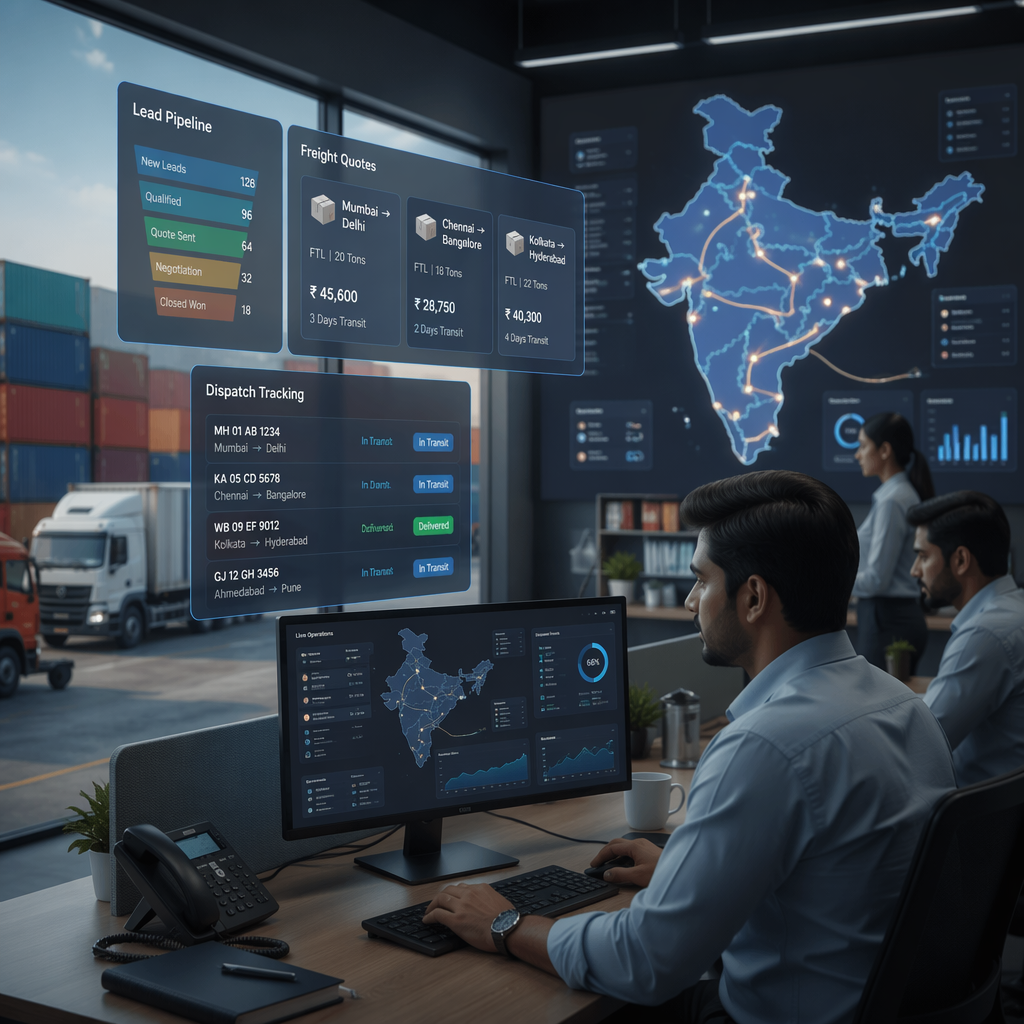
This is the core revenue leakage problem that a logistics CRM solves — not complex technology, not AI-driven demand forecasting, not digital freight exchange integration. Just a reliable system that captures every enquiry, sends every quote, tracks whether it was acknowledged, and fires a follow-up if it was not.
For Indian transporters moving goods between Tier 1 and Tier 2 cities, this single operational fix can recover 15 to 25 percent of previously lost revenue within the first ninety days of use. For a company doing two crore per month in freight billing, that is 30 to 50 lakhs per year recovered from enquiries that already came in — without spending a single rupee on marketing.
The opportunity is enormous. Only 13 percent of Indian logistics MSMEs use any form of CRM today. The other 87 percent are managing freight relationships on WhatsApp, Excel, and prayer. The gap between what these businesses earn and what they could earn with better follow-up discipline is the single largest under-exploited margin improvement available to them.
Where freight revenue actually leaks: a five-stage audit
Revenue leakage in Indian logistics does not happen at one point. It happens at five distinct stages in the freight sales and operations cycle, and most transporters are unaware of more than one or two of them.
Stage 1 is enquiry capture. Freight enquiries arrive through multiple channels: phone calls, WhatsApp messages, email, referrals from existing customers, and occasionally through aggregator platforms like Shiprocket or Porter for smaller loads. In a manual system, enquiries that arrive outside office hours — or when the pricing person is on the road — simply disappear.
A CRM with a shared inbox and mobile access ensures every enquiry is logged within minutes, regardless of channel or time of day.
Stage 2 is quote follow-up. The average Indian B2B buyer takes 48 to 72 hours to compare freight rates before booking. During that window, most transporters send the quote and do nothing. The CRM automates this: send the quote, schedule a WhatsApp follow-up at 24 hours, escalate to the sales manager at 48 hours if there is no response.
This single automation recovers a measurable percentage of quotes that would otherwise go cold.
Stage 3 is trip and delivery confirmation. Once a booking is confirmed, the risk shifts to operational transparency. Customers who cannot get real-time trip status call the fleet manager repeatedly. A CRM that logs trip milestones — pickup confirmed, in transit, delivered, POD received — eliminates this friction and creates a customer experience that competitors on WhatsApp cannot match.
Stage 4 is invoice and collections. Indian logistics companies routinely carry 45 to 90 days of outstanding receivables because invoice follow-up is manual. A CRM that flags overdue invoices and sends automated payment reminders via WhatsApp reduces days-sales-outstanding by an average of 15 to 20 days — a significant working capital improvement for asset-heavy fleet businesses.
Stage 5 is customer retention and reactivation. The most profitable logistics customers book regularly. A CRM that tracks booking frequency, flags customers who have not booked in 30 days, and triggers a re-engagement message captures repeat business that a manual system cannot monitor at scale.
Each of these five stages represents a separate revenue protection opportunity that most Indian logistics MSMEs are currently leaving unaddressed.
What a logistics CRM in India must actually do versus what vendors oversell
The logistics technology market in India is crowded with promises — freight exchange platforms, transport management systems, GPS fleet tracking, e-way bill integrations, digital lorry receipt management. Most of these are operations tools, not sales and relationship management tools.
A CRM built for Indian logistics MSMEs needs to do a small number of things exceptionally well, not attempt to be a full transport management system.
The first non-negotiable is WhatsApp-native follow-up. Indian freight buyers communicate on WhatsApp. A CRM that forces interaction through email or a dedicated portal will see adoption rates near zero. The logistics CRM must integrate with WhatsApp Business API to send quote notifications, trip updates, and payment reminders through the channel customers already use.
The second requirement is mobile-first design for the field. Fleet managers and sales executives are rarely at a desk. The CRM must work fully on a mobile browser — logging enquiries, updating trip status, checking outstanding invoices — without requiring a laptop. A desktop-only CRM will be used by exactly nobody in the operations team.
Third is simple freight rate quotation. The CRM should store standard lane rates, allow quick customisation for spot rates, and generate a formatted quote that can be sent via WhatsApp or email in under two minutes. If generating a quote takes longer than sending a WhatsApp message manually, the CRM will not be adopted.
Fourth is receivables visibility. The accounts team needs a real-time view of what is billed, what is collected, and what is overdue — sorted by customer, by lane, or by salesperson. This is not accounting software; it is the visibility layer that prompts the right follow-up at the right time.
Fifth is fleet and vehicle tagging. Each deal should be taggable to a vehicle or vehicle type. This allows the fleet manager to see utilisation by vehicle, identify underperforming assets, and prioritise which lanes to push during slow periods. HelloGrowthCRM covers all five requirements for Indian logistics MSMEs at pricing that makes sense even for a team of three operations staff.
A 90-day implementation roadmap for Indian transport companies
The most common reason Indian logistics MSMEs abandon CRM implementations is poor sequencing. They try to migrate everything at once — historical data, lane rates, existing customers, outstanding invoices — and the project collapses under its own weight. A phased 90-day approach delivers measurable ROI before the team is asked to change all their habits simultaneously.
Days 1 to 14 cover enquiry capture only. Configure the CRM with a shared inbox connected to your business WhatsApp number. Do not migrate historical data. Do not change the rate quoting process. Simply ensure that every new freight enquiry — regardless of source — is logged in the CRM with the customer name, origin, destination, load type, and required date.
Assign it to a salesperson. This one step creates visibility that did not exist before.
Days 15 to 30 focus on quote tracking and follow-up automation. Create a simple freight rate template. For the next two weeks, send all new quotes from inside the platform. Configure a 24-hour follow-up reminder for every sent quote. Measure how many quotes were previously going unacknowledged. Most companies discover that 40 to 60 percent of quotes had no follow-up whatsoever.
Days 31 to 60 add trip milestones and customer communication. For each confirmed booking, log trip milestones and configure automated WhatsApp notifications to the customer at each stage. This reduces inbound status-check calls dramatically and improves customer experience without adding headcount.
Days 61 to 90 activate invoice tracking and collections. Import current outstanding receivables. Configure payment due-date reminders at 7 days before due, on the due date, and at 7 and 14 days overdue. Most companies collect 15 to 20 percent of stale receivables within the first month of systematic follow-up.
By day 90, the CRM has recovered lost quotes, reduced operational calls, and improved collections — three measurable outcomes that justify the subscription cost many times over, without any disruption to existing operations.
ROI calculation for a 50-truck Indian transport company
Numbers ground the decision. Here is a conservative ROI model for a mid-sized Indian transport company with 50 trucks doing approximately 1.5 crore per month in freight revenue.
On recovered lost quotes: if the business receives 200 freight enquiries per month and currently converts 30 percent, that is 60 bookings. Systematic follow-up increases conversion to 38 to 42 percent — call it 40 percent. That is 80 bookings on 200 enquiries, a gain of 20 bookings per month.
At an average freight value of 18,000 rupees per booking, that is 3.6 lakhs per month in recovered revenue — 43 lakhs per year.
On reduced collections cycle: if the company carries 40 lakhs in outstanding receivables and the average collection period drops from 75 days to 58 days, the working capital freed up is approximately 9 lakhs. At a typical MSME borrowing rate of 14 percent per annum, that is 1.26 lakhs per year saved in financing costs.
On reduced administrative overhead: a shared CRM eliminates the daily "where is this enquiry" and "has this invoice been followed up" conversations. Conservative estimate: two hours per day saved across the sales and accounts team. At a fully-loaded cost of 400 rupees per hour for a sales executive, that is 2.4 lakhs per year in recovered productive time.
Total conservative annual benefit: 46 to 47 lakhs. Annual cost of HelloGrowthCRM for a team of five users: approximately 60,000 rupees. Return on investment: approximately 76 times. This is not a technology investment in the traditional sense. It is a revenue recovery exercise — retrieving money that the business was already earning the right to, and then leaving on the table due to operational gaps that cost almost nothing to fix.
For Indian logistics MSMEs, the question is not whether to adopt a CRM. It is how long they can afford to keep not using one while competitors who do are booking their customers instead. Every month of delay is another month of lost quotes, slow collections, and avoidable customer churn.
Ready to put this into practice?
Set up your pipeline, WhatsApp follow-ups, and AI lead scoring in minutes — free, no credit card.
Try HelloGrowthCRM freeGet CRM tips in your inbox
Join thousands of sales professionals who get weekly insights on CRM strategy, AI automation, and pipeline optimization.
Rushabh Shah is co-founder of Soor LLC and leads product strategy at HelloGrowthCRM. He has worked with hundreds of small business sales teams to design CRM workflows that improve pipeline predictability and reduce operational overhead.