CRM for Vet Clinics: Automating Pet Recalls and Growing Client Retention

Co-Founder, HelloGrowthCRM · March 14, 2026 · 10 min read
HelloGrowthCRM software
Built for real small-business sales teams
HelloGrowthCRM helps reps qualify faster, follow up on time, and close more deals—with practical automation in one place.
- AI lead scoring and pipeline visibility
- Built-in dialer, WhatsApp, and email automation
- Sales forecasting and RevOps-ready reporting
The Silent Patient Loss Problem
Most vet clinics have a retention problem they do not fully see. A pet owner brings their dog for a vaccination in March. The vet's team provides excellent care. The pet owner leaves happy. And then — nothing. No reminder for the booster due in 6 weeks. No recall for the annual vaccination due next March. No follow-up on the dental issue the vet mentioned. No message asking how Max is doing.
A year later, if that pet owner thinks about it at all, they assume they need to take the dog back for a check-up but cannot remember which clinic they visited or whether anything was due. They search on Google. They find a clinic closer to their new home. They book there.
This is not a story about a bad vet or poor service. It is a story about the structural retention gap that exists when a healthcare business does not have a system for proactive patient recall. Industry data from veterinary practice benchmarks consistently shows that 30-40% of active patients do not return in any given year — not because they are unhappy with their vet, but because nobody reminded them.
The financial cost of this silent attrition is substantial. A vet clinic with 500 active patients, an average spend of Rs.4,500 per patient per year, losing 35% of patients annually, is leaving Rs.7.9 lakh in recurring revenue at risk every year. Recovering even half that attrition with systematic recall would add Rs.3.9 lakh to annual revenue without acquiring a single new client.
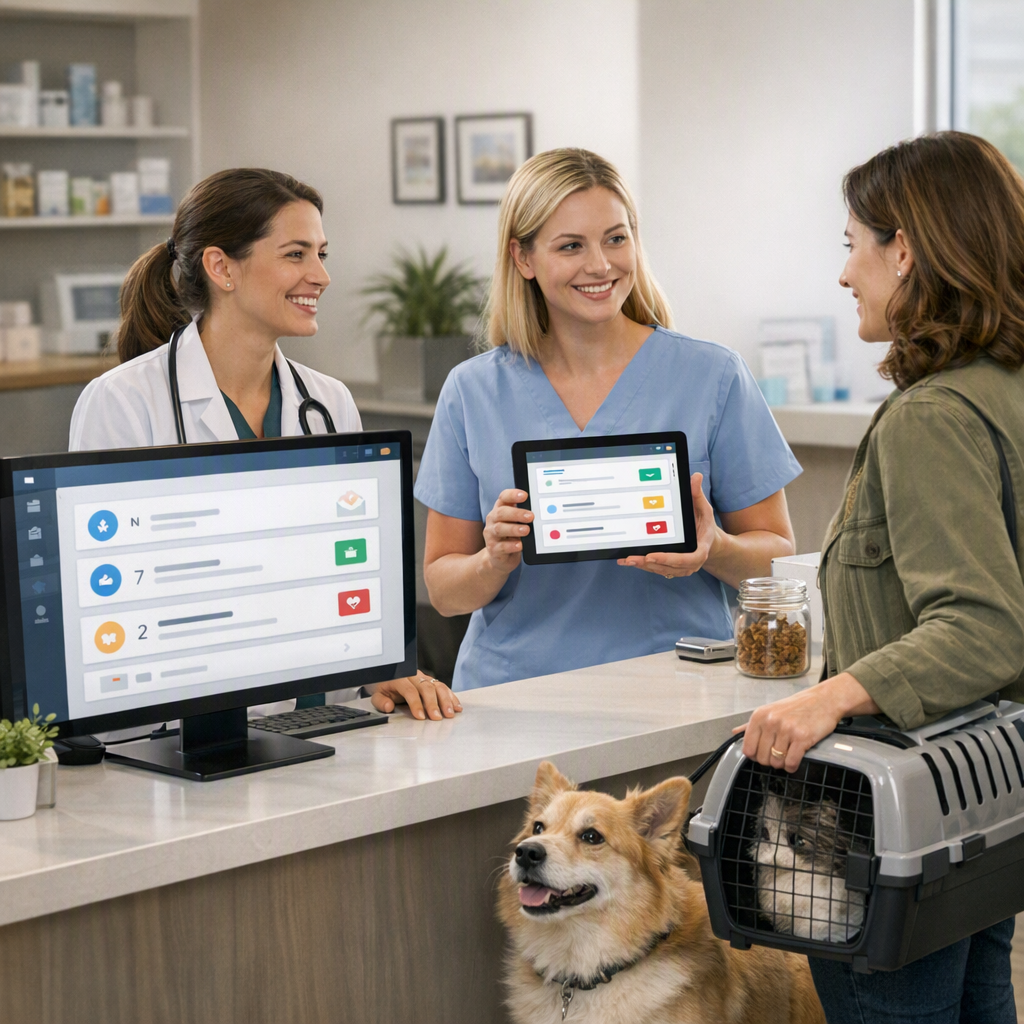
A CRM designed for veterinary practices turns recall from something that depends on a staff member's memory and spare time into a systematic, automated operating rhythm that runs even on the clinic's busiest days. The technology required is not sophisticated — it is simply a system that knows which pets are due for what, when to send a message, and how to follow up if the first message does not get a booking.
Why Practice Management Software Is Not Enough for Retention
Most established vet clinics use some form of practice management software — systems like VetEnvision, eVetPractice, Digitail, or a custom billing system — to manage appointments, billing, and medical records. The practice management system is essential for clinical operations. It is not a client relationship and retention system.
Practice management software tells you what happened during a visit: which vaccines were administered, which medications were prescribed, what the diagnosis was, and what the client was charged. This is critical clinical information. But it does not tell you what should happen next from a relationship and retention perspective.
Which pets have vaccinations due in the next 30 days? Which patients have not been seen in over 12 months? Which clients received a post-visit recommendation for a dental procedure but never booked it? Which multi-pet households have brought in only one of their three animals this year?
Which clients responded to the last reminder message but still have not booked? Answering these questions requires a different kind of system — one that tracks relationship status, communication history, and upcoming care milestones. That is what a CRM does.
A vet clinic needs both systems working together: the practice management system as the clinical record and the CRM as the client relationship and retention system. In HelloGrowthCRM, this integration is manageable because the CRM handles the client communication layer — recall messages, follow-up calls, post-visit check-ins — while the practice management system maintains the clinical record.
The practical implication for a clinic owner is straightforward: if you are relying on your practice management software to automatically retain patients, you are depending on a system that was never designed for that purpose. The patients you are losing are not visible in your practice management system — they are visible only in the CRM as contacts without a recent visit date.
Vaccination Recall Automation: A 3-Message Sequence That Works
Vaccination recall is the highest-ROI automation a vet clinic can implement, and it is also the most straightforward to set up. For every vaccine administered, the clinic knows the next due date. Converting that clinical data point into a proactive client message is simply a matter of connecting the visit record to an automated reminder sequence in the CRM.
A well-designed vaccination recall sequence has three touchpoints. The first reminder goes out 30 days before the due date: Hi Mrs. Kapoor, this is Pawsome Clinic. Max's annual vaccination is due next month around March 15th. Shall we book you in? This early reminder gives the client maximum flexibility and catches the proactive planners before they forget.
The second reminder goes out 7 days before the due date for clients who did not respond to the first: Hi Mrs. Kapoor, Max's vaccination is coming up next week. We have morning slots available Wednesday and Thursday. Would either work? This reminder creates gentle urgency and makes booking easy by offering specific options.
The third reminder goes out 7 days after the due date if the client has not yet been seen: Hi Mrs. Kapoor, Max's vaccination was due last week. No problem — we can still take care of it. Would you like to book this week? Late vaccinations are better than none, and many clients who missed the due date are simply waiting for someone to prompt them.
This three-message sequence gives clinics a systematic recall process in place of relying on unassisted patient memory. The incremental visits generated pay for the CRM subscription many times over in the first month alone.
For multi-pet households, create a contact record for the pet owner as the account holder and link multiple pet records to that contact, each with their own vaccination schedule, health history, and reminder cadence. When the front desk team opens the owner's record, they can immediately see all pets and all upcoming care milestones.
This enables bundled outreach: Hi Mrs. Kapoor, Max's vaccination is due March 15th. We can also see that Mittens is due for her annual check-up around the same time. Would you like to bring them both in together? This saves the client a second trip and increases average transaction value for the clinic.
Post-Visit Follow-Up, No-Show Recovery, and Annual Wellness Reminders
Post-visit follow-up is one of the strongest retention tools available to a vet clinic and one of the least commonly deployed. For every visit that involved a surgical procedure or a significant diagnosis — skin condition, ear infection, joint issue, post-spay or neuter — set up an automated 48-hour follow-up message: Hi Mrs.
Kapoor, just checking in — how is Max doing after his procedure yesterday? Is he eating normally and moving comfortably? Please call us immediately if you notice any swelling or discharge. Otherwise, we will see you for his post-op check in 10 days.
This message provides genuinely useful clinical guidance and creates a moment of connection that signals the clinic cares about the patient beyond the transaction. Pet owners who receive post-procedure follow-up messages are significantly more likely to recommend the clinic to friends and family and to return for non-emergency care like annual wellness visits and preventive treatments.
No-show recovery is equally important. When a client books an appointment and does not attend without cancelling, most clinics mark the slot as wasted and move on. A CRM turns the no-show into a recovery opportunity. One hour after the missed appointment time, send an automated message: Hi Mrs.
Kapoor, we missed you for Max's appointment today. No problem — shall we rebook? Here are the next available slots. Clients who receive a no-show recovery message rebook at a rate of 45-55%, versus 15-20% for clients left to rebook at their own initiative.
For annual wellness reminders, set a reminder 11 months after the most recent wellness visit for every adult pet. For senior pets — dogs over 7, cats over 10 — set bi-annual wellness reminders and include a brief note about the importance of more frequent monitoring.
This positions the clinic as a proactive health partner rather than a reactive treatment provider — a positioning that drives both retention and client trust across the life of the pet-owner relationship.
In HelloGrowthCRM, all three of these automations — post-visit follow-up, no-show recovery, and annual wellness reminders — can be configured in under an hour. Once set up, they run continuously for every patient without requiring any manual effort from clinic staff.
Preventive Care Upsell Pipeline and Revenue Forecasting
Most vet clinics offer preventive care services that clients do not consistently take up — dental scaling, deworming, flea and tick prevention, senior wellness panels, nutritional counselling, and weight management programs. These services are genuinely beneficial for pet health, and when presented in the right context, clients are receptive to them.
The challenge is creating a systematic process for making these recommendations at the right time.
In a CRM, preventive care recommendations can be tracked as a pipeline. When a vet makes a clinical recommendation — the vet notes that Max should have a dental scale in the next 3 months — that recommendation is logged in the CRM as an open upsell opportunity.
An automated reminder goes out to the client 30 days after the visit: Hi Mrs. Kapoor, just a reminder that Dr. Priya recommended a dental scale for Max at his last visit. Dental health is one of the most common causes of pain and infection in dogs. Shall we book Max in? We have slots available next week.
The preventive care pipeline view in the CRM shows all open recommendations across the patient base — how many dental scale recommendations are outstanding, how many deworming courses are due, how many senior wellness panels have been recommended but not booked.
This is both a revenue opportunity and a clinical quality metric: a clinic where most veterinary recommendations result in booked services is providing better outcomes for its patients.
For revenue forecasting, a vet clinic CRM with accurate recall compliance rates, average visit values by service type, and multi-pet household data can produce a reliable 90-day revenue forecast. If 180 patients are due for vaccinations next month at an average visit value of Rs.800, that is Rs.1.44 lakh in projected recall revenue.
Add the dental scale pipeline at 40% conversion rate and the deworming reminder pipeline and you have a detailed, service-by-service forecast that helps with staffing and supply planning.
For Indian vet clinics specifically, a 300-patient clinic with an active upsell pipeline for dental care alone, achieving a 40% conversion rate on recommendations at Rs.2,500 per dental scaling, generates Rs.30,000 per month in additional revenue from a service the clinic was already recommending but not consistently converting.
Visit our CRM for vet clinics page for details on getting started with a free plan that covers up to 200 active patients.
Ready to put this into practice?
Set up your pipeline, WhatsApp follow-ups, and AI lead scoring in minutes — free, no credit card.
Try HelloGrowthCRM freeGet CRM tips in your inbox
Join thousands of sales professionals who get weekly insights on CRM strategy, AI automation, and pipeline optimization.
Rushabh Shah is co-founder of Soor LLC and leads product strategy at HelloGrowthCRM. He has worked with hundreds of small business sales teams to design CRM workflows that improve pipeline predictability and reduce operational overhead.