Pricing Hypothesis Worksheet(Free Download)
Experiment-driven pricing worksheet with hypothesis definition, competitor benchmarking, test design, outcome tracking, decision logging, and pricing history.
Template preview
GTM workspace
What's included
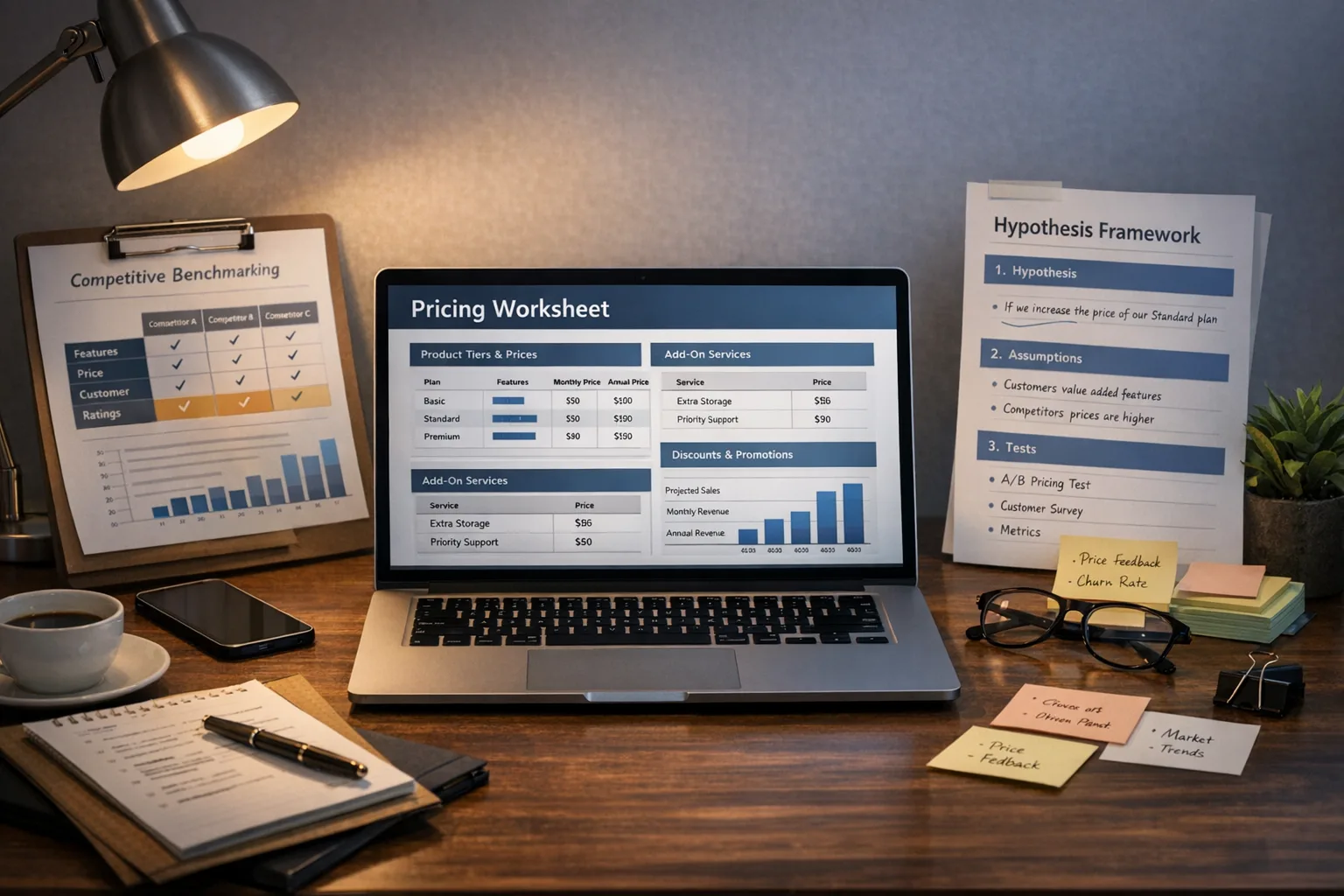
Hypothesis definition, competitor benchmark rows, experiment design, outcome tracking, structured decision log, pricing history, and governance notes in one repeatable pricing workflow.
Automation rules
- Supports structured before-versus-after comparison by keeping baseline, test, and control outcomes together.
- Turns one-off pricing tests into reusable knowledge through decision logging and experiment history.
Dashboards & views
- Hypothesis definition
- Competitive research
- Experiment design
- Outcome tracking
- Decision log
- Pricing history
- Governance
Template specs
2.0Updated 2026-04-25
No credit card · Free forever
A practical pricing experimentation template for product, finance, and growth teams testing pricing changes with more rigor. It includes structured pricing hypotheses, competitive pricing research, experiment design, outcome tracking, decision logging, a running experiment history, and governance fields so pricing changes can be tested, documented, and revisited over time instead of decided from instinct alone.
The Problem This Solves
Pricing changes often happen without a repeatable experiment process, clear baseline comparison, or documented reasoning. Without structured hypotheses and outcome tracking, teams struggle to separate signal from noise, justify pricing decisions internally, and learn from previous tests.
Who It's For
Product managers, pricing owners, finance leaders, founders, growth teams, and RevOps partners responsible for pricing and packaging decisions.
Use Cases
- Design and run controlled pricing experiments with clear test and control definitions
- Benchmark competitors and identify pricing gaps before changing price, packaging, or discounts
- Track before-and-after performance for conversion, revenue, deal size, and retention metrics
- Document pricing decisions and maintain a reusable history of experiments and learnings
How to Use This Template
- 1
Define the hypothesis in an if / then / because format and document the pricing element, target segment, assumptions, and risk
- 2
Research competitor pricing models, packaging, positioning, and discount patterns
- 3
Design the experiment with test and control groups, sample size, duration, impacted channels, success criteria, and guardrails
- 4
Track outcome metrics side by side for baseline, test group, and control group performance
- 5
Log the final decision, key learnings, and follow-up actions, then add the experiment to pricing history
Inside the template: sample data
The exact rows that ship with the Pricing Hypothesis Worksheet download — replace them with your own records after import.
| Metric | Baseline | Test group result | Control group result | % change | Significance |
|---|---|---|---|---|---|
| Conversion rate | 12.4% | 11.8% | 12.1% | -2.5% | Not significant |
| Revenue per user | $302 | $348 | $307 | +15.2% | Directional |
Results you can expect
- Define the pricing hypothesis, benchmark competitors, and finalize the test design with guardrail metrics.
- Run the experiment, gather outcome data, and collect customer and sales feedback for directional interpretation.
- Use the decision log and history to refine future pricing tests and strengthen institutional pricing knowledge.
Pairs well with
Value Proposition Canvas
Validate whether pricing reflects the value story you are taking to market.
Competitive Battle Cards
Use competitor pricing insight to sharpen packaging and positioning decisions.
Product Launch Playbook
Coordinate major pricing or packaging changes with broader GTM rollout planning.
Customization guide
- Adjust the experiment metrics to match your business model, such as ARPU, NRR, payback, or retention.
- Add more competitor rows or experiment history if you track multiple markets or product lines.
- Tailor guardrail metrics to the risks that matter most, such as churn, win rate, discounting, or sales cycle length.
- Do not run pricing changes without a clear control group or a documented baseline unless the change is operationally unavoidable.
- Do not record only the final decision without also documenting the assumptions and learnings behind it.
- Review pricing experiments alongside win-loss feedback and objection patterns to understand not just what happened, but why.
- Keep a running pricing history so teams can avoid repeating tests that already failed under similar conditions.
Frequently Asked Questions
Long enough to gather a meaningful sample while accounting for your sales cycle and channel mix. Many teams need at least several weeks and enough volume to compare test and control groups without relying on anecdotal results.
Start with the change that has the clearest business rationale and the lowest operational risk, such as a price point change, packaging adjustment, or discount policy update for a well-defined segment.
Ready to use this template?
Deploy Pricing Hypothesis Worksheet in HelloGrowthCRM with one click. Get started free — no credit card · free forever.
Free forever · No credit card required · Set up in minutes
Related resources
Related Templates
Product Launch Playbook
CRM-ready launch workspace with messaging framework, cross-functional workstreams, weekly timeline, readiness checklist, and post-launch reviews.
Competitive Battle Cards
Sales-ready competitive battle card template with top-3 competitor cards, objection handling, rep-tested win tactics, and recurring review workflows.
Value Proposition Canvas
Collaborative value proposition canvas with customer jobs, pains, gains, product value mapping, claim validation, messaging hierarchy, and prioritization.