HelloGrowthCRM software
Built for real small-business sales teams
HelloGrowthCRM helps reps qualify faster, follow up on time, and close more deals—with practical automation in one place.
- AI lead scoring and pipeline visibility
- Built-in dialer, WhatsApp, and email automation
- Sales forecasting and RevOps-ready reporting
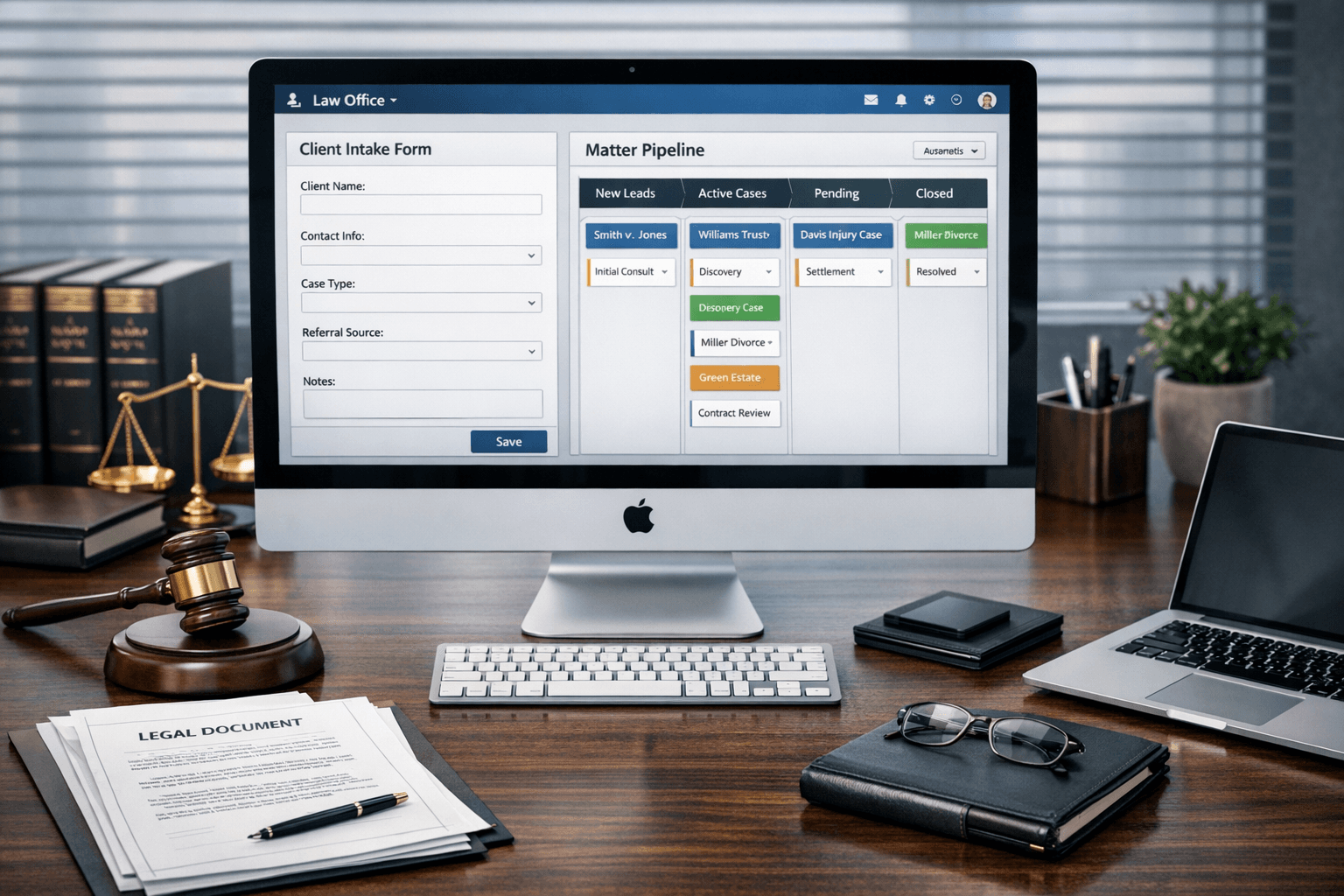
Client Relationship Management (CRM) systems have become vital tools for law firms, streamlining operations while enhancing client experiences. Specifically, a CRM for law firms focusing on client intake and matter pipeline management enables firms to automate workflows, monitor cases, and maintain valuable client relationships efficiently. This post delves into how implementing an effective CRM can revolutionize client intake and matter pipeline management, ultimately positioning law firms for growth and increased client satisfaction.
Understanding CRM for Law Firms
A Customer Relationship Management system designed for law firms helps in organizing case-related information and improving client interactions throughout the life cycle of a matter. From initial consultations to case resolutions, a CRM system assists firms in capturing vital client information, managing documents, and automating repetitive tasks.
Over the years, law firms have acknowledged the necessity of enhancing operational efficiency. Many are now adopting AI CRM systems that not only serve basic needs but also incorporate advanced features, bringing added value to the firm's processes.
The Importance of Client Intake
Client intake is the cornerstone of any successful law firm. It lays the foundation for relationships and establishes trust between clients and attorneys. A well-structured client intake process maximizes conversion rates and ensures potential clients feel valued from the first point of contact.
Steps in the Client Intake Process
- Initial Contact:
- The very first interaction could be through a website form, phone call, or email. Efficient tracking of this stage allows for better follow-up and nurturing of leads. - Qualifying Leads:
- Not all inquiries will materialize into clients. Implementing AI Lead Scoring tools helps law firms prioritize prospects based on criteria such as case type, urgency, and budget. - Data Collection:
- Gathering essential information like client name, contact details, case specifics, and other relevant data is critical. A robust CRM enables seamless data capture that can be integrated into the firm’s database. - Client Follow-Up:
- Automated follow-ups can be initiated via Email Automation, ensuring timely communication with prospects to enhance conversion efforts. - Document Management:
- Store and organize all client documents in one centralized location for easy access and reference. This reduces paperwork, enhances compliance, and speeds up the onboarding process.
Challenges in Client Intake
Despite its importance, many law firms face challenges when it comes to client intake, such as:
- Inconsistent Processes: Lack of standardization can lead to missed opportunities and errors in data entry.
- Time-Consuming Workflows: Manually handling inquiries can drain resources.
- Communication Gaps: Delayed responses to potential clients can harm the firm's reputation.
Adopting a CRM tailored for law firms can alleviate these challenges, providing answers like automated workflows, integrated communication tools, and comprehensive data management.
Managing Your Matter Pipeline
Once a client is onboarded, managing their case effectively becomes paramount. Matter pipeline management provides a visual representation of each case, helping attorneys keep track of progress and deadlines.
Elements of an Effective Matter Pipeline
- Visualization of Cases:
- A clear representation of all ongoing matters in a single view allows for easier assessments of current workloads and impending deadlines. - Task Assignment:
- Automation can help in assigning specific tasks to team members based on their expertise and availability, improving workflow efficiency. - Progress Tracking:
- Easily track various stages of a matter to identify bottlenecks early on. Utilizing Sales Forecasting tools can help law firms anticipate future workloads and staffing needs. - Client Communication:
- Regular updates can be sent directly to clients through CRM features, maintaining consistent communication and enhancing the client experience. - Document Management:
- Streamlining document creation and management, especially in legal contexts, is vital for organization and security.
Why Matter Pipeline Management Matters
Efficient matter management leads to:
- Increased Productivity: Your team can focus on critical activities rather than administrative tasks.
- Improved Client Satisfaction: Proactive updates and streamlined experiences translate to happy clients who are likely to refer your services to others.
- Enhanced Tracking and Reporting: Quickly generate reports to assess the performance of your firm and individual matters.
When considering effective solutions, a platform like HelloGrowthCRM simplifies both client intake and matter pipeline management by offering a comprehensive suite of Sales Tools that ensure efficiency. Let's take a look at how you can integrate HelloGrowthCRM into your firm’s practices.
HelloGrowthCRM: A Game-Changer for Law Firms
HelloGrowthCRM features are uniquely designed to address the specific needs of law firms. Here's how:
Streamlined Client Intake
- Lead Capture Forms: Integrate customized web forms to capture essential client data directly into your CRM system.
- Automation: Pre-configured triggers can automate communication, such as sending a welcome email to new leads or initiating follow-up reminders for attorneys, ensuring no potential clients are overlooked.
Efficient Matter Pipeline Management
- Customizable Workflows: Set up specific workflows per practice area, allowing your team to track each matter's unique requirements effectively.
- Integrated Document Management: Store, share, and track changes to legal documents safely and efficiently.
Comprehensive Reporting and Analytics
- Performance Dashboards: Visual representations of key metrics help in assessing firm performance in real-time.
- Predictive Analytics: Utilizing data from ongoing cases enables the anticipation of trends and areas for improvement, thereby enhancing future operations.
Pricing and Plans
Adopting a CRM system may seem like a significant investment, but the operational efficiencies gained translate into higher revenues. Understand HelloGrowthCRM's value with our competitive Pricing plans, allowing you to choose what fits your firm's needs best.
Actionable Steps for Implementing CRM in Your Law Firm
- Identify Pain Points: Map out current processes in your client intake and matter management to identify challenges and inefficiencies.
- Define Goals: What do you hope to achieve with a new CRM system? Consider both quantitative metrics (like conversion rates) and qualitative (like client satisfaction).
- Choose the Right CRM: Evaluate options with a particular focus on usability and available features that align with your goals. Explore HelloGrowthCRM by requesting a Demo to witness its capabilities firsthand.
- Train Your Team: Ensure your staff understands how to utilize the CRM efficiently. Training can be offered either through HelloGrowthCRM resources or internal upskilling.
- Monitor and Optimize: After implementation, consistently monitor usage and results. Make necessary adjustments to workflows or features utilized based on team feedback.
FAQs about CRM for Law Firms
What is the primary benefit of using a CRM for client intake in law firms?
The primary benefit is the automated management of the client intake process, which improves efficiency, enhances the client experience, and increases conversion rates.
How can CRM help with matter pipeline management?
CRM systems provide a visual overview of all ongoing matters, automate task assignments, track case progress, and facilitate communication, enhancing overall workflow.
Can HelloGrowthCRM integrate with existing tools my firm uses?
Yes, HelloGrowthCRM offers various Integrations that allow seamless connection with your existing tech stack, enhancing functionality.
Is HelloGrowthCRM secure for sensitive client information?
Absolutely. A robust CRM like HelloGrowthCRM implements highest-grade security measures to protect client data, maintaining confidentiality and compliance with legal regulations.
What if my firm has unique practice areas?
HelloGrowthCRM offers customizable features tailored to fit specific practice areas, allowing law firms to create workflows that align with their particular operational needs.
In conclusion, implementing a well-structured CRM system tailored for law firms, like HelloGrowthCRM, not only simplifies client intake and matter pipeline management but also boosts operational efficiency and client satisfaction. Firms can take proactive steps to scale their practice and nurture long-term client relationships.
Ready to streamline your firm's operations? Try HelloGrowthCRM today by signing up for our Free Trial and experience the transformation firsthand.
Implementation Checklist for CRM for Law Firms: Client Intake and Matter Pipeline Management
Teams researching crm for law firms client intake and matter pipeline management usually need more than a high-level definition. They need a repeatable process, clear ownership, and a way to connect day-to-day execution back to pipeline quality and revenue outcomes. That is why the most useful version of this topic is practical: it should help a team decide what to standardize, what to automate, and what to measure first.
Start by deciding where crm for law firms client intake and matter pipeline management fits in the revenue workflow. For some teams it belongs near lead qualification, because better prioritization affects who gets attention first. For others it belongs in pipeline management, because the real problem is inconsistent stage movement, poor follow-up discipline, or weak forecast confidence. The exact placement matters because it determines which records, fields, and manager reviews should change after the process is introduced.
Step-by-step rollout model
- Define the business outcome the team wants from crm for law firms client intake and matter pipeline management. That could be faster speed-to-lead, better conversion from demo to opportunity, cleaner qualification, or fewer stalled deals.
- Identify which team owns the process day to day. A workflow with no owner usually becomes a dashboard topic instead of an execution habit.
- Decide which fields or signals are required. Keep the list narrow enough that reps can maintain it without turning the CRM into admin overhead.
- Add automations only after the workflow is clear. Good automation reduces repetitive work, but bad automation hides process problems and makes reporting less trustworthy.
- Review performance weekly. Teams improve faster when they inspect real records, not just summary charts.
What strong teams usually standardize
- A clear definition of when a lead, account, or deal qualifies for the next step
- Required fields that support follow-up, segmentation, and reporting
- Ownership rules for handoffs, reminders, and stage progression
- Manager review checkpoints for aging, conversion, and execution quality
- An escalation path for records that are blocked, stale, or missing context
Metrics to watch after rollout
When a team implements crm for law firms client intake and matter pipeline management well, performance should change in ways that are visible. Look at conversion rate between stages, response time, meeting creation, pipeline age, follow-up completion, and forecast confidence. If those numbers do not move after implementation, the process may be too theoretical, too hard to use, or not connected tightly enough to how reps actually work inside the CRM.
It is also useful to separate activity metrics from quality metrics. A team can appear busy while still failing to improve outcomes. Measuring both helps leadership understand whether crm for law firms client intake and matter pipeline management is increasing output only, or improving the quality of decisions and follow-through as well.
How HelloGrowthCRM supports this workflow
HelloGrowthCRM is most effective when the team uses it as an operating system rather than a contact database. The platform helps centralize lead records, activity history, communication, automation triggers, reporting, and follow-up actions in one place. That matters for crm for law firms client intake and matter pipeline management because it reduces the gap between strategy and execution. Reps can see the context, managers can inspect progress, and leaders can connect the process back to revenue performance.
For example, a team may start with a simple scoring or qualification framework, then connect it to follow-up tasks, reporting views, internal alerts, and manager dashboards. Another team may apply the same principle to messaging, meeting scheduling, outbound sequencing, or account prioritization. In each case, the system works best when the workflow is inspectable and the next step is obvious.
Common mistakes that reduce content quality and execution quality
One common mistake is treating crm for law firms client intake and matter pipeline management as a one-time setup instead of an ongoing operating discipline. Teams launch the framework, create a dashboard, and assume the problem is solved. In reality, the process needs feedback loops. Inputs drift, rep behavior changes, and the market evolves. Without review, even a good workflow loses accuracy.
Another mistake is overcomplicating the first version. Teams sometimes try to capture too many fields, too many exceptions, or too many automations before the basic operating model is stable. That creates resistance and lowers adoption. A better approach is to launch the smallest version that still produces measurable decisions, then add sophistication after the team trusts the workflow.
Practical FAQ extension
How long should a team give this process before judging results?
Most teams need a few weeks of consistent use before they can evaluate whether crm for law firms client intake and matter pipeline management is improving execution. The exact timing depends on deal cycle length and lead volume, but a workflow should usually be reviewed across multiple reporting intervals before large conclusions are drawn.
Does crm for law firms client intake and matter pipeline management matter only for large sales teams?
No. Smaller teams often benefit even more because a clear workflow prevents follow-up gaps and makes performance easier to inspect without adding management layers. The key is to keep the process proportional to team size.
What is the best first improvement to make?
Usually the best first improvement is clarity. Define the next step, the owner, and the required information. Once those are stable, automation and reporting become much more valuable.
Final execution notes for CRM for Law Firms: Client Intake and Matter Pipeline Management
crm for law firms client intake and matter pipeline management becomes commercially valuable when it helps a team move faster with more confidence, not when it just adds vocabulary. The teams that get the best results usually connect workflow design, data hygiene, automation, and manager inspection into one rhythm. That is the lens readers should use when evaluating any approach connected to HelloGrowthCRM.
Frequently Asked Questions
Ready to put this into practice?
Set up your pipeline, WhatsApp follow-ups, and AI lead scoring in minutes — free, no credit card.
Try HelloGrowthCRM freeGet CRM tips in your inbox
Join thousands of sales professionals who get weekly insights on CRM strategy, AI automation, and pipeline optimization.

The HelloGrowthCRM team publishes guides on CRM strategy, AI sales tools, and revenue operations for small business sales teams.