GST Invoice Format: Free Online Generator, Word, Excel and PDF
Fill in the invoice below and print it or save it as a PDF, or download the GST invoice format in Word, Excel or PDF further down. HSN/SAC, taxable value and the CGST+SGST or IGST split are laid out for you. For illustration — verify with your CA.
Parties & lines
Intra-state (CGST+SGST)
Auto from seller GSTIN (29) vs place of supply (27)
Line 1
HSN or SAC · quantity · rate · discount % (before tax) · GST %
Tax invoice
Original for recipient
Seller Pvt Ltd
Bengaluru, Karnataka
GSTIN: 29AAAAA0000A1Z5
Invoice No: INV-2026-042
Date: 2026-04-09
Place of supply: 27
Bill to
Buyer Enterprises
Mumbai, Maharashtra
GSTIN: 27BBBBB0000B1Z8
| Description | HSN | Qty | Rate | Taxable | IGST |
|---|---|---|---|---|---|
| SaaS subscription | 9983 | 1 | ₹1,00,000.00 | ₹1,00,000.00 | ₹18,000.00 |
Amount in words: Rupees One Lakh Eighteen Thousand Only
Inter-state: IGST applies at the full GST rate on taxable value.
GST invoice generator — important
What does this tool do?
Builds a printable tax invoice layout with line-wise taxable values and CGST+SGST (intra-state) or IGST (inter-state) based on your toggle or GSTIN state codes.
Why does it matter?
A clear invoice reduces disputes and supports compliant bookkeeping — but the correct tax treatment depends on your actual supply and registration.
Definition
GST in India is levied on the taxable value of supply; intra-state supplies typically split into CGST and SGST, while inter-state supplies generally attract IGST.
Assumptions
- You confirm HSN/SAC, place of supply, and rates for each line
- Reverse charge, composition, exports, and exemptions are not modeled here
How do you interpret your results?
Use this as a formatting aid. Validate e-invoicing, thresholds, and reporting with your chartered accountant or tax advisor.
How can you improve your numbers?
Verify place of supply
POS drives whether IGST vs CGST/SGST applies — do not guess for high-value B2B deals.
Keep audit trail
Store invoice series, originals, and credit notes in line with your compliance process.
GST invoice format: the fields a tax invoice must show
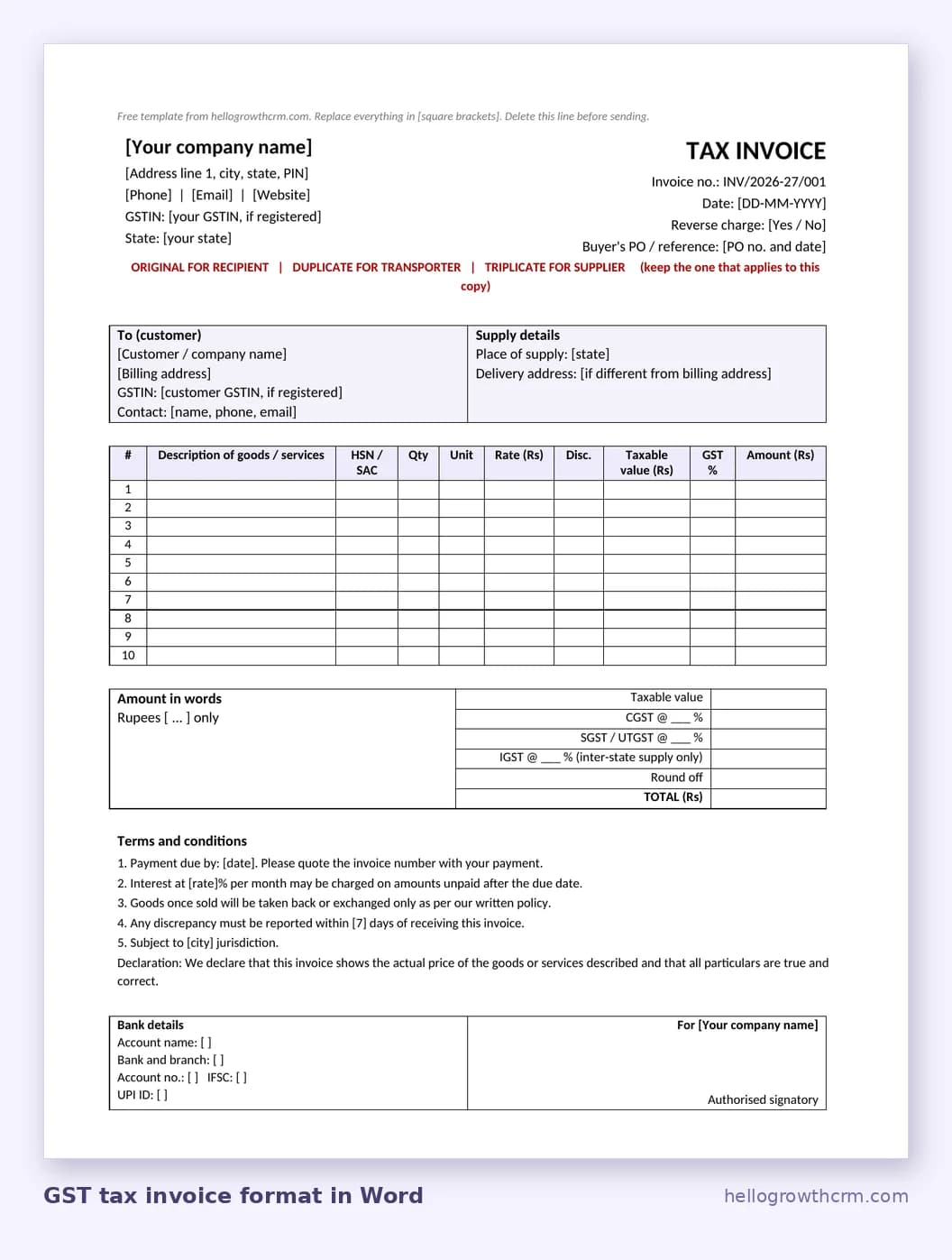
There is no single government-issued GST invoice format. Any layout is acceptable as long as it carries the particulars listed in rule 46 of the CGST Rules, 2017. This is that list in plain language, in the order most invoices present it. The generator above and the downloads below already have a place for each one.
| Field on the invoice | What to enter |
|---|---|
| Supplier name, address and GSTIN | Exactly as on your registration certificate. |
| Invoice number | One consecutive series for the financial year, up to 16 characters: letters, numbers, hyphen or slash. |
| Date of issue | The date the invoice is raised. |
| Recipient name, address and GSTIN or UIN | For a registered buyer. Their GSTIN is what lets them claim input tax credit. |
| Recipient name, address, delivery address and state | For an unregistered buyer when the invoice value is ₹50,000 or more, or when the buyer asks for it. |
| HSN code or SAC | Four digits for turnover up to ₹5 crore, six digits above that. |
| Description of goods or services | Specific enough that the buyer's accounts team can match it to the order. |
| Quantity and unit | For goods: the number and the unit, such as Nos, Kg or Mtr. |
| Total value of supply | Quantity multiplied by rate, before any discount. |
| Taxable value | The value after discount or abatement. Tax is charged on this figure. |
| Rate of tax | CGST and SGST or UTGST, or IGST, and cess where it applies. |
| Amount of tax | Shown separately for each tax. |
| Place of supply and state name | Needed for an inter-state supply. It decides whether IGST applies. |
| Delivery address | When it differs from the place of supply. |
| Whether tax is payable on reverse charge | Yes or No. |
| Signature or digital signature | Of the supplier or an authorised representative. Not needed on an electronically issued invoice. |
| QR code with the invoice reference number | Only for businesses that must issue e-invoices. |
Source: rule 46 of the CGST Rules on the CBIC tax information portal, read on 21 September 2026. Rules are amended from time to time, so confirm the current text, and how it applies to you, with your chartered accountant.
GST tax invoice format: a worked sample
A fabric trader in Surat bills a garment maker in Ahmedabad. Both are in Gujarat, so the supply is intra-state and the five per cent GST is split equally into CGST and SGST. The rates are for illustration. Use the rate that applies to your goods.
| Description and HSN | Quantity | Rate | GST | Taxable value |
|---|---|---|---|---|
| Cotton shirting fabric, HSN 5208 | 120 Mtr | ₹185 | 5% | ₹22,200 |
| Polyester lining fabric, HSN 5407 | 80 Mtr | ₹95 | 5% | ₹7,600 |
| Taxable value | ₹29,800 | |||
| CGST at 2.5% | ₹745 | |||
| SGST at 2.5% | ₹745 | |||
| Invoice total | ₹31,290 |
Amount in words: Rupees Thirty One Thousand Two Hundred Ninety Only. Had the buyer been in Maharashtra, the same ₹29,800 would carry a single IGST line of ₹1,490 instead of the two lines, and the place of supply would read Maharashtra. Nothing else changes.
Bill of supply format
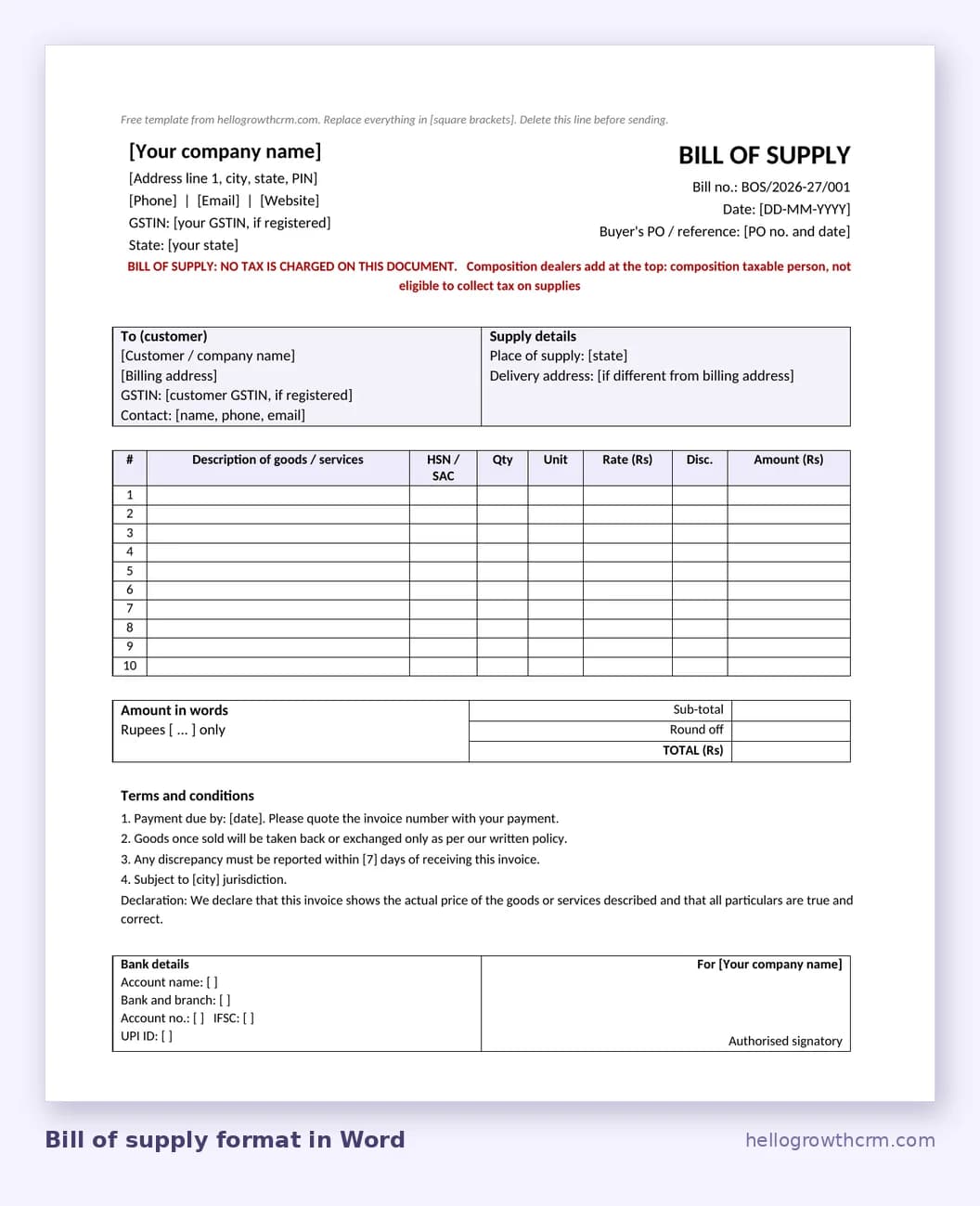
A bill of supply replaces the tax invoice when no tax is charged. Two kinds of business issue it: a composition dealer, and a registered person supplying exempt goods or services. Under rule 49 it carries the supplier's name, address and GSTIN, a consecutive serial number, the date, the recipient's details, the HSN code, the description, the value after any discount, and a signature. It has no tax rate and no tax amount, and the buyer cannot claim input tax credit on it.
A composition dealer must also write these words at the top of the bill of supply: composition taxable person, not eligible to collect tax on supplies.
| Description and HSN | Quantity | Rate | Amount |
|---|---|---|---|
| Tomatoes, fresh, HSN 0702 | 200 Kg | ₹28 | ₹5,600 |
| Onions, fresh, HSN 0703 | 300 Kg | ₹22 | ₹6,600 |
| Total (no tax charged) | ₹12,200 |
Sample: a vegetable wholesaler selling fresh produce, which is exempt. If one order holds both taxable and exempt items for an unregistered buyer, the rules allow a single invoice-cum-bill of supply.
Export invoice format
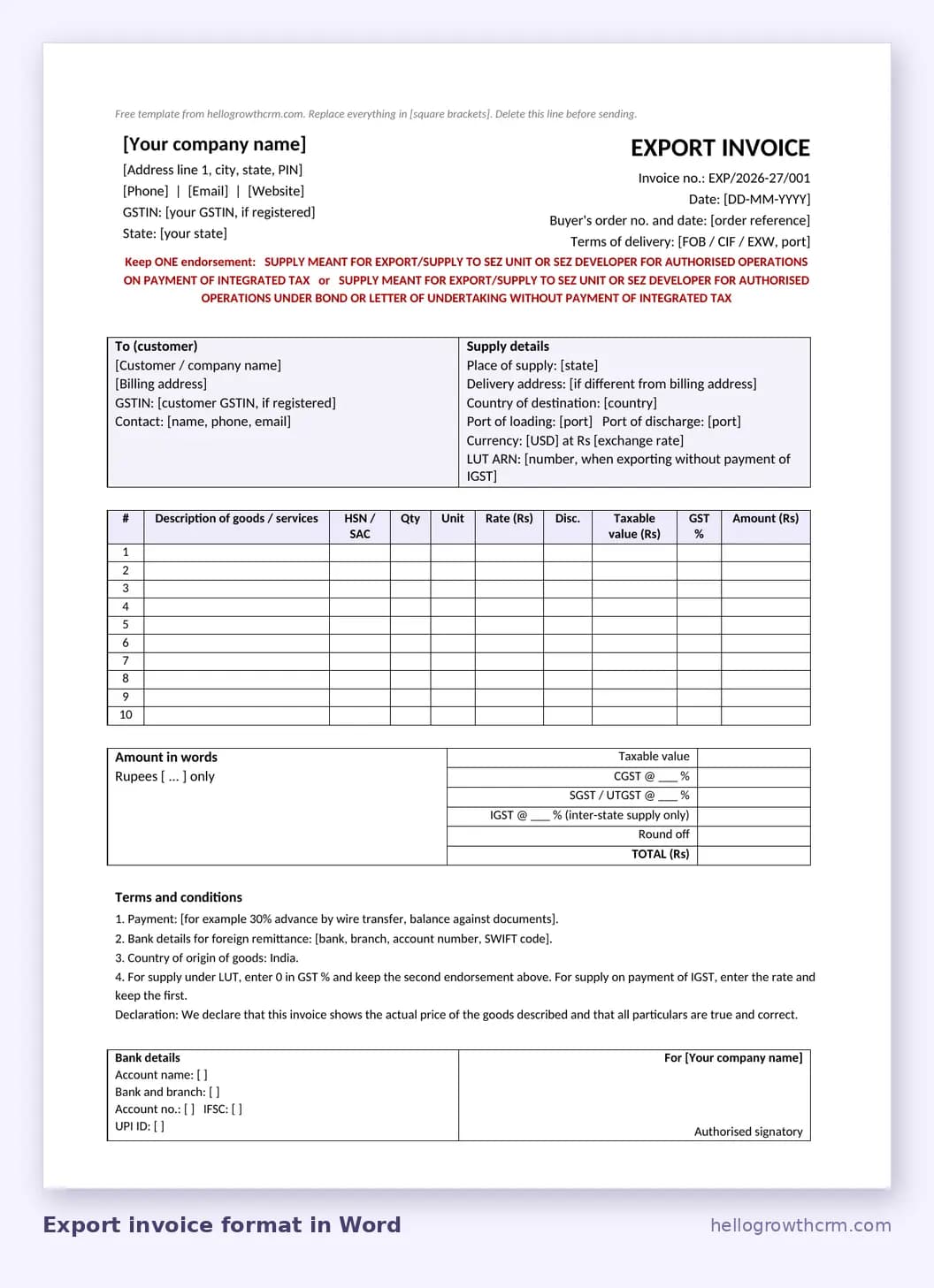
An export invoice is a tax invoice with a few additions. In place of the unregistered buyer's details it shows the name and address of the recipient, the address of delivery and the name of the country of destination. It also carries one of two endorsements, depending on how you export:
- When IGST is paid and later refunded: SUPPLY MEANT FOR EXPORT/SUPPLY TO SEZ UNIT OR SEZ DEVELOPER FOR AUTHORISED OPERATIONS ON PAYMENT OF INTEGRATED TAX
- When you export under a bond or letter of undertaking: SUPPLY MEANT FOR EXPORT/SUPPLY TO SEZ UNIT OR SEZ DEVELOPER FOR AUTHORISED OPERATIONS UNDER BOND OR LETTER OF UNDERTAKING WITHOUT PAYMENT OF INTEGRATED TAX
In practice exporters add the invoice currency and exchange rate, the terms of delivery such as FOB or CIF, the ports of loading and discharge, the LUT reference, and bank details for the foreign remittance. The customs documents have their own requirements, so treat this as the GST side only. Before the order is confirmed, the document to send is a proforma invoice.
Download the GST invoice format in Excel, Word and PDF
Free, with no sign-up. The only mention of us is one removable line in the Word files and a How to use sheet in the workbook, which you delete before sending.
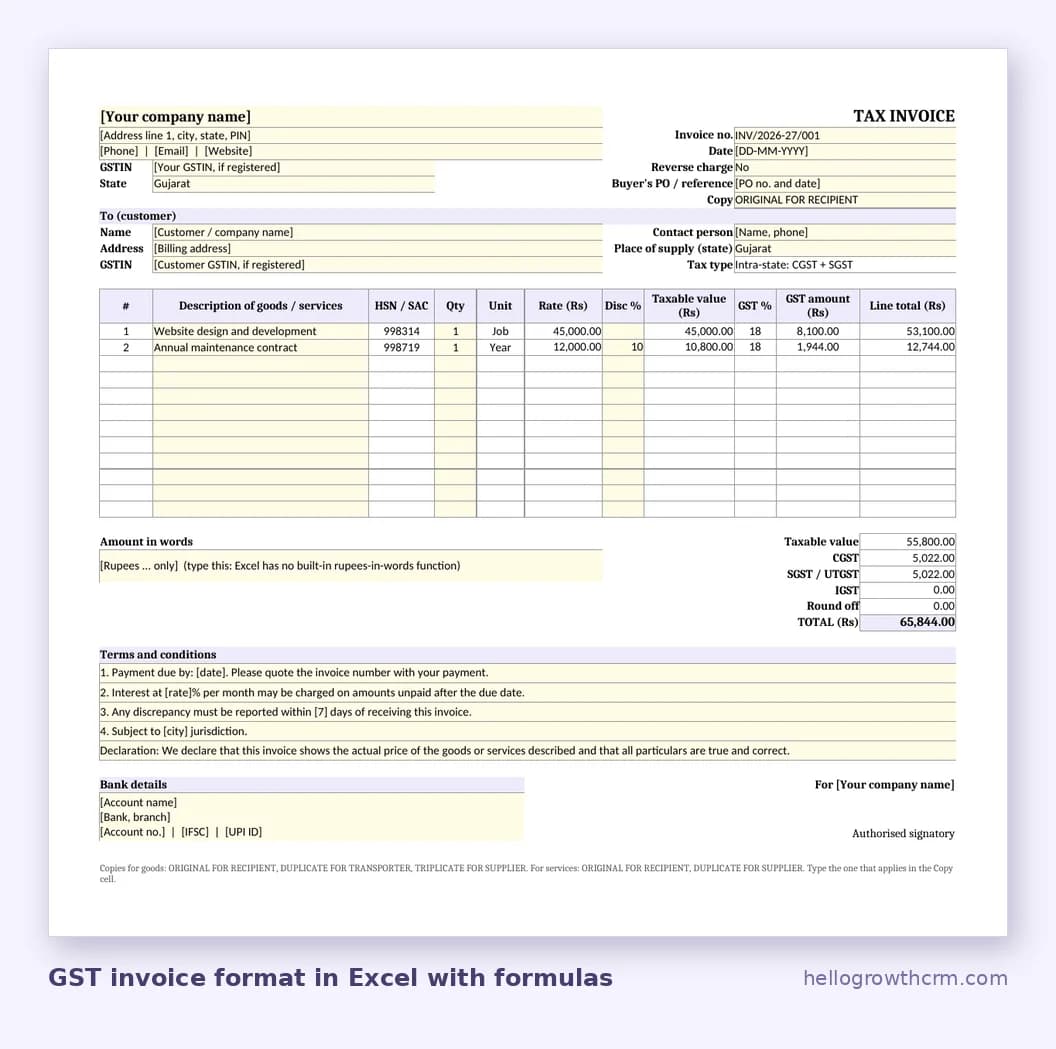
- GST invoice format in Excel (.xlsx): totals, the CGST and SGST or IGST split and the round off are formulas. Separate sheets for the tax invoice, the bill of supply and the export invoice, and an item list that fills in HSN, unit, rate and GST per cent.
- GST invoice format in Word (.docx): the tax invoice layout with placeholders in square brackets.
- GST invoice format in PDF: a blank layout to print and fill in by hand.
- Bill of supply format in Word (.docx): no tax columns, with the HSN column kept.
- Export invoice format in Word (.docx): with both endorsements, the country of destination, ports, currency and LUT reference.
For the documents that come before the invoice, see the quotation formats, the estimate bill format and the free quotation maker. For what comes after it, there are payment reminder messages to copy.
Invoice rules that people ask about
Invoice numbering
One consecutive series, unique for the financial year, of up to sixteen characters. Letters, numbers, hyphens and slashes are allowed. Many businesses restart the series each April, for example INV/2026-27/001.
HSN digits
Businesses with turnover up to ₹5 crore in the previous year show four digits, and those above it show six. Export and import documents generally use eight.
Copies
Goods: original for recipient, duplicate for transporter, triplicate for supplier. Services: original for recipient, duplicate for supplier.
E-invoicing
Businesses whose turnover has crossed ₹5 crore in any year since 2017-18 must report business-to-business invoices to the invoice registration portal and print the QR code it returns. For them, an invoice made any other way is not a valid invoice. A few categories, such as banks, insurers and goods transport agencies, are exempt. This tool and these formats do not connect to the portal.
When to issue it
For goods, at or before the time the goods are removed or delivered. For services, within thirty days of the supply.
Once invoices go out every week, the work shifts from the format to the follow-up. In HelloGrowthCRM the invoice is raised from the deal with GST billing, and unpaid invoices are chased with WhatsApp payment reminders.
What the GST Invoice Generator does
The GST Invoice Generator builds a printable, GST-formatted tax invoice in your browser. You enter your business details and GSTIN, the customer's details, and your line items with HSN/SAC codes and the applicable GST rate — and the tool lays out taxable value, the CGST+SGST or IGST split, and totals in a clean, professional format.
For a small Indian business, the alternative is usually a Word template that someone edits by hand — where a mistyped rate, a missing GSTIN, or tax applied as IGST on an intra-state sale creates real cleanup work at filing time. A structured generator removes the format-level mistakes so the only thing you need to get right is your own numbers.
How to use the GST Invoice Generator
Fill in supplier and customer details
Add your business name, address, and GSTIN, then the customer's details and state. For B2B invoices, include the customer's GSTIN so they can claim input credit.
Add line items with HSN/SAC and rates
Enter each product or service, its HSN or SAC code, quantity, and the applicable GST rate. The tool computes taxable value and tax per line automatically.
Check the tax split, then print or save as PDF
Confirm the invoice shows CGST+SGST for same-state supplies or IGST for inter-state supplies, review the totals, and use Print / Save PDF to keep a copy for sending and your records.
How to read your results
The tax shows as CGST + SGST
The invoice is treating the sale as intra-state. That is correct when you and your customer are in the same state — if the customer is actually in another state, fix the state field before sending.
The tax shows as IGST
The sale is being treated as inter-state supply. Verify the customer's billing state supports that, and remember their GSTIN matters here — B2B buyers will reconcile this invoice against their returns.
Totals differ from your quote
The usual causes are a wrong GST rate on one line or tax quoted as included versus added. Recheck each line's rate against the applicable slab for that item, and state clearly whether prices are inclusive or exclusive of GST.
A note on compliance
This generator formats the invoice; it does not determine your legal obligations. E-invoicing thresholds, reverse charge, and place-of-supply edge cases depend on your registration — confirm with a CA.
Real-world examples
A Pune-based freelance designer billing a Bangalore client
Her first out-of-state client asked for a proper tax invoice with her SAC code. Entering both states, the generator applied IGST rather than the CGST+SGST split she used for local clients — a distinction she had been getting wrong on hand-made invoices. The client's accounts team cleared payment without the usual back-and-forth.
A hardware trader replacing a shared Word template
Two staff members were editing the same invoice template and occasionally shipping invoices with stale HSN codes or last month's customer details. Switching to the generator meant every invoice started blank with enforced fields, and the owner made GSTIN and state mandatory checks part of dispatch. Filing reconciliation the next quarter took noticeably less correction work.
GST Invoice Generator — Free Online — frequently asked questions
Quick answer
When do I use CGST and SGST vs IGST?
- Is this legally compliant
- Can I create a GST invoice online for free
- What details must appear on a GST tax invoice