Best CRM Software in India (2026): Top 10 for SMBs Compared
Co-Founder, HelloGrowthCRM · July 9, 2026 · 17 min read
Quick Answer
The best CRM software in India for most SMBs in 2026 is HelloGrowthCRM (Rs.899/user/month flat, WhatsApp and dialer included), with Zoho CRM as the strongest ecosystem play, LeadSquared for enterprise-scale lead operations, and Kylas or Bigin for very small teams. Pick based on WhatsApp needs, team size, and total cost including add-ons.
HelloGrowthCRM software
Built for real small-business sales teams
HelloGrowthCRM helps reps qualify faster, follow up on time, and close more deals—with practical automation in one place.
- AI lead scoring and pipeline visibility
- Built-in dialer, WhatsApp, and email automation
- Sales forecasting and RevOps-ready reporting
How we ranked the best CRM software for Indian businesses
India's CRM market has matured into three distinct tiers, and most bad buying decisions come from comparing across tiers as if they were interchangeable. Global enterprise platforms (Salesforce, HubSpot, Microsoft Dynamics) offer the deepest feature sets at the highest total cost.
Indian ecosystem players (Zoho, LeadSquared, Kylas, Vtiger) balance local pricing with broad functionality. WhatsApp-first challengers (HelloGrowthCRM, TeleCRM) are built around how Indian SMBs actually sell — over WhatsApp and phone calls.
Our ranking criteria reflect what matters in Indian buying decisions specifically: transparent INR pricing without forced annual contracts, native WhatsApp Business API support (not a bolt-on), a built-in dialer or telephony for calling-heavy sales motions, DPDPA 2023 compliance, integrations with the Indian stack (IndiaMART, JustDial, Razorpay, Tally, UPI), Indian language support, and realistic setup time for a team without a dedicated CRM admin.
One number worth knowing before you compare features: most Indian SMBs that abandon a CRM do so within 90 days, and the top reported reason is that the team kept working in WhatsApp while the CRM sat empty. Whatever you buy, the WhatsApp question — native, add-on, or absent — will decide adoption more than any other feature.
Total cost of ownership matters more than sticker price. A Rs.1,000/user CRM that needs a Rs.50,000 setup engagement, paid add-ons for calling and WhatsApp, and a consultant for every workflow change costs more in year one than a Rs.1,500/user CRM with everything included. Every price below is the published starting point; calculate your own stack before deciding.
1. HelloGrowthCRM — best overall for WhatsApp-first Indian SMBs
HelloGrowthCRM tops this list for the segment that describes most Indian SMBs: 5 to 200 employees, selling over WhatsApp and phone, currently losing follow-ups in a mix of personal WhatsApp, Excel, and memory. It is a complete AI CRM — Kanban pipelines, AI lead scoring, sales forecasting, and 12 agentic AI agents — with the two channels Indian sales runs on built natively into every plan: the official WhatsApp Business API and an auto-dialer with call recording and AI summaries.
Pricing is deliberately simple: a free-forever plan (200 leads, WhatsApp and dialer included, no credit card), then Rs.899 per user per month on the Growth plan. No per-module fees, no WhatsApp add-on, no calling add-on. Integrations cover IndiaMART, JustDial, Razorpay, Tally, and 630+ other tools; the platform is DPDPA 2023 compliant and SOC 2 Type II attested, with Hindi, Gujarati, Tamil, Marathi, and other Indian language support.
Honest limitations: it is a young platform (founded 2022 by Soor LLC; Indian entity Meru Technosoft) with a smaller third-party review base than Zoho or Salesforce, and enterprises needing 500-seat deployments with complex approval chains will find deeper admin tooling in Salesforce or LeadSquared.
Setup is genuinely same-day for a small team — the guided import maps your Excel columns and your pipeline is live the same afternoon.
Best for: WhatsApp-and-phone sales teams in real estate, education, healthcare, manufacturing, financial services, and local services that want one flat price for the full stack.
2-4. Zoho CRM, LeadSquared, and Kylas — the Indian ecosystem leaders
Zoho CRM remains the most widely deployed CRM in India, and for good reason: enormous configurability, a 45+ product suite around it, respected free and low-cost tiers, and a partner network in every city. The trade-offs are the flip side of that breadth.
Configuration depth means most teams need a partner or a trained admin to get value; WhatsApp arrives via add-ons rather than natively; and costs stack as you add modules (Campaigns, Desk, Books) that the sticker price does not show. For teams with an admin and patience, Zoho rewards the investment.
For a 15-person sales team that needs follow-ups fixed this month, it is often too much machine. Bigin, Zoho's lightweight pipeline product, is a better fit at the very small end — genuinely simple, though calling and WhatsApp remain basic.
LeadSquared is India's lead-management heavyweight, strongest where lead volume is industrial: ed-tech admission funnels, BFSI, healthcare chains. Its field-force automation and lead distribution logic are best in class. It is also priced and implemented like enterprise software — published plans start around Rs.1,250-2,500/user/month, setup engagements commonly add Rs.50,000+, and contracts are annual.
If you process thousands of leads a month with a defined ops team, shortlist it. If you are under 50 seats, you will pay for capacity you never use.
Kylas has carved out a real niche as the SMB-friendly Indian CRM with unlimited-user pricing (around Rs.12,999/month flat for the platform rather than per-seat). For teams above 25 users with straightforward needs, the economics are attractive. Depth is the trade-off: AI capabilities, calling, and WhatsApp are lighter than the tools above, and the flat price becomes expensive below 10 users compared with per-seat options.
5-7. TeleCRM, Freshsales, and Vtiger — calling-first and value picks
TeleCRM is built around one job: telecalling. Auto-dialers, call tracking, WhatsApp follow-ups, and rep-level call reporting make it popular with lending, insurance, and ed-tech calling floors. As a calling tool it is focused and effective; as a CRM it is narrower — pipeline management, forecasting, and integrations trail full CRMs, and teams whose sales motion extends beyond calls tend to outgrow it.
We maintain a detailed TeleCRM alternative comparison for teams evaluating the switch.
Freshsales (Freshworks) is the most polished mid-market option on this list — clean UI, solid built-in phone, Freddy AI scoring, and fair entry pricing. Two cautions for Indian buyers: WhatsApp and advanced features climb the pricing tiers quickly, and Freshworks' real strength is the full Freshworks bundle, so standalone CRM buyers can feel the upsell gravity.
Notably, our alternatives page for Freshsales is one of the most-read comparisons on this site — switching interest is real.
Vtiger is the quiet value pick: open-source roots, an all-in-one edition covering sales, support, and marketing at honest prices, and an India-based team. The UI feels dated next to newer tools and the ecosystem is smaller, but for cost-conscious teams that want breadth without Zoho's sprawl, it deserves a look.
8-10 in brief: Salesforce is the global standard and the right answer for Indian enterprises with dedicated admin teams and complex processes — and overkill below roughly 100 seats once implementation and per-cloud licensing land. HubSpot offers the best free CRM to start and a beautiful product, but the jump from free to the tiers where AI, automation, and calling live is the steepest price cliff in the market.
Bigin by Zoho rounds out the list as the best pure-simplicity pick for 2-10 person teams.
The Indian SMB CRM buying checklist (2026)
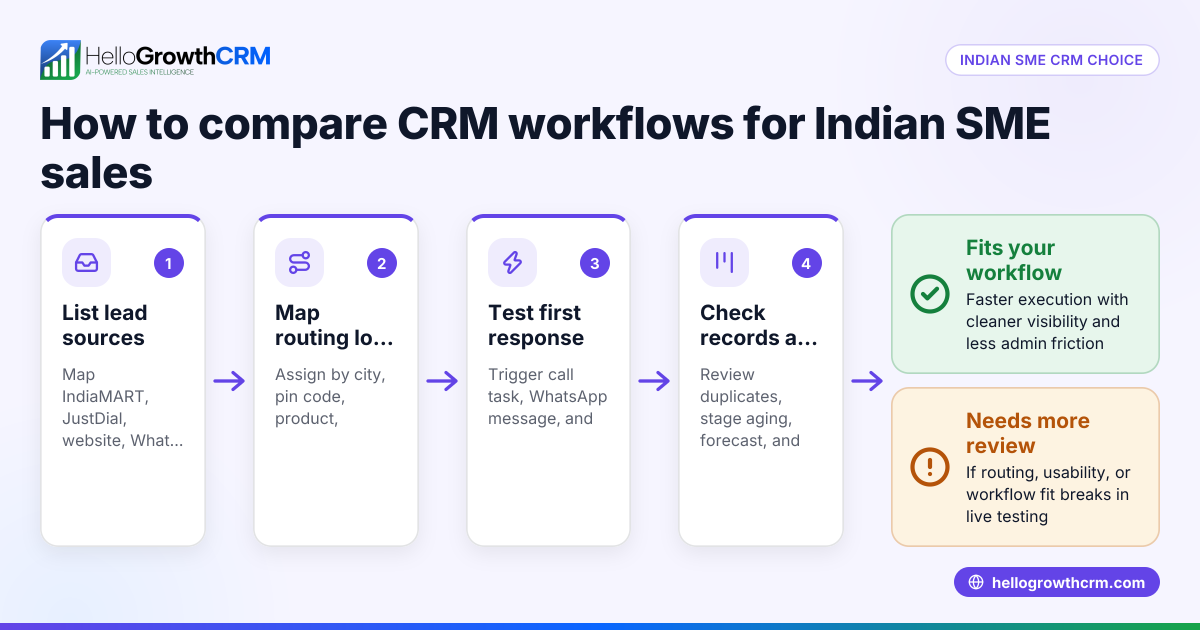
Run every shortlisted CRM through these ten checks before you commit. They reflect where Indian CRM purchases actually succeed or fail.
One: WhatsApp Business API — native, add-on, or absent? Native means conversations drive the pipeline; add-on means two systems taped together. Two: calling — is a dialer included, or is it a paid integration? Calling-heavy teams should test call quality and recording before paying.
Three: total year-one cost — licence plus setup plus add-ons plus the consultant you will call in month three. Get it in writing. Four: DPDPA 2023 compliance — ask for the vendor's data-processing documentation; you carry legal exposure for customer data in your CRM.
Five: Indian stack integrations — IndiaMART, JustDial, Razorpay, Tally, UPI. If your leads come from IndiaMART and your books live in Tally, this is not optional.
Six: language support for your team and your customers. Seven: mobile experience — field reps will only use what works one-handed in a moving car. Eight: import path — can you migrate your Excel or current CRM yourself in an afternoon, or does it need a project?
Nine: free plan or genuine trial — insist on testing with your real leads, not demo data. Ten: exit path — can you export everything if you leave? Vendors confident in their product make leaving easy.
If you want the short version: under 10 seats and simple needs, test Bigin and HelloGrowthCRM free plans side by side. WhatsApp-and-calls sales motion at any size, HelloGrowthCRM. Heavy configurability with an admin on staff, Zoho. Industrial lead volume with an ops team, LeadSquared. Start free, import your real pipeline, and let two weeks of actual usage — not feature grids — make the decision.
Implementation checklist for Best CRM Software in India (2026): Top 10 for SMBs Compared
Best CRM Software in India (2026): Top 10 for SMBs Compared creates the most value when the team turns it into a repeatable operating rhythm instead of treating it like a one-time idea. That means defining ownership, documenting the workflow, and making sure the CRM captures the information required to move work forward consistently.
For teams in the Compare category, the real gain usually comes from clarity. Reps should know what triggers the next step, managers should know what to inspect weekly, and leadership should know which metrics indicate that the workflow is improving execution rather than just creating extra activity.
A practical implementation checklist should also explain what happens before launch and what happens after launch. Before rollout, the team should agree on definitions, entry criteria, ownership rules, and the small set of data points that matter most.
After rollout, the team should review real records, measure whether the workflow is actually being used, and tighten the process when a stage, task, or handoff is still too ambiguous.
This is where many CRM initiatives lose momentum. Teams buy the feature or copy the framework, but they never translate it into a weekly operating habit. The stronger path is to keep the workflow simple, connect it to visible manager review points, and make sure the next action is obvious enough that reps do not need to guess what to do next.
What strong teams standardize after adopting Best CRM Software in India (2026): Top 10 for SMBs Compared
The strongest teams usually standardize stage rules, ownership, response expectations, and the minimum fields required for reporting. They also make sure follow-up tasks, communication history, and manager review points are visible in one system instead of being scattered across spreadsheets and inboxes.
That consistency is especially important for HelloGrowthCRM readers because the platform is designed to connect lead management, communication, pipeline control, and reporting in one place. When those pieces stay aligned, teams spend less time cleaning up process gaps and more time improving conversion quality.
Standardization does not mean forcing the whole company into unnecessary complexity. It means choosing the handful of rules that make execution more reliable. That might include one definition of a qualified lead, one owner for each stage transition, one agreed list of required fields, and one review cadence for deals or accounts that are going stale.
Those rules make automation and dashboards more trustworthy because everyone is working from the same operating model.
It also helps new hires ramp faster. When a process is written down clearly and reflected in the CRM itself, reps can understand how work moves without relying on tribal knowledge. That reduces friction, shortens onboarding time, and makes the system easier to improve later because the baseline workflow is already visible and testable.
Metrics to review when evaluating Best CRM Software in India (2026): Top 10 for SMBs Compared
A useful workflow should change measurable outcomes. The exact metrics vary by topic, but most teams should review conversion rate, stage velocity, follow-up completion, response time, pipeline aging, and forecast confidence. Looking at both activity metrics and quality metrics gives a more reliable picture than tracking volume alone.
If the workflow is not improving those signals, the issue is often not effort but design. The team may be tracking too much, automating too early, or failing to define the next action clearly enough for reps and managers to trust the process.
It is also worth separating leading indicators from lagging indicators. Leading indicators show whether the team is doing the right things now, such as responding quickly, completing follow-up tasks, or moving records forward with the right context. Lagging indicators show whether those habits ultimately improve outcomes, such as more meetings booked, better conversion between stages, higher win rates, or more accurate forecasts.
Teams need both views if they want to improve the system instead of reacting only after performance slips.
For HelloGrowthCRM buyers, this matters because the platform is meant to reduce the gap between activity and insight. A strong CRM should help teams see what changed, why it changed, and which part of the workflow needs attention next. When those metrics are reviewed consistently, the blog topic becomes more than educational content.
It becomes a practical operating standard that guides better day-to-day decisions.
How HelloGrowthCRM readers should apply Best CRM Software in India (2026): Top 10 for SMBs Compared
The best next step after reading this guide is to connect the topic to a real operating problem in your funnel. That could be slow lead response, unclear qualification, poor pipeline hygiene, weak forecasting, or disconnected communication. Once the problem is specific, it becomes easier to decide which features, tools, or service paths inside HelloGrowthCRM will actually help.
That practical lens is what turns educational blog content into a useful buying and implementation resource. It helps teams compare options more clearly, reduce CRM complexity, and make better process decisions with less trial and error.
A useful way to apply the guide is to identify one workflow your team already struggles with, then map the current steps from start to finish. Where does work stall? Which fields are missing? Which manager review points are inconsistent? Which channels are disconnected from the CRM?
Answering those questions creates a direct path from educational content to implementation priorities, which is much more valuable than collecting ideas without acting on them.
From there, teams can use HelloGrowthCRM in stages. Some will start with software only and implement the workflow internally. Others will pair the software with managed RevOps support so follow-up, reporting, and process discipline improve faster. In both cases, the strongest outcome comes from using the blog guidance as a bridge between diagnosis and execution, not as a standalone article that never changes how the team works.
Operational expansion for Best CRM Software in India (2026): Top 10 for SMBs Compared
Best CRM Software in India (2026): Top 10 for SMBs Compared creates the most value when the team turns it into a repeatable operating rhythm instead of treating it like a one-time idea. That means defining ownership, documenting the workflow, and making sure the CRM captures the information required to move work forward consistently.
For teams in the Compare category, the real gain usually comes from clarity. Reps should know what triggers the next step, managers should know what to inspect weekly, and leadership should know which metrics indicate that the workflow is improving execution rather than just creating extra activity.
A practical implementation checklist should also explain what happens before launch and what happens after launch. Before rollout, the team should agree on definitions, entry criteria, ownership rules, and the small set of data points that matter most.
After rollout, the team should review real records, measure whether the workflow is actually being used, and tighten the process when a stage, task, or handoff is still too ambiguous.
This is where many CRM initiatives lose momentum. Teams buy the feature or copy the framework, but they never translate it into a weekly operating habit. The stronger path is to keep the workflow simple, connect it to visible manager review points, and make sure the next action is obvious enough that reps do not need to guess what to do next.
What strong teams standardize after adopting Best CRM Software in India (2026): Top 10 for SMBs Compared
The strongest teams usually standardize stage rules, ownership, response expectations, and the minimum fields required for reporting. They also make sure follow-up tasks, communication history, and manager review points are visible in one system instead of being scattered across spreadsheets and inboxes.
That consistency is especially important for HelloGrowthCRM readers because the platform is designed to connect lead management, communication, pipeline control, and reporting in one place. When those pieces stay aligned, teams spend less time cleaning up process gaps and more time improving conversion quality.
Standardization does not mean forcing the whole company into unnecessary complexity. It means choosing the handful of rules that make execution more reliable. That might include one definition of a qualified lead, one owner for each stage transition, one agreed list of required fields, and one review cadence for deals or accounts that are going stale.
Those rules make automation and dashboards more trustworthy because everyone is working from the same operating model.
It also helps new hires ramp faster. When a process is written down clearly and reflected in the CRM itself, reps can understand how work moves without relying on tribal knowledge. That reduces friction, shortens onboarding time, and makes the system easier to improve later because the baseline workflow is already visible and testable.
Metrics to review when evaluating Best CRM Software in India (2026): Top 10 for SMBs Compared
A useful workflow should change measurable outcomes. The exact metrics vary by topic, but most teams should review conversion rate, stage velocity, follow-up completion, response time, pipeline aging, and forecast confidence. Looking at both activity metrics and quality metrics gives a more reliable picture than tracking volume alone.
If the workflow is not improving those signals, the issue is often not effort but design. The team may be tracking too much, automating too early, or failing to define the next action clearly enough for reps and managers to trust the process.
It is also worth separating leading indicators from lagging indicators. Leading indicators show whether the team is doing the right things now, such as responding quickly, completing follow-up tasks, or moving records forward with the right context. Lagging indicators show whether those habits ultimately improve outcomes, such as more meetings booked, better conversion between stages, higher win rates, or more accurate forecasts.
Teams need both views if they want to improve the system instead of reacting only after performance slips.
For HelloGrowthCRM buyers, this matters because the platform is meant to reduce the gap between activity and insight. A strong CRM should help teams see what changed, why it changed, and which part of the workflow needs attention next. When those metrics are reviewed consistently, the blog topic becomes more than educational content.
It becomes a practical operating standard that guides better day-to-day decisions.
How HelloGrowthCRM readers should apply Best CRM Software in India (2026): Top 10 for SMBs Compared
The best next step after reading this guide is to connect the topic to a real operating problem in your funnel. That could be slow lead response, unclear qualification, poor pipeline hygiene, weak forecasting, or disconnected communication. Once the problem is specific, it becomes easier to decide which features, tools, or service paths inside HelloGrowthCRM will actually help.
That practical lens is what turns educational blog content into a useful buying and implementation resource. It helps teams compare options more clearly, reduce CRM complexity, and make better process decisions with less trial and error.
A useful way to apply the guide is to identify one workflow your team already struggles with, then map the current steps from start to finish. Where does work stall? Which fields are missing? Which manager review points are inconsistent? Which channels are disconnected from the CRM?
Answering those questions creates a direct path from educational content to implementation priorities, which is much more valuable than collecting ideas without acting on them.
From there, teams can use HelloGrowthCRM in stages. Some will start with software only and implement the workflow internally. Others will pair the software with managed RevOps support so follow-up, reporting, and process discipline improve faster. In both cases, the strongest outcome comes from using the blog guidance as a bridge between diagnosis and execution, not as a standalone article that never changes how the team works.
Frequently Asked Questions
Ready to put this into practice?
Set up your pipeline, WhatsApp follow-ups, and AI lead scoring in minutes — free, no credit card.
Try HelloGrowthCRM freeGet CRM tips in your inbox
Join thousands of sales professionals who get weekly insights on CRM strategy, AI automation, and pipeline optimization.
No spam. Unsubscribe anytime.
Rushabh Shah is co-founder of Soor LLC and leads product strategy at HelloGrowthCRM. He has worked with hundreds of small business sales teams to design CRM workflows that improve pipeline predictability and reduce operational overhead.