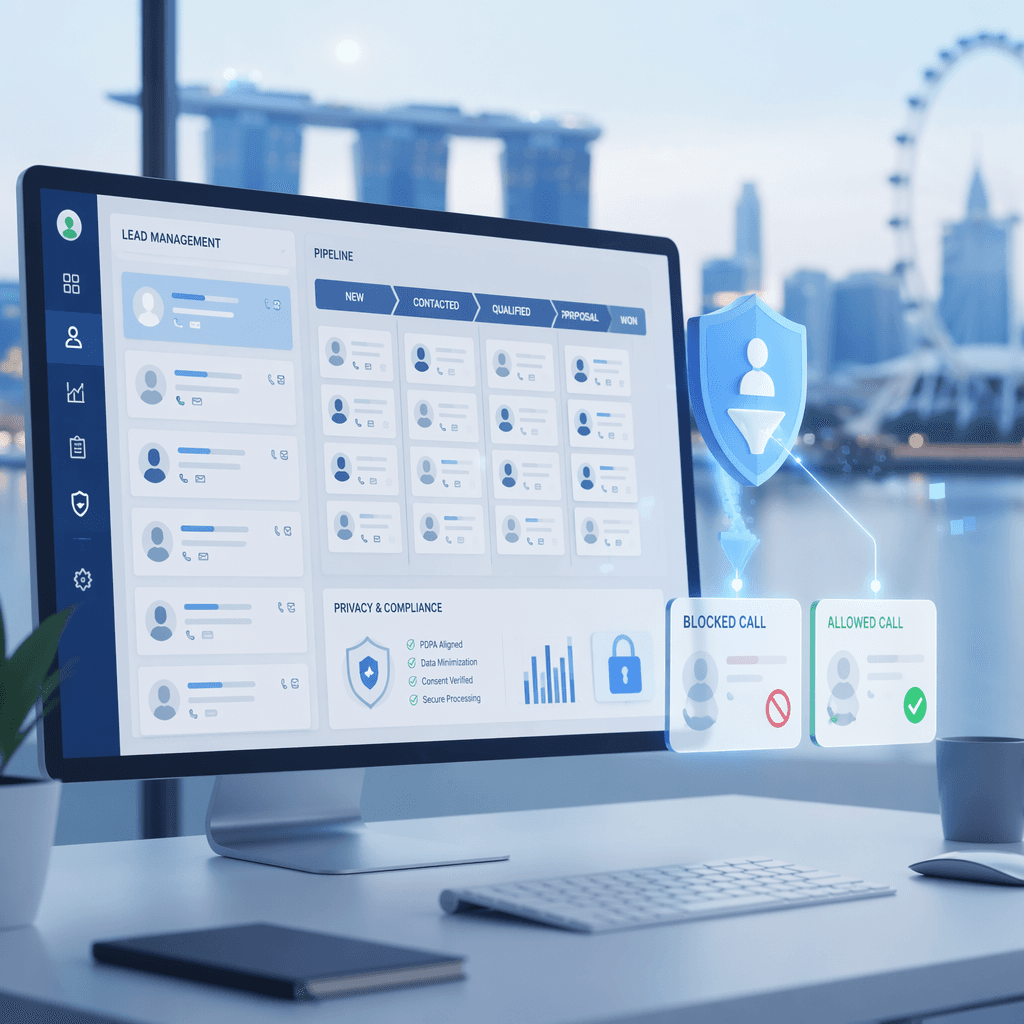
HelloGrowthCRM software
Built for real small-business sales teams
HelloGrowthCRM helps reps qualify faster, follow up on time, and close more deals—with practical automation in one place.
- AI lead scoring and pipeline visibility
- Built-in dialer, WhatsApp, and email automation
- Sales forecasting and RevOps-ready reporting
PDPA‑compliant CRM lead management in Singapore is the practice of capturing, storing, and using prospect data in a customer relationship management (CRM) system while following the Personal Data Protection Act (PDPA), the Personal Data Protection Commission (PDPC) guidelines, and the national Do Not Call (DNC) Registry. For B2B teams in places like the Singapore CBD, Jurong East, or Tampines, this means designing lead capture forms, consent tracking, and outreach workflows so every email, call, or WhatsApp message is backed by documented consent and verified against the DNC registry. When done correctly, a compliant CRM pipeline not only avoids penalties but also improves sales pipeline quality, forecasting accuracy, and trust with prospects.
Key Takeaways
- PDPA requires Singapore companies to obtain, track, and respect consent before sending marketing messages or calling leads.
- The national Do Not Call Registry must be checked before voice calls, SMS, or fax marketing unless explicit consent exists.
- A compliant CRM pipeline includes consent fields, audit trails, and automated DNC checks during lead capture and outreach.
- Singapore B2B teams can connect CRM systems with IMDA-supported digital tools and PEPPOL invoicing workflows for compliant revenue operations.
- Platforms like AI CRM systems help automate consent tracking, pipeline visibility, and outreach governance.
Why PDPA Compliance Matters in CRM Lead Management
Singapore’s Personal Data Protection Act governs how organizations collect, use, and disclose personal data. In practice, this directly affects how sales teams manage leads in their CRM.
According to the PDPC, organizations must obtain consent before collecting personal data and must inform individuals of the purpose for which the data will be used. The PDPC guidance explains these obligations clearly on the official site: https://www.pdpc.gov.sg/.
For B2B sales teams, this means:
- Lead capture forms must clearly state how contact information will be used.
- CRM systems must store proof of consent.
- Marketing calls and messages must respect the Do Not Call registry.
The DNC registry specifically restricts organizations from sending marketing messages to registered numbers without consent. Businesses must check numbers before outreach. The PDPC explains the registry requirements here: https://www.pdpc.gov.sg/Overview-of-PDPA/Do-Not-Call.
In one rollout we did with a 12‑person SaaS sales team in the Singapore CBD, their CRM had over 8,000 leads but no consent fields. Reps were sending cold WhatsApp messages without checking DNC status. After implementing structured consent tracking and automated checks, outbound compliance improved immediately and their pipeline conversion rate actually increased because the outreach targeted genuinely opted‑in prospects.
Compliance is not just a legal requirement. It also improves lead quality.
The Three Core Components of a PDPA-Compliant CRM Pipeline
A compliant lead management system has three foundational elements: consent tracking, DNC verification, and controlled outreach workflows.
1. Consent Capture at Lead Entry
Consent must be captured at the moment personal data enters your system.
Typical sources include:
- Website forms
- Webinar registrations
- Event signups in locations like Marina Bay Sands or Suntec
- LinkedIn lead forms
- Partner referrals
Each lead record should include structured fields such as:
- Consent status
- Consent source (web form, event, partner)
- Consent timestamp
- Purpose of data use
Platforms with structured automation, such as Email Automation, help ensure that only consented contacts enter marketing sequences.
When I audit CRM pipelines, the most common mistake is storing consent in free‑text notes. That makes compliance audits almost impossible. Instead, consent must be a structured field that automation rules can reference.
2. Do Not Call Registry Checks
Singapore’s DNC registry has three lists:
- No Voice Call List
- No Text Message List
- No Fax Message List
If a phone number is listed, organizations cannot send marketing messages unless the individual has given clear consent.
This means CRM workflows must check numbers against the registry before outreach. Sales tools such as a CRM Dialer or messaging systems like WhatsApp & SMS CRM should include compliance safeguards.
In practice, a compliant workflow looks like this:
- Lead enters CRM
- Phone number automatically checked against DNC
- Outreach channel enabled only if compliant
Without automation, sales reps often skip this step. That creates real legal risk.
3. Outreach Governance and Activity Logging
A compliant CRM must record every interaction with a lead.
This includes:
- Calls
- Emails
- WhatsApp messages
- Meeting invitations
A system like Smart Inbox centralizes communication history so teams can prove outreach was compliant.
This audit trail is critical if a complaint is filed with the PDPC.
Building a Revenue-Ready Pipeline That Still Follows PDPA
Compliance should not slow down revenue teams. In fact, a well‑designed pipeline often performs better because it focuses on higher‑intent leads.
Structured Pipeline Stages
A strong B2B pipeline usually includes stages like:
- New Lead
- Qualified Lead
- Discovery
- Proposal
- Negotiation
- Closed Won
Using tools such as AI Pipeline Management helps sales managers monitor stage velocity and deal progression.
For example:
- Discovery → Proposal conversion rate
- Average days per stage
- Pipeline coverage ratio (pipeline value vs quota)
These metrics help forecast revenue accurately.
Teams can also calculate pipeline quality using tools like the Pipeline Health Score.
Lead Prioritization with AI
Not every compliant lead is a good lead.
AI scoring models analyze signals such as:
- Company size
- Industry
- Engagement history
- Email response rate
- Website activity
Tools like AI Lead Scoring help sales teams prioritize high‑intent prospects.
In one implementation we ran for a Jurong East manufacturing supplier, their sales team had 2,300 leads collected from trade shows and website downloads. After deploying AI scoring, only 18% were classified as high‑priority prospects. The team focused there first and increased meeting bookings by 34% within two months.
Compliance plus prioritization leads to more efficient selling.
Connecting CRM Lead Management with Singapore’s Digital Ecosystem
Singapore has one of the most advanced digital business infrastructures in the region. CRM pipelines should integrate with these systems.
IMDA Digital Readiness and Automation
The Infocomm Media Development Authority (IMDA) promotes digital adoption for SMEs through various programs. Businesses can explore these initiatives at https://www.imda.gov.sg/.
Many of these initiatives support tools that integrate with CRM workflows.
Examples include:
- marketing automation tools
- digital invoicing platforms
- AI workflow automation
Through integrations such as Zapier or All Integrations, CRM platforms can connect marketing tools, support systems, and finance software into one operational workflow.
PEPPOL E‑Invoicing for B2B Finance
For Singapore B2B companies, revenue operations does not stop at closing deals. It continues through invoicing and payment collection.
Singapore’s nationwide PEPPOL network enables standardized electronic invoicing. The Inland Revenue Authority of Singapore explains the framework here: https://www.iras.gov.sg/taxes/goods-services-tax-(gst)/e-invoicing.
A compliant sales workflow can look like this:
- Lead captured with consent in CRM
- Opportunity created and tracked in pipeline
- Proposal sent using Proposal Builder
- Deal closed and invoice issued through PEPPOL‑connected accounting software
This alignment ensures both sales and finance remain compliant with Singapore regulations.
How to Implement PDPA-Compliant CRM Lead Management: Step-by-Step
- Define consent capture points
Identify where leads enter your system, such as website forms, events, or LinkedIn ads, and add clear consent language. - Create structured consent fields in CRM
Add fields for consent source, timestamp, and marketing permission so compliance can be automated. - Integrate DNC registry checks
Ensure phone numbers are verified before calls or SMS outreach. - Automate outreach eligibility rules
Use workflow rules so only compliant leads enter campaigns or call queues. - Centralize communications
Route calls, emails, and messages through the CRM using tools like Smart Inbox so all activity is logged. - Score and prioritize leads
Apply AI scoring to focus sales reps on the highest‑intent prospects. - Monitor pipeline metrics
Track stage velocity, conversion rates, and forecast accuracy using tools like Sales Forecasting.
Common Mistakes Singapore Companies Make
Even mature B2B companies often miss key compliance steps.
Storing Consent Outside the CRM
Some teams store consent in marketing tools or spreadsheets. This creates gaps during compliance audits.
Consent must be recorded in the CRM record itself.
Allowing Manual Outreach Without Checks
When reps manually send WhatsApp messages or call numbers directly, DNC checks are skipped.
Using CRM-based calling tools prevents this.
Not Training Sales Teams on PDPA
Compliance is not just a legal department issue.
Sales teams should understand:
- when consent is required
- how DNC affects outreach
- what communication channels are allowed
In my experience, a one‑hour compliance training session dramatically reduces risky behavior.
Why HelloGrowthCRM Helps Singapore Teams Stay Compliant
HelloGrowthCRM was designed with modern revenue operations workflows in mind.
The platform combines consent-aware lead management with automation and AI insights.
Key capabilities include:
- centralized contact records with consent tracking
- integrated communication tools like CRM Dialer
- automated prioritization through AI Lead Scoring
- pipeline monitoring through AI Pipeline Management
- built‑in revenue analytics through Revenue Attribution
This article references HelloGrowthCRM because it is the product I work with. Other CRM systems can also implement similar compliance workflows, though the automation level may differ.
For Singapore teams operating from the CBD, Jurong East, or Tampines, the real goal is simple: build a sales pipeline that grows revenue without risking PDPA violations.
If your team wants to see how compliant lead management works in practice, explore the full platform capabilities on the Features page or start with a Free Trial of HelloGrowthCRM.
About the author
Daniel Tan is a Revenue Operations Lead at HelloGrowthCRM with 11 years of experience building B2B SaaS sales infrastructure across Southeast Asia. He specializes in CRM architecture, pipeline forecasting, and compliance‑driven sales operations. Daniel previously led a RevOps overhaul for a Singapore SaaS company that rebuilt a 9,000‑lead database into a fully PDPA‑compliant pipeline used by a 20‑person sales team across the Singapore CBD and Jurong East.
Frequently Asked Questions
Q: What does PDPA require for CRM lead management in Singapore?
A: The PDPA requires organizations to obtain consent before collecting and using personal data. In CRM systems, this means recording consent details such as source, purpose, and timestamp. Companies must also ensure outreach activities follow the Do Not Call Registry rules.
Q: Do B2B sales calls also need to follow the Do Not Call registry?
A: Yes. The DNC registry applies to marketing messages sent to Singapore telephone numbers, including calls and SMS. Unless explicit consent has been given, organizations must check the registry before making marketing outreach.
Q: How often should companies check the DNC registry?
A: The PDPC requires organizations to check numbers within 30 days before sending marketing messages. Many CRM systems automate this verification during outreach workflows.
Q: What information should be stored in a CRM to prove consent?
A: A compliant CRM record should include the consent source, timestamp, and purpose of data use. It should also store any form submissions or agreement records associated with that consent.
Q: Can CRM automation help with PDPA compliance?
A: Yes. CRM automation can enforce rules such as blocking outreach to leads without consent or those listed on the DNC registry. It also helps maintain activity logs for compliance audits.
Q: How does PEPPOL e‑invoicing connect with CRM pipelines?
A: Once a deal is closed in a CRM pipeline, invoice data can be sent to accounting systems connected to the PEPPOL network. This ensures standardized electronic invoicing for B2B transactions in Singapore.
Q: What is the easiest way for SMEs in Singapore to implement compliant lead management?
A: Start with a CRM platform that supports consent tracking, automated outreach controls, and centralized communication logs. Many SMEs begin by implementing an AI‑enabled CRM that integrates with marketing tools and finance systems.
Frequently Asked Questions
Ready to put this into practice?
Set up your pipeline, WhatsApp follow-ups, and AI lead scoring in minutes — free, no credit card.
Try HelloGrowthCRM freeGet CRM tips in your inbox
Join thousands of sales professionals who get weekly insights on CRM strategy, AI automation, and pipeline optimization.

The HelloGrowthCRM team publishes guides on CRM strategy, AI sales tools, and revenue operations for small business sales teams.