Best Outbound Calling Software for India Sales Teams in 2026

Co-Founder, HelloGrowthCRM · March 12, 2026 · 16 min read
Quick Answer
The best outbound calling software for Indian sales teams combines a click-to-call dialer with automatic call logging, AI call summaries, and WhatsApp follow-up in one system. Standalone VoIP tools (Exotel, Knowlarity) require manual CRM updates after each call. A CRM-native dialer like HelloGrowthCRM logs every call automatically, adds an AI summary, and queues the next WhatsApp follow-up, so reps spend less time on post-call admin.
HelloGrowthCRM software
Built for real small-business sales teams
HelloGrowthCRM helps reps qualify faster, follow up on time, and close more deals—with practical automation in one place.
- AI lead scoring and pipeline visibility
- Built-in dialer, WhatsApp, and email automation
- Sales forecasting and RevOps-ready reporting
What Is Outbound Calling Software — and Why Sales Teams Can't Work Without It
Outbound calling software is a platform that enables sales reps to make high-volume outbound calls from a computer or mobile device, log every call automatically, record conversations for review, and integrate call activity with CRM pipeline data. The alternative — dialing individual numbers on a mobile phone and manually typing notes into a spreadsheet — is the default for most Indian sales teams, and it creates three compounding problems: reps waste 20–30% of their selling time on manual dialing and logging, call records are incomplete or missing, and managers have no visibility into individual rep call volume or outcomes.
Outbound calling software solves all three problems. A rep dials with one click from the CRM record, the call is logged automatically with duration and outcome, the recording is attached to the lead, and the manager sees real-time call dashboards showing calls per rep, connect rates, and average call duration across the team.
For Indian B2B sales teams, the calling problem is compounded by the volume of leads from marketplace sources — JustDial, IndiaMart, 99acres, Magicbricks — that require immediate phone follow-up. A team receiving 200 leads per day from these sources needs to make 400–600 calls (initial + follow-up) per day.
That's operationally impossible without outbound calling software that automates the dialing queue, handles call logging, and keeps reps in a continuous calling flow without switching between tools.
HelloGrowthCRM includes a built-in cloud dialer that works without a separate VoIP account, supports SIP trunking, and integrates natively with every lead source — so every inbound lead from every channel enters the same outbound calling queue automatically.
Types of Outbound Calling Software: Predictive, Power, and Preview Dialers
Outbound calling software is not a single category — there are three distinct dialer types, each suited to different calling volumes and sales motions.
Preview dialers present the rep with the lead record before connecting the call. The rep reviews the contact details, previous interaction history, and notes, then clicks to dial. Preview dialing is slower than automated dialing (30–60 seconds per call versus 10–15 seconds) but results in higher-quality calls because reps enter each conversation with context.
It's best for B2B sales teams calling high-value prospects where personalization matters more than volume.
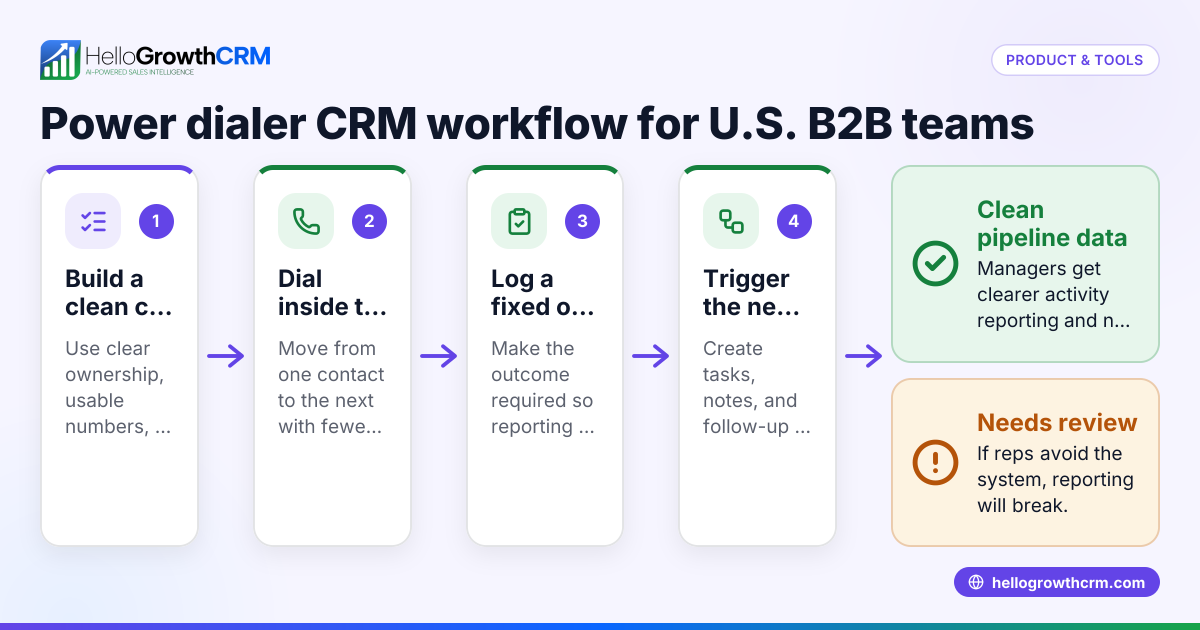
Power dialers automatically dial the next number in the queue as soon as the rep completes or disposes the current call. There's no waiting between calls — the rep hears the dial tone immediately after clicking 'End Call'. Power dialing increases rep call volume by 40–60% compared to manual dialing while preserving the quality of human-to-human connection (the rep is always live on the call).
HelloGrowthCRM's built-in dialer operates as a power dialer: the rep sets the call queue and works through it continuously.
Predictive dialers use algorithms to dial multiple numbers simultaneously, connecting reps only when a live person answers. This maximizes talk-time utilization (up to 45–50 minutes of actual conversation per hour) but introduces a brief pause when the call connects — the moment between the prospect picking up and the rep appearing on the line.
In India, predictive dialers are regulated under TRAI guidelines, and the brief connection gap triggers high call-drop rates for leads who assume it's a robocall. For Indian B2B sales teams, power dialers typically outperform predictive dialers in connect-to-conversation conversion.
HelloGrowthCRM supports both preview and power dialing modes, configurable per team or per campaign. For high-value B2B prospecting, preview mode is recommended. For high-volume follow-up on marketplace leads, power mode is appropriate.
Top Outbound Calling Software Options for Indian Sales Teams
The Indian market has several outbound calling options that range from standalone dialers to fully integrated CRM-dialer platforms.
HelloGrowthCRM (CRM + Built-in Dialer) is the most complete option for teams that need calling integrated with pipeline management. The dialer is native — no separate VoIP account, no third-party integration, no per-minute fees on top of the CRM cost.
Call recordings, transcripts, AI call coaching, and WhatsApp follow-up triggers all live inside the same platform. INR pricing from ₹899/user/month. Best for: teams that need calling + CRM + WhatsApp in one place.
Exotel is India's leading cloud telephony platform with a strong outbound calling product. It excels at IVR, multi-level call routing, and high-volume dialing for call centers. Exotel does not include a CRM, so it requires integration with a separate pipeline tool.
Pricing is per-minute consumption-based plus a monthly platform fee. Best for: call centers with dedicated telephony requirements and an existing CRM.
Ozonetel CloudAgent is a cloud contact center platform with predictive dialing, call recording, and CRM integrations via API. It's widely used by Indian BPOs and enterprise telesales operations. Higher cost and setup complexity than CRM-native dialers. Best for: enterprise call centers with 50+ concurrent agents.
JustCall is a cloud phone system with outbound dialing, SMS, and CRM integrations. Primarily designed for US/global markets with Indian phone number support. USD pricing. Best for: India-US teams needing a single calling platform across both markets.
Knowlarity is another India-based cloud telephony provider with outbound dialer capabilities, IVR, and call recording. Used by mid-size enterprises. Pricing is consumption-based. Best for: businesses that need enterprise telephony features and Indian customer support.
For most Indian SMB sales teams choosing their first outbound calling software, the primary question is whether they need a standalone telephony platform or a CRM-native dialer. Standalone platforms offer more telephony configurability; CRM-native dialers offer better workflow integration and lower total cost.
CRM-Native Dialer vs Standalone Calling Software: Which Is Right for Your Team?
The decision between a CRM-native dialer and a standalone calling platform is one of the most consequential tech choices an Indian sales team makes. It determines whether call data and CRM data live in the same system — or whether integration overhead creates ongoing operational friction.
CRM-native dialers (like HelloGrowthCRM's built-in dialer) store call recordings, transcripts, and outcomes on the same lead record as pipeline stage, deal value, WhatsApp conversations, and email threads. A rep opening a lead record sees the complete interaction history — every call, every message — in one timeline.
A manager pulling a rep performance report sees call volume, talk time, and deal conversion in the same dashboard. There's no integration to maintain, no data sync to debug, and no additional cost beyond the CRM subscription.
Standalone calling platforms (Exotel, Ozonetel, Knowlarity) offer deeper telephony configurability: multi-level IVR, complex call routing with queue management, phone number management across hundreds of DID numbers, and call center-grade reporting.
For teams with 50+ concurrent agents and dedicated telephony managers, standalone platforms are often the right choice. For teams under 30 reps, the configurability of standalone platforms is rarely used, and the integration overhead is a constant drag.
The integration overhead is worth quantifying. A team running Exotel + Zoho CRM typically needs: (1) webhook configuration to push call events from Exotel to Zoho, (2) field mapping maintenance when either platform updates its API, (3) duplicate resolution when calls don't match to the right lead, and (4) manual troubleshooting when sync breaks (which happens several times per year).
This operational overhead is invisible in a product comparison but visible in the 30 minutes per week an IT admin or RevOps manager spends maintaining the integration. Over 12 months, that's 26 hours of avoidable work.
HelloGrowthCRM eliminates this overhead entirely by keeping calling and CRM in the same platform.
Key Features to Evaluate in Outbound Calling Software
Evaluating outbound calling software requires looking beyond the headline features (call recording, reporting) to the workflow details that determine whether reps use the platform effectively.
Call disposition options should match your sales process exactly. If your disposition options are 'Connected', 'Not Answered', and 'Busy' — and your team needs 'Demo Scheduled', 'Sent Proposal', 'Wrong Number', 'DNC' — the disconnect creates workarounds. Look for platforms that let you configure disposition options per campaign or team.
Voicemail drop lets reps leave a pre-recorded voicemail with one click rather than waiting through the entire voicemail greeting on every unanswered call. For a rep making 80 calls per day with a 60% no-answer rate, voicemail drop saves 40–50 minutes of daily passive waiting. HelloGrowthCRM supports voicemail drop with per-rep custom recordings.
Local presence dialing displays a local area code when calling a prospect, increasing answer rates by 20–40% in research studies. For national sales teams calling across states, local presence dialing is a high-ROI feature that most teams underinvest in.
AI call coaching analyzes recordings for talk-to-listen ratio, objection patterns, competitor mentions, and adherence to script. HelloGrowthCRM's AI coaching layer surfaces these insights per call and aggregates them across the team so managers can coach on patterns rather than individual incidents.
WhatsApp follow-up automation triggers a WhatsApp message automatically when a call is not answered or when specific dispositions are selected. This 'call + WhatsApp' sequence is the highest-performing outbound follow-up pattern for Indian sales teams — the WhatsApp message catches prospects who don't answer unknown numbers but will respond to a message.
Mobile dialer is non-negotiable for field sales teams. HelloGrowthCRM's iOS and Android apps include full dialer functionality with the same CRM integration as the desktop version — call, log, and update lead status from the field.
Outbound Calling Compliance in India: TRAI Rules Every Sales Team Must Follow
Outbound calling in India is regulated by TRAI's Telecom Commercial Communication Customer Preference Regulations (TCCCPR). Sales teams that ignore these regulations risk fines, carrier blocking, and permanent damage to their calling infrastructure. Understanding the key rules is not optional for any team doing outbound at scale.
DNC (Do Not Call) compliance: TRAI maintains a National Customer Preference Register (NCPR). Subscribers registered on NCPR cannot be called for commercial purposes. Outbound calling software must scrub call lists against the NCPR before dialing. HelloGrowthCRM's compliance layer flags NCPR-registered numbers in the CRM and excludes them from outbound dialing queues automatically.
Calling hours: Commercial calls may only be made between 9 AM and 9 PM recipient's local time. Automated calling outside these hours is prohibited. HelloGrowthCRM's dialer enforces calling hours by default, preventing queued calls from firing before 9 AM or after 9 PM.
Header registration: All commercial SMS and calls must originate from registered headers (business names). For IVR-based outbound calling, the calling number must be registered with TRAI. HelloGrowthCRM works with registered SIP trunk providers to ensure compliant CLI presentation.
Opt-in for WhatsApp: Meta's WhatsApp Business API requires that businesses only send proactive messages to users who have opted in. For outbound WhatsApp follow-up on cold calls, this means the prospect must have explicitly consented to receive WhatsApp messages from your business — typically via a form, checkbox, or prior conversation.
Non-compliance consequences are significant. Carriers can block the calling number within 24 hours of a TRAI complaint, and rebuilding calling infrastructure around a blocked number takes 2–4 weeks. For high-volume outbound teams, a blocked number is an existential operational disruption. Compliance is simply not optional.
How to Get 40% More Connects with a Call + WhatsApp Outbound Sequence
The most effective outbound follow-up pattern for Indian sales teams is not a multi-call sequence — it's a call + WhatsApp sequence that uses both channels in a coordinated workflow.
The pattern works as follows: Day 1, attempt one outbound call. If connected, log outcome and advance the lead appropriately. If not answered, send an immediate WhatsApp message: 'Hi [Name], I just tried calling you from HelloGrowthCRM to discuss [product/offer].
Are you available for a 10-minute call today? [Calendar link]'. Day 2, if no WhatsApp response, attempt a second call and send a second WhatsApp message if unanswered. Day 3, final call attempt and a closing WhatsApp message: 'Hi [Name], I'll try one more time today. If you'd prefer to reach out when it suits you, here's my contact: [direct number/WhatsApp link].'
This three-day, two-channel sequence outperforms a pure calling sequence on connect rate by 35–45% in HelloGrowthCRM benchmark data across Indian B2B teams. The reason is behavioral: Indian mobile users are conditioned to ignore calls from unknown numbers (spam caller ID labeling is widespread) but are highly responsive to WhatsApp messages from business contacts.
The sequence uses calling as the higher-intent outreach and WhatsApp as the recoverable fallback.
In HelloGrowthCRM, this sequence is configured in Automations → Outbound Sequences. Set the trigger (unanswered call disposition), set the delay (immediate for Day 1 WhatsApp, 24-hour delay for Day 2), select the WhatsApp template, and activate. The sequence runs automatically across your entire outbound queue without manual step management.
AI call coaching in HelloGrowthCRM identifies which reps are running the combined sequence consistently and which are dropping the WhatsApp step — so managers can enforce the sequence as a standard operating procedure rather than a suggestion. Teams that run the combined sequence systematically typically see connect-to-conversation rates 2–3× higher than pure call-only strategies within 30 days.
Implementation checklist for Best Outbound Calling Software for India Sales Teams in 2026
Best Outbound Calling Software for India Sales Teams in 2026 creates the most value when the team turns it into a repeatable operating rhythm instead of treating it like a one-time idea. That means defining ownership, documenting the workflow, and making sure the CRM captures the information required to move work forward consistently.
For teams in the CRM & Sales category, the real gain usually comes from clarity. Reps should know what triggers the next step, managers should know what to inspect weekly, and leadership should know which metrics indicate that the workflow is improving execution rather than just creating extra activity.
A practical implementation checklist should also explain what happens before launch and what happens after launch. Before rollout, the team should agree on definitions, entry criteria, ownership rules, and the small set of data points that matter most.
After rollout, the team should review real records, measure whether the workflow is actually being used, and tighten the process when a stage, task, or handoff is still too ambiguous.
This is where many CRM initiatives lose momentum. Teams buy the feature or copy the framework, but they never translate it into a weekly operating habit. The stronger path is to keep the workflow simple, connect it to visible manager review points, and make sure the next action is obvious enough that reps do not need to guess what to do next.
What strong teams standardize after adopting Best Outbound Calling Software for India Sales Teams in 2026
The strongest teams usually standardize stage rules, ownership, response expectations, and the minimum fields required for reporting. They also make sure follow-up tasks, communication history, and manager review points are visible in one system instead of being scattered across spreadsheets and inboxes.
That consistency is especially important for HelloGrowthCRM readers because the platform is designed to connect lead management, communication, pipeline control, and reporting in one place. When those pieces stay aligned, teams spend less time cleaning up process gaps and more time improving conversion quality.
Standardization does not mean forcing the whole company into unnecessary complexity. It means choosing the handful of rules that make execution more reliable. That might include one definition of a qualified lead, one owner for each stage transition, one agreed list of required fields, and one review cadence for deals or accounts that are going stale.
Those rules make automation and dashboards more trustworthy because everyone is working from the same operating model.
It also helps new hires ramp faster. When a process is written down clearly and reflected in the CRM itself, reps can understand how work moves without relying on tribal knowledge. That reduces friction, shortens onboarding time, and makes the system easier to improve later because the baseline workflow is already visible and testable.
Metrics to review when evaluating Best Outbound Calling Software for India Sales Teams in 2026
A useful workflow should change measurable outcomes. The exact metrics vary by topic, but most teams should review conversion rate, stage velocity, follow-up completion, response time, pipeline aging, and forecast confidence. Looking at both activity metrics and quality metrics gives a more reliable picture than tracking volume alone.
If the workflow is not improving those signals, the issue is often not effort but design. The team may be tracking too much, automating too early, or failing to define the next action clearly enough for reps and managers to trust the process.
It is also worth separating leading indicators from lagging indicators. Leading indicators show whether the team is doing the right things now, such as responding quickly, completing follow-up tasks, or moving records forward with the right context. Lagging indicators show whether those habits ultimately improve outcomes, such as more meetings booked, better conversion between stages, higher win rates, or more accurate forecasts.
Teams need both views if they want to improve the system instead of reacting only after performance slips.
For HelloGrowthCRM buyers, this matters because the platform is meant to reduce the gap between activity and insight. A strong CRM should help teams see what changed, why it changed, and which part of the workflow needs attention next. When those metrics are reviewed consistently, the blog topic becomes more than educational content.
It becomes a practical operating standard that guides better day-to-day decisions.
How HelloGrowthCRM readers should apply Best Outbound Calling Software for India Sales Teams in 2026
The best next step after reading this guide is to connect the topic to a real operating problem in your funnel. That could be slow lead response, unclear qualification, poor pipeline hygiene, weak forecasting, or disconnected communication. Once the problem is specific, it becomes easier to decide which features, tools, or service paths inside HelloGrowthCRM will actually help.
That practical lens is what turns educational blog content into a useful buying and implementation resource. It helps teams compare options more clearly, reduce CRM complexity, and make better process decisions with less trial and error.
A useful way to apply the guide is to identify one workflow your team already struggles with, then map the current steps from start to finish. Where does work stall? Which fields are missing? Which manager review points are inconsistent? Which channels are disconnected from the CRM?
Answering those questions creates a direct path from educational content to implementation priorities, which is much more valuable than collecting ideas without acting on them.
From there, teams can use HelloGrowthCRM in stages. Some will start with software only and implement the workflow internally. Others will pair the software with managed RevOps support so follow-up, reporting, and process discipline improve faster. In both cases, the strongest outcome comes from using the blog guidance as a bridge between diagnosis and execution, not as a standalone article that never changes how the team works.
Frequently Asked Questions
Ready to put this into practice?
Set up your pipeline, WhatsApp follow-ups, and AI lead scoring in minutes — free, no credit card.
Try HelloGrowthCRM freeGet CRM tips in your inbox
Join thousands of sales professionals who get weekly insights on CRM strategy, AI automation, and pipeline optimization.
Harnish Shah is co-founder of Soor LLC and oversees engineering and growth at HelloGrowthCRM. He brings expertise in AI-driven software architecture and go-to-market systems for B2B SaaS, and has helped early-stage companies scale their sales infrastructure.