HelloGrowthCRM software
Built for real small-business sales teams
HelloGrowthCRM helps reps qualify faster, follow up on time, and close more deals—with practical automation in one place.
- AI lead scoring and pipeline visibility
- Built-in dialer, WhatsApp, and email automation
- Sales forecasting and RevOps-ready reporting
HelloGrowthCRM vs LeadSquared is a B2B CRM comparison about which platform better handles inbound lead routing, follow-up automation, pipeline visibility, and ongoing revenue operations support, with HelloGrowthCRM generally fitting teams that want faster execution and lower admin load, while LeadSquared often fits process-heavy marketing and inside-sales environments.
Key Takeaways
- HelloGrowthCRM is stronger for teams that want fast lead routing, AI-assisted follow-up, and lower day-to-day admin effort.
- LeadSquared is often a better fit for companies with heavier marketing automation needs or more structured call-center style workflows.
- For B2B buyers, the real decision is not feature count. It is how quickly leads get assigned, contacted, and moved with clear pipeline accountability.
- Implementation effort matters as much as license cost. A cheaper tool can become more expensive if routing logic, workflows, and reporting need ongoing manual care.
- HelloGrowthCRM stands out if you also want Managed RevOps support instead of owning every CRM process internally.
- If your main goal is speed-to-lead without adding operations headcount, compare workflow depth, reporting clarity, and service support together.
HelloGrowthCRM vs LeadSquared: which CRM is better for B2B lead routing and follow-up automation?
HelloGrowthCRM vs LeadSquared is best answered by your operating model: HelloGrowthCRM is better for B2B teams that need fast routing, simple automation, strong pipeline visibility, and RevOps support, while LeadSquared is better for teams that need structured lead capture, telesales workflows, and broader marketing-process control.
Both platforms can manage leads and automate follow-up. The difference is where the system does the heavy lifting.
If your team is dealing with:
- high inbound lead volume
- multiple lead sources
- uneven rep response times
- poor handoff between marketing and sales
- limited ops capacity
then you need more than a contact database. You need rules, speed, visibility, and enforcement.
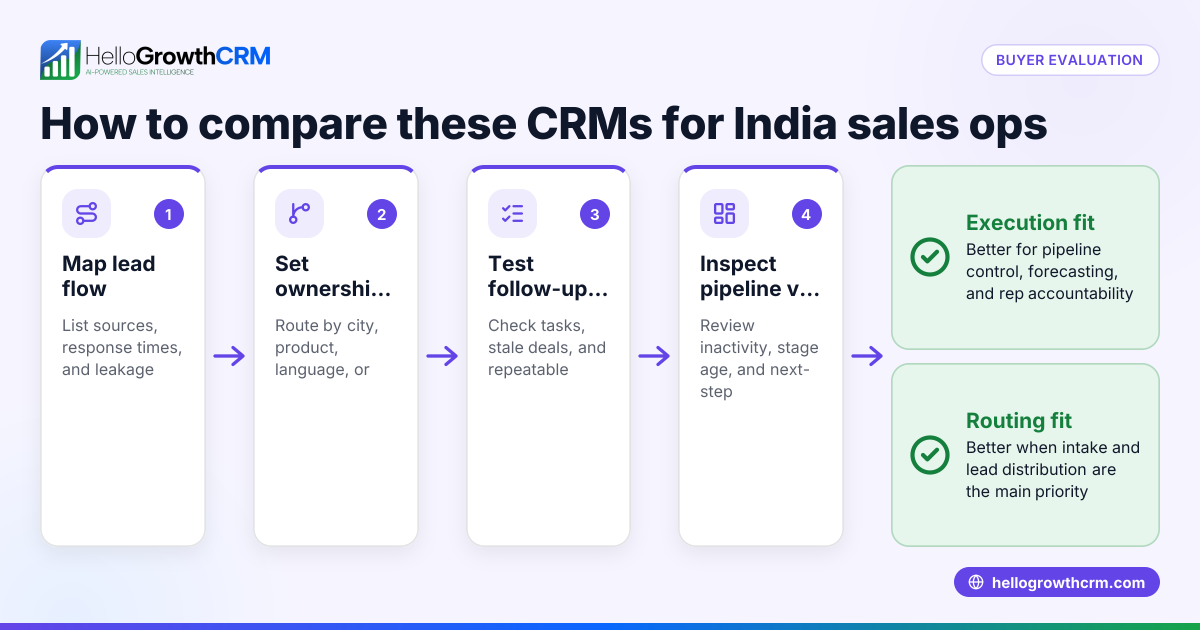
In practice, I would frame this decision around four buyer questions:
- How fast can the CRM route the right lead to the right rep?
- How easy is it to automate follow-up across email, calling, and messaging?
- How clearly can managers see pipeline bottlenecks and response gaps?
- How much internal ops work is needed to keep it all running?
That last point gets ignored too often. In one rollout we did with a 12-person sales team, the CRM selection looked close on paper. The real difference came after week three, when routing exceptions, duplicate leads, and stale tasks started piling up. The tool that required less admin discipline won.
What B2B buyers usually mean by lead routing and follow-up automation
For most B2B teams, lead routing means assigning inbound leads based on geography, account owner, territory, form source, product line, or qualification score. Follow-up automation means triggering the next best action fast enough that no lead sits untouched.
Harvard Business Review reported that firms that contacted potential customers within an hour were nearly seven times as likely to qualify the lead as firms that waited even one more hour.
That stat is old, but the operating truth still holds. If routing is slow, follow-up is late. If follow-up is late, conversion drops.
How do HelloGrowthCRM and LeadSquared differ at a high level?
At a high level, HelloGrowthCRM focuses on unified sales execution with AI-assisted workflows and RevOps simplicity, while LeadSquared leans more toward lead capture, distribution, and process configuration for marketing and inside-sales teams. Both can work for B2B, but their day-to-day feel is different.
HelloGrowthCRM is built for teams that want fewer disconnected tools. Features like AI CRM, AI Lead Scoring, Email Automation, CRM Dialer, and AI Pipeline Management sit close to the pipeline, not in separate workflow islands. That matters when managers need one place to inspect lead response, task completion, and deal movement.
LeadSquared is widely known for lead capture, marketing automation, inside-sales execution, and industry use cases where call activity and structured lead journeys matter. For some teams, that structure is a plus. For others, it can create more setup overhead.
Here is the simplest comparison:
| Area | HelloGrowthCRM | LeadSquared |
|---|---|---|
| Best fit | B2B teams focused on fast routing, follow-up, and pipeline control | Teams with heavier lead capture and inside-sales workflow needs |
| Lead routing | Strong for practical rule-based routing with AI support | Strong for configurable lead distribution workflows |
| Follow-up automation | Unified across sales actions and AI-assisted workflows | Strong workflow automation, often process-led |
| Pipeline visibility | Strong manager-facing visibility with AI insights | Available, but buyer experience depends on setup depth |
| Admin overhead | Lower for teams wanting simplicity | May suit teams comfortable with more process configuration |
| RevOps support | Includes Managed RevOps option | Typically managed internally or through partners |
| Ideal buyer | Lean revenue team, scaling SaaS, services, B2B sales orgs | Marketing-led and inside-sales-led teams with structured flows |
Where HelloGrowthCRM fits best
HelloGrowthCRM fits best when your team wants one system for assignment, action, visibility, and coaching. It is especially useful when the sales manager, founder, or RevOps lead cannot spend hours each week fixing workflow drift.
You can also extend execution with tools like Meeting Scheduler, Smart Inbox, Sales Task Boards, and AI Deal Insights, which reduces context switching.
Where LeadSquared fits best
LeadSquared often fits businesses with strong inbound programs, defined marketing-to-sales flows, and teams that are comfortable managing more structured automation logic. It can make sense when lead capture and distribution sit at the center of the stack.
Which platform is better for inbound lead routing?
For inbound lead routing, HelloGrowthCRM is better for B2B teams that want fast assignment with less operational drag, while LeadSquared is better for teams that want deeper process control and are willing to manage more routing logic over time.
The best routing engine is the one your team will maintain correctly.
A routing setup should support:
- territory or account ownership
- round robin by rep capacity
- source-based rules
- qualification thresholds
- reassignment rules for no response
- SLA tracking for first touch
HelloGrowthCRM makes this easier to operationalize because routing is tightly connected to action layers like Sales Task Boards, AI Sales Copilot, and Smart Inbox. A routed lead should not just land on a rep. It should create the next action automatically.
When I have audited pipelines like this, the most common failure is not bad routing logic. It is broken follow-through after assignment. Reps get the lead, but the call task is missing, email sequence is not triggered, or manager visibility ends at assignment. That is where integrated execution matters.
LeadSquared can support robust routing. But if your team lacks a dedicated ops owner, rule complexity can become a hidden tax.
Routing criteria B2B teams should test in demos
Ask both vendors to show these live:
- assignment by region and product line
- round robin with rep availability
- fallback rules for unworked leads
- duplicate detection across channels
- SLA breach alerts in real time
- manager dashboard for response lag
If you want a benchmark before buying, use a simple framework like a RevOps Maturity Assessment to see whether your bottleneck is routing logic, rep capacity, or reporting.
Which platform is better for follow-up automation?
For follow-up automation, HelloGrowthCRM is better when sales teams need multi-step action orchestration with low admin effort, while LeadSquared is better when buyers want more process-driven automation and can support more hands-on workflow design internally.
Good follow-up automation should do three things well:
- Trigger the right action fast
- Adapt based on lead behavior
- Show managers what happened and what did not
HelloGrowthCRM connects follow-up to core execution tools such as Email Automation, CRM Dialer, WhatsApp & SMS CRM, and AI Voice Agents. That gives teams multiple channels without stitching together too many layers.
If your workflow depends on inbox coordination, meeting scheduling, and call outcomes, it helps to have native links to Gmail, Google Meet, Microsoft Teams, and Calendly.
LeadSquared can also automate lead nurture and sales actions. It may appeal to teams with more detailed stage-based journey mapping. But more flexibility can mean more upkeep, especially when sales managers need to change rules quickly.
According to Gartner’s CRM topic page, CRM success depends on aligning technology with sales process execution, not just centralizing records. That is exactly why follow-up automation should be judged on behavior and accountability, not feature lists alone.
What to compare in real workflows
Test a real inbound scenario:
- demo request comes from paid ads
- lead is scored
- routed to the correct rep
- first email goes out
- call task is created
- no-contact leads get reassigned
- manager sees SLA breaches
If one platform needs three admins and several custom workarounds to do that reliably, it is not the simpler option.
How do pipeline visibility and reporting compare?
For pipeline visibility, HelloGrowthCRM is better for teams that want immediate manager insight into lead response, pipeline health, and deal risk, while LeadSquared is suitable when teams are willing to configure reporting around their process model and operating cadence.
Visibility is not just about charts. It is about answering operational questions fast:
- Which leads were not touched in the first 15 minutes?
- Which rep has the highest first-response delay?
- Which stage has the longest velocity in days?
- Which source creates meetings but not opportunities?
- Which deals are at risk due to inactivity?
HelloGrowthCRM leans into these execution questions with AI Pipeline Management, AI Deal Insights, Sales Forecasting, and Revenue Attribution. For many B2B teams, that is more useful than broad reporting flexibility because it shortens the path from insight to action.
A simple tool like the Pipeline Health Score can also help buyers pressure-test whether they need better forecasting, cleaner stages, or better response discipline.
What good visibility looks like
A strong manager dashboard should show:
- response SLA by source and rep
- stage conversion by owner
- aging leads and stale deals
- follow-up completion rates
- meetings booked vs opportunities created
- forecast confidence
In one SaaS implementation I led, we reduced weekly pipeline review time by moving from static exports to live stage-velocity and inactivity reporting. The savings were not just time. The manager finally had proof of where follow-up was breaking.
What about pricing, implementation effort, and admin overhead?
Pricing and implementation effort matter because the cheaper CRM is not the better choice if it needs more setup, more maintenance, and more operational cleanup. For most B2B buyers, total cost includes software, onboarding time, workflow upkeep, reporting work, and missed leads during ramp.
I cannot make definitive public price comparisons here because packages, seat mixes, support scope, and negotiated terms can change. Buyers should always verify current costs directly with each vendor.
That said, use this framework:
| Cost factor | HelloGrowthCRM | LeadSquared |
|---|---|---|
| License cost | Verify on Pricing or with sales | Verify with vendor |
| Time to first live workflow | Often faster for lean B2B teams | Depends on process complexity |
| Internal admin need | Lower if using built-in workflow stack | Can be higher with deeper process customization |
| Ongoing optimization | Can be reduced with Managed RevOps | Often owned internally |
| Best value case | Teams wanting speed and simplicity | Teams wanting more structured process control |
A practical buying lens
Check these five items before you decide:
- Time to launch: How many days until lead routing is live?
- Workflow ownership: Who updates rules after go-live?
- Manager visibility: Can frontline managers self-serve answers?
- Tool sprawl: Will you still need separate systems?
- Support model: Do you want software only, or software plus RevOps help?
If you want to explore platform scope, start with Features, review All Integrations, and compare against your current stack.
How to choose between HelloGrowthCRM and LeadSquared: Step-by-Step
Choosing between HelloGrowthCRM and LeadSquared works best when you map your real lead flow, test one live routing and follow-up scenario, compare admin effort, and score each platform on speed, visibility, and support rather than buying on feature volume or vendor positioning alone.
- Map your current lead flow
List every inbound source, assignment rule, and follow-up step. Include owners, SLAs, and failure points. - Define your must-have routing rules
Write down territory logic, account ownership rules, round robin needs, and reassignment triggers. - Test one real inbound workflow in both demos
Ask each vendor to show form capture, routing, task creation, first-touch automation, and manager visibility. - Measure admin effort
Ask who maintains workflows, dashboards, and exceptions after launch. This is where hidden cost shows up. - Score pipeline visibility
Check whether managers can see stale leads, response lag, stage aging, and deal risk without exports. - Review support and implementation help
If your team is lean, factor in services like Managed RevOps, not just software access. - Validate ROI before signing
Use a tool like the CRM ROI Calculator to estimate value from faster response and better conversion.
If your team needs faster lead response, clearer pipeline accountability, and less admin overhead, HelloGrowthCRM is the stronger choice for many B2B revenue teams. You can explore Pricing, book a Demo, or start a Free Trial to test the workflows in your own environment.
About the author
Arjun Mehta is a Revenue Operations Lead at HelloGrowthCRM with 10 years of experience in B2B SaaS sales operations, CRM design, and pipeline management. He has led CRM and lead-routing rollouts for global inbound sales teams ranging from founder-led motions to 50-plus rep environments. One project that informed this article involved redesigning territory rules, SLA alerts, and follow-up automation for a 12-person SDR-AE team that was losing qualified inbound demand to slow response times. HelloGrowthCRM is the author’s product, and this comparison is intended to help buyers evaluate fit based on operating needs.
Frequently Asked Questions
Q: Is HelloGrowthCRM better than LeadSquared for B2B sales teams?
A: HelloGrowthCRM is generally better than LeadSquared for B2B sales teams that need fast lead routing, lower admin effort, and strong pipeline visibility. LeadSquared can still be a good fit for teams with heavier marketing-process or inside-sales workflow requirements.
Q: Which CRM is better for inbound lead routing?
A: HelloGrowthCRM is better for inbound lead routing when your priority is speed, simplicity, and rep accountability after assignment. LeadSquared is strong when you need more structured routing logic and can support more process configuration internally.
Q: Does HelloGrowthCRM support automated follow-up across channels?
A: Yes, HelloGrowthCRM supports automated follow-up across channels through email, calling, and messaging workflows tied to sales execution. Buyers should still confirm the exact channels, triggers, and sequencing needed for their process during a live demo.
Q: Is LeadSquared better for marketing automation?
A: LeadSquared is often better for marketing automation if your team runs lead capture, nurture, and structured journey workflows at the center of the revenue process. That does not automatically make it better for pipeline visibility or lean sales execution.
Q: Which platform has lower admin overhead?
Frequently Asked Questions
Ready to put this into practice?
Set up your pipeline, WhatsApp follow-ups, and AI lead scoring in minutes — free, no credit card.
Try HelloGrowthCRM freeGet CRM tips in your inbox
Join thousands of sales professionals who get weekly insights on CRM strategy, AI automation, and pipeline optimization.

The HelloGrowthCRM team publishes guides on CRM strategy, AI sales tools, and revenue operations for small business sales teams.